
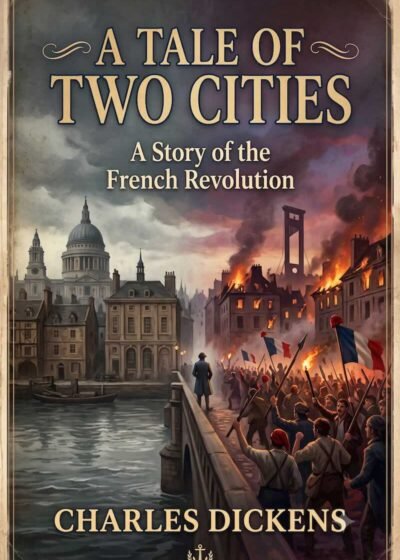
A Story of the French Revolution.
Charles Dickens’s A Tale of Two Cities, published in 1859, opens with perhaps the most famous paradox in English literature: “It was the best of times, it was the worst of times.” Set against the turbulent backdrop of the French Revolution, this historical novel departs from Dickens’s traditional character-driven narratives to deliver a sweeping, plot-driven epic. Bridging the contrasting worlds of London and Paris, the novel explores the intoxicating brutality of political upheaval, the inescapable weight of historical injustice, and the transcendent power of personal resurrection and self-sacrifice.
The Canvas of Revolution: London vs. Paris
The narrative constructs a stark dichotomy between two European capitals in the late eighteenth century. London is depicted as a place of relative stability and safety, though marred by social complacency, a flawed justice system, and spiritual inertia. In contrast, Paris is a city simmering with righteous fury that inevitably boils over into catastrophic violence. Dickens masterfully captures the atmosphere of pre-revolutionary France, where a callous aristocracy crushes the peasantry underfoot, symbolizing the inevitable retribution that follows systemic oppression. When the revolution finally erupts, Dickens does not romanticize the mob; instead, he portrays the Jacquerie and the Reign of Terror as a blood-soaked tempest where the oppressed transform into merciless oppressors, driven by the insatiable appetite of the Guillotine.
Shadows and Light: The Central Characters
At the heart of this historical storm is a web of characters whose personal destinies intertwine with the fate of nations. Doctor Alexandre Manette embodies the theme of psychological resurrection; recalled to life after eighteen agonizing years of unjust imprisonment in the Bastille, he is restored to sanity through the unwavering devotion of his daughter, Lucie. Lucie serves as the emotional and moral anchor of the novel—a guiding light who binds the central figures together with empathy and grace.
Around her orbit two strikingly similar men who represent opposing paths of human potential. Charles Darnay, an exiled French aristocrat who renounces his family’s cruelty, embodies honor, duty, and moral rectitude. His physical double, Sydney Carton, is a brilliant but cynical English barrister drowning his wasted talents in alcohol. Carton’s profound, unrequited love for Lucie triggers a quiet moral reawakening, setting the stage for his ultimate redemption.
The Anatomy of Terror and Retribution
Opposing the domestic harmony of the Manette household is Madame Defarge, one of literature’s most chilling antagonists. Relentlessly knitting a secret register of those condemned to die by the revolution, she symbolizes the cold, dehumanizing logic of absolute vengeance. Her grievance against the aristocracy is deeply personal and historically justified, yet her inability to separate the innocent from the guilty illustrates Dickens’s central warning: violence begotten by injustice inevitably consumes both the oppressor and the liberator.
The Ultimate Sacrifice: A Masterpiece of Resurrection
Ultimately, A Tale of Two Cities is not merely a political critique, but a profound meditation on rebirth. As the narrative reaches its breathtaking climax in the shadow of the Guillotine, Sydney Carton finds ultimate purpose by trading places with the condemned Darnay. His final act of love elevates a wasted life into immortality. Through Carton’s sacrifice, Dickens asserts that love and selflessness remain the sole enduring counterweights to the destructive cycles of human history.