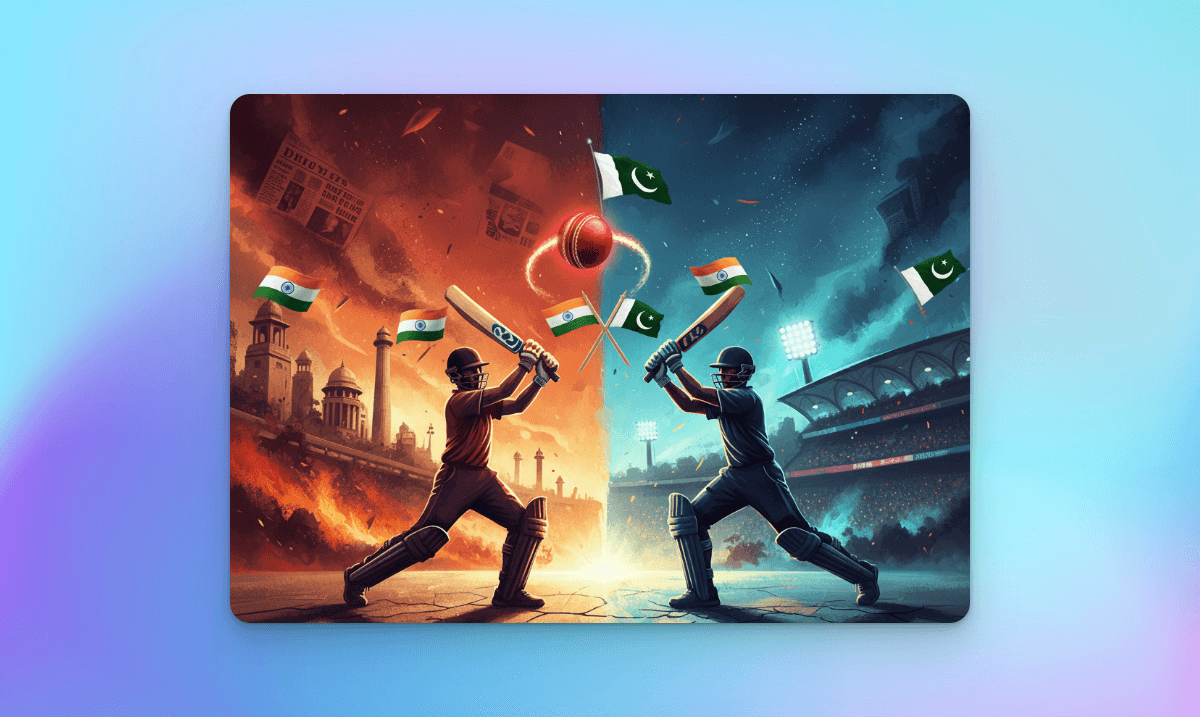
The desert air in Dubai on this Sunday in September 2025 is thick with anticipation, a palpable charge that feels far hotter than the 39°C heat baking the city. For the thousands gathered at the Dubai International Stadium, and the millions more watching around the globe, this is more than a game. It is a Super Fours clash in the Asia Cup, a contest that goes “far beyond the numbers” but is defined by them nonetheless. Both India and Pakistan arrive with a powerful momentum, each having secured “commanding victories” in their opening fixtures. The stage is set not just for a cricket match, but for a high-stakes examination of nerve, strategy, and resilience.
The on-field narrative of this particular encounter presents a fascinating contrast. India enters the fray with a lineup of seasoned veterans, including experienced campaigners like Suryakumar Yadav, Hardik Pandya, and Jasprit Bumrah, all of whom have faced Pakistan in these pressure-cooker situations before. In stark opposition, Pakistan’s side is fielding “several new faces” in the absence of star players Babar Azam and Mohammad Rizwan. This introduces an immediate, on-field tension: the veteran Indian side against an experimental Pakistani squad. Furthermore, the conditions in Dubai, with the pitch showing signs of being on the “slower side,” have prompted a significant tactical shift. While Pakistan has traditionally relied on a formidable pace attack, the team is expected to adopt a “spin-heavy line-up” for this match. This strategic pivot is more than just a reaction to the pitch; it is a clear-cut adjustment in response to their recent history of losses to India. The repeated failures of their pace-dominated approach in recent high-profile matches have likely forced this tactical re-evaluation, highlighting the profound psychological and strategic burden of this rivalry on every decision made.
The Enduring Scars: A Rivalry Forged in Partition
To understand the immense weight of this singular match, one must look back to its origins. The India-Pakistan cricket rivalry is “widely regarded as one of the most intense in world sport” and is unique in its deep entwinement with the political and historical fabric of the two nations. Its very foundation lies in the trauma of the 1947 Partition, which birthed two separate states from a single, formerly united land. When Pakistan’s cricket team first toured India in for their inaugural Test matches, the rivalry was hard-fought from the very beginning, with India clinching the series 2–1.
The history of this rivalry is punctuated by long, silent periods where the political climate made sporting contests impossible. The 1965 and 1971 Indo-Pak wars, for instance, led to a complete suspension of cricket between 1962 and 1977. This pattern of diplomatic crises interrupting bilateral cricket continued in later decades, with ties being repeatedly suspended after events like the 2008 Mumbai terror attacks. This historical record demonstrates a crucial dynamic: cricket is not merely a reflection of the rivalry but a casualty of it, a direct barometer of the state of diplomatic relations between the two countries. The fact that a single terror attack could freeze bilateral ties for over a decade—with no full series played since —underscores that the link between politics and sports is not superficial, but a deeply embedded and reactive one.
The World’s Most-Watched Match
Source: India-Pakistan Cricket Rivalry document & The Economic Times
The Paradox of Cricket Diplomacy: A Tool of Both Peace and Power
Cricket’s role in the India-Pakistan dynamic is a study in paradox. At various points in history, it has served as a powerful vehicle for diplomacy. The term “cricket diplomacy” itself emerged in this context, most notably when Pakistan’s President Zia ul-Haq visited India in to attend a Test match in an explicit bid to ease tensions. A more recent phase of goodwill occurred between 2003 and 2008, when bilateral tours resumed, serving as a powerful symbol of thawing relations. In these moments, the game transcended its sporting role to become a bridge for goodwill and dialogue between leaders and their people.
However, the game’s function has fundamentally changed, particularly since the 2008 Mumbai attacks. The rivalry now more frequently operates as an “exclusionary power tool“. The recent 2025 Asia Cup provides a stark example of this shift: a match report noted that Indian players refused the customary handshake with their Pakistani counterparts, with a team official explaining that “some things are beyond sportsmanship” in a clear nod to recent violence. This act, a simple refusal of a handshake, is a powerful symbol of a decade-long political stance. The shift from using cricket as a vehicle for dialogue to employing it as an instrument of protest or defiance marks a fundamental decline in the trust and goodwill that once allowed for “cricket diplomacy.”
The Tale of Two Records: The Numbers That Define a Narrative
The numbers behind the rivalry reveal a fascinating contradiction. As of September 2025, the overall head-to-head record in official matches across all formats slightly favors Pakistan, with 88 wins to India’s in 209 contests. When broken down by format, Pakistan maintains a lead in Tests (12 wins to 9) and ODIs (73 wins to 58).
But a different story emerges when one looks at the game’s biggest stages. In ICC tournaments, India holds an overwhelming dominance. The head-to-head record in all ICC World Cups stands at 15 wins for India and only 1 for Pakistan, with a similar imbalance in T20 World Cups, where India leads 7–1. This statistical disparity suggests a different mindset at play. In a bilateral series, the pressure is spread out over weeks. In a single, high-stakes tournament match, every ball carries the weight of a nation. India’s consistent performance on this grand stage may indicate a superior ability to handle the immense, immediate pressure of these knockout-style games. Conversely, Pakistan’s historical dominance in Tests and ODIs might be a relic of an era when bilateral ties were more common, and their recent record reflects the immense pressure of the new, modern rivalry format.
This tale of two records can be visually represented by the following table, which highlights the fascinating split between historical performance and high-pressure tournament play:
ICC World Cup Dominance
India’s overwhelming record in major tournaments.
A look at their record in ICC World Cups (T20 and ODI) shows a clear trend.
The Statistical Ledger: Overall vs. ICC Tournaments
| Format | Matches Played | India Wins | Pakistan Wins | Draw/Tie/No Result |
| Overall | 209 | 77 | 88 | 44 |
| Test | 59 | 9 | 12 | 38 |
| ODI | 136 | 58 | 73 | 5 |
| T20I | 14 | 10 | 3 | 1 |
| ICC World Cup H2H | 16 | 15 | 1 | 0 |
| ICC T20 World Cup H2H | 8 | 7 | 1 | 0 |
The Heroes and the Villains: Duels That Became Legends
The rivalry is not just about nations and numbers; it is about the men who have embodied its drama. The battle between Sachin Tendulkar and the express pace of Shoaib Akhtar in the late 1990s and early 2000s stands as a testament to this personal element. Akhtar himself once remarked that “Sachin played me the best… all the other batters were scared of me”, This simple quote shows that despite the intense on-field aggression, there was a shared respect between two legends who brought out the best in each other.
More recently, the high-profile duel between Virat Kohli and Pakistan’s young pacers, particularly Mohammad Amir, has captivated a new generation of fans. In the 2016 Asia Cup, Amir famously dismissed Kohli, but the Indian batsman and his teammate Yuvraj Singh “saw off Amir’s spell” to secure a hard-fought victory. These individual battles are a microcosm of the larger rivalry, oscillating between fierce, high-stakes competition and moments of shared respect. While the on-field sledging has often mirrored the broader tension, there have been powerful moments of camaraderie that transcend the political divide. During the 2023 Asia Cup, for instance, Pakistani fans were seen cheering for Kohli, and Pakistani bowler Shaheen Afridi presented a gift to his Indian counterpart, Jasprit Bumrah, for his newborn son. The contrast between these moments of sportsmanship and the previously mentioned refusal to shake hands in 2025 is a crucial nuance, showing that while personal gestures of goodwill can still exist, they are increasingly overshadowed by the prevailing institutional and nationalistic sentiments.
The Modern Crucible: Neutral Grounds, New Narratives
The post-2008 era has fundamentally redefined the rivalry. With no full bilateral series having occurred since 2012, all matches are now confined to multilateral tournaments at neutral venues like the UAE and Sri Lanka. The political constraints are starkly visible: when Pakistan was supposed to host the 2023 Asia Cup, India’s refusal to travel led to a “hybrid model” where their matches were moved to Sri Lanka. This dynamic means that each match is no longer part of a larger, evolving series; it is a single, isolated, high-stakes event.
This confinement has transformed every clash into a quasi-final that carries the weight of a nation. The past few years have been particularly dramatic in this respect. In the 2023 Asia Cup, India delivered a crushing victory, defeating Pakistan by 228 runs. The following year, India edged out a nail-biting win by 6 runs in New York. The rivalry’s most recent chapter, the 2025_ICC_Champions_Trophy, saw India once again defeat Pakistan by 6 wickets in the semi-final in Dubai. This victory was powered by an unbeaten century from Virat Kohli, who simultaneously reached multiple milestones, including becoming the(https://www.olympics.com/en/news/icc-champions-trophy-2025-cricket-india-vs-pakistan-group-match-report) and setting a new record for most catches by an Indian fielder. The fact that Pakistan’s first chance to host a major ICC event in decades saw its matches involving India moved to neutral sites served as a powerful symbol of the current state of relations.
A Saga of Sport and State
1947
The Partition of British India creates two nations, laying the foundation for a fierce rivalry.
1952
Pakistan tours India for their inaugural Test series, the first official cricket meeting between the two.
1962-1977
No matches are played for 15 years due to the Indo-Pakistani Wars of 1965 and 1971.
Late 1980s-90s
Neutral venues like Sharjah and Toronto become the main battlegrounds for the rivalry.
2008-Present
Cricket ties are suspended following the Mumbai terrorist attacks, with matches limited to ICC events.
A Nation Holds Its Breath: The Cultural Spectacle
The cultural significance of the India-Pakistan rivalry is staggering. It is a spectacle that transcends the sport itself, treated by media and fans alike as a national event. The viewership numbers are testament to its scale: over 800,000 fans applied for tickets to the(https://en.wikipedia.org/wiki/India%E2%80%93Pakistan_cricket_rivalry), while an estimated 273 million people watched it on TV. A 2023 analysis even suggested that one India-Pakistan match could become “the most-watched cricket broadcast in history“.
In the digital age, this fervor has found a new outlet. Social media has become a “battleground of reactions, memes, and debates,” underscoring how deeply embedded the rivalry is in the cultural identity of both nations. As one report summarized, these matches are “not just about cricket—they are about passion, identity, and the several decades of strong rivalry“. The emotional investment of the fans is immense and can lead to both incredible camaraderie and extreme, often-alarming, reactions. While there have been moments of shared cheers and dancing during rain delays, defeats have also prompted acts of hooliganism, effigy-burnings, and threats against players’ families. This powerful dynamic indicates that the rivalry functions as a “pressure-release valve for public sentiment“, a symbolic conflict where national pride is the ultimate prize, making every loss a painful blow and every victory a moment of profound exultation.
Conclusion: The Unending Story
The 2025 Asia Cup Super Fours match, regardless of its final score, is another chapter in a story that refuses to end. It is a rivalry that has endured because it has consistently mirrored the complex, often fraught, relationship between two nations born of the same land. The game’s history—marked by long periods of silence, brief moments of diplomacy, and a modern era of high-stakes, neutral-venue clashes—is a direct reflection of a shared, and often painful, history.
Ultimately, the India-Pakistan cricket rivalry is not defined by a single score or a solitary champion. It is a continuous narrative of conflict and camaraderie, of heroes and villains, and of a shared passion that carries the full weight of national pride and historical baggage. It is a story told in the roar of the crowd, the defiant silence of a handshake, the statistics on a scorecard, and the endless debates on social media. It is, and will remain, an unending story.