
Introduction and Overview
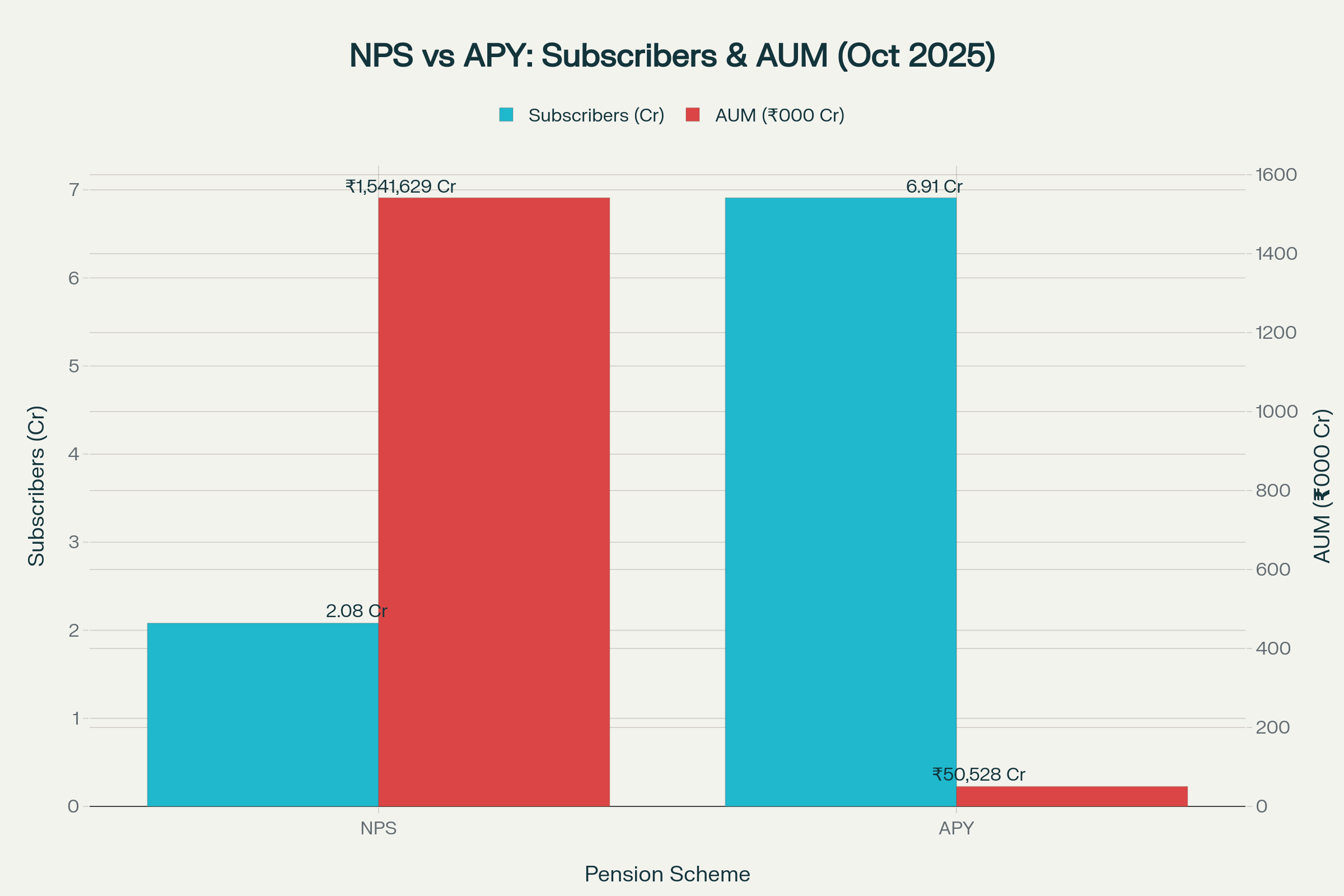
The National Pension Scheme (NPS) is a market-linked, low-cost, defined-contribution retirement system regulated by PFRDA. Launched in 2004 for government employees and extended to all citizens in 2009, NPS offers two account types—Tier I (retirement corpus with withdrawal restrictions) and Tier II (voluntary savings with free withdrawals). Investors can choose lifecycle-based auto allocation or Active Choice across Equity (E), Corporate Bonds (C), Government Securities (G), and Alternative Assets (A). Charges are among the lowest globally, and long-term compounding with disciplined contributions aims to build a retirement corpus.
Key Features at a Glance
- Regulator: Pension Fund Regulatory and Development Authority (PFRDA)
- Account types: Tier I (primary pension), Tier II (optional savings)
- Investment choices: Auto Choice (LC-75/50/25) or Active Choice (E/C/G/A with caps)
- Low costs: Fund management and admin charges are among the lowest
- Portability: Across jobs, locations, and fund managers
- Transparency: NAV-based daily valuation and online account access
- Liquidity: Partial withdrawals permitted under specified conditions
Pros vs Cons
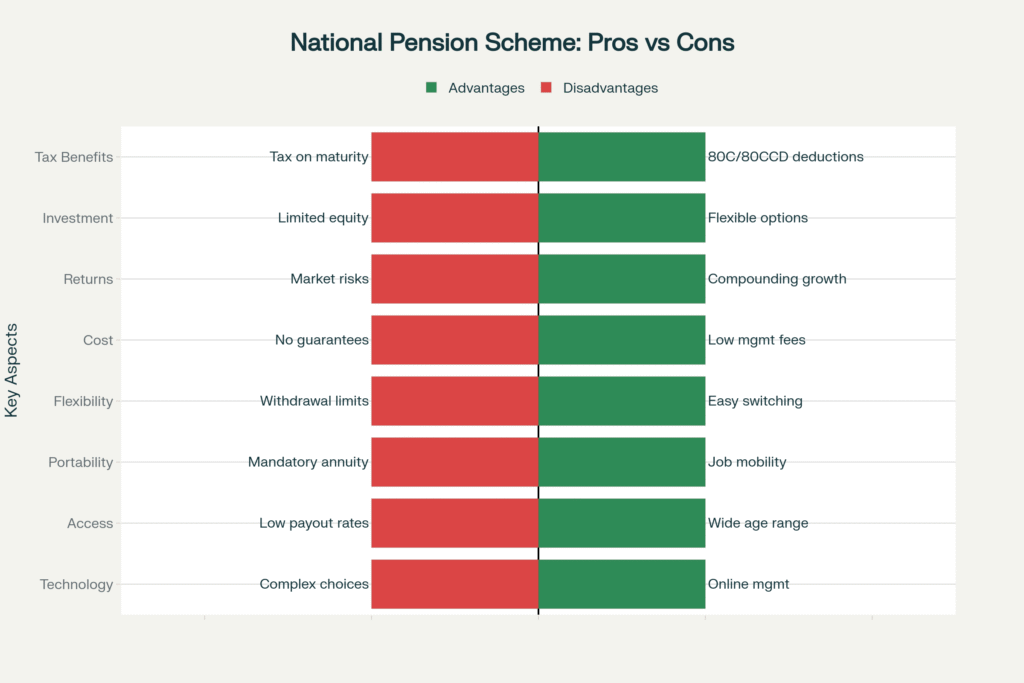
| Pros | Cons |
|---|---|
| Low cost structure improves net returns over long horizons | Market-linked—returns are not guaranteed |
| Tax advantages under 80C, 80CCD(1B) and 10(12A) | Mandatory annuitization at exit for Tier I |
| Professional fund management by licensed PFMs | Equity cap limits may constrain aggressive investors |
| Flexible asset allocation (Auto/Active) | Partial withdrawal and exit rules add complexity |
| Portability across employers and states | Lock-in until age 60 (Tier I) |
| Transparent, regulated product with online access | Annuity income taxed as per slab in retirement |
Eligibility and Account Types
- Who can join: Indian citizens (resident/non-resident) and OCI, age 18–70; KYC required.
- Tier I: Primary retirement account. Minimum contribution typically Rs 500 per contribution and Rs 1,000 per year (as guided by PFRDA; POPs may specify operational thresholds). Tax benefits available.
- Tier II: Optional savings account with free withdrawals; no tax benefits for general citizens (certain benefits for central government employees subject to rules).
- Corporate NPS: Employers can contribute on behalf of employees with separate tax rules.
Investment Choices and Asset Allocation
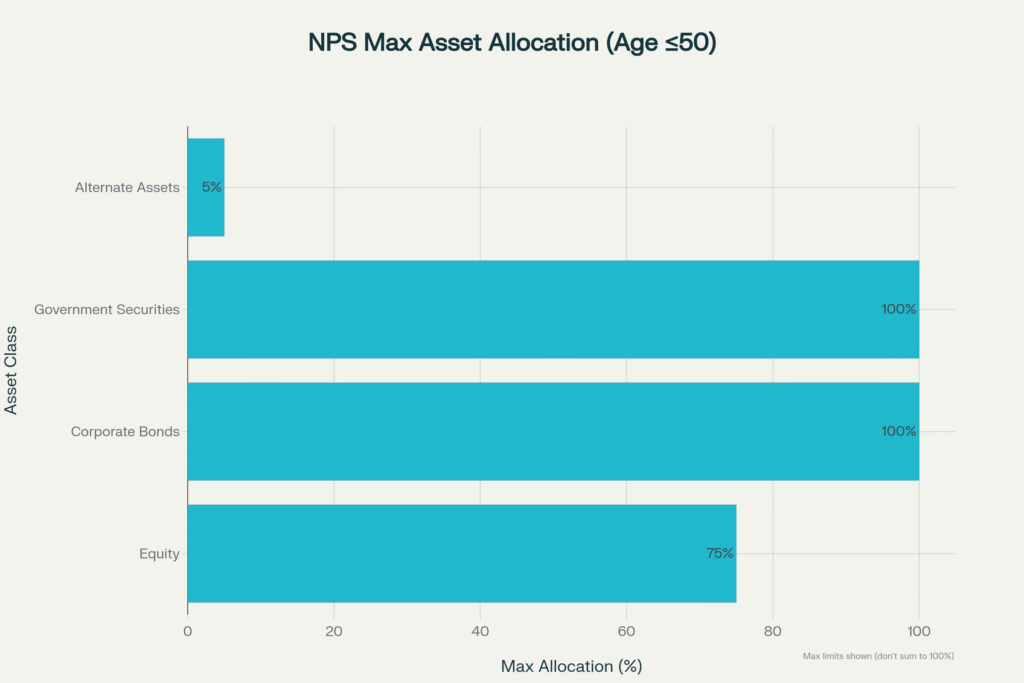
- Auto Choice: Lifecycle funds that reduce equity exposure with age (LC-75 Aggressive, LC-50 Moderate, LC-25 Conservative).
- Active Choice: Investor selects E/C/G/A subject to caps (E typically capped at 75% for citizens; A capped lower). Rebalancing allowed; switch PFMs and schemes as needed.
- Performance: Historically, diversified NPS schemes have delivered competitive long-term returns; past performance does not guarantee future results.
Tax Benefits (as per prevailing provisions; verify latest rules)
- Section 80CCD(1): Within overall 80C limit of Rs 1.5 lakh—employee/self-contribution subject to 10% of salary (20% of gross income for self-employed).
- Section 80CCD(1B): Additional exclusive deduction up to Rs 50,000 for NPS Tier I.
- Section 80CCD(2): Employer’s contribution up to 10% of salary (14% for central government) deductible, subject to overall limits.
- At Exit (Section 10(12A)): Up to 60% of corpus withdrawable tax-exempt; minimum 40% to be used to buy an annuity (annuity income taxable).
- Partial Withdrawal (Section 10(12B)): Up to 25% of own contributions for specified purposes after 3 years, subject to limits.
Withdrawals, Exit and Annuity Rules
- Normal exit at 60: Up to 60% lump sum tax-free; at least 40% for annuity. Option to defer withdrawal and continue contributions up to age 70.
- Premature exit (before 60): Up to 20% lump sum; at least 80% annuitized, subject to minimum corpus thresholds.
- Partial withdrawals: Education, marriage of children, purchase/construction of first house, specified illnesses, etc., after meeting criteria.
- Annuity options: Immediate annuity, with/without return of purchase price, joint-life variants; choose IRDAI-regulated annuity provider.
Best Practices for NPS Investors
- Start early to maximize compounding; contribute regularly via SIP-like scheduling.
- Choose Auto Choice unless you actively monitor markets and rebalance.
- Maintain equity within comfort for volatility; consider lifecycle glide-path.
- Review PFM performance annually; switch if consistent underperformance.
- Align NPS with other retirement assets (EPF/PPF/mutual funds) for holistic allocation.
- Plan annuity selection well before retirement; compare rates and features.
- Keep nominee details and contact information up to date.
Frequently Asked Questions
- Can NRIs invest? Yes, subject to FEMA and KYC; OCI eligible; PIO no longer eligible unless otherwise specified by PFRDA.
- What are costs? Low fund management fees (basis points), plus small record-keeping and POP charges.
- Can I have multiple NPS accounts? Only one PRAN across India; portable.
Conclusion
NPS is a regulated, low-cost, long-horizon retirement solution that complements EPF/PPF and mutual funds. With disciplined contributions, prudent asset allocation, tax benefits, and strong oversight, NPS can be a core component of a diversified retirement plan, particularly for investors seeking structured, goal-based investing with transparency and portability.