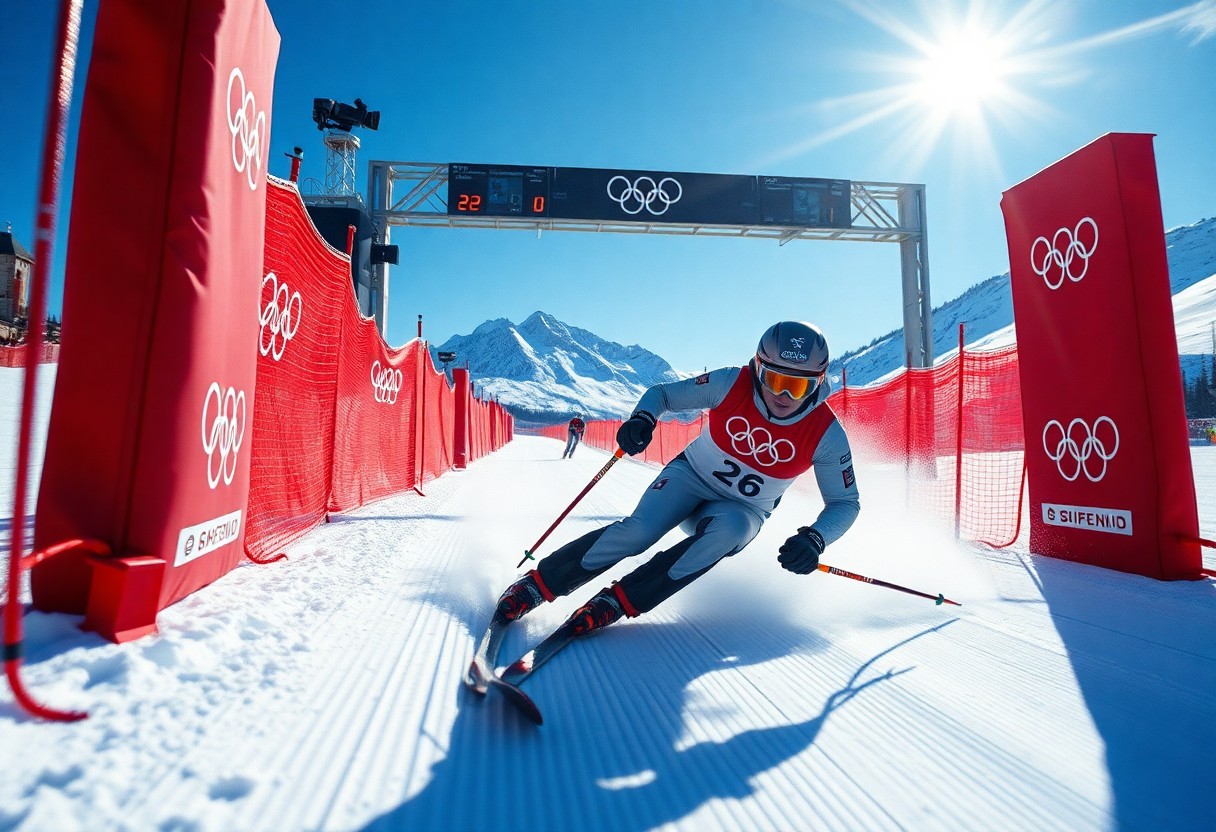
Just as Milan-Cortina prepares to host, you can expect Alpine skiing to push limits with higher speeds and steeper, more technical courses, testing athletes’ skill and equipment; unpredictable mountain weather will add risk and drama, while enhanced safety measures and course redesigns aim to protect racers; you’ll see fierce national pride, a possible home advantage for Italian contenders and rising stars reshaping medal forecasts.
Key Takeaways:
- Alpine events will be centered in Cortina d’Ampezzo, highlighting steep, varied Dolomite terrain with upgraded courses and infrastructure to meet Olympic speed and technical standards.
- The competitor mix will combine established medal contenders with a wave of younger talent, keeping podiums unpredictable and increasing depth across traditional powerhouses and emerging nations.
- Variable winter weather and ongoing climate shifts will make snow management, artificial snow systems, and contingency scheduling important factors in race outcomes.
- Advances in ski technology, aerodynamics, data analytics, and course safety measures will continue to marginally shift performance and influence race strategies.
- Expect strong spectator interest and enhanced broadcast experiences (on-course cameras, analytics overlays), plus a legacy focus on regional tourism and long-term winter-sport facilities.
Host venues and course design
Milan-Cortina region: venues, altitude and course characteristics
You’ll find the Alpine programme concentrated around Cortina d’Ampezzo’s Tofane sector and nearby Dolomite ridges, where elevations for race starts typically sit between about 1,200 and 2,400 metres. The Tofane slopes give organisers natural vertical relief and exposed pitches that favour classic high-speed profiles, while lower-altitude stadiums in the region provide the sheltered, technically consistent runs needed for giant slalom and slalom.
Course designers will exploit steep ribs, narrow chutes and long compressions in the upper sections, then open into broader flats where speed can spike; that mix is why local weather and snow management are decisive. For background on how athletes and national teams are approaching the region you can read the FIS preview at Paris carrying ‘good pressure’ of home support at Milano ….
Discipline-specific course expectations: downhill, Super-G, giant slalom, slalom, alpine combined and team events
For downhill and Super-G you should expect courses built to the upper FIS ranges: long start-to-finish runs with vertical drops that push the design limits, big air and compressions that produce very high speeds (commonly 130-160 km/h). Safety will be front of mind, so extensive netting, reinforced catch areas and multiple safety transitions will appear on exposed sections; those protections can be the difference between a calculated risk and a catastrophic run.
In giant slalom and slalom the emphasis shifts to rhythm, abrupt pitch changes and shorter, punchy verticals – gates set to reward clean edge-to-edge technique and fast, reactive skiing. Alpine combined will pair a shortened speed leg with a traditional slalom that tests versatility, while the mixed-team event will use a compact parallel course that magnifies gate setup and start tactics: small margins and split-second timing decide rounds.
You’ll notice teams dial equipment aggressively for each discipline – longer, stiffer skis and lower profiles for speed; shorter, nimble setups and sharpened edges for tech days – and course-setters will exploit natural terrain to create sections where mistakes are heavily punished.
Piste preparation, snowmaking capacity and environmental constraints
Organisers will rely on a combination of natural snow and extensive artificial coverage: reservoirs, high-capacity snow guns and automated networks are being positioned to guarantee firm race surfaces even in warm spells. That infrastructure lets you expect consistent, icy racebeds early in the morning, because grooming teams will compact and machine the surface repeatedly to achieve maximum hardness and predictability.
Environmental protections in the Dolomites – including water-use limits, protected-area rules and post-event restoration obligations – constrain where and how much alteration is allowed, so you’ll see targeted, minimal-impact interventions rather than wholesale regrading. Event planners must balance the need for race-quality pistes with strict mitigation: seasonal access windows, erosion control and re-vegetation plans are standard.
Practically, that means race schedules may favour colder hours, grooming will be intensive (winch grooming, water injection and repeated passes), and organisers will prioritise snow conservation and rapid restoration after events to comply with local regulations and preserve the landscape.
Competition format, schedule and qualification
Official event program and potential format tweaks
The Olympic alpine program is expected to stick to the established 11 events – men’s and women’s Downhill, Super-G, Giant Slalom, Slalom, Alpine Combined, plus the mixed team parallel – which gives you a mix of speed, technical and head-to-head racing across the two-week window. The balance between speed events (Downhill, Super-G) and technical events (Giant Slalom, Slalom) remains the defining feature
Event organizers and broadcasters have discussed format adjustments that would enhance spectator appeal: expanded head-to-head parallel rounds, shorter televised sprint courses, or changes to seeding to favor more dramatic elimination heats. You can gauge how small changes affect elite athletes from training previews – for example, American Ryan Cochran-Siegle posts fastest time in first men’s downhill training – which show athletes adapting quickly when formats or course profiles shift. The IOC/FIS quota system typically limits alpine skiing to around 306 athletes (approximately 153 men and 153 women), with a maximum per NOC that has historically been in the low 20s (commonly a cap of 22 across genders). Qualification is driven by FIS points and Olympic quota allocation lists: you earn spots through World Cup, World Championship, and continental results, plus the basic qualification standard that allows smaller nations to send at least one representative in each gender. National federations then apply their own selection policies on top of those quotas. Big teams like Austria, Switzerland and the U.S. often have internal criteria demanding World Cup points, top-30 finishes or specific selection races, while smaller federations may nominate athletes based on national championships or discretionary picks. That means even if your country has earned quota slots, your personal path to Beijing-Cortina may depend as much on internal trials as on FIS rankings. Expect last-minute roster moves: injury, form shifts in January World Cups, or discretionary selections can change entries days before the Games. You should track federation announcements through late January and watch how nations deploy their quota – some will concentrate on speed specialists, others on technical depth – because strategy affects medal chances and team composition. You should expect alpine events to be spread across the full Games (6-22 February 2026), with organizers building in multiple reserve days for wind, heavy snow or unseasonable thaw. For speed events, FIS rules give the men’s downhill a vertical drop of roughly 800-1,100 meters and the women’s downhill about 500-800 meters, so course preparation and avalanche control are significant logistical tasks that can force postponements or course shortens. Race-day decisions often hinge on wind and visibility; high winds can make a downhill or Super-G unsafe and have led to postponements at recent Olympics. Broadcast windows add pressure to keep events on schedule, so you may see start-time shifts to midday or evening to maximize TV audiences, plus contingency plans to swap event order (running Giant Slalom before Slalom, for example) to exploit better weather windows. Organizers routinely maintain multiple contingency tools: reserve days, alternative lower-elevation start points, and the option to compress two runs into a single day for technical events. If you’re following athletes live, be prepared for schedule volatility and check official daily bulletins – the sequence and timing you expect can change within 24 hours if wind or temperature trends demand it. You’ll still see the sport’s headline names dominate medal conversations: Mikaela Shiffrin (age 32 in 2026) heads into her fourth Olympic Games with unmatched technical pedigree and a clear aim for multiple medals across slalom and giant slalom, while Marco Odermatt (age 29) arrives as the athlete most likely to control the men’s giant slalom and overall-title narratives after his breakthrough at the World Cup level and a 2022 Olympic title in GS. Expect these two to anchor their teams’ strategies-Shiffrin for the U.S. and Odermatt for Switzerland-because their presence reshapes start orders, team pairings in the parallel event, and how other nations allocate resources across disciplines. On the speed side you’ll watch proven campaigners like Sofia Goggia (age 34) and Austria’s veterans-Vincent Kriechmayr and Matthias Mayer-who bring Olympic medals, World Cup downhill and super‑G wins, and deep course experience that matter when weather or course-set quirks force split-second decisions. Their race-day savvy often flips podium odds: when visibility drops or course hardness changes, experience converts into tenths of seconds. That makes them among the safest bets for a speed podium, even if younger athletes push them in form weeks before the Games. You should track the late-season form lines closely because breakout athletes and comeback stories will reshape medal markets; young skiers who logged their first World Cup podiums in 2024-25 can become dark-horse Olympic medalists if they peak in January-February 2026. Names to watch will include athletes who moved from occasional top-30s to regular top-10s last season-those gains often show up as improved start positions and confidence on championship courses. Injury histories matter more than ever, and you’ll notice athletes whose 2023-24 rehabilitations culminate in targeted appearances on steep, icy venues-this is where an athlete like Goggia has repeatedly proved that a return from fracture or knee surgery can still produce gold. Teams that manage recovery windows-by limiting race days, tuning training loads, and choosing selective World Cup starts-give you the best indicators of who will be both fit and race‑sharp in Milan-Cortina. More detail: you can pinpoint likely medal spoilers by comparing late-season World Cup metrics-top‑5 frequency, average finish improvement, and start-number trends-from December through January; athletes who reduce their average finish by 10-15 places in that window often translate that form into Olympic results, because those improvements reflect technical gains and mental readiness on championship terrain. You’ll want to monitor Austria for sheer depth: their men’s and women’s squads routinely fill the four-athlete Olympic quota across technical and speed events, and they supply multiple top-15 World Cup starters per race. Switzerland remains a two-headed threat with Odermatt and Lara Gut‑Behrami anchoring both tech and speed, while the U.S. centers its medal hopes on Shiffrin plus a handful of super-G and downhill specialists who can turn a single brilliant descent into a podium. Norway and Italy balance elite stars with young depth-Norway with Aleksander Aamodt Kilde and Henrik Kristoffersen in different disciplines, Italy with Sofia Goggia and Federica Brignone-style all‑rounders-so you should expect them to target podiums across at least three events rather than concentrating medals in one discipline. That strategic distribution increases their chances in the alpine team parallel as well, because mixed-team depth matters more than an isolated superstar in that format. More detail: examine each nation’s start list by event and note how many athletes have posted top‑10 World Cup results in the current season-nations with three or more top‑10s per gender (for example, Austria and Switzerland in recent seasons) are statistically more likely to deliver multiple medals and a strong team-event showing, because Olympic quota limits (maximum four per nation per event) reward countries that can field several medal-capable starters rather than a single standout. You’ll see ski and boot manufacturers pushing lighter, more anisotropic composite layups and tuned flex patterns that let you hold an edge longer at high lean angles; modern race skis increasingly combine carbon weaves with targeted dampers and sandwich-plate constructions to reduce chatter on icy GS pitches. Teams report that improved torsional stiffness and vibration damping translate into measurable time gains on steep, high-speed sections-often in the range of tenths to a few tenths of a second per run depending on course profile-so your equipment choice directly affects line stability and exit speed. FIS continues to update equipment specifications (ski geometry, helmet standards and binding/boot interface rules) to manage speed and athlete safety, which forces you to balance agility against stability when selecting set-ups. Because rule-driven limits often narrow the range of legal geometries, you’ll need to extract marginal gains through plate geometry, edge treatments and aerodynamic suit fits; those marginal gains can be positive for podium potential but also increase exposure to high-speed impacts, so risk management in equipment choices is important. You’ll find IMUs (accelerometers/gyroscopes) sampling at 500-1,000 Hz, GNSS with RTK corrections at 10-20 Hz, pressure insoles and strain gauges forming a common sensor suite that quantifies turn timing, edge angle and force application; high-speed video between 500-1,000 fps is used to validate kinematics. Timing systems used at World Cups and Olympics maintain precision to 0.01 s, and coaches pair that with sensor-derived sector breakdowns to isolate where you lose 0.05-0.20 s on a given line. Machine-learning models and biomechanical pipelines are increasingly standard for turn-shape classification and predictive performance modeling, enabling you to compare your actual line to an algorithmically derived “optimal” line and to prioritize interventions. Teams applying these analytics have reduced intra-run variability and shortened decision-to-action cycles in training sessions, letting you focus on the specific gates or sectors that cost the most time while monitoring load to avoid overuse. You should expect real-time telemetry to remain limited by on-hill connectivity and battery constraints-practical live feeds typically update at 1-5 second intervals while the full high-frequency record is downloaded post-run for deep analysis-but even low-latency overlays let you spot gross line deviations immediately. That immediate objective feedback can reveal losses as small as 0.1 s per sector and help you adjust technique between attempts, although the richest insights come from synchronized post-run fusion of IMU, GNSS, pressure and video data. You’ll see more targeted altitude exposures-training blocks at 2,000-3,500 m such as glacier camps or high-mountain bases (e.g., Val Senales, Hintertux or Saas-Fee) used for 2-3 week hematological and ventilatory adaptations-combined with shorter, low-altitude intensity weeks to maintain neuromuscular sharpness. Because adaptations take time, your program will mix live-high/train-low principles and careful load management; insufficient recovery at altitude increases fatigue and injury risk, so monitoring hemoglobin, wellness and power output is important. Simulation tools (ski-ergometers, turn simulators, force-plate lab sessions) pair with periodized strength and power phases: base strength blocks of 8-12 weeks at moderate intensities, followed by 4-6 week power-specific blocks and short, high-skill on-snow windows close to competition. Microcycles commonly span 7-14 days, and you’ll see final tapers of 7-14 days before major events to peak neuromuscular and technical performance. Many national programs combine GPS/IMU external load monitoring with daily subjective and objective internal load measures so you can adjust volume and intensity dynamically; that approach reduces overtraining and times your peak for championship weeks, giving you the best chance to convert technical preparation into race-day speed. When executed well, this integrated preparation can shave meaningful tenths from your runs while protecting you from preventable fatigue-related crashes. Netting is layered and zoned to manage the highest-energy impacts: you’ll see double or triple nets up to 2-3 meters high at high-risk sections such as takeoffs, compression zones and finish-area approaches, with the outer net anchored to energy-absorbing posts to reduce peak forces on a skier. Course layout follows FIS homologation guidelines-vertical drops and gate spacing are chosen to limit excessive speeds (men’s Downhill courses typically sit in the 800-1,100 m vertical-drop window), and run-off areas of several meters are carved into terrain so that when you lose control there’s graded deceleration before the barrier systems. Organizers are also deploying newer protective tech where the line is most aggressive: inflatable air fences and energy-absorbing crash pads are placed behind nets at known impact points, GPS-based timing and video analytics flag sections with repeated near-misses, and snowpack engineering (banked exits, softened landings) is used to reshape micro-topography. For official course specs and venue maps you can consult the Milano Cortina event pages such as Olympic Alpine Skiing | Milano Cortina 2026 Winter Olympics. Preventive measures start with training and equipment: neuromuscular programs and targeted strength work reduce non-contact knee injury risk by a significant margin (studies suggest reductions in the range of about 30-50% for structured programs), and meticulous binding settings plus boot-fitting cut down inadvertent release failures. On race day you’ll notice medical posts positioned along the course with dedicated trauma-trained physicians, at least one rapid-response ambulance and a helicopter on standby; the aim is immediate on-scene stabilization followed by transfer to a specialist centre, with organizers planning for sub-30-minute hospital-transfer capability from remote sections when weather and access permit. Return-to-play follows an objective, staged pathway: you’re cleared only after symptom resolution, measurable strength and functional test thresholds (for example, limb symmetry indices within ~10% on hop and strength tests for knee injuries), and a graded on-snow progression under medical and performance staff. For concussions the protocol is stepwise with minimum 24-hour intervals between stages and mandatory medical sign-off before full training; for ACL reconstructions expect a conservative timeline generally in the 6-12 month range depending on graft, rehab progress and sport-specific testing, with psychological readiness and on-snow confidence built into the final clearance. You’ll see much of the alpine program concentrated on the high Tofane massif (peaks to 3,244 m), which gives organizers a genuine advantage for natural snow on speed courses, while lower-elevation warming trends leave valley approaches and training slopes more exposed. Organizers are balancing that natural altitude benefit with targeted snowmaking: the model is to limit blanket coverage and instead use energy- and water-efficient systems, local storage reservoirs and night-time production windows to reduce pumping loads. As a hard example of scale, Beijing 2022’s Zhangjiakou snow operation required on the order of 1.2 million cubic meters of water for artificial snow – a precedent that underlines how much water and energy you can expect to be mobilized if natural snow falls short, and why emissions-management and water-reuse plans will matter for public acceptance and cost control. Your travel and viewing experience will be shaped by narrow mountain logistics and modern broadcast demands. Cortina sits roughly 400 km from Milan (about 4-5 hours by road under good conditions), so timed shuttle systems, expanded park-and-ride hubs and tight traffic-management windows will be used to prevent bottlenecks on routes like the SS51; those measures are necessary because local road capacity can be limited to a few thousand spectators per hour. On the transmission side, expect a typical downhill production to deploy 40-60 cameras (helicopters, cablecams, slo-mo rigs and fixed mast cameras), backed by fiber rings and emerging 5G low-latency links to deliver multi-angle feeds and immersive formats. Be aware that high winds or fog are immediate operational risks – they can ground helicopters and drones, forcing broadcasters to rely more heavily on cablecams and on-mountain fixed arrays to keep your live feed uninterrupted. Following this, you can expect the Alpine skiing program at the 2026 Winter Olympics to showcase faster, tighter racing as athletes leverage refined equipment, advanced training methods and bold course lines; variable weather and technical course design will reward adaptability, so you’ll witness dramatic lead changes and a compelling mix of veteran experience and rising talent vying for the podium. You should also anticipate a more immersive spectator experience driven by enhanced broadcast technologies and sustainability-focused venue planning, meaning your viewing – whether on-site or remote – will benefit from clearer storytelling, richer camera angles and event operations that balance high-performance sport with environmental and community considerations. A: Alpine events are centered in the Dolomites around Cortina d’Ampezzo, using established World Cup-grade courses that combine steep pitches, technical turns and high-speed sections; organizers plan to highlight classic tracks such as Tofane for technical and speed disciplines while preparing contingency plans for snow and wind. Expect a mix of traditional, challenging lines favored by elite racers and selective course-set patterns designed to test both speed and versatility, with infrastructure upgrades to spectator zones, TV sightlines and athlete facilities. A: Contenders will emerge from current and rising World Cup leaders across nations with strong alpine programs-Austria, Switzerland, Italy, France, Norway, Sweden and the United States-featuring specialists in technical (slalom, giant slalom) and speed (downhill, super-G) events. Watch established podium regulars who maintain World Cup form through 2024-2026, plus younger skiers breaking through on the circuit; team depth will matter for consistency across seven individual events and the mixed team parallel event, and late-season World Cup results in 2025-2026 will better define the medal favorites. A: Variable alpine weather-temperatures, wind and precipitation-will strongly influence scheduling, course preparation and race fairness: warmer spells can force artificial snowmaking, harder freeze-thaw cycles produce icier, faster surfaces advantaging certain racers, and high winds can delay or postpone downhill and super-G for safety. Organizers will use course refrigeration, snow fencing and contingency days when possible, but racers and teams will need adaptable waxing, tuning and race strategies to handle rapid changes in surface consistency and visibility. A: No major overhaul is confirmed as of mid-2024, but incremental changes driven by the FIS can appear between Olympic cycles-potential adjustments to start procedures, timing technology, course inspection protocols, or athlete safety measures. The mixed team parallel event remains part of the program and could see refinements in seeding or format to improve spectator clarity and TV timing. National federations and teams should track official FIS bulletins in the lead-up to ensure compliance with any technical or procedural updates. A: Advances in ski construction, edge and base materials, binding systems, aerodynamic suits and helmet design will continue to shave hundredths of a second from runs; precise waxing techniques and data-driven tuning tailored to forecasted snow crystal structure will be decisive. Teams will rely on video analysis, wind-tunnel or CFD testing, GPS and inertial sensors for line optimization, plus enhanced strength, balance and altitude preparation programs. Investment in airbag protection and course safety features also affects risk tolerance in high-speed sections, influencing how aggressively athletes attack the course.Qualification criteria, athlete quotas and national selection dynamics
Scheduling, weather windows and contingency planning
Athlete landscape and medal contenders
Established champions and Olympic trajectories
Rising talents, injury recoveries and late-season breakouts
Nations to watch: depth charts and team prospects
Equipment, technology and preparation trends
Equipment developments, FIS rule changes and performance implications
Data analytics, biomechanics, timing and on-course sensor technology
Preparation strategies: altitude camps, simulation and periodization
Safety, risk management and medical readiness
Course safety: netting, layout standards and protective innovations
Injury prevention, emergency medical response and return-to-play protocols
Environmental, logistical and broadcast considerations
Snow reliability, sustainability measures, transport and broadcast logistics
Summing up
FAQ
Q: What venues will host alpine skiing at the 2026 Winter Olympics and what can we expect from the courses?
Q: Which athletes and teams are likely to be favorites in 2026?
Q: How might weather and snow conditions affect the competition schedule and race outcomes?
Q: Are there any expected rule, format or event changes for alpine skiing in 2026?
Q: How will equipment, technology and athlete preparation influence performance at these Games?