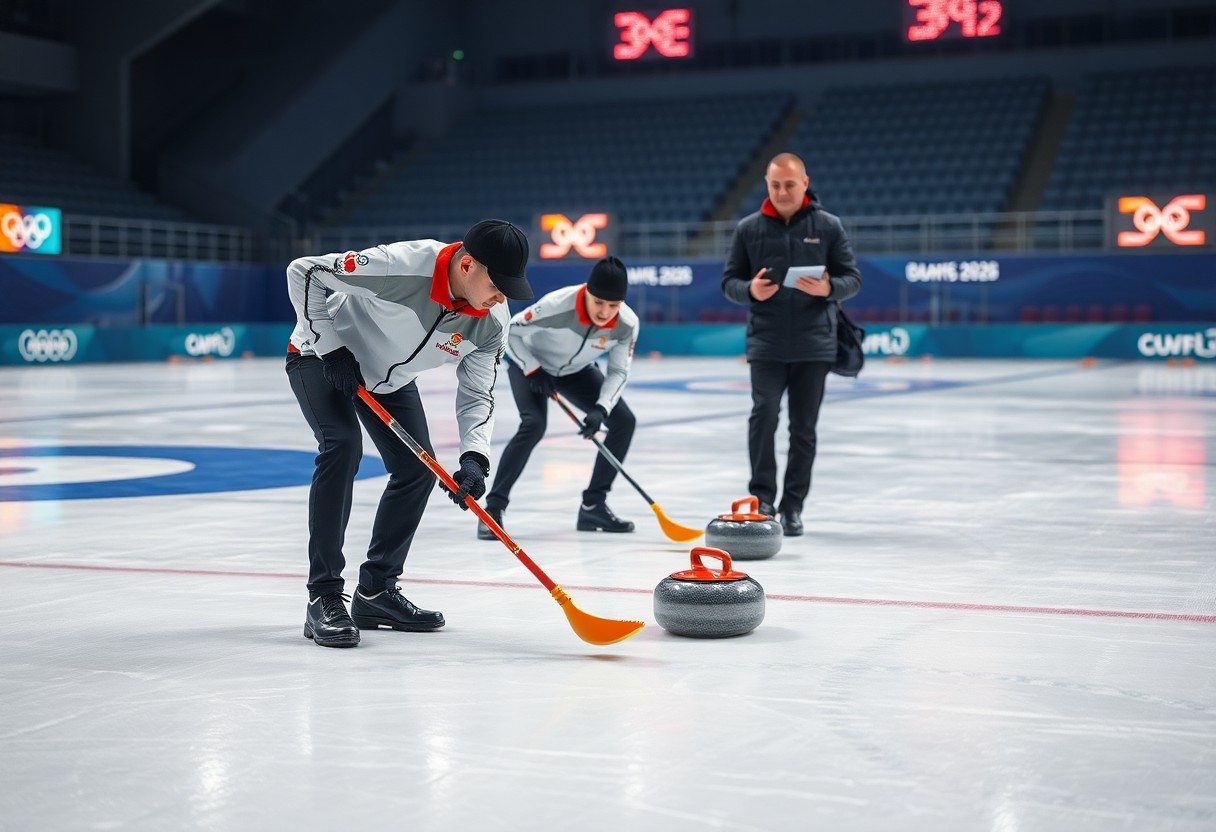
Curling at the 2026 Winter Olympics will force you to adapt as venue-specific ice behavior, evolving analytics, and possible format tweaks reshape how games are played. You’ll need to prioritize reading unpredictable ice and managing pace, leverage advanced analytics and data-driven shot selection, and exploit opportunities for tactical innovation in shot-calling and sweeping to stay competitive under tighter schedules and heightened international depth.
Key Takeaways:
- Venue and ice variability (altitude, humidity, arena refrigeration) will push teams to prioritize early ice reconnaissance and rapid equipment/tuning adjustments.
- In the established five-rock era teams will favor more aggressive, multi-stone setups and complex guard-and-draw sequences, increasing the premium on precise weight and line control.
- Mixed-doubles tactics and power-play thinking will further influence team play, promoting quicker decision-making, greater shot creativity, and flexible in-game role switching.
- Expanded use of analytics, shot-tracking and opponent modeling will shape end-by-end strategy, risk assessment and lineup choices more than ever.
- Coaching strategies will emphasize versatile rosters, elite sweeping fitness and mental resilience to handle the tighter schedules, travel demands and heightened media scrutiny of the Olympics.
Rule, Equipment and Ice Innovations
Anticipated IF/IOC rule clarifications and enforcement changes
You should expect the IF and IOC to tighten language around release and sweeping definitions that have caused controversy in recent championships; the World Curling Federation’s five‑rock rule (adopted in 2018) is settled, but officials are focusing on clearer hogline release criteria, standardized foot‑fault detection and a uniform protocol for burned‑rock calls. Curling at the 2026 Milan Cortina Winter Olympics will be the testing ground for any procedural clarifications the IOC signs off on, so you’ll see rulebooks and on‑ice instructions refined well before teams arrive.
Enforcement is likely to become more technology‑driven: expect wider use of high‑speed cameras, electronic hogline sensors and expanded video‑review windows that let umpires evaluate foot placement and sweeping contact more precisely. When you plan strategy, factor in faster, stricter on‑ice rulings-mistimed releases or marginal foot faults could lead to immediate shot forfeits or standardized penalty outcomes rather than discretionary warnings that varied by event in the past.
Advances in broom and stone technology and their tactical implications
You’ll see broom heads evolve with new fiber blends and construction that change how heat and friction are applied to the pebble; manufacturers are developing stiffer, denser bristle configurations and lighter composite handles that let sweepers produce more consistent, higher‑pressure sweeps without fatigue. That shift gives you the option to extend sweeping windows on delicate draws and takeouts, so teams will increasingly program end plans that assume greater sweep effectiveness on marginal shots.
Stone manufacturers are improving machining tolerances on the running band and experimenting with finish treatments that reduce variability between rocks, which means draw weight and curl will be more repeatable across deliveries. When your stones behave more predictably you can rely on tighter angles for ticks, raises and freezes; as a result, tactical emphasis will move toward precise placement and multi‑shot sequences instead of one big power takeout.
In practice, your shot-calling will shift: with more consistent stones and more effective brooms you should favor set‑up ends that exploit incremental advantages-playing three or four staged guards and taps rather than a single high‑risk swing. Teams already testing prototypes in national high‑performance centres report improved repeatability in draws and a measurable increase in successful late‑end precision shots, so incorporating those tools into your training will be crucial to adapt to the 2026 competitive environment.
Tactical Evolution on the Sheets
Shifts between offensive scoring and conservative play
You’ll see teams toggle more deliberately between attacking to build multi-point ends and pulling back to protect the hammer; when the probability of converting a clean two is below about 30-35% many skips opt to blank or play for a single rather than attempt a high-variance three. Midgame (ends 4-7) has become the frequent battleground: you can go aggressive to create a 3+ opportunity if ice and draw weight favor precise freezes, but switching to a peel-and-control approach quickly minimizes the opponent’s chances of a big swing.
When you’re in a round-robin match you should lean toward offense to climb the standings, while in elimination play you’ll adjust toward containment and error minimization; expect fewer high-risk attempts in quarterfinals and later. Use situational thresholds (score, end number, hammer ownership) to force consistency-for example, if you’re tied entering the 8th with hammer, favor preserving that hammer rather than gambling for an early three unless your setup has >40% success likelihood.
Hammer management, blank-end strategy and late-game planning
You should prioritize which ends to hold the hammer for: keeping it for the 8th and 10th often outweighs a midgame deuce, so teams increasingly blank the 5th-7th to load the last rocks; retaining last-rock advantage into the 10th remains the single most valuable asset in close games. If you’re trailing by one entering the 8th, switch to line-and-weight play to manufacture a two, but if tied with two ends remaining you may accept a single earlier to guarantee the hammer late.
Analytics-driven planning helps: think in expected points per end and game-win probability rather than isolated shot value-your hammer’s average scoring expectation is roughly double that without it, so trading ends deliberately is often the right call. When you guard against steals, force your opponent into low-percentage shots by simplifying the house setup and avoiding risky freezes that open up runback or double-takeout angles.
More detail: in late-game sequences you’ll often sacrifi ce a deuce early to ensure the hammer in the 9th and 10th; giving up a steal in the 9th or 10th is the most dangerous outcome, so practice end-scenario templates (force-then-blank, controlled freeze, angle-out) and decide beforehand who will call the line versus weight under pressure.
Popularity and counter-strategies for aggressive takeouts and runbacks
Aggressive takeouts and runbacks have become more common because players control weight and brushing better, making complex angles playable; when you execute a runback successfully you can convert a two or three from what looked like a locked-up end. However, you should only attempt these high-reward shots if your team’s success probability is above roughly 50%, otherwise the variance hands momentum to the opponent.
To counter this, you’ll prioritize layered guard structures, purposeful freeze placement and early peel sequences that remove the angle lanes runbacks need; deploying a tick or guard peel in ends 2-4 often denies the geometry required for a clean runback later. In match planning, assign one player to specialize in runback practice and set a clear threshold for when you allow such attempts during competition versus when you force the opponent into simpler hits.
More detail: drill-specific work pays off-runback drills of 30-40 repetitions focused on weight control and curl read produce measurable gains, and if your team reaches a stable ~60% success rate in practice it becomes justifiable to call runbacks in tight games; otherwise lock down guards and force the simpler hit-and-roll exchanges.
Team Structure, Roles and Conditioning
Redefined roles: the modern skip, vice and position specialization
You’ll see the skip evolve from pure tactician to a hybrid leader who throws clutch stones and delegates more in-end decisions to the vice. Teams are increasingly assigning the vice-skip as an on-ice strategist for specific ends-so when the vice holds the broom you get two experienced decision-makers collaborating, which often shortens deliberation time and improves shot choice under pressure. At high-performance camps you’ll hear coaches refer to a 60/40 split of tactical versus shot-execution responsibilities between skip and vice during set plays, and that split is showing up in game footage from World Curling Tour events.
You should expect deeper position specialization: leads trained primarily for perfect guards and high-accuracy draws, seconds drilled for heavy-hit weight and sweeping stamina, and thirds focused on intricate peels and angle raises. Teams from Canada and Sweden have experimented with swapping traditional roles mid-tournament to exploit matchups-one practical example saw a team rotate their second and third across three round-robin games to counter two opponents who favored center-line guards, producing a measurable uptick in hammer-conversion rate.
Physical conditioning, sweeping specialization and substitution strategies
Your preparation now needs to be more scientific: elite sweepers typically train 4-6 sessions per week combining interval cardio, loaded squats and plyometrics to sustain repeated 20-30 second maximal sweeping bursts. In competition this translates to sustained heart rates at 70-85% of max during long ends, and that physiological load makes sweeping specialization a performance multiplier but also a key fatigue risk. Coaches are monitoring players’ GPS and heart-rate data to decide when to rotate the alternate into the lineup between draws.
You’ll notice substitution strategies becoming tactical rather than just injury-driven; alternates are used proactively to preserve a primary sweeper for playoff games, or to bring a specialist sweeper in for matches on unpredictable ice. With Olympic round-robins typically spanning around 9-12 games, teams that rotate one player every 3-4 draws report fewer late-tournament performance drops and higher shot percentages in medal rounds.
For more on how the Olympic schedule and format influence these decisions see Winter Olympics 2026: How does curling work?, which outlines event structure that teams factor into their conditioning and substitution plans.
Data, Analytics and Coaching Tools
Use of shot-by-shot data and win-probability models to shape strategy
You’ll increasingly rely on shot-by-shot repositories-models trained on roughly 10,000-50,000 labeled competitive shots-to convert individual shot outcomes into end- and game-level win-probability (WP) curves. In practice that means you can quantify the expected WP swing from a single aggressive play: late-end takeouts or precise freezes commonly produce 10-30 percentage point WP changes in high-leverage situations, so your pre-game plan will include explicit WP thresholds that trigger risk-on versus risk-off calls.
Because these models let you compare expected value across sequences, you can operationalize choices like blanking an end versus forcing a one: if the model says a blank raises your WP by 12% compared with playing for one under the rink’s current breakout conditions, you can justify more conservative calls early in the end. At the same time you must adjust models for local factors-ice pace, pebble structure and broom-technique variability-which can shift raw WP outputs by several percentage points; treat the numbers as decision aids, not automatic prescriptions, and log outcomes so your dataset grows each week.
AI-assisted scouting and opponent game-plan development
AI-driven video analysis and pattern recognition will let you build opponent profiles that go far beyond “likes to draw” or “likes to hit.” You can automatically tag tendencies such as shot-type frequency by score state (for example, opponents choosing takeouts in ~65% of ends when trailing after the 6th) and identify individual player signatures-release angle ranges, rotation rates and weight windows-using pose-estimation and puck-tracking algorithms. That lets you design targeted counterplans: if an opponent’s third misses corner guards under high-rotation throws, your plan can emphasize early corner clutter to force uncomfortable shots.
Operationally, your analytics stack will generate a one-page opponent dossier before every match with 3-5 high-value counters (e.g., force early guard placement, upside-down double-threats on the 3rd stone) and probabilistic heat maps showing where the opposition concedes most steals. You can then rehearse specific disruptions in practice-forcing that opponent into their lowest-percent shot window-which converts scouting from passive observation into a repeatable tactical lever.
Going deeper, you’ll leverage Monte Carlo simulations-often running 5,000-10,000 iterations per end-to test multiple response trees against an opponent’s shown tendencies, producing expected-point distributions that reveal when you should deviate from textbook strategy. Combining biomechanical markers with decision-pattern models also exposes exploitable fatigue or consistency drops late in games, allowing you to schedule strategic pressure points where your analytics indicate the opponent’s error-rate rises.
In-game analytics, communication protocols and pace-of-play decisions
During play you’ll use streamlined dashboards that present three quick metrics-current WP, expected points for the end, and shot-success probability-to the coaching team so decisions fit within time limits. That means your timeout and communication protocols have to be pre-agreed: designate who speaks (skip versus coach), which metric triggers a timeout (for example, a WP swing >5 percentage points or a critical disagreement on shot selection), and how long the discussion can be to avoid pace-of-play penalties. In fast-clock environments you’ll convert complex model outputs into a single actionable recommendation-attack, defend, or stall-delivered in under 10 seconds.
Pace-of-play pressures also change risk calculus: when thinking-time is tight you may accept slightly lower expected-value shots because the opponent gains less time to respond. To exploit that, you can script quick-call options for common board states-three to five pre-vetted choices ranked by WP-so your team implements analytics without introducing delay. Be aware that over-communication or attempting to feed raw model readouts to players on the ice can backfire and incur procedural penalties; your interface must compress analytics into concise, rule-compliant guidance.
On a practical level, set up communication templates that map board states to a two-word directive plus a numerical confidence band (e.g., “force – 7%” or “blank – 12%”), and rehearse these under clock pressure in practice so you and your athletes interpret terse calls consistently. That discipline turns analytics from a second opinion into a real-time competitive advantage without slowing your team or creating confusion when seconds matter most.
Olympic Format, Scheduling and Competitive Environment
Round-robin, playoff format and what condensed schedules demand
You’ll be preparing for a familiar Olympic shell: a 10-team round-robin (9 games) where the top four move into straight semifinals rather than a Page playoff, so every round-robin result directly affects seeding and your margin for error. Because losses can’t be clawed back through a double-chance Page system, you must prioritize early wins and tactical risk management in the first half of the schedule-an opening 2-3 game swing can define medal prospects.
With draws compressed into the two-week Olympic window, expect to play multiple sessions across consecutive days and to face situations where you have less than 24 hours between high-stakes matches. That forces you to use your alternate strategically, stagger practice intensity, and plan nutrition and recovery with the same detail as your shot charts. In practice, teams that rotated their alternate at world championships-where playing three games in 48 hours is common-showed better late-tournament accuracy and fewer sweeping-related injuries, so your depth management becomes a tactical asset.
Influence of mixed doubles prominence and crossover athlete strategy
The growing stature of mixed doubles-an 8-end, two-player format with five stones each per player-changes national allocation of talent and your roster decisions. You may be pressured to split top athletes between team and mixed events or to create specialists; either route affects team chemistry. For example, countries that fielded dedicated mixed doubles pairs at recent Worlds and Olympics preserved their four-person team rhythm and gained a medal edge, so you should weigh the benefit of specialization against the increased medal opportunities mixed doubles brings (Curling seeks to break free of reliance on Winter Games …).
Beyond selection, your tactical load shifts: mixed doubles demands quicker decision-making, more versatile shot repertoires, and higher individual shot volumes per game, so athletes crossing over must adjust pacing and sweeping intensity. Teams that trained crossover athletes with targeted conditioning and simulated back-to-back scheduling saw fewer late-game misses; therefore you should build specific mixed-doubles drills and recovery protocols if you expect players to double up.
Psychological, Cultural and Preparatory Factors
- mental-skills training and pressure management
- team dynamics and coaching methodologies
- national program differences and support-staff models
Mental-skills training for the Olympic stage and pressure management
You should expect more teams to build deliberate, repeatable pressure simulations into daily practice: simulated shot-clock scenarios with crowd-noise playback, end-of-game draw-and-raise sequences repeated 50-100 times, and timed decision drills that mimic the Olympic time-of-play constraints. Integrating focused arousal-control techniques – diaphragmatic breathing, cue words, and short visualization scripts used immediately before delivery – reduces shot variability in high-pressure situations and is now part of many national-team sessions.
Technology and measurement are becoming standard tools in your mental toolkit: heart-rate variability (HRV) monitoring, brief biofeedback sessions after practice, and simple VR or immersive video to recreate packed-ice environments let you quantify stress responses and practice down-regulation. Teams are increasingly coordinating 6-12 week mental-skills blocks aligned with physical tapering so that you enter the Games with both a practiced routine and measurable recovery metrics.
Team dynamics, coaching methodologies and national program differences
Your team’s decision-making model will shape on-ice choices: some programs push for player-led autonomy where the skip acts as a final integrator, while others keep a clearer coach-driven structure with a performance analyst feeding real-time input. Expect to see differences in support-staff size too – top-funded teams often travel with 3-5 specialists (coach, physiotherapist, sport psychologist, data analyst), and that staffing gap can change how quickly you can adapt strategy during a multi-game Olympic schedule.
Cultural approaches to selection and preparation drive tactical variety: nations using centralized training centers favor long-term technical harmonization and standardized systems, whereas countries relying on domestic trials emphasize peak performance under selection pressure and on-ice adaptability. Examples from recent cycles show that teams emerging from centralized pathways tend to have fewer mid-game communication breakdowns, while trial-selected teams often display superior clutch shot conversion because they’re battle-tested in winner-take-all scenarios.
Your on-ice communication patterns, conflict-resolution processes, and role clarity (skip, vice, front-end, alternate) materially affect execution under stress; teams that run structured debriefs after each draw and assign explicit in-game decision protocols reduce time-wasting and cognitive load, and teams that practice rotating leadership in domestic events often maintain better resilience when an injury or substitution occurs. Teams that invest in a coherent communication model and multiple support roles gain an operational edge.
This will make you rethink not just shot selection but how your team structures practice, support and in-competition decision-making for 2026.
Final Words
Upon reflecting, you will see that curling strategies at the 2026 Winter Olympics will be defined by a stronger fusion of analytics and on-ice intuition: teams will rely on data-driven shot selection and opponent scouting, while your on-ice tactics must remain flexible to changing ice surfaces and venue conditions. Expect greater emphasis on end-game planning, sweeping efficiency, and fitness so you can extend shot windows and execute pressured shots more consistently.
As a coach or player, you should prioritize adaptable lineups, clearer communication, and simulation-based practice that rehearses multiple tactical scenarios. Your competitive edge will come from integrating technology, precise stone placement, and disciplined risk management so that incremental gains in strategy and execution translate into podium results.
FAQ
Q: What rule or format changes could most affect curling tactics at the 2026 Winter Olympics?
A: Even if core rules stay the same, small adjustments in time controls, tie-break procedures or the way alternates may be used will change tactics. Stricter shot clocks force faster decision-making and reward simpler, lower-risk shot sequences. Any move toward shorter broadcast-friendly sessions encourages teams to favor earlier scoring attempts rather than slow build-ups. If organizers allow more flexible substitution patterns, coaches will rotate specialists (heavy-hitters, draw experts) to exploit matchups. Teams will plan both macro strategies for entire games and micro plans for each end to fit tighter schedules and in-event personnel shifts.
Q: How will ice and venue conditions at Milan-Cortina influence strategic choices?
A: Olympic ice tends to be colder, more consistent and will be prepared for television, so curl (lateral movement) and speed may differ from many national rinks. Teams will allocate practice time to detailed ice mapping-tracking speed, curl and how a pebble breaks down over sessions-and adapt rock selection and sweeping intensity accordingly. On stiffer ice, teams will increase heavy-weight takeouts and limit delicate draws; on slow, curlier surfaces they will favor protection strategies with guards and precision draws. Altitude, arena temperature and ice maintenance schedules also impact late-end strategy as stone behavior can change over a single session.
Q: Will shot selection or end-game management change compared with previous Olympics?
A: Expect a shift toward clearer risk-management frameworks. With higher stakes and tighter time limits, teams will opt for shot sequences that reduce multi-stone chaos unless they have a clear probability edge. Early ends may see more aggressive stone placement to build scoring chances quickly, while late ends emphasize clock management and zeroing in on a single decisive angle or double. Teams will practice calculating “minimum necessary” shots to score or force and will increasingly use pre-agreed contingency lines for common late-game scenarios to save time and avoid indecision.
Q: How will analytics and technology alter in-game decision making at the 2026 Games?
A: Advanced tracking, shot-probability models and opponent tendency databases are now integral. Coaches and players will use near-real-time analytics to estimate risk-reward on complex shots, to evaluate percentage plays under current ice conditions and to scout opponent patterns for specific ends and scores. Pre-tournament simulations will inform preferred lines and match plans; during games, succinct data cues (shot percentages, heat maps of miss directions) will guide whether to press for multiple points or play a conservative blank/steal strategy.
Q: How will team composition, training and mental preparation change strategic behavior on the ice?
A: Teams will place more emphasis on role specialization, physical conditioning and mental resilience. Greater use of alternates and rotation plans lets teams deploy players tailored to specific ice or opponent profiles, which changes in-game tactics because a coach can choose a shotmaker or sweeper for particular ends. Fitness programs improve sweeping efficacy late in games, expanding options for heavier hit-based strategies. Mental training shortens deliberation under pressure, enabling quicker, higher-quality calls when the shot clock or broadcast timing forces rapid decisions.