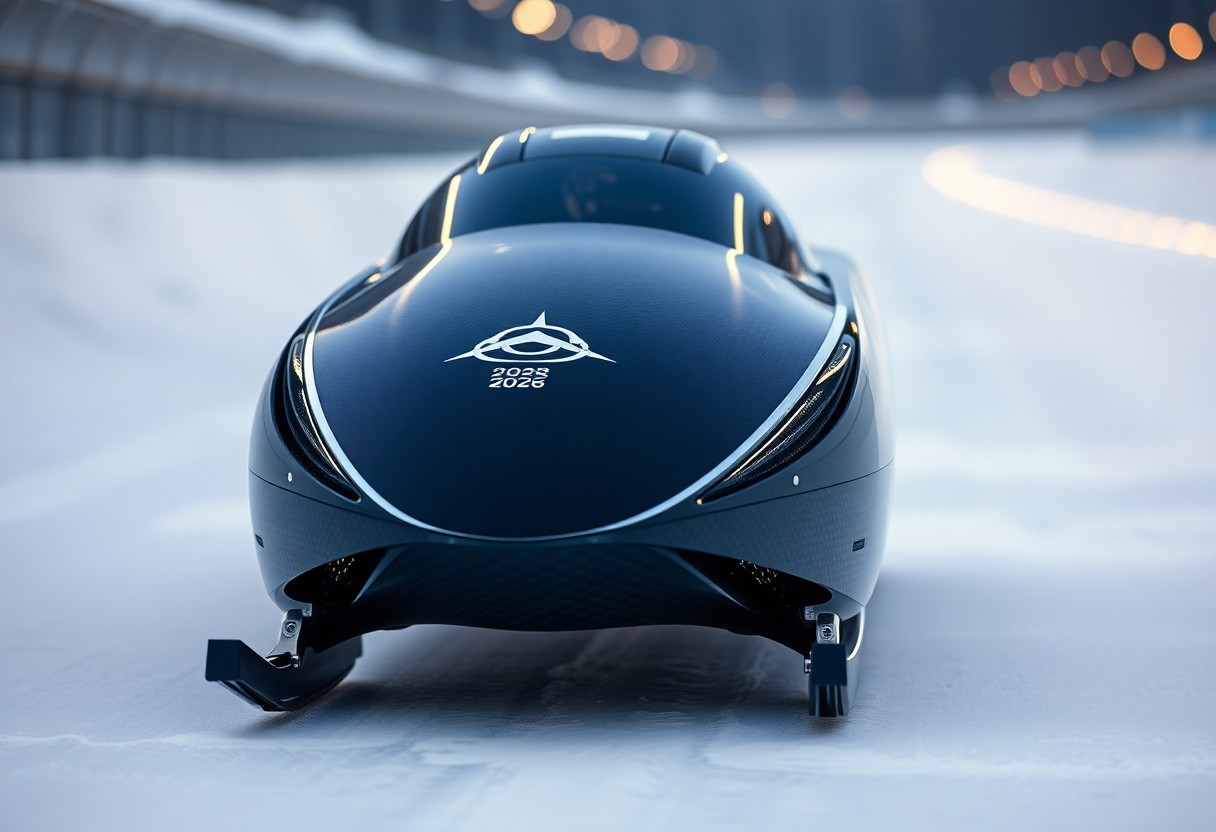
Many innovations could reshape bobsleigh by 2026, and you should watch for aerodynamic composite sleds and active suspension that shave milliseconds, sensor-driven training and AI telemetry guiding your runs, as well as higher speeds and greater G-forces that raise risk; organizers counter with improved helmets, sled crumple zones and track-safety upgrades to protect athletes while pushing performance boundaries.
Key Takeaways:
- CFD-driven aerodynamic refinements and biomimetic shaping of sled and helmet designs to reduce drag and improve stability.
- Lightweight, high-strength composites and selective 3D-printed components for optimized stiffness-to-weight ratios and quicker prototype cycles.
- Advanced runner technologies and surface treatments tailored to ice chemistry and temperature for better grip and lower friction.
- Integrated sensors, real-time telemetry and AI analytics for on-run performance tuning, predictive maintenance and enhanced driver coaching.
- Enhanced safety systems and track innovations – energy-absorbing sled structures, improved crash barriers and precision ice-refrigeration control.
Sled Design and Materials
Aerodynamic refinements: CFD, wind-tunnel validation and drag reduction
You’ll see teams lean into high-fidelity CFD workflows that combine RANS with localized LES patches and meshes exceeding 50-100 million cells to capture the turbulent wake behind the pilot and the sled tail. By modeling the sled at realistic Reynolds numbers for top speeds (~145 km/h on some Olympic tracks) engineers can target specific separation zones; tuning nose curvature, canopy seams and sled-tail shaping frequently yields measurable reductions in drag coefficient that translate directly into time savings.
Then you validate in the tunnel: many programs run full-scale tests or 50% scale models with pressure-sensitive paint, tufting and force balances to close the loop between simulation and reality, often achieving 1-3% agreement between CFD and experiment. Since even a 2-4% drag reduction can shave hundredths of a second per run – the margin between podium places – you’ll watch aerodynamic detail (gap seals, runner fairings, surface texture control) become as performance-driven as weight and steering geometry.
Advanced composites and alloys: strength-to-weight innovations
You’ll notice wider adoption of high-modulus carbon weaves and hybrid preforms (carbon + glass or aramid) paired with thermoplastic matrices that allow faster curing and localized reheating for repairs. Replacing aluminum subframes with tailored CFRP laminates typically reduces structural mass by 30-40% for equivalent bending stiffness, and teams are embedding nano-reinforcements (CNTs, graphene platelets) to improve interlaminar toughness and fatigue life without large mass penalties.
Metals haven’t disappeared: additively manufactured titanium brackets (commonly Ti-6Al-4V) and aluminum-lithium spars remain popular where impact resistance and predictable failure modes are required. You should note that increasing specific strength often shifts the failure mode toward brittle delamination or fatigue crack growth in composites, so material selection is as much about damage tolerance and inspectability as peak stiffness-delamination risk is the main safety concern you must manage through layup design and non-destructive testing protocols.
- High-modulus, unidirectional CFRP for primary load paths to cut mass while preserving stiffness
- Thermoplastic matrices enabling field reheating and faster layup cycles for rapid prototyping
- Nano-additives (CNTs, graphene) targeted at improving impact resistance and electrical conductivity for embedded sensors
- Topology-optimized titanium fittings 3D-printed to minimize fastener count and stress concentrations
- Out-of-autoclave curing and automated fiber placement to reduce production variability and cost
Material innovations vs. impact
| Innovation | Benefit / Impact |
| High-modulus CFRP laminates | 30-40% mass reduction for same stiffness; lower center of gravity potential |
| Thermoplastic matrices | Faster turnaround, field reparability, higher fracture toughness vs some thermosets |
| Nano-reinforcements | Improved damage tolerance, potential EMI shielding for embedded electronics |
| 3D-printed titanium fittings | Reduced part count, optimized load paths, customizable mounting interfaces |
| Out-of-autoclave processes | Lower production cost and reduced cycle time for small-batch development |
To get practical, you’ll see teams pair automated fiber placement for primary spars with hand-finished skins where complex geometry or localized reinforcement is required; this hybrid manufacturing approach balances repeatability with the ability to tune layups for individual pilot mass and track profiles, while embedded fiber optic or strain sensors let you monitor integrity run-to-run.
Modular sled platforms: customization, quick-change components and repairability
You’ll find modular platform concepts that separate the chassis, runner modules and aerodynamic fairings with standardized interfaces and bolt patterns to let crews re-configure geometry between practice, training and competition runs. Quick-change runner blocks and nose modules that swap in within 5-15 minutes using quick-release pins and a small torque wrench reduce downtime and let you test incremental setup changes trackside.
Designers also emphasize repairability: interchangeable crash pods, sacrificial skin panels and replaceable mounting bosses cut repair time after minor impacts, and teams increasingly carry a stock of modular components so you can keep a sled competitive without a full rebuild. That approach mirrors pit-stop thinking from motorsport-speed in configuration and part replacement equals more on-track testing and optimization.
In practice you’ll see systems where the central carbon monocoque accepts multiple skin geometries and runner modules via precision dowel-and-bolt interfaces; this reduces bespoke machining and lets you swap a damaged nose or tail section in minutes, while serialized components simplify spares logistics and homologation tracking for competition compliance.
Runners, Ice Interaction and Track Dynamics
Runner metallurgy and surface engineering for optimized glide
You should expect teams to push metallurgical tuning beyond simple hardening: many elite runners are already made from high-carbon bearing steels (AISI 52100 / 100Cr6) but you’ll see tighter process control-precision forging, advanced quench-and-temper cycles and cryogenic treatments-to reduce retained austenite and raise hardness into the HRC 58-64 range, which improves wear resistance and dimensional stability under repeated thermal cycles. Surface engineering will complement bulk metallurgy; polished finishes targeting sub-micron roughness (Ra < 0.2 µm) combined with selective surface texturing-micro-grooves or laser-patterning at scales of 10-100 µm-will be used to manage the thin water film that forms under high-pressure sliding.
You’ll also see more use of thin, engineered coatings in testing programs: electroplated chromium or DLC (diamond-like carbon) overlays to increase surface hardness and reduce abrasive wear, and experimental nanocomposite layers (graphene- or MoS2-infused) to change wettability and shear characteristics. Teams will quantify trade-offs in the lab-abrasion tests, pin-on-disk and full-run sled dyno trials-because a coating that lowers friction at +2°C ice might raise drag at −8°C; the best-performing runner is often the one that matches the track’s temperature and abrasive properties.
Adaptive runner concepts and active control: feasibility and legality
Active systems-miniature actuators that change runner curvature, edge angle or local temperature in real time-are tempting because you can tailor contact patch and pressure distribution dynamically as you negotiate transitions. Prototypes have included piezo-actuated micro-adjusters, embedded resistive heating elements and shape-memory alloy (Nitinol) inserts that alter camber with temperature. In controlled tests these approaches can change local contact stress by tens of percent and materially alter the thin melt-layer behavior under the runner, which can translate into measurable time gains over a full run.
Before you spec an active design, accept the regulatory and safety constraints: IBSF competition rules effectively ban powered or remotely controlled performance systems during a run, and any moving parts that could fail unpredictably are likely to be prohibited for safety reasons. That means practical pathways are limited to passive or pre-set adaptive technologies-materials that respond predictably to temperature or load, or devices you can set before the start but that don’t change during the heat.
You can still innovate within those limits: shape-memory alloys and thermally responsive polymers that change geometry once (during warm-up) can be tuned to the expected start temperature and then remain static on course, avoiding active in-run control while delivering an adaptive benefit. Teams will validate these solutions with repeated thermal cycling, endurance wear testing and rigorous failure-mode analysis to satisfy scrutineering and to avoid introducing a component that could debond or fracture under high lateral loads.
Ice-friction science and track-specific setup strategies
Friction on ice at bobsleigh speeds is governed by a thin water film created by pressure and shear; you should treat ice temperature, surface microtopography and humidity as your primary tuning variables. Typical effective friction coefficients span roughly μ ≈ 0.005-0.03 depending on conditions, and small changes in μ translate directly into tenths of seconds over a run. You’ll use ice thermography and profilometry to map a track: colder sections (below −8°C) tend to be mechanically dominated and favor very smooth, harder runners, while warmer sections (near −2°C to −4°C) develop more meltwater and favor hydrophobic surface finishes or micro-grooves that control water evacuation.
Track-specific setup means adjusting runner width, edge bevel and contact length for load distribution through turns; for example, on the Eugenio Monti track in Cortina you’ll likely prefer slightly narrower contact profiles to reduce drag through its longer straights and to limit hydroplaning risk on sections exposed to sun and variable ambient temperatures. You’ll validate these choices in a matrix of test runs, measuring split times, lateral accelerations and post-run runner wear to converge on the optimal compromise between corner bite and straight-line glide.
Testing protocols you should apply include sled dyno measurements, controlled-speed passes with instrumented runners, and single-run thermal scans to detect hot spots where excessive friction could indicate poor match. Combining these data with historic track weather (altitude, sun exposure, humidity) lets you develop a setup book-runner specification per ice temp and humidity bands-that gives you repeatable, defensible choices on race day. Failing to match runner setup to the specific ice state is the fastest way to lose time or create a dangerous handling condition.
Athlete Equipment and Performance Technology
Next‑generation race suits, helmets and drag‑reduction apparel
You’ll see fabrics and surface textures that come straight from aerospace and competitive cycling: micro‑ribbed textiles and 3D‑knit panels that lower skin‑suit turbulence. Wind‑tunnel and CFD work now targets reductions in the order of 1-3% total aerodynamic drag, which at bobsleigh top speeds of ~140-150 km/h can translate to roughly 0.05-0.3 seconds saved per run-enough to change podium order. Teams are also shifting seam placement, zipper geometry and sleeve shaping based on track‑specific flow maps rather than one‑size designs.
Helmet advances focus on integrated visor channels and tailored fairings to smooth the rider-sled interface; some lab tests show helmet fairing tweaks cut helmet‑induced drag by up to 10% relative to baseline shells. You must balance those gains against visibility and safety: aggressive visor shapes that improve aerodynamics can reduce peripheral vision and increase crash risk, so manufacturers are pairing aerodynamic gains with stricter impact certification and anti‑fog/anti‑scratch coatings to keep performance practical under IBSF rules.
Wearable sensors, force-plate starts and in-run biomechanics
Force plates embedded in start lanes (typically sampling at 1,000 Hz) and wearable IMUs (500-1,000 Hz) let you break the start into millisecond‑level events: peak horizontal push forces for elite crews commonly exceed ~2,000 N, and rate‑of‑force‑development windows predict sled acceleration more reliably than single peak values. You’ll get synchronized pressure‑insole maps, thigh and trunk IMU streams, and sled accelerometer/gyro data that together quantify push timing, hand placement and transition into the sled with sub‑0.01 s precision-metrics coaches convert into repeatable drills.
Integration matters: teams using commercial systems (Kistler force platforms, Xsens IMUs or bespoke sled IMUs) feed live dashboards to coaches so you can reduce start variability and target weak links. Several national programs report between 5-10% reductions in start timing variability after implementing force‑plate feedback and protocolized strength‑power interventions, translating to measurable time gains downtrack.
More information on the sensor side: data pipelines now include onboard preprocessing (zero‑lag filtering, bias compensation) and ML models that extract features such as impulse, concentric eccentric timing and RFD over 0-50 ms and 0-200 ms windows-windows you’ll need >500 Hz sampling to capture accurately. Teams are also using event‑triggered high‑speed video (500-1,000 fps) synchronized to force data so you can validate technique changes visually and quantify how an extra 0.02 s of contact time or a 5% RFD increase affects sled acceleration.
Virtual reality and high-fidelity simulators for start and corner training
Full‑motion sled simulators and VR rigs are becoming common in the off‑season and indoor training cycles. You’ll encounter systems combining 6‑DOF motion platforms, sled telemetry playback and visual displays running at 90-120 Hz with end‑to‑end latency kept under 20 ms to preserve vestibular cues. These rigs let you rehearse high‑risk corners and start sequences without ice time: teams can replay exact telemetry from Olympic runs and practice line corrections hundreds of times in a week.
Practical benefits are tangible: simulators let you retrofit subtle line changes and measure the consistency of driver inputs under repeatable conditions, which shortens the learning curve for new push crew configurations and sled setups. However, be aware of simulator limitations-mismatch between motion cues and visual flow can produce simulator sickness and false‑positive training adaptations if platform dynamics aren’t tuned to the recorded G‑profiles.
More information on simulator training: modern setups integrate your force‑plate start metrics and in‑run IMU streams into scenario training so you can practice entire runs with feedback loops-if you deviate on entry angle or push timing, the system immediately loads comparative telemetry and suggests corrective drills. That closed‑loop approach lets you test equipment changes (suit, helmet fairing, runner setup) in a controlled, repeatable environment before committing them on real ice.
Data, Analytics and Artificial Intelligence
You’ll see timing and sensor ecosystems tighten around the sled itself, driven in part by advances from official suppliers – including Omega’s new technology for the 2026 Winter Olympics – so that split-second timing, inertial data and environmental sensing feed the same analytics pipeline in real time.
Real-time telemetry, rider-sled integration and race coaching tools
Sensors on modern sleds will routinely combine high-rate IMUs (500-1,000 Hz), strain gauges on runners and force pedals, plus local UWB or optical position fixes to deliver centimetre-level line tracking and sub-50 ms actionable latency to coaches during training runs. You can expect edge processors to perform initial fusion and anomaly filtering on-board, then stream summarized packets to coaches and race-engineers so you get immediate corrections on line, entry angle or weight shift rather than waiting for post-run video analysis.
Augmented coaching dashboards will overlay live telemetry on track maps and helmet video, offering automated corner suggestions (e.g., tighten entry by 2-3° or move 3-5 cm toward inside edge) and predictive split-time impacts in milliseconds. Use of haptic cues in the helmet or handlebar gives pilots immediate, non-verbal feedback; however, data dropouts or miscalibrated sensors can produce misleading cues that increase risk, so you’ll need robust validation and fallback rules before acting on automated guidance during high-speed practice runs.
Machine learning for setup optimization, predictive maintenance and opponent analysis
ML models will map setup parameters – runner angle, runner compound, stiffness distribution, ballast placement – to expected run-time outcomes using a mix of supervised learning and Bayesian optimization. Teams will train on thousands of segmented runs (real and simulated), run tens of thousands of simulated permutations in track models, and then use surrogate models to search for configurations that shave off tens of milliseconds per run. You’ll benefit from models that quantify uncertainty so you can choose conservative gains on race day and push larger experimental changes only in training.
On the maintenance side, anomaly-detection networks will monitor vibration spectra and temperature traces to predict bearing or runner degradation days to weeks ahead, letting you swap parts before failure and avoid equipment-related crashes. For opponent analysis, clustering algorithms and sequence models will time-align public broadcasts, official split-timings and any shared telemetry to reveal rivals’ cornering tendencies, acceleration patterns and sensitivity to ice temperature, enabling tactical adjustments that are measured in hundredths of a second.
Operationally, you’ll run heavy model training in the cloud (GPU clusters for simulation-born neural nets) while deploying compact models on-board or at the track-side for low-latency inference; adopt cross-validation, synthetic-data augmentation and clear feature-importance reporting so decisions remain interpretable and reproducible. Strong governance around data sharing and model validation will be necessary so that your performance gains are reliable and not the result of overfitting small datasets.
Safety, Compliance and Governance
Passive and active safety systems: crash protection, energy absorption and sled integrity
You’ll notice a greater emphasis on structural engineering in sled design, with manufacturers using carbon-fiber sandwich shells and aluminum-honeycomb crush zones to dissipate impact energy. Given that bobsleigh crews can reach speeds of up to around 150 km/h and sustain peak lateral and deceleration loads often exceeding 5 g in the fastest turns, designers are increasingly integrating deformable nose cones, sacrificial bulkheads and reinforced cockpit rails to protect athletes’ legs and torsos without compromising steering precision.
On the active side, expect wider deployment of high-rate inertial sensors (accelerometers/gyros sampling at 500-1,000 Hz) and onboard telemetry that flags dangerous attitude excursions the instant they occur, enabling faster medical response and post-crash forensics. You may also see certified energy-absorption test protocols-crash fixtures that measure peak deceleration and absorbed joules-to validate sled integrity after a minor impact, and emergency locator beacons or automatic run-stop signals that trigger when sensor thresholds are exceeded.
Rule-making, equipment certification and enforcement at the Olympic level
The governance framework you’ll see at the Games will build on past reforms prompted by high-profile incidents such as the 2010 Whistler fatality, when the IOC and federations tightened track and equipment scrutiny. Olympic-level enforcement already combines homologation (pre-event certification of sleds and runners), spot checks during training and competition, and material tests-laser-profile scans of runners, hardness testing of steels, and verifications of declared sled mass and ballast compliance-to prevent unsafe or performance-distracting modifications.
Technical delegates and inspection teams operate a centralized equipment-control hub at the Games where sleds are checked and sometimes sealed; violations can lead to immediate disqualification or retroactive penalties. You should expect intensified use of digital evidence chains (photographed inspection logs, time-stamped sensor dumps) so rulings are traceable and defensible, and for stricter limits on any in-run active devices-many federations now explicitly ban electronic steering aids or active aerodynamic elements.
Looking ahead to 2026, enforcement will likely incorporate independent third-party certification labs accredited to standardized sled safety tests, and explicit homologation windows-so when you arrive at the competition bubble your team must present certified sled documentation and pass dynamic or destructive-sample tests before being cleared to race. Strong governance will increasingly rely on measurable thresholds (material strength, energy absorption in joules, sensor-trigger criteria) rather than ambiguous wording, making compliance more objective and enforcement faster.
Track Infrastructure, Operations and Sustainability
Track technology: refrigeration, surface preparation and turn profiling innovations
You’ll see refrigeration systems shifting from legacy glycol loops to higher-efficiency architectures that use CO2 (R-744) cascade systems and electrically driven heat pumps, enabling more stable ice temperatures in the range of -5°C to -10°C while cutting primary energy use by up to 30% in pilot installations. Surface preparation now pairs precision brine injection with zoned cooling control and embedded temperature sensor arrays every 5-10 meters, so your ice can be tuned to millimetre-level consistency along straights and through high-load turns.
Turn profiling is becoming a data-driven exercise: LiDAR scans and CFD modeling let track engineers adjust banking and radii to shave tenths of seconds while managing peak lateral loads-important because sleds still hit speeds approaching 145-150 km/h and sustained lateral forces above 4-5 g in some corners. Expect more modular insert panels and adjustable liners that let you alter friction and curvature between events, reducing the need for heavy mechanical reconstruction and giving race directors finer control over safety and spectacle.
Operational advances: timing systems, ice maintenance robotics and event logistics
Timing is moving toward integrated timing stacks combining photogate redundancy, high-speed optical tracking and GNSS-synced event clocks to deliver millisecond-level accuracy
You’ll also see operations tied to a single event-management backbone: credentialing, start-order changes, sled weigh-ins and medical response are orchestrated from a unified dashboard that interfaces with timing, broadcast, and the integrated transponder network-examples from recent World Cup test events show turnaround between heats dropping by 10-15% when these systems are combined and automated. Energy recovery and demand-shifting are now standard considerations: waste-heat capture from compressors can preheat athlete facilities and reduce site heating loads by 20-40%, while on-site battery storage and timed refrigeration runs can shave peak-grid demand during competition. You should expect greater use of photovoltaic canopies over spectator areas and electric vehicle fleets for logistics, both of which help lower operational carbon intensity and improve the venue’s year-round utility for community use. Legacy planning is moving past one-off conversion promises to concrete contracts: many organizing committees now include clauses requiring post-Games conversion into public training centres, emergency-response training facilities, or modular components that can be repurposed-measures that improve the chance your investment yields ongoing community benefit rather than a mothballed landmark. IBSF seals partnership with Warner Bros. Discovery for Olympic season coverage has pushed operations teams to prioritize broadcast-friendly infrastructure-meaning your venue’s timing and telemetry must be resilient, standardized and ready to feed global production while meeting sustainability targets simultaneously. Drawing together the trends shaping bobsleigh, you can expect advances in sled engineering-lighter composite frames, refined aerodynamics informed by CFD, and additive-manufactured components-to shave fractions of a second. You will see integrated sensor suites and real-time telemetry feeding AI-driven adjustments to runners, setup and line strategy, while textile innovations in skintight suits and optimized start-surface interactions will boost push-phase efficiency. You should also watch for enhanced track and ice-management technologies, improved crash-avoidance systems and stricter equipment rules as governing bodies adapt to new tech; these will change how you interpret results and compare eras. Overall, the 2026 Games will highlight the interplay of marginal gains, data-led decision making and regulatory responses, so your focus will shift from raw power alone to how teams synthesize engineering, analytics and preparation into faster, safer runs. A: Expect lighter, stiffer sled shells made from advanced carbon-fiber layups and hybrid composites optimized by topology optimization and generative design. Teams are using high-resolution finite-element models and additive manufacturing for complex internal structures and mounting points that improve stiffness-to-weight ratio while complying with IBSF regulations that prohibit motors or active propulsion. Internal ballast systems will be refined for rapid, legal weight distribution tuning between runs. A: Enhanced CFD workflows and full-scale wind-tunnel testing will refine sled and helmet shapes, skirt geometries, and crew positions to reduce drag and manage crosswinds. Surface finishes, microscale riblets or compliant coatings can lower boundary-layer separation without active parts, and careful integration of crew biomechanics with sled fairings will shave tenths of a second on long runs. All aerodynamic work must stay within the federation’s static-part rules, so gains come from shape and surface optimization rather than movable aero devices. A: Precision CNC profiling, laser polishing and advanced metal alloys will produce consistent runners with tailored edge geometry for specific track ice conditions. Surface engineering-thin ceramic or polymer-infused coatings and controlled microtextures-can change friction and water-film behavior to suit temperature and humidity, while in-run thermal and pressure mapping during testing helps teams choose the optimal runner finish. Active heating or powered elements remain banned, so improvements focus on passive material science and exact shaping. A: Teams will deploy high-speed motion capture, force-plate sleds, wearable inertial sensors and synchronized video to micro-analyze push technique and optimize push sequencing for each athlete combination. Personalized strength-speed programming, sprint-specific periodization, and real-time bar-mounted power meters in practice let coaches quantify contributions and refine exchanges. Robotic sled-pushers and repeatable launch rigs will speed up learning by delivering identical practice starts without athlete fatigue. A: Expect denser sensor networks embedded in the ice and infrastructure for real-time ice-temperature, friction and vibration monitoring, enabling more precise refrigeration management and safer, more consistent surfaces. Enhanced crash-absorbing barriers, telemetry-enabled sleds for live athlete status and high-fidelity timing with millisecond accuracy will improve safety and broadcast storytelling; AR overlays and richer live data streams will bring technical insights to viewers without altering competition rules.Sustainability measures: energy efficiency, carbon reduction and legacy planning
To wrap up
FAQ
Q: What sled design innovations might we see at the 2026 Winter Olympics?
Q: How will aerodynamic advances change performance?
Q: What innovations are expected in runner technology and ice interaction?
Q: How will athlete preparation and start performance evolve?
Q: What track, safety and event-technology innovations might appear in Milan-Cortina 2026?