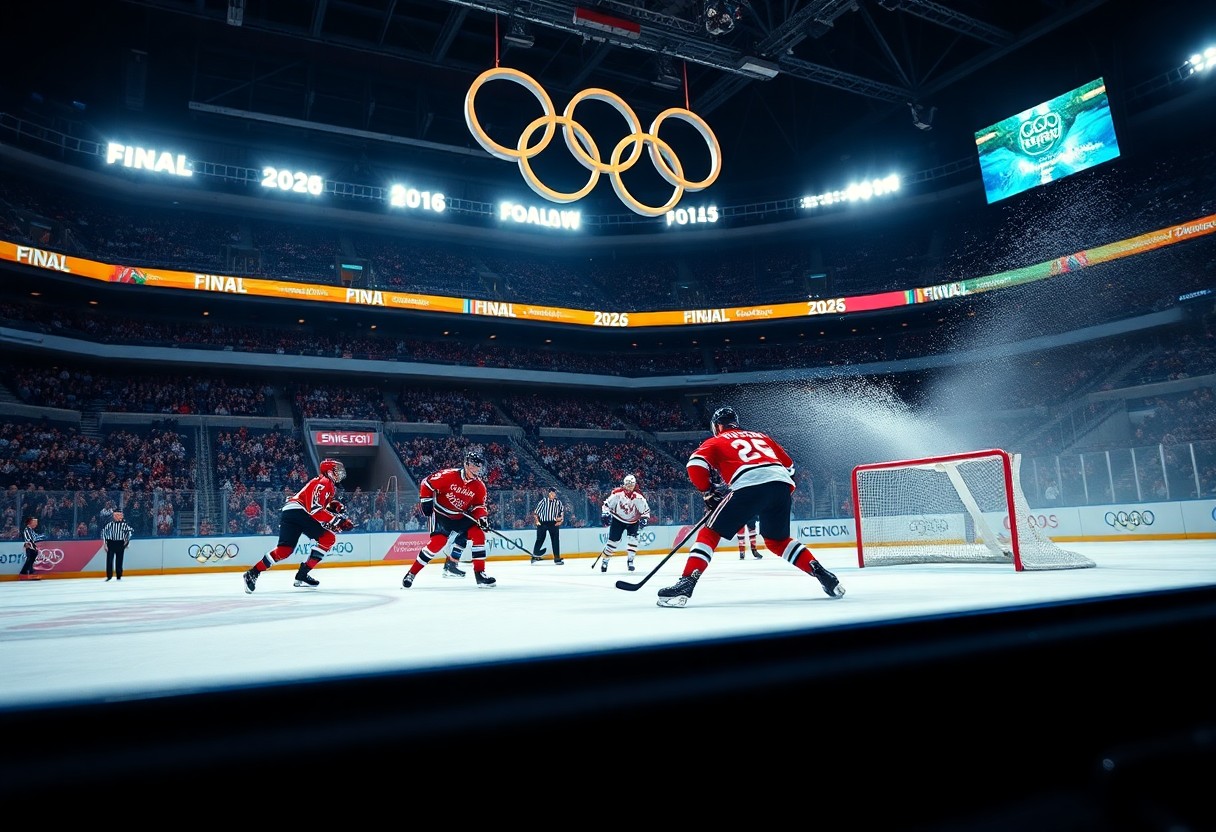
Overall, you should assess that while elite hockey nations still dominate, upsets are possible if a team brings NHL-level stars, tactical discipline, and depth; your watch should focus on roster availability, cohesion, and tournament form, because injuries and short preparation can be as dangerous as superior skill, and surges from emerging programs can threaten favorites in the condensed Olympic format.
Key Takeaways:
- Traditional powerhouses – Canada, Finland, Sweden, USA and the Czech Republic – are the likeliest gold contenders; Russia remains a major factor if eligible to compete.
- NHL player availability will be the single biggest determinant: NHL participation yields full-strength teams, while its absence levels the field toward European and domestic-based players.
- Elite goaltending, depth on defence and strong special teams often decide short-format tournaments and can let non-favorites prevail.
- Host advantage in Milan-Cortina can boost Italy and make travel/logistics easier for nearby teams, but is unlikely to overturn top contenders on its own.
- Rising programs – Switzerland, Germany, Slovakia – have narrowed the gap and can challenge for medals with disciplined systems and strong coaching.
Olympic format & qualification
Tournament structure: groups, knockout rounds, and medal games
The men’s tournament uses a 12-team field divided into three groups of four for a round-robin preliminary stage; you get three group games to set seeding and tiebreakers (head-to-head, goal differential, goals scored, then IIHF ranking). The most common progression sends the top two teams from each group plus the two best third-place teams into an eight-team quarterfinal bracket, after which single-elimination quarterfinals, semifinals and the bronze/gold medal games decide the podium.
Because the format compresses high-stakes games into a short window, you should watch how scheduling and rest days affect depth – teams with deeper forward lines and reliable tandem goalies often gain an edge in the knockout rounds where one off-night ends a gold bid.
Qualification pathways for Paris 2026 host and other slots
The host nation receives an automatic berth (for 2026 that means Italy), while the remaining slots are filled through a combination of IIHF World Ranking placement and pre-Olympic qualification tournaments. Typically you’ll see the highest-ranked nations by the IIHF cut into the field directly and the final two-to-four spots decided via multi-stage qualifiers held in the seasons before the Games, giving lower-ranked hockey nations a pathway into the 12-team draw. See also the roundup on roster and team X-factors in Gold or bust? X factors for all 12 Olympic men’s hockey teams.
Qualification windows usually span the two seasons before the Olympics, with final qualification tournaments staged roughly one year out; you can expect national federations to prioritize World Championship positioning because IIHF ranking points from those events are often the baseline for direct qualification or seeding into final qualifying groups.
Roster rules, eligibility, and IIHF entry requirements
Olympic rosters are limited in size – teams generally register up to 25 players including goaltenders – and every player must hold citizenship and a valid passport for the country they represent under IIHF and IOC rules. You’ll see national teams submit preliminary rosters, finalize their 23-25 selections shortly before accreditation, and manage injury replacements under tournament deadlines; the availability of professional-league players (NHL or otherwise) can dramatically shift a team’s medal outlook.
If you follow eligibility stories, note that the IIHF requires formal paperwork for any player changing national allegiance: beyond citizenship, a player usually must complete a period of participation in the new country’s national competitions (commonly two consecutive seasons – a minimum of 16 months) and receive IIHF clearance before appearing on an Olympic entry form, with additional restrictions if the player previously represented another country at an IIHF event.
Historical precedents and trends
Past Olympic champions: patterns and dominant eras
You can trace clear cycles: early decades were largely won by Canada, then the Soviet Union established a multi-decade hegemony from its 1956 Olympic debut, turning the tournament into a showcase of state-run development and tactical discipline. That era produced repeat golds and a predictable top tier through the Cold War, until the 1980s and the growing parity of European programs began to narrow the gap.
Since the NHL began allowing its players in 1998, the title picture has become far more fluid: the Czech Republic took gold in Nagano (1998), Canada reclaimed top honors in Salt Lake City (2002) and again on home ice in Vancouver (2010) and Sochi (2014), Sweden won in Turin (2006), Olympic Athletes from Russia won in Pyeongchang (2018) under unusual eligibility rules, and Finland captured its first men’s gold in Beijing (2022). That sequence shows how professional player availability, tournament format, and short-term form now determine who can realistically challenge for gold.
Notable upsets and lessons from previous Winter Games
You should look at the 1980 Lake Placid upset as an archetype: the U.S. amateur side beat the Soviet Union 4-3 in the medal-round game and then won gold by defeating Finland, proving that team cohesion and tactical clarity can overcome superior individual talent in a short tournament. That result still informs how you evaluate underdog chances-momentum and belief matter more in February than season-long statistics.
Further examples reinforce practical lessons: the Czech Republic’s 1998 gold was anchored by elite goaltending from Dominik Hašek, and Sweden’s 2006 win emphasized two-way structure and special-teams efficiency. Meanwhile, tournaments without NHL participation (notably 2018 and 2022 dynamics) produced unexpected podiums because roster rules and player availability reshuffle the competitive order, giving you a reminder that organizational and eligibility factors can be as decisive as talent.
From these cases you should take away actionable points: in the Olympic sprint format a hot goalie or a dominant penalty kill can swing multiple single-elimination games, host-nation support often amplifies small edges (as Canada experienced in 2010), and changes to roster composition-NHL participation or not-create windows where non-traditional contenders can rise. Those are the variables you need to track when judging whether any team can realistically challenge for gold in 2026.
Current global landscape of men’s ice hockey
Profile of perennial contenders (Canada, USA, Finland, Sweden, Russia/ROC status)
You know that Canada and the United States are built on the deepest talent pools, with Canada’s professional, junior and university systems feeding a steady stream of elite skaters and the U.S. benefiting from the NCAA/USHL pipeline; if NHL players are available, both become immediate gold contenders. Finland’s recent surge – highlighted by its 2022 Olympic gold and repeated World Championship success in the last decade – shows how an organized development model and elite goaltending can turn a relatively small population into a consistent top-tier power.
Sweden brings methodical player development and two-way forwards who perform on the big stage, and would be among your shortlist regardless of NHL participation. Russia’s standing is more complex: their talent base remains one of the deepest in the world via KHL and NHL alumni, but their international eligibility and federation status have been unsettled since the IIHF suspensions and geopolitical fallout in 2022, so you must factor uncertainty about whether a Russia/ROC presence will be allowed and at what roster strength.
Secondary favorites and recent medalists (Czechia, Switzerland, Germany)
Czechia remains a traditional power with a proven ability to produce top-level skill and game-breakers from its Extraliga and export pipelines; you should treat them as capable of podium results when their goaltending and power play click. Switzerland has established itself as a perennial dark horse, combining disciplined defensive systems and high-save-percentage goalies to punch above its weight at Worlds and Olympics; their structure makes them dangerous in short tournaments.
Germany’s silver at the 2018 PyeongChang Games illustrated how a well-coached, cohesive roster can upset the established order – you can expect Germany to be a tactically smart opponent that exploits mistakes and gains momentum in knockout formats. Czechia, Switzerland and Germany each blend domestic-league cohesion with a growing number of NHL/KHL contributors, so their ceiling in a given year often depends on which expatriate stars are released for the Games.
You should watch roster construction closely: Switzerland and Germany often win with elite goaltending and team defense, while Czechia’s medal chances hinge on whether their top forwards and special teams align in tournament form.
Emerging nations and investment trends (China, Slovakia, others)
China poured significant resources into hockey ahead of Beijing 2022 – building arenas, youth programs and pursuing naturalized players to raise its competitive level – and while the men’s team improved, you should view China as still several tiers below Europe’s top programs in depth. Slovakia, on the other hand, blends a strong hockey tradition with renewed youth development and a steady trickle of NHL prospects, meaning they can act as a dangerous mid-tier contender when a cohort of young talent peaks together.
Other nations such as Latvia, Norway and Japan are also investing selectively: you will see targeted academy partnerships, IIHF development grants and exchange programs with stronger leagues designed to close the gap. Those incremental investments often translate into tournament upsets and more consistent top-12 finishes, so your assessment of medal possibilities should include which of these programs have credible pipelines entering 2026.
You should pay attention to two trends: first, strategic investments (facility builds, coaching exchanges, targeted naturalizations) create faster short-term improvement than broad-based systems change; second, nations that couple youth development with export pathways to top leagues are the most likely emerging challengers by 2026.
Impact of professional leagues and player availability
NHL participation history and prospects for 2026
When the NHL last allowed full participation it was in 2014, and you saw Olympic rosters built around NHL superstars; since then the league chose not to send players in 2018 and 2022, which materially changed the competitive balance and medal outcomes. The NHL has not provided players for the Olympics since Sochi 2014, and that gap is the baseline for any realistic 2026 forecast.
Negotiations for 2026 are fluid: you should expect the final decision to hinge on an agreement that addresses lost regular-season games, player insurance and liability, and calendar logistics. Owners have consistently been reluctant because an 82-game schedule would require a roughly two-week break and substantial calendar adjustments, while the NHLPA and players are generally in favor of Olympic participation-so a deal will require concessions on both scheduling and financial protections.
Club release rules, insurance, and timing conflicts for top players
Under current practice, without a specific transfer or participation agreement the NHL (and its clubs) are not obligated to release contracted players for the Olympics, so you will find that release is crucially a negotiated exception rather than an automatic right. Clubs can refuse to release NHL-contracted players unless the league implements a formal Olympic break and indemnity framework, which is why any 2026 plan must be negotiated at the league and union level.
Teams require comprehensive insurance that covers salary continuation, medical treatment, long-term disability and legal exposure if a player is injured at the Games; you should expect clubs to insist on third-party indemnification and a clear protocol for post-injury rehabilitation and roster replacements. Calendar conflicts also bite: the Olympic window overlaps the NHL trade-deadline period and the All-Star Game planning, so moving or compressing the schedule (and shifting the trade deadline) would be necessary to accommodate NHL participation.
More specifically, you can look at prior models where the league agreed to a temporary pause and the involved federations arranged layered insurance-federation policies plus IOC provisions-while clubs pushed for explicit contractual language that absolved them of future liability. If that layered indemnity and schedule accommodation aren’t guaranteed, NHL clubs will almost always prioritize season integrity and decline player release.
Tactical and tournament variables that influence gold-medal chances
Coaching systems, special teams, and international-style adaptations
You judge a coach not just by systems but by how quickly they change them to the tournament environment: teams that can flip between an aggressive, North American forecheck and a possession-based, wider-ice game win matchups more often. Special teams matter more than roster star power – a power-play efficiency north of ~25% and a penalty-kill above ~85% will swing multiple games in a short Olympic schedule, because power-play goals cluster and create outsized momentum shifts.
You should watch which staffs prioritize zone entry structure and neutral-zone traps for 60x30m ice versus tight-cycle, board-play systems developed in the NHL. Coaches who prepare two gameplans – one for possession in the offensive zone and one for quick counters on transition – give their teams a measurable edge when opponents can’t adapt mid-tournament.
Goaltending, depth scoring, and the role of small-sample variance
You know Olympic tournaments are short: depending on format, teams typically play about 6-8 games. That short run magnifies variance – a hot goalie can carry a squad into the medal rounds, and a cold one can eliminate a favorite. Over roughly 200 shots faced in a tournament, a save-percentage swing of .020 translates into about 4 extra goals against, which is often the difference between advancing and going home.
You need scoring beyond a single top line to survive the grind. If your top line produces 40-50% of your goals, opponents can neutralize you with targeted matchups; teams that spread scoring across three or four lines reduce the impact of goaltender variance and single-game bounces. Depth scoring also lets you manage ice time in back-to-back games without dipping heavily into fatigue.
More detail: since single-elimination and short group phases increase randomness, you should prioritize a goalie with proven tournament experience and a defense that limits high-danger chances – limiting opposing expected-goals (xG) against by even 0.5 per game lowers variance and steadies results over the 6-8 game window.
Venue, schedule, travel, and ice-surface differences
You must factor venue geography: Milan and Cortina d’Ampezzo will split play in 2026, and the difference in elevation and travel logistics between a low-altitude city and a mountain town affects recovery and puck behavior. Teams traveling from North America cross multiple time zones (typically 6-9 hours), which means jet lag can blunt peak performance for up to 3-4 days unless you manage sleep and light exposure aggressively.
You also need to adjust to ice characteristics: Olympic rinks are 60 × 30 m versus the NHL’s 60.96 × 25.9 m, so the extra width (about 4 meters) creates more room for lateral play and favors speed and zone-stretching tactics. Scheduling density-games every other day or with a single rest day-changes rotation patterns and increases the value of a deep fourth line and multiple reliable goaltenders.
More detail: venue-specific minutiae matter – ice temperature, humidity, and local ice-making practices can alter puck glide and bounce; if you scout early you gain an advantage, because a team that practices on the exact game sheet for two days before the opener will have better reads on line-change timing and bank passes than a team that arrives the morning of the first game.
Forecasting contenders and realistic gold-medal scenarios
Data-driven indicators: IIHF rankings, Elo ratings, and objective metrics
You should weigh the Tournament Info 2026 MEN’S TOURNAMENT alongside the IIHF world rankings and independent Elo-style ratings to form a baseline – the Olympic field is 12 teams, so seeding volatility matters more than in larger tournaments. IIHF rankings summarize multi-year performance and federation depth, while Elo variants place heavier emphasis on recent results and margin of victory; combining both points to a core top five (Canada, USA, Finland, Sweden, Czechia) that you should treat as the most probable medal contenders.
Focus on objective metrics like goal differential over the past two World Championships, top-6 forward minutes per game, and save percentage of a nation’s projected starting goaltender. When a nation’s goal differential is +1.5 or higher over recent major tournaments and their projected roster includes three NHL-caliber top-6 forwards, their probability of reaching the semis rises sharply. Conversely, teams with strong rankings but declining underlying numbers (ageing top lines, negative possession metrics) are more vulnerable to upsets.
Best-case scenarios for top nations and brackets that favor upsets
You can map several plausible gold paths depending on roster access: if NHL players are available and Canada brings elite depth across four lines, a path through a relatively weaker quarterfinal opponent (seeded 7-8) gives them the best statistical shot at gold; same logic applies to the USA. Finland and Sweden benefit most when their defensive systems meet lesser offensive groups early – an early low-scoring quarterfinal against a puck-possession underdog lets elite goaltending decide, which plays to Nordic strengths.
Brackets that favor upsets tend to cluster top seeds against one another before the final four. For example, if the standard 12-team format places three top-5 teams in the same half, you get an increased chance that a top-10 underdog slips into the final by exploiting fatigue and matchup mismatches. You should watch for scenarios where a traditionally strong team draws a counter-style opponent (heavy forecheck, fast neutral-zone transition) in a single-elimination game; those stylistic mismatches are where one hot goalie or an opportunistic power play can overturn seeding.
To wrap up
Drawing together, you can conclude that several teams will realistically challenge for gold at the 2026 Winter Olympics: established powers such as Canada, the United States, Finland and Sweden, plus strong European contenders like Czechia and Switzerland, all have the roster depth and international experience to compete, while host conditions and player availability can create openings for upsets. Your assessment should hinge on final rosters, league release policies and recent international form; consult the event overview at Ice hockey at the 2026 Winter Olympics and monitor qualification and pre-tournament play to refine your expectations.
FAQ
Q: Which teams are eligible to qualify for the men’s and women’s ice hockey tournaments at the 2026 Winter Olympics?
A: The men’s tournament is scheduled for 12 teams and the women’s for 10 teams. Eligibility is determined by the IIHF system: the host nation receives an automatic berth, the highest-ranked nations in the IIHF World Ranking after the designated World Championship(s) earn direct qualification, and the remaining spots are decided through a series of Olympic qualification and final qualification tournaments. National federations must meet IIHF entry requirements to take part in those events.
Q: Does the host nation automatically earn a spot and does that apply to both men and women?
A: Yes. The host nation (Italy for Milan-Cortina 2026) is granted automatic qualification in the Olympic ice hockey tournaments, typically for both men and women, subject to IIHF confirmation and any administrative requirements. That host slot reduces the number of qualification places available to other nations.
Q: Can a low-ranked or non-traditional hockey country realistically challenge for the gold medal?
A: While upsets can occur in a short tournament, gold medals have historically gone to established hockey powers because of deeper talent pools, stronger professional leagues, and greater international experience. A lower-ranked nation can reach the knockout rounds and occasionally win individual games, but winning gold usually requires sustained program depth, elite goaltending, and the ability to assemble top players for the event.
Q: How does NHL player availability affect which teams can contend for gold at the Olympics?
A: NHL player participation has a major impact. If NHL players are released to play, countries with many NHL professionals (notably Canada and the USA, and several European teams) become stronger favorites. If NHL players do not attend, rosters rely on domestic and European-league players, which tends to level the field and increase parity, giving well-prepared non-NHL teams better chances. As of mid-2024, final arrangements for 2026 NHL participation had not been confirmed.
Q: What practical steps can an underdog nation take to maximize its chance of challenging for gold?
A: Focus on long-term development and short-term tournament preparation: improve youth and pro development to deepen the talent pool, secure release agreements with clubs for top players, schedule high-quality international friendlies to build cohesion, emphasize goaltending and defense (tournament-winning areas), deploy advanced scouting and game plans for specific opponents, and assemble experienced coaching and support staff. Success also depends on peaking at the Olympic window and navigating qualification tournaments to secure a berth.