
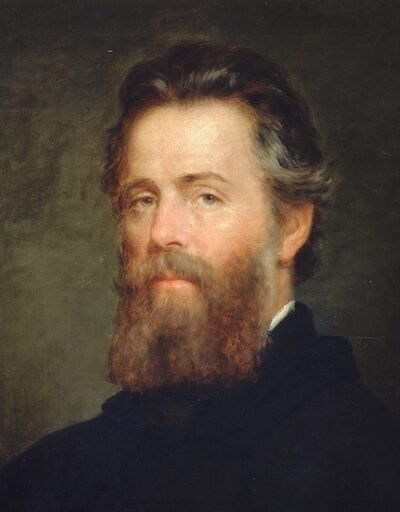
Herman Melville (1819–1891) stands as one of the most enigmatic and visionary titans of American literature. Today, he is celebrated worldwide for his profound philosophical depth, dark psychological exploration, and innovative narrative forms, most notably in his 1851 masterpiece, Moby-Dick; or, The Whale. Yet, Melville’s life was defined by a tragic paradox: he achieved immense popularity in his twenties as a writer of exotic sea adventures, only to spend his later decades in creative isolation and public obscurity after his work became too radical and complex for his contemporaries.
Early Life and Maritime Adventures
Born in New York City into a family of aristocratic lineage, Melville’s early life was upended by financial disaster. His father’s bankruptcy and sudden death left the family impoverished, forcing Melville to abandon his formal education and seek employment. In 1839, he took to the sea as a cabin boy on a merchant ship bound for Liverpool. By 1841, he embarked on the whaling ship Acushnet for the South Pacific, initiating a four-year global odyssey that would define his literary career. He deserted his ship in the Marquesas Islands, lived briefly among the indigenous Typee people, mutinied aboard an Australian whaler, and served on a U.S. Navy frigate. These gritty, firsthand experiences provided a rich repository of maritime knowledge and cross-cultural encounters.
Literary Rise and Public Rejection
Upon returning to America, Melville transformed his Pacific adventures into bestselling romances. His debut novel, Typee (1846), followed by Omoo (1847), brought him instant fame. However, Melville quickly grew restless with simple travelogues. Driven by a deep philosophical curiosity and an intense intellectual friendship with Nathaniel Hawthorne—to whom Moby-Dick is dedicated—he began weaving complex allegories, existential themes, and dense Shakespearean language into his work.
This artistic evolution alienated his readership. When Moby-Dick appeared in 1851, its unconventional structure and brooding fatalism bewildered critics and sold poorly. His subsequent novel, Pierre; or, The Ambiguities (1852), a dark psychological drama, was universally condemned, effectively destroying his reputation as a viable commercial author.
The Customs Inspector and Secret Masterpiece
Facing financial strain and dwindling readership, Melville shifted to shorter fiction, producing enduring classics such as “Bartleby, the Scrivener” and “Benito Cereno.” After publishing The Confidence-Man in 1857—a biting satire of American commercialism—he abandoned prose novels entirely. To support his family, Melville worked for nineteen years as a customs inspector on the New York docks, spending his quiet evenings writing complex, book-length poetry, including the epic Clarel.
During his final years, Melville secretly returned to prose, drafting a short novel that remained unpublished at his death. When Herman Melville died in 1891, his obituary famously misspelled his name, and his great works were out of print. It was not until the “Melville Revival” of the 1920s that scholars discovered his manuscript for Billy Budd, Sailor and reassessed his catalog. Today, Herman Melville is universally recognized not merely as a gifted chronicler of maritime sea tales, but as a fearless intellectual pioneer who dared to chart the darkest, most unfathomable depths of the human soul.