
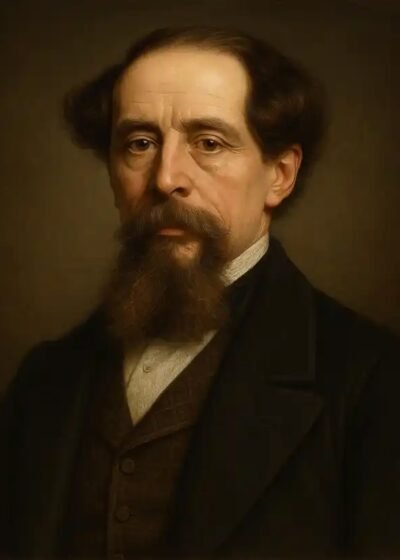
Charles Dickens (1812–1870) stands as the literary Colossus of Victorian England, a writer whose astonishing imagination and fierce social conscience reshaped the English novel. More than a mere entertainer, Dickens was a mythmaker and social crusader who captured the rapid, disorienting transformation of an industrializing world. His name has become synonymous with both the squalor of nineteenth-century urban poverty and the exuberant resilience of the human spirit.
The Crucible of Trauma
Dickens’s profound empathy for the downtrodden was forged in childhood trauma. In 1824, when his father was incarcerated in the Marshalsea debtor’s prison, twelve-year-old Charles was pulled from school and forced to work ten-hour days labeling pots at Warren’s Blacking Warehouse. This sudden descent into working-class squalor left an indelible psychological scar. It instilled in him a lifelong horror of institutional cruelty and a deep sympathy for neglected children—themes that would later animate masterpieces like Oliver Twist, David Copperfield, and Great Expectations.
His literary ascent was meteoric. Beginning his career as a political journalist and sketch writer under the pseudonym “Boz,” Dickens achieved runaway success at age twenty-four with The Pickwick Papers (1836). Over the next three decades, he produced fifteen novels, five Christmas novellas, and hundreds of short stories, maintaining a frenetic pace of production that captivated the English-speaking world.
Master of the Serial Epic
Dickens revolutionized how fiction was consumed by mastering the serial publication format. By releasing his novels in cheap, monthly or weekly installments, he democratized literature, making it accessible to working-class readers alongside the bourgeoisie. This episodic structure required unique narrative engineering: Dickens expertly wove intricate, multi-layered plots driven by dramatic cliffhangers, melodramatic tension, and vivid world-building.
He populated his universe with over two thousand characters who remain etched in cultural memory—from the miserly Ebenezer Scrooge and the benevolent Samuel Pickwick to the predatory Fagin and the spectral Miss Havisham. While critics occasionally dismissed his figures as caricatures, Dickens’s genius lay in his ability to inflate human traits to mythic proportions while grounding them in genuine emotional truth.
The Social Crusader and Legacy
Beyond his storytelling prowess, Dickens wielded his pen as a weapon for social justice. He used his immense popularity to expose the horrors of Victorian institutions: abusive Yorkshire boarding schools in Nicholas Nickleby, the paralyzing bureaucracy of the Chancery court in Bleak House, and the soul-crushing utilitarianism of industrial factories in Hard Times. His scathing critiques swayed public opinion and helped accelerate legislative reforms around child labor, prison conditions, and urban sanitation.
In his final years, Dickens undertook exhausting public reading tours across Britain and America, performing his works with a dramatic intensity that ultimately broke his health. When he died of a stroke in 1870 at age fifty-eight, leaving The Mystery of Edwin Drood unfinished, he was mourned globally as a champion of the poor. Today, the adjective “Dickensian” endures not only to describe oppressive societal squalor, but also the warmth, humor, and moral clarity required to overcome it.