
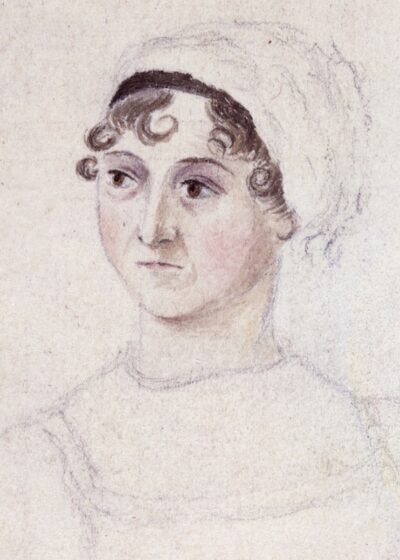
Jane Austen (1775–1817) stands as one of the most revered and perceptive novelists in English literature. Working within the quiet confines of Regency-era England, she transformed the traditional domestic romance into a profound exploration of human psychology, moral character, and social dynamics. Although she published anonymously during her lifetime, Austen’s biting irony, structural brilliance, and keen observational eye established her as a pioneer of literary realism whose works continue to captivate readers worldwide across generations.
Early Life and Intellectual Roots
Born on December 16, 1775, in Steventon, Hampshire, Austen was the seventh of eight children in a close-knit clerical family. Her father, a country parson, actively encouraged intellectual curiosity and granted his children unrestricted access to his extensive library. Within this supportive environment, Austen began composing her Juvenilia—satirical sketches, parodies, and short stories—during her early teenage years. Her lifelong bond with her older sister, Cassandra, served as her primary emotional and creative anchor. Surrounded by the modest routines of the provincial landed gentry, Austen absorbed the nuanced manners, economic anxieties, and social rituals that would become the fertile ground of her fictional universe.
Major Works and Literary Style
Austen produced six timeless novels: Sense and Sensibility (1811), Pride and Prejudice (1813), Mansfield Park (1814), Emma (1815), and the posthumously published Northanger Abbey and Persuasion (both 1818). Beneath their sparkling romantic surfaces, these narratives offer an uncompromising critique of a rigid society where marriage was frequently the sole pathway to financial security for women. Rather than relying on sweeping historical melodrama, Austen deliberately focused her gaze on “3 or 4 Families in a Country Village,” using domestic courtship as a microcosm to examine universal ethical dilemmas.
Her technical brilliance lies in her pioneering use of free indirect discourse, a revolutionary narrative style that seamlessly blends the third-person authorial voice with a character’s private thoughts. This technique allowed her to expose human vanity, self-deception, and mercenary ambition with extraordinary psychological depth. Through enduring heroines such as Elizabeth Bennet and Emma Woodhouse, Austen consistently championed intellectual independence, self-awareness, and the essential balance between personal sensibility and moral integrity.
Enduring Legacy and Impact
During her lifetime, Austen’s novels were published simply “By a Lady,” bringing her modest financial earnings but no public celebrity. It was not until decades after her untimely death at age 41 in Winchester that critics fully appreciated the transformative nature of her craft. Literary giants from Sir Walter Scott to Virginia Woolf lauded her unique ability to elevate ordinary occurrences into high art, comparing her structural precision and character development to Shakespeare’s dramatic mastery.
Today, Jane Austen is universally recognized not merely as a chronicler of Regency manners, but as a master observer of the human condition. Her six novels have inspired countless film adaptations, critical interpretations, and a devoted global readership. By proving that profound drama, wit, and emotional truth could be discovered in the subtle interplay of drawing-room conversation, Austen fundamentally reshaped the trajectory of the modern English novel, securing an enduring and immortal legacy in world literature.