
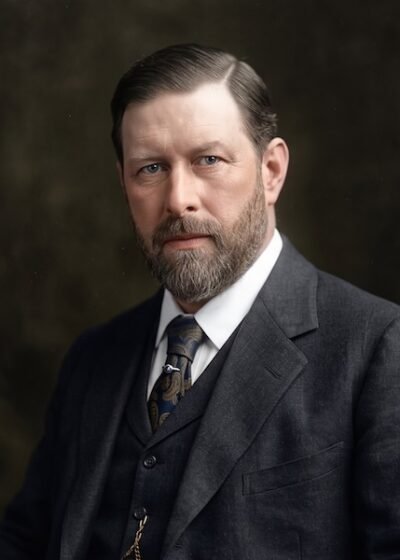
Abraham “Bram” Stoker (1847–1912) was an Irish author best known today as the architect of the modern vampire mythos through his 1897 Gothic masterpiece, Dracula. Yet, during his lifetime, Stoker was far better known as the tireless business manager of London’s prestigious Lyceum Theatre and the devoted confidant of the Victorian era’s most celebrated actor, Sir Henry Irving.
Early Life and Irish Folklore
Born on November 8, 1847, in Clontarf, a coastal suburb of Dublin, Stoker’s early childhood was defined by a mysterious, undiagnosed illness that left him bedridden until the age of seven. During these long, isolated years, his mother entertained him with vivid Irish folklore and gruesome tales of the 1832 cholera epidemic in Sligo—narratives saturated with premature burials and lingering death that left a profound imprint on his imagination. Remarkably, Stoker made a complete physical recovery, going on to excel as both an honor student and a champion athlete at Trinity College Dublin.
The Theatre and Henry Irving
Following graduation, Stoker entered the civil service at Dublin Castle, following in his father’s footsteps. To satisfy his creative ambitions, he worked as an unpaid theater critic for the Dublin Evening Mail, a newspaper co-owned by Gothic writer Joseph Sheridan Le Fanu. In 1876, Stoker wrote a glowing review of Henry Irving’s performance in Hamlet. The grateful actor invited Stoker to dinner, sparking a dynamic professional partnership that would alter the course of Stoker’s life.
In 1878, Stoker married Florence Balcombe—a celebrated Dublin beauty who had previously been courted by Oscar Wilde—and relocated to London to become the acting manager of Irving’s Lyceum Theatre. For the next twenty-seven years, Stoker managed the theatre’s complex finances, organized grueling international tours, and served as Irving’s personal assistant. Through this role, he became immersed in London’s elite literary and artistic circles, forging friendships with luminaries such as Arthur Conan Doyle, James McNeill Whistler, and his literary idol, Walt Whitman.
The Creation of Dracula
Despite his exhaustive managerial duties, Stoker wrote numerous novels and short stories to supplement his income. In 1897, he published Dracula, an epistolary novel structured through diary entries, letters, ship logs, and newspaper clippings. Though Stoker never traveled to Eastern Europe, he spent seven years conducting meticulous research into Transylvanian geography, Eastern European folklore, and vampire legends at the British Museum and the coastal town of Whitby. The aristocratic, magnetic, and imperious character of Count Dracula was heavily modeled on Henry Irving, whom Stoker secretly hoped would perform the role on the stage.
Final Years and Legacy
While Dracula received positive reviews upon release for its atmospheric dread and psychological depth, it was not an immediate financial blockbuster. Following Irving’s death in 1905 and the collapse of the Lyceum company, Stoker suffered a stroke and faced severe financial strain. He continued writing until his death in London on April 20, 1912. Through subsequent stage plays and legendary cinema adaptations, Stoker’s creation transcended literature to become an immortal cultural icon, permanently defining the horror genre.