
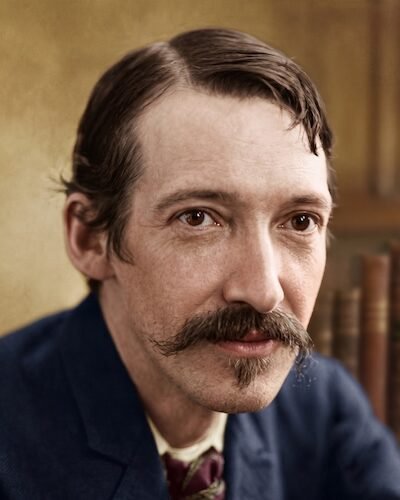
Robert Louis Stevenson (1850–1894) was a Scottish novelist, essayist, poet, and travel writer who authored some of the most enduring adventure and horror classics in Western literature. Despite a life plagued by severe chronic illness, Stevenson’s restless imagination and literary ambition drove him across the globe, transforming him into a leading figure of the late-Victorian neo-romantic movement. Works such as Treasure Island, Kidnapped, and The Strange Case of Dr Jekyll and Mr Hyde remain celebrated for their vivid storytelling and psychological depth.
Edinburgh Roots and Rejection of Tradition
Born on November 13, 1850, in Edinburgh, Scotland, Stevenson was the only child of a prosperous civil engineer. The Stevenson family dynasty was renowned for constructing deep-sea lighthouses along the treacherous Scottish coastline, and it was expected that young Robert would carry on the engineering legacy. However, his childhood was defined by acute respiratory illnesses that left him bedridden during damp Edinburgh winters.
Confined to his sickroom, Stevenson’s world was enriched by his nurse, Alison Cunningham, who read him dramatic tales of Scottish history and high-seas adventure. When he entered Edinburgh University, he immersed himself in the city’s bohemian underworld rather than lecture halls. To his father’s profound disappointment, Stevenson formally abandoned engineering and law, declaring instead his determination to become a professional writer.
Wanderlust and Literary Breakthroughs
Seeking warmer climates to soothe his afflicted lungs, Stevenson traveled extensively across Europe. These journeys inspired his earliest travelogues, including An Inland Voyage (1878) and Travels with a Donkey in the Cévennes (1879). While in France, he fell in love with Fanny Van de Grift Osbourne, an American woman ten years his senior. After a grueling journey to California to reunite with her, the two married in 1880 and returned to Britain.
The 1880s marked Stevenson’s most prolific creative period. In 1883, he published Treasure Island, a pirate adventure that permanently established the cultural tropes of treasure maps and one-legged sailors through the unforgettable Long John Silver. He cemented his status in 1886 with two major triumphs: the historical Scottish romance Kidnapped and his Gothic masterpiece, The Strange Case of Dr Jekyll and Mr Hyde. The latter became an immediate sensation, capturing Victorian anxieties surrounding human duality and moral hypocrisy.
The Pacific Years and Enduring Legacy
In 1888, his health still deteriorating, Stevenson chartered a yacht and set sail for the South Pacific. Enchanted by Polynesian cultures, he settled in Samoa in 1890, purchasing a four-hundred-acre estate named Vailima. There, he immersed himself in local politics, defending Samoan rights against Western colonial powers. The native Samoans revered him, bestowing upon him the title of Tusitala, meaning “The Teller of Tales.”
On December 3, 1894, Stevenson suffered a fatal cerebral hemorrhage and died suddenly at age forty-four. In accordance with his wishes, Samoan chiefs carried his body to the summit of Mount Vaea overlooking the Pacific Ocean. Though twentieth-century modernists briefly dismissed his romances, Stevenson is rightfully recognized today as a brilliant literary stylist and a supreme architect of adventure whose stories continue to captivate readers worldwide.