
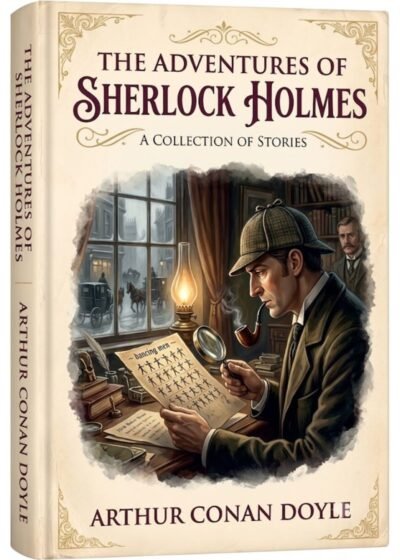
Twelve Cases, One Sitting Room, and a New Kind of Hero
Before The Adventures of Sherlock Holmes, detective fiction had mostly been a one-off affair: a novel-length mystery, solved once, forgotten by the next book. Arthur Conan Doyle changed the economics of the genre by accident. Commissioned by The Strand Magazine to write a series of self-contained short stories built around a single recurring character, he produced something readers had never quite had before — a hero they could visit once a month, in twenty-minute installments, for a year. From “A Scandal in Bohemia” in July 1891 through “The Adventure of the Copper Beeches” in June 1892, Conan Doyle handed the reading public exactly what serialized fiction needed and rarely got: closure. Each story stands alone. Each one still ends at 221B Baker Street.
That structural trick — a stable home base, a rotating cast of desperate clients, a case wrapped up by the final page — is easy to take for granted now precisely because it worked so well that it became the template for the mystery genre as a whole. It is why you can put down one Holmes story and pick up another out of order without feeling lost, and why, more than a century later, the same pattern still runs every procedural on television.
The Strand Magazine Gamble That Paid Off
The commercial numbers behind the collection are almost as dramatic as anything in the stories themselves. Before “A Scandal in Bohemia” appeared, The Strand was selling a respectable but unremarkable 100,000 copies a month. By the time the twelfth story, “The Adventure of the Copper Beeches,” had run its course, circulation had climbed toward half a million. Readers lined up at newsstands for the next installment the way audiences would later queue for movie premieres, and Sidney Paget’s illustrations — which gave Holmes his now-inseparable deerstalker cap and Inverness cape, details Conan Doyle himself never specified in the text — fixed an image of the detective in the public imagination that no subsequent adaptation has fully shaken loose.
Conan Doyle wrote these stories quickly and, by his own later account, without any particular sense that he was doing his important work. He considered himself a serious historical novelist first, and thought of the Holmes stories as a lucrative sideline. That disconnect between what Conan Doyle valued and what the world wanted from him would only widen in the years after this collection’s publication, but here, at the start, the partnership between author and character was still new enough to be pure fun — for Conan Doyle and for his readers alike.
Watson’s Eye, Holmes’s Mind
Part of what makes the collection endure is a narrative decision so effective it now feels inevitable: none of these twelve cases are narrated by Holmes. They are narrated by Dr. John Watson, a capable, intelligent man who nonetheless cannot see what Holmes sees, which means the reader gets to be surprised right alongside him. The gap between what Watson observes and what Holmes deduces from those same observations — the scuffed shoe, the ink-stained finger, the callus in the wrong place — is the engine that drives nearly every story in the book, and it is why the phrase “elementary, my dear Watson” (which, notably, appears nowhere in this text in that exact form) became shorthand worldwide for a certain kind of triumphant, condescending cleverness.
The cases themselves range widely in tone and stakes: royal blackmail and coded threats in “A Scandal in Bohemia,” a criminal scheme built on sheer bureaucratic absurdity in “The Red-Headed League,” a domestic tragedy dressed as a case of vanishing identity, a manor-house horror story with a genuinely unsettling method of murder in “The Adventure of the Speckled Band.” What unites them isn’t genre so much as method — Holmes’s insistence, restated in different words in nearly every story, that theorizing ahead of data is “a capital mistake,” and that the truth is available to anyone patient enough to actually look.
Why It Still Gets Read
Sherlock Holmes was not, strictly, Conan Doyle’s invention from nothing — he built the character’s deductive method partly on Dr. Joseph Bell, a University of Edinburgh surgeon under whom Conan Doyle had trained, and partly on Edgar Allan Poe’s earlier detective C. Auguste Dupin. But something about the specific combination assembled in this collection — the London fog, the Baker Street rooms, the cocaine and the violin, the loyal doctor holding the pen — proved more durable than either source material. Holmes has never been out of print, never been out of adaptation, and has been played on screen by more actors than perhaps any other fictional character in the English language.
Modern readers coming to this collection for the first time sometimes expect a dry, dusty artifact of Victorian crime writing. What they find instead is startlingly brisk: stories under thirty pages that open with a knock at the door and end, almost invariably, with Holmes explaining exactly how obvious it all was — a rhythm mystery fiction has been chasing, one way or another, ever since.