
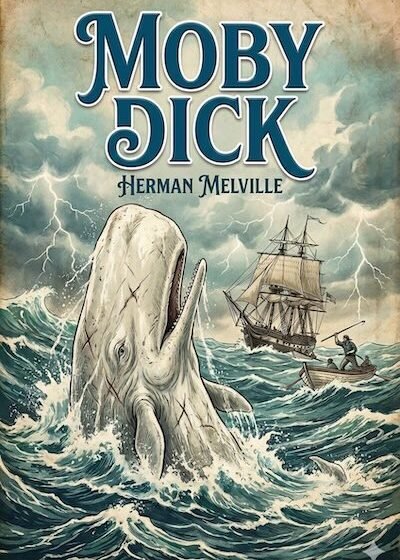
Herman Melville’s 1851 masterpiece, Moby-Dick; or, The Whale, stands as one of the most towering and ambitious works in American literature. Ostensibly a maritime adventure story about a commercial whaling voyage, the novel transcends its genre to become a profound philosophical meditation on fate, obsession, nature, and the human condition. Through its rich, encyclopedic prose and complex allegory, Melville explores the limits of human knowledge and humanity’s fraught, enduring relationship with an indifferent universe.
The Narrative and Its Narrator
The story is narrated by Ishmael, a restless intellectual and schoolmaster who turns to the sea to cure his spiritual melancholy. His opening command, “Call me Ishmael,” remains one of the most recognizable introductory lines in literary history. Traveling to Nantucket, Ishmael befriends Queequeg, a heavily tattooed Polynesian harpooneer whose nobility and genuine warmth challenge 19th-century Western prejudices. Together, they sign aboard the whaling ship Pequod, a vessel that functions as a microcosm of global humanity, staffed by sailors of diverse races and creeds under a strict maritime hierarchy.
The Obsession of Captain Ahab
At the center of the tragedy looms Captain Ahab, the enigmatic and monomaniacal commander of the Pequod. Having lost his leg to a gargantuan, snow-white sperm whale named Moby Dick on a previous voyage, Ahab is consumed by a singular, vengeful purpose. He bends the entire crew to his will, transforming a routine economic enterprise into a suicidal quest for retribution. To Ahab, the white whale is not merely a marine predator, but the tangible embodiment of all cosmic malice and inscrutable forces tormenting mankind. His tyrannical defiance of nature and fate drives the narrative toward its inevitable, catastrophic climax.
Themes, Symbolism, and Form
What distinguishes the novel from traditional adventure fiction is Melville’s groundbreaking formal experimentation. The dramatic narrative frequently pauses for intricate “cetological” chapters: detailed essays exploring whale anatomy, harvesting methods, blubber processing, and maritime law. Rather than serving as simple digressions, these encyclopedic sections underscore the ultimate impossibility of fully understanding, conquering, or categorizing the natural world.
The narrative is steeped in multi-layered symbolism that invites endless interpretation:
-
Moby Dick: Represents the sublime, unknowable essence of nature, deity, and truth; at once majestic, terrifying, and profoundly indifferent.
-
The Pequod: Symbolizes human civilization steering blindly toward mutual destruction under obsessive, authoritarian leadership.
-
The Doubloon: A gold coin nailed to the ship’s mast that reflects the internal biases, anxieties, and desires of each crewman who inspects it.
Legacy and Cultural Impact
Upon its publication in 1851, the novel was a critical and commercial disappointment. Contemporary reviewers were bewildered by its unconventional structure, dense Shakespearean language, and dark, brooding philosophical ambiguity. Melville died in 1891 believing his greatest work had been forgotten. However, during the literary revival of the 1920s, modern scholars rediscovered the text, celebrating its profound psychological depth and prophetic vision. Today, Moby-Dick is recognized as a literary monument and the quintessential Great American Novel, an epic tragedy that immortalizes the grandeur, beauty, and peril of the human struggle against the vast infinite.
This text is in the public domain in the United States. Sourced from Project Gutenberg, used under the terms of the Project Gutenberg License.