
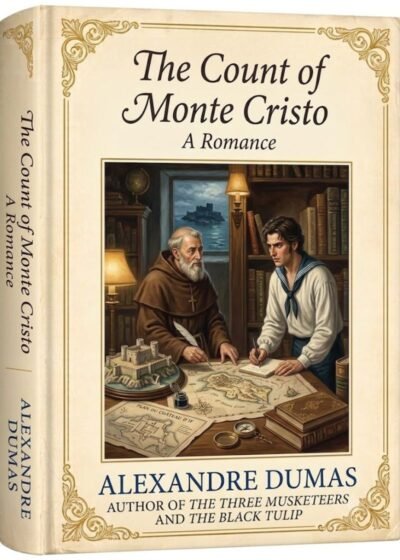
Edmond Dantès is nineteen years old, about to be made captain of his own ship, and one day from marrying the woman he loves, when four men decide that his good luck is a problem that needs solving. A word in the wrong ear, a letter no one bothers to read twice, and a prosecutor more interested in protecting his own father than the truth: that’s all it takes. Dantès disappears into the Château d’If, an island fortress off Marseilles, and by every account that matters to the people who put him there, he simply stops existing. The Count of Monte Cristo is the story of what happens when a man like that comes back — not quickly, not emotionally, but with fourteen years, an old priest’s entire education, and a buried fortune to work with.
A Prison Sentence as a Graduate Degree
What makes the first third of the novel so durable isn’t the injustice itself — wrongful imprisonment is a familiar enough engine for a revenge story. It’s what Dumas does with the years Dantès spends doing nothing but thinking. Locked in with the Abbé Faria, a fellow prisoner convinced he can tunnel his way to freedom and mostly succeeds only in tunnelling into Dantès’s cell instead, the young sailor is handed languages, chemistry, swordsmanship, history, and, not incidentally, the location of a fortune hidden on the island of Monte Cristo. The prison stops being a hole in the ground and becomes a kind of finishing school for a man who has decided, with total clarity, what he is going to do with the rest of his life. By the time he claims Faria’s treasure and reinvents himself as a Count with no discernible past, the transformation doesn’t feel like a fairy tale. It feels earned, in the way that only obsessive, unhurried preparation can feel earned.
Revenge as Engineering, Not Passion
Most revenge stories run hot. Monte Cristo’s runs cold, and that’s the twist that keeps the novel from collapsing into melodrama across its considerable length. The four men who destroyed Edmond Dantès — the rival who informed on him, the friend who let it happen, the prosecutor who buried the case, and the shipmate who benefited from his absence — are now a baron, a general, a crown prosecutor, and a banker, each with a fortune, a reputation, and a family built on the exact silence that made Dantès disappear. The Count doesn’t come after them with a sword. He comes after them with information, patience, other people’s ambitions, and a truly unsettling amount of money, engineering ruin so precisely tailored to each man’s specific vanity that it reads less like vengeance than like a man solving four separate, very personal puzzles. Dumas, writing for a newspaper serial that had to hook readers chapter by chapter for two straight years, understood exactly how to make patience suspenseful — a much harder trick than making a swordfight suspenseful.
A Novel Built the Way Its Hero Builds His Revenge
The book itself has a strange, well-documented origin that mirrors its plot: Dumas based the outline on the real case of François Picaud, a Parisian shoemaker imprisoned on false testimony from jealous friends who, on his release, spent years quietly ruining the men responsible. Dumas took that skeleton of a true crime story to his most important collaborator, the historian and playwright Auguste Maquet, who researched and drafted much of the plot architecture before Dumas rewrote it into the propulsive, cliff-hanging voice that made him the most read man in France. It’s worth knowing this going in, not to diminish the achievement, but because it explains something about the novel’s peculiar texture — the historical solidity of the Restoration-era politics sitting right next to some of the most theatrical plotting in nineteenth-century fiction.
Why People Are Still Reading a Book This Long
Umberto Eco, no soft touch for popular fiction, singled out Dantès as a hero whose sheer competence and will could make a reader believe, if only for a chapter, in the possibility of getting even with an unfair world — even while noting that Dumas’s prose, dashed off at serial speed, is never going to win a style prize. That trade-off is exactly why the book has outlasted almost everything else published alongside it in 1844: it moves. Since the first silent film in 1908, the story has been adapted roughly fifty times — feature films in half a dozen languages, a Mexican miniseries, a French blockbuster, even a gender-swapped Korean drama — because the premise is infinitely portable in a way that pure costume drama isn’t. Wrongful imprisonment, secret fortune, patient ruin: every culture has its own version of that fantasy. Dumas just got there first, and wrote it at a length that lets you live inside the revenge as long as Dantès has to wait for it. The Count’s own answer for how he survived fourteen years in a cell and the further years it takes to spend his fortune wisely comes down to two words he leaves behind for the next generation to live by: wait, and hope. It’s a strange motto for a five-volume, chapter-a-week thriller to end on — and it’s exactly why the book still works.