
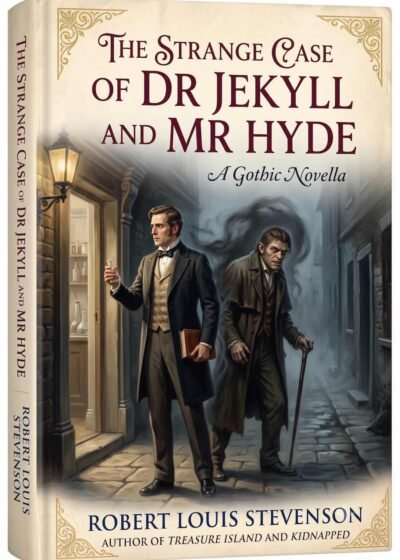
Published in 1886 by Scottish author Robert Louis Stevenson, The Strange Case of Dr Jekyll and Mr Hyde is a defining Gothic novella that shocked Victorian readers and permanently entered the global lexicon. Born from a feverish nightmare, Stevenson’s psychological thriller explores the terrifying consequences of isolating the human soul into its constituent parts. Today, “Jekyll and Hyde” remains universal shorthand for a fractured personality and moral hypocrisy.
Narrative Mystery and Setting
Rather than unfolding through the perspective of the title character, the narrative is structured as a compelling detective mystery. The story follows Gabriel John Utterson, a stoic London lawyer who begins investigating the bizarre relationship between his longtime friend, the respectable physician Dr. Henry Jekyll, and a brutal, repellent stranger named Edward Hyde. Utterson’s suspicion deepens after Hyde is witnessed trampling a young child and later violently murdering the elderly Sir Danvers Carew.
Stevenson establishes an atmospheric landscape that mirrors his protagonist’s internal divide. While nominally set in a fog-choked Victorian London, the environment is heavily inspired by Stevenson’s native Edinburgh—a city sharply split between the affluent New Town and the impoverished Old Town. This duality is physically embodied in Jekyll’s residence: a handsome, welcoming front façade that conceals a dark, neglected laboratory door through which Hyde slips into the night.
The Chemistry of Duality
The central mystery is resolved through Jekyll’s posthumous confession, which details his fateful scientific experiment. Tormented by societal pressure to maintain an immaculate professional reputation while secretly yearning for illicit indulgences, Jekyll hypothesizes that “man is not truly one, but truly two.” To liberate himself from moral guilt, he synthesizes a chemical potion designed to separate his civilized conscience from his primal appetites.
The experiment succeeds, birthing Edward Hyde—a physically smaller, younger, and distinctly ape-like figure who represents Jekyll’s stripped-down, unadulterated evil. Initially, Jekyll delights in his newfound freedom, committing depraved acts as Hyde before retreating to the safety of his respectable identity. However, the balance of power rapidly deteriorates. Hyde grows increasingly dominant, eventually asserting himself spontaneously without the chemical draught. When Jekyll’s supply of a crucial, impure salt runs out, he finds himself trapped forever in the monstrous form of Hyde, ultimately driving him to self-destruction.
Themes and Cultural Legacy
At its core, Stevenson’s masterpiece functions as a scathing critique of Victorian bourgeois hypocrisy. The strict moral codes of late-nineteenth-century society forced individuals to repress their natural desires, creating a breeding ground for secret double lives. Furthermore, Hyde’s primitive, regressive appearance tapped into intense contemporary anxieties surrounding Darwinian evolution and the fear of human degeneration.
By framing moral conflict as a biological and psychological phenomenon rather than a purely supernatural curse, Stevenson anticipated modern psychoanalysis and concepts of the subconscious shadow. The Strange Case of Dr Jekyll and Mr Hyde remains an immortal examination of the human condition, enduring as both a gripping cautionary tale and a profound exploration of the darkness lurking behind the mask of civilization.