
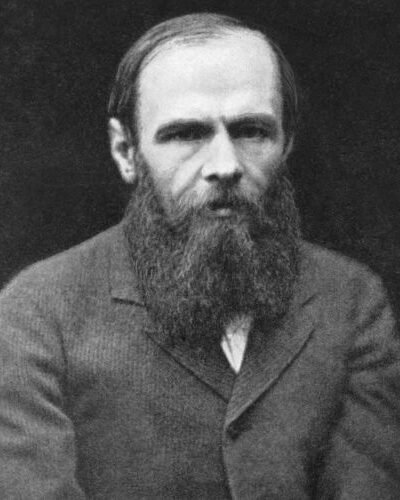
A Childhood Built on Duty and Dread
Fyodor Mikhailovich Dostoyevsky was born in Moscow in 1821, in an apartment attached to the hospital for the poor where his father worked as a staff physician. That household set the terms for almost everything that followed in his fiction: a strict, anxious father who ran the family like a ward under his charge, a gentle mother who died when Fyodor was still a teenager, and a keen, early awareness of poverty, illness, and the fragility of a household’s peace. He was sent to study military engineering in St. Petersburg, a career chosen for him rather than by him, and he hated nearly every day of it. He graduated, took a government post, resigned within a year, and gave himself over entirely to writing — a decision that looked, at the time, like recklessness, and in hindsight looks like the only thing he was ever going to do.
An Overnight Success, and Then a Firing Squad
His first novel, Poor Folk, was an immediate sensation in 1846, and for a brief while Dostoyevsky was the most talked-about young writer in Russia. That early triumph collapsed fast. He fell in with the Petrashevsky Circle, a group of intellectuals reading and discussing banned utopian socialist texts, and in 1849 the group was arrested on the Tsar’s orders. Dostoyevsky and his co-defendants were marched out, blindfolded, and lined up before a firing squad — a staged execution, called off at the last possible second as a deliberate act of psychological cruelty, with the real sentence, four years of hard labor in a Siberian penal colony, delivered only after the mock deaths had done their work. He came out of Siberia in 1854 profoundly changed: chronically epileptic, permanently marked by what he had seen among the other convicts, and newly, fiercely committed to a Christian faith that was no longer inherited but fought for. He said so himself, later, describing a belief that had “passed through an enormous furnace of doubt” rather than arriving easily.
A Career Built on Debt, Gambling, and Genius
The two decades after Siberia were Dostoyevsky’s great creative period and also the most chaotic stretch of his life. He edited magazines that failed, buried his first wife and his beloved older brother within months of each other, ran up crushing debts, and developed a gambling habit — specifically roulette — so severe that he once dictated an entire novel, The Gambler, against a punishing deadline just to avoid losing the rights to all his future work to a predatory publisher. Out of this same period came Notes from Underground, Crime and Punishment, The Idiot, and Demons — each one built around a mind pushed to an extreme (a spiteful recluse, a murderer with a theory, a saintly epileptic prince, a terrorist cell) and each one arguing, in its own register, against the idea that reason alone can organize a decent human life. His second marriage, to the stenographer Anna Grigoryevna Snitkina, finally gave him the stability — someone to manage his money, his deadlines, and his household — that let him work at the scale his last novels needed.
The Final Furnace: The Brothers Karamazov
Dostoyevsky’s last novel, The Brothers Karamazov, was serialized through 1879 and 1880 and finished only months before his death in January 1881 — while he was also mourning his young son Alyosha, who had died of an epileptic seizure partway through its composition, a loss that runs directly under the novel’s preoccupation with suffering children and inherited guilt. He intended it as the opening volume of a much larger work following its youngest brother into a life of revolutionary politics; his death meant that promised second novel never arrived, and the book we have is, by accident of biography, both his final statement and an unfinished one. Even so, it’s routinely read as the fullest expression of everything he had been building toward — brothers who each embody appetite, intellect, and faith, arguing with each other about God, suffering, and freedom without any of them ever fully winning.
Legacy: The Writer Who Got There First
Dostoyevsky died a matter of weeks after finishing his last novel, mourned publicly across Russia as a writer who had spoken for the poor, the desperate, and the doubting. His influence only grew from there. Freud called The Brothers Karamazov the most magnificent novel ever written; Nietzsche credited Dostoyevsky as the only psychologist he had anything to learn from; twentieth-century existentialists from Sartre to Camus built directly on the ground he’d cleared, in which ideas are treated not as abstractions but as forces that move through real people and get real people killed. His English-language reputation owes an enormous debt to Constance Garnett, whose translations — including the one this edition draws from — introduced Dostoyevsky to generations of English-speaking readers starting in the 1910s, for decades the only version most of them ever read. Later translators have quarreled with her choices, but not with the size of what she made accessible. More than a century on, Dostoyevsky is still treated less as a historical monument than as an active argument — one most readers find they haven’t finished having with him.