
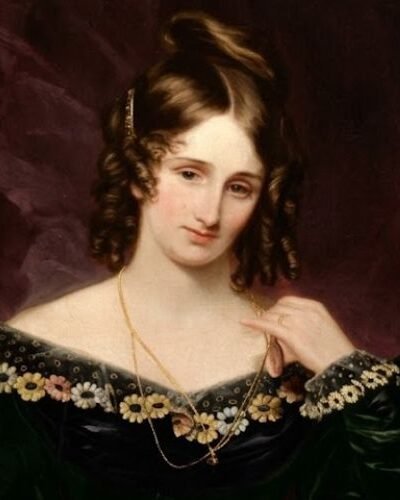
Mary Wollstonecraft Shelley (1797–1851) was an English novelist, essayist, and biographer best known as the creator of Frankenstein; or, The Modern Prometheus (1818). Widely celebrated as a masterpiece of Gothic horror and the foundational text of modern science fiction, her signature novel has often overshadowed a rich literary career defined by intellectual rebellion, profound personal tragedy, and remarkable resilience.
Radical Heritage and Intellectual Youth
Born in London on August 30, 1797, as Mary Wollstonecraft Godwin, she was the daughter of two of the late eighteenth century’s most revolutionary thinkers: the feminist philosopher Mary Wollstonecraft, author of A Vindication of the Rights of Woman, and the anarchist philosopher and novelist William Godwin. Tragically, her mother died of puerperal fever just eleven days after giving birth, leaving Mary and her half-sister, Fanny Imlay, to be raised by their father.
Though she received little formal schooling, Mary was educated deeply within Godwin’s extensive library and enriched by the vibrant intellectual circle that frequented their home, including poets Samuel Taylor Coleridge and Charles Lamb. Her father fostered her literary ambitions from a young age, though her childhood was complicated by a difficult and strained relationship with her stepmother, Mary Jane Clairmont.
Romance and Elopement
In 1814, at age sixteen, Mary began a passionate liaison with the charismatic Romantic poet Percy Bysshe Shelley, a devoted disciple of her father who was already married. Rejecting traditional social mores, Mary and Percy eloped to continental Europe, accompanied by Mary’s stepsister, Claire Clairmont. Their return to England was met with severe social ostracism, crippling debt, and paternal estrangement.
The ensuing years were nomadic and marked by profound sorrow. Over the course of their relationship, Mary would endure the devastating loss of three of her four children—a grief that deeply permeated her psychological and creative landscapes. The couple formally married in late 1816 following the suicide of Percy’s first wife, Harriet.
The Year Without a Summer and Frankenstein
In the summer of 1816, Mary, Percy, and Claire traveled to Lake Geneva, Switzerland, to stay near Lord Byron and his physician, John William Polidori. Trapped indoors by the incessant rain and gloomy atmosphere of the “Year Without a Summer”—caused by the volcanic eruption of Mount Tambora—Byron challenged his guests to write their own ghost stories.
Inspired by a vivid waking dream and nocturnal discussions on galvanism and the origins of life, eighteen-year-old Mary conceived the tale of Victor Frankenstein and his tragic creation. Published anonymously in 1818 when she was just twenty, Frankenstein synthesized Gothic terror, Romantic philosophy, and scientific anxieties into an enduring cultural myth that interrogated human hubris and the ethical boundaries of science.
Later Life and Enduring Legacy
In 1822, Percy Bysshe Shelley drowned in a boating accident off the coast of Italy, leaving Mary a twenty-four-year-old widow with her sole surviving child, Percy Florence Shelley. Returning to England, she supported herself and her son through prolific writing and editing. Among her notable later works is The Last Man (1826), a pioneering apocalyptic science fiction novel depicting a future world ravaged by a global plague. She also dedicated years to preserving, editing, and promoting her late husband’s poetry.
Mary Shelley died of a suspected brain tumor on February 1, 1851, at age fifty-three. Today, she is recognized not merely as a central figure of the Romantic circle, but as a formidable literary intellect and the undisputed mother of science fiction.