
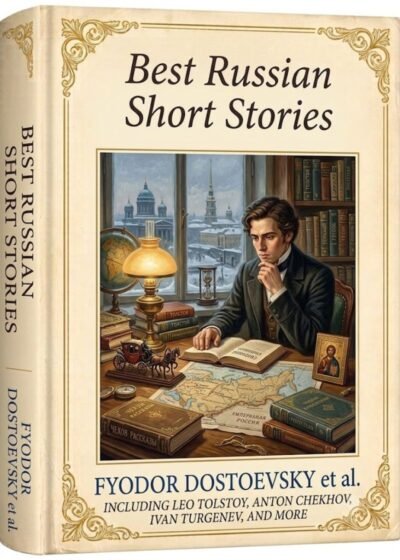
Nineteen Writers, One Country, One Extraordinary Century
In 1917, the American publisher and translator Thomas Seltzer sat down to do something no one had quite managed in English before: fit the whole sweep of nineteenth-century Russian fiction into a single volume a reader could actually finish. The result, Best Russian Short Stories, opens with Pushkin’s The Queen of Spades and closes with Kuprin’s The Outrage, and in between marches through Gogol, Turgenev, Dostoyevsky, Tolstoy, Chekhov, Gorky, and a dozen others who between them invented, refined, and radicalized the short story as Russia understood it. Seltzer wasn’t padding a table of contents with famous names for their own sake. He was trying to show a lineage — how Gogol’s coat-obsessed clerk in The Cloak begat Dostoyevsky’s downtrodden dreamers, how Tolstoy’s moral parables and Chekhov’s clear-eyed vignettes grew out of the same soil, and how, by the time you reach Gorky and Andreyev, the polite drawing-room fiction of Pushkin’s era has curdled into something closer to a warning.
The stories themselves range wildly in tone and stakes. There’s the gothic dread of the title tale, in which an old countess’s gambling secret drives a young officer to ruin and madness. There’s the quiet devastation of Chekhov’s Vanka, nine years old and writing a Christmas letter to a grandfather who will never receive it. There’s Tolstoy’s God Sees the Truth, But Waits, a parable of wrongful imprisonment and forgiveness so spare it reads like scripture, and Andreyev’s Lazarus, which takes the Biblical resurrection and asks the question no Sunday sermon does: what does a man who has actually seen death become to everyone who loves him? Gorky contributes two stories from his tramp years, full of riverbanks, hunger, and unsentimental tenderness for people polite literature usually ignored. Kuprin closes the book with a courtroom-adjacent scene that still stings for how directly it names hypocrisy.
Why Seltzer’s Introduction Is Worth Reading on Its Own
Most anthology introductions are throat-clearing. Seltzer’s is an argument. He makes the case that Russian literature’s defining trait isn’t melancholy or brooding, as the era’s American readers assumed, but fidelity — a refusal to flatter, caricature, or condescend to any character, however poor or ordinary. He traces a direct line from Gogol’s overcoat to Dostoyevsky’s slum-dwellers, quotes the (possibly apocryphal, endlessly repeated) line that the whole of Russian prose “came out from under Gogol’s Cloak,” and stakes out sharp, opinionated positions on writers he clearly reveres — Chekhov above all, whom he calls a writer who doesn’t invent so much as reveal, as though he had access to some private frequency the rest of us can’t tune into. Seltzer wrote this essay at a genuinely strange moment: the book went to press in the same year as the Russian Revolution, and his introduction, written by a committed radical who spent the 1910s editing the socialist magazine The Masses, reads Russian fiction’s obsession with the poor as a kind of prophecy fulfilling itself in real time.
The Book That Trained a Generation of American Readers
This wasn’t a niche release. Boni and Liveright’s original edition sold well enough that Random House folded it into the brand-new Modern Library series in the 1920s, where it sat on shelves as volume 18 — the kind of unglamorous, load-bearing paperback that quietly did more to shape what “Russian literature” meant to English-language readers than any single novel could. For decades, an American who wanted a first taste of Chekhov, or had never heard of Korolenko or Artsybashev, was more likely to encounter them here, in Seltzer’s compact, opinionated survey, than anywhere else. It compresses a century of upheaval — serfdom, censorship, revolution, exile — into stories short enough to read in a sitting and unsettling enough to outlast the sitting by a long while.
Reading It Now
What holds up, over a hundred years later, is exactly what Seltzer argued made these writers Russian in the first place: an almost stubborn insistence on looking at ordinary suffering without flinching and without turning it into spectacle. There’s no unifying plot here, no single hero — just nineteen very different writers, working in the same tradition, independently arriving at the conclusion that the servant, the track-walker, the prostitute, and the resurrected man all deserve exactly as much narrative attention as the prince. That’s still a radical thing for a book to insist on, and it’s why this particular anthology, assembled quickly by a working translator more than a century ago, hasn’t been supplanted so much as it’s simply never stopped being useful.