
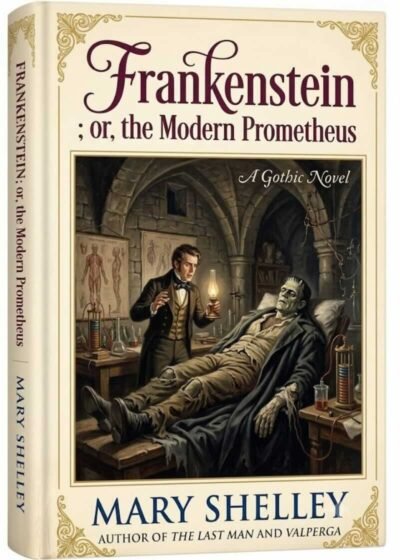
Published anonymously in 1818 by English author Mary Shelley when she was just twenty years old, Frankenstein; or, The Modern Prometheus is a foundational masterpiece of Western literature. Seamlessly synthesizing the psychological dread of Gothic horror with the philosophical inquiry of the Romantic movement, Shelley’s novel is widely celebrated as the first true work of science fiction. Over two centuries later, it remains a potent cultural myth interrogating the boundaries of scientific ambition and the moral responsibilities of a creator toward their creation.
Origins and Concentric Structure
The novel’s genesis famously occurred during the wet, freezing summer of 1816 at Lake Geneva, Switzerland. Trapped indoors alongside Lord Byron, Percy Bysshe Shelley, and Dr. John William Polidori during the “Year Without a Summer,” Mary Shelley responded to a challenge to compose a ghost story. Inspired by waking nightmares and intense evening debates surrounding galvanism and the origins of life, she crafted a narrative structured through layered, concentric framing devices.
The overarching story is told through the epistolary letters of Arctic explorer Captain Robert Walton to his sister in England. Walton rescues a freezing, dying Victor Frankenstein from the ice, who then recounts his own tragic history. Within Victor’s narrative lies the heart of the novel: the harrowing first-person testimony of his abandoned creation, offering a profound glimpse into the psyche of the perceived monster.
The Tragedy of Creation and Abandonment
The narrative follows Victor Frankenstein, a brilliant and obsessed young Swiss scientist studying at the University of Ingolstadt. Driven by a consuming desire to conquer death and unlock the secrets of life, Victor methodically assembles a humanoid creature from graveyard relics and slaughterhouse remains. However, upon animating his creation with a spark of life, Victor is instantly overcome with profound revulsion and flees his laboratory, abandoning his creation to the world.
Left to navigate a hostile environment in complete isolation, the nameless creature secretly observes a rural peasant family, educating himself in language, literature, and human empathy. When he eventually reveals himself to society, he is met with violent terror and brutal rejection. Heartbroken and enraged by his creator’s abandonment and humanity’s prejudice, the creature embarks on a campaign of vengeance, systematically murdering Victor’s closest loved ones and drawing the scientist into a fatal pursuit across the frozen Arctic wastes.
Themes and Enduring Cultural Legacy
Beneath its gripping horror exterior, Frankenstein functions as a deep philosophical exploration of human duality, isolation, and ethical accountability. The subtitle, The Modern Prometheus, evokes the Greek Titan who stole fire from the gods to gift to humanity and suffered eternal punishment for his overreaching hubris. Like Prometheus, Victor usurps a divine prerogative—the creation of life—but critically fails to provide the nurturing guidance, companionship, and love required of a parent. Shelley sharply challenges her era’s boundless optimism in scientific progress by demonstrating that intellectual pursuit without moral responsibility breeds catastrophe.
Furthermore, the novel explores the nature of monstrosity; the creature is not born evil, but is molded into a fiend through systemic isolation and cruelty. Today, Mary Shelley’s masterpiece transcends classical literature to serve as an indispensable framework for modern bioethical debates. From artificial intelligence to genetic engineering, Frankenstein endures as a vital cautionary tale, reminding humanity that our greatest technological achievements can become our undoing if divorced from empathy and moral consciousness.