
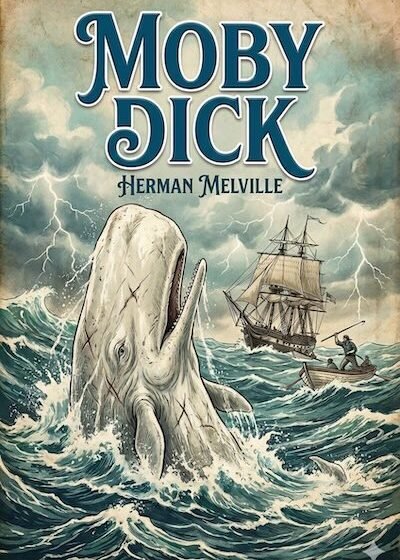
Chapter 7: The Chapel
In this same New Bedford there stands a Whaleman’s Chapel, and few are the
moody fishermen, shortly bound for the Indian Ocean or Pacific, who fail
to make a Sunday visit to the spot. I am sure that I did not.
Returning from my first morning stroll, I again sallied out upon this
special errand. The sky had changed from clear, sunny cold, to driving
sleet and mist. Wrapping myself in my shaggy jacket of the cloth called
bearskin, I fought my way against the stubborn storm. Entering, I found a
small scattered congregation of sailors, and sailors’ wives and widows. A
muffled silence reigned, only broken at times by the shrieks of the storm.
Each silent worshipper seemed purposely sitting apart from the other, as
if each silent grief were insular and incommunicable. The chaplain had not
yet arrived; and there these silent islands of men and women sat
steadfastly eyeing several marble tablets, with black borders, masoned
into the wall on either side the pulpit. Three of them ran something like
the following, but I do not pretend to quote:—
SACRED TO THE MEMORY OF JOHN TALBOT, Who, at the age of eighteen, was lost
overboard, Near the Isle of Desolation, off Patagonia, November 1st, 1836.
THIS TABLET Is erected to his Memory BY HIS SISTER.
SACRED TO THE MEMORY OF ROBERT LONG, WILLIS ELLERY, NATHAN COLEMAN, WALTER
CANNY, SETH MACY, AND SAMUEL GLEIG, Forming one of the boats’ crews OF THE
SHIP ELIZA Who were towed out of sight by a Whale, On the Off-shore Ground
in the PACIFIC, December 31st, 1839. THIS MARBLE Is here placed by their
surviving SHIPMATES.
SACRED TO THE MEMORY OF The late CAPTAIN EZEKIEL HARDY, Who in the bows of
his boat was killed by a Sperm Whale on the coast of Japan, August 3d,
1833. THIS TABLET Is erected to his Memory BY HIS WIDOW.
Shaking off the sleet from my ice-glazed hat and jacket, I seated myself
near the door, and turning sideways was surprised to see Queequeg near me.
Affected by the solemnity of the scene, there was a wondering gaze of
incredulous curiosity in his countenance. This savage was the only person
present who seemed to notice my entrance; because he was the only one who
could not read, and, therefore, was not reading those frigid inscriptions
on the wall. Whether any of the relatives of the seamen whose names
appeared there were now among the congregation, I knew not; but so many
are the unrecorded accidents in the fishery, and so plainly did several
women present wear the countenance if not the trappings of some unceasing
grief, that I feel sure that here before me were assembled those, in whose
unhealing hearts the sight of those bleak tablets sympathetically caused
the old wounds to bleed afresh.
Oh! ye whose dead lie buried beneath the green grass; who standing among
flowers can say—here, here lies my beloved; ye know not the
desolation that broods in bosoms like these. What bitter blanks in those
black-bordered marbles which cover no ashes! What despair in those
immovable inscriptions! What deadly voids and unbidden infidelities in the
lines that seem to gnaw upon all Faith, and refuse resurrections to the
beings who have placelessly perished without a grave. As well might those
tablets stand in the cave of Elephanta as here.
In what census of living creatures, the dead of mankind are included; why
it is that a universal proverb says of them, that they tell no tales,
though containing more secrets than the Goodwin Sands; how it is that to
his name who yesterday departed for the other world, we prefix so
significant and infidel a word, and yet do not thus entitle him, if he but
embarks for the remotest Indies of this living earth; why the Life
Insurance Companies pay death-forfeitures upon immortals; in what eternal,
unstirring paralysis, and deadly, hopeless trance, yet lies antique Adam
who died sixty round centuries ago; how it is that we still refuse to be
comforted for those who we nevertheless maintain are dwelling in
unspeakable bliss; why all the living so strive to hush all the dead;
wherefore but the rumor of a knocking in a tomb will terrify a whole city.
All these things are not without their meanings.
But Faith, like a jackal, feeds among the tombs, and even from these dead
doubts she gathers her most vital hope.
It needs scarcely to be told, with what feelings, on the eve of a
Nantucket voyage, I regarded those marble tablets, and by the murky light
of that darkened, doleful day read the fate of the whalemen who had gone
before me. Yes, Ishmael, the same fate may be thine. But somehow I grew
merry again. Delightful inducements to embark, fine chance for promotion,
it seems—aye, a stove boat will make me an immortal by brevet. Yes,
there is death in this business of whaling—a speechlessly quick
chaotic bundling of a man into Eternity. But what then? Methinks we have
hugely mistaken this matter of Life and Death. Methinks that what they
call my shadow here on earth is my true substance. Methinks that in
looking at things spiritual, we are too much like oysters observing the
sun through the water, and thinking that thick water the thinnest of air.
Methinks my body is but the lees of my better being. In fact take my body
who will, take it I say, it is not me. And therefore three cheers for
Nantucket; and come a stove boat and stove body when they will, for stave
my soul, Jove himself cannot.