
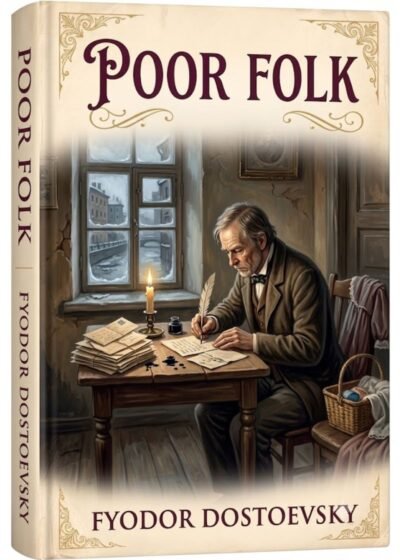
Two People, One Courtyard, and Every Letter They Ever Sent
Fyodor Dostoyevsky was twenty-four, broke, and completely unknown when he wrote Poor Folk, and you can feel that hunger on every page. The whole novel is letters — nothing else. Makar Devushkin, an aging, threadbare government copying clerk who has spent thirty years transcribing other men’s paperwork without ever once being noticed for it, writes across a St. Petersburg courtyard to Varvara Dobroselova, a much younger woman he has appointed himself guardian, benefactor, and unspoken suitor to. Their windows face each other. He can read whether her curtain is up or down like a signal flag. Neither of them can afford the postage, the tea, the new shoes, or the dignity they keep pretending to have plenty of, and the entire nine-month correspondence — April geraniums to a September departure neither one wants — is the whole book. There is no narrator to step in and tell you what to think of them. You get exactly what these two people choose to put in writing, which turns out to be the most devastating way imaginable to tell a story about poverty: sideways, in complaints about landladies, borrowed novels, patched coats, and small extravagances neither of them can justify but both keep making anyway, for each other.
The Night Belinsky Couldn’t Put It Down
Dostoyevsky handed the manuscript to his roommate, the poet Nikolai Nekrasov, more or less on a dare. Nekrasov and a friend started reading it after midnight meaning to skim a few pages and instead read the whole thing straight through, then turned up at Dostoyevsky’s door before dawn to tell him so. Nekrasov carried it to Vissarion Belinsky, the most feared and most listened-to critic in Russia, a man who could make or unmake a literary reputation with a single line in a journal. Belinsky read it in one sitting too, and when he finally met the young writer he reportedly told him: do you yourself understand what you have written? He didn’t mean it as flattery exactly — he meant that Dostoyevsky, barely out of engineering school, had somehow produced the first great Russian “social novel,” a book that made the misery of a nobody-clerk feel as consequential as anything happening to a prince. Overnight, an unpublished former army draftsman became the most talked-about new name in Russian letters. It is hard to overstate how strange that ascent was, and how quickly it curdled — within a couple of years the same critics who had crowned Dostoyevsky would be needling him for repeating himself, and within a few more he would be standing before a firing squad on a trumped-up political charge, reprieved at the very last second and shipped to a Siberian labor camp instead. Poor Folk was written before any of that. It’s the sound of a writer who doesn’t yet know what’s coming for him, spending everything he has on two invented people and their small, ordinary catastrophe.
Out From Under Gogol’s Coat
Dostoyevsky wrote Poor Folk in open conversation with Nikolai Gogol, whose story “The Overcoat” had already made the downtrodden government clerk a fixture of Russian fiction — pathetic, comic, and ultimately crushed by a world that barely notices him. Dostoyevsky’s trick is to hand that same kind of man a pen and let him read Gogol’s story about himself. Makar Devushkin does exactly that partway through the novel, and he’s furious: he recognizes every degrading detail of his own life in it, and he resents being turned into material, being laughed at by readers who will never have to live the way he lives. It’s one of the boldest things a first novel has ever done — arguing, from inside a work of fiction, that fiction itself can be a small cruelty when it treats poor people as scenery instead of as people who might read the book too. That argument, quiet as it is, is why literary historians still treat Poor Folk as the hinge between Gogol’s grotesque, distanced comedy and the interior, morally serious realism that Dostoyevsky would spend the rest of his career developing — the same attention to a suffering mind’s own logic that would later produce Raskolnikov, and the Underground Man, and old Karamazov.
Why It Still Lands
Strip away the historical context and Poor Folk still works as what it always was: a quietly heartbreaking story about two people trying to love each other honestly while neither can afford honesty about money. Makar’s letters are funny before they’re sad — he is proud, prickly, endlessly self-justifying, capable of turning a missing coat button into a small tragedy of dignity — and that comic surface is exactly what makes the accumulating weight of his devotion so hard to read by the end. Varvara, for her part, is no passive object of his affection; her own letters carry a full, separately devastating history of loss, dependency, and the very limited choices available to a poor woman in her position. Dostoyevsky never resolves their story into a tidy romance or a tidy tragedy — he lets it end the way real correspondence ends, mid-sentence, overtaken by a decision made mostly out of the frame. Nearly two centuries on, in an age that still argues about who gets to tell whose story and what dignity costs, Poor Folk reads less like a period piece than like the first draft of a question Dostoyevsky would spend his whole career refusing to stop asking.