
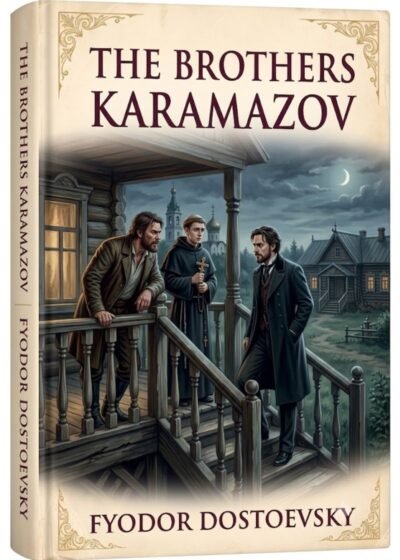
One Father, Four Sons, and a Murder That Won’t Stay Solved
Fyodor Pavlovitch Karamazov is a drunken, grasping buffoon of a landowner, and by the time someone finally kills him, almost everyone in the small town of Skotoprigonyevsk has a reason to want him dead. His three legitimate sons — Dmitri, the hot-blooded soldier fighting his father for both money and a woman; Ivan, the brilliant, corrosive intellectual; and Alyosha, the gentle novice sent from the monastery to make peace among them — circle the old man all summer. So does Smerdyakov, the epileptic servant everyone assumes is a Karamazov too, in every way but name. When the murder finally happens, The Brothers Karamazov becomes, on its surface, a courtroom thriller: who did it, who confesses, who is believed, and why the truth and the verdict turn out to be two entirely different things. Dostoevsky uses that scaffolding — inheritance, jealousy, a body in a garden — the way a cathedral uses scaffolding: necessary, load-bearing, and beside the point once you’re standing inside looking up.
The Book That Argues With God and Means It
Buried in the middle of the novel is a chapter that has spent over a century escaping its own book: “The Grand Inquisitor,” Ivan’s parable in which Christ returns to sixteenth-century Seville and is arrested by the Church itself, for the crime of giving humanity a freedom it never wanted. It’s often anthologized, taught, and quoted entirely on its own, which says something about how the novel works — every major idea in it can stand up and walk away by itself, and still it needs the other nine hundred pages to mean what it means. Ivan’s rebellion against a world where children suffer for no reason (“too high a price is asked for harmony,” he says, handing back his “entrance ticket”) is answered, chapters later and much more quietly, by Father Zossima’s insistence that everyone is responsible for everyone else, and that love in practice is “a harsh and dreadful thing” compared to love as a feeling. Dostoevsky doesn’t referee the argument. He built three brothers who each embody one answer — appetite, intellect, faith — and let them try to live with each other.
Dostoevsky’s Last Word
Serialized through 1879 and 1880 and finished only months before Dostoevsky’s death in early 1881, The Brothers Karamazov was written by a man who had already survived a mock execution, four years in a Siberian prison camp, a lifelong gambling habit, and the death of his own young son partway through composing it — a grief that bleeds directly into the novel’s obsession with suffering children and the limits of forgiveness. He intended it as the first part of a larger work that would follow Alyosha into revolutionary politics; he never got the chance to write the sequel. What survives is nevertheless treated by most readers and critics as the most complete statement of everything Dostoevsky had been circling since Notes from Underground and Crime and Punishment: that ideas are not abstractions, they’re forces that move through actual people and get people killed, and that doubt, taken seriously enough, is closer to faith than easy certainty ever is. As Dostoevsky himself put it, describing his own belief, “my hosanna has passed through an enormous furnace of doubt.” This translation is Constance Garnett’s — the version that introduced Dostoevsky to the English-speaking world starting in 1912, and for the better part of a century, the only Dostoevsky most English readers ever actually read.
Why It Still Gets Under Readers’ Skin
It would be easy for a hundred-and-forty-year-old Russian novel about theology and inheritance law to read like homework. The Brothers Karamazov doesn’t, because Dostoevsky never lets an idea sit still long enough to become comfortable. Every position gets its most persuasive possible spokesman — even the devil, when he shows up late in the book, is disappointingly banal rather than grand, which is somehow worse. The novel has gone on to shape thinkers who had nothing else in common: Freud called it the most magnificent novel ever written, Einstein claimed it taught him more than any scientist, and its fingerprints are all over twentieth-century existentialism, from Sartre to Camus, and over the modern psychological novel generally. It’s not read today because it’s a classic. It’s read because the question at its center — how do you go on loving a world that allows a child to suffer — has never stopped being an open one, and Dostoevsky refuses to hand readers a tidy answer for it.