
The IMF published its October 2026 World Economic Outlook on 13 October, titled “Resilience Under Strain, Urgent Choices.” The short version: the global economy has held up better than forecasters feared, but it is using up its cushions to do it. Two forces are pulling in opposite directions. A war-driven energy shock is a drag. An AI-driven investment boom is a lift.
Here are the eight numbers that carry the story.
1. 3.1%: global growth in 2026
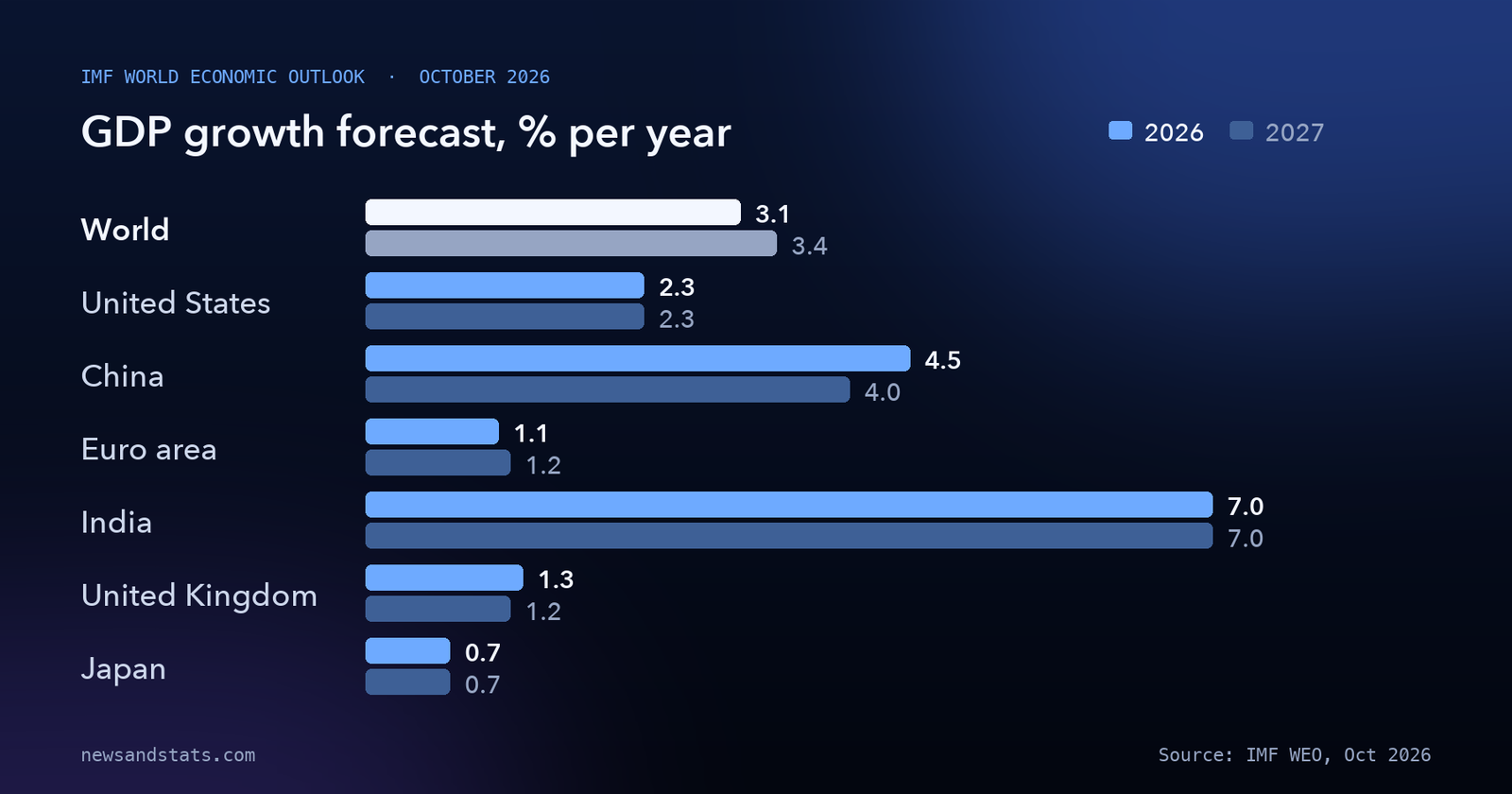
The IMF expects the world economy to grow 3.1% this year and 3.4% in 2027. That is steady rather than strong, and well below the rapid-growth years before 2020. What matters is the gap between countries, which the rest of this post is about.
2. 4.7%: global inflation in 2026
Headline inflation is projected to rise to 4.7% this year before easing to 4.1% in 2027. Core inflation, which strips out food and energy, is forecast at 3.9% in 2026 and 3.7% in 2027. Core inflation sitting that far above typical central-bank targets is why the IMF is telling central banks to keep policy tight, and to tighten further if price pressures persist.
3. $95.74: the oil price the forecast assumes
The IMF’s baseline assumes oil averages about $95.74 a barrel in 2026 and $87.39 in 2027. That is the energy shock in one number. The forecast also assumes the conflict does not escalate and that energy markets gradually settle, so it is a “no further trouble” scenario.
4. 2.5%: what growth might have been without the workarounds
The IMF estimates global growth would have been about 0.6 percentage points lower, around 2.5%, without the ways economies have adapted to the energy shock: rerouting supply, drawing down inventories, switching fuel sources and using energy more efficiently. The warning is that some of those workarounds, inventories especially, are running low.
5. 2.3%: the United States
US growth is forecast at 2.3% in both 2026 and 2027, supported by consumer spending and the AI investment boom.
6. 4.5%: China
China is forecast to slow to 4.5% in 2026 and 4.0% in 2027, largely because of weak domestic demand.
7. 7.0%: India
India is forecast to grow 7.0% in both 2026 and 2027, the fastest among the major economies in the table below. Energy imports are a real exposure for India, so the oil assumption in number 3 matters more here than in most places.
8. 1.1%: the euro area
The euro area is forecast to grow just 1.1% in 2026 and 1.2% in 2027, the weakest of the big blocs apart from Japan.
The full picture
| Economy | 2026 | 2027 |
|---|---|---|
| World | 3.1% | 3.4% |
| United States | 2.3% | 2.3% |
| China | 4.5% | 4.0% |
| Euro area | 1.1% | 1.2% |
| India | 7.0% | 7.0% |
| United Kingdom | 1.3% | 1.2% |
| Japan | 0.7% | 0.7% |
Source: IMF World Economic Outlook, October 2026.
Why the gap between countries is the real story
IMF chief economist Pierre-Olivier Gourinchas framed the year as two shocks at once. The energy price rise from the Middle East war is a negative supply shock. The AI-driven surge in tech investment is a positive demand shock. Where a country sits relative to each decides how it fares: energy exporters that are not in the conflict region, and economies tightly wired into the AI supply chain, are doing better. Energy importers with little stake in the AI boom are doing worse.
Low-income countries face an extra risk from higher food prices linked to transport disruption, fertilizer costs and weather.
What to watch next
- Energy inventories. The IMF says the buffers that absorbed the shock are thinning. A second shock would hit a less protected system.
- AI concentration. Much of the investment lift sits in a small number of firms, sectors and economies. If it slows, the lift goes with it.
- Borrowing costs. The IMF flags the risk of sharply higher bond yields in major economies, with high public debt and little fiscal room.
Sources
- IMF, World Economic Outlook, October 2026: “Resilience Under Strain, Urgent Choices” (13 October 2026)
- IMF blog by Silvana Tenreyro, “Global Economic Resilience Is Under Strain, Demanding Decisive Policy Action”
- IMF October 2026 WEO database appendix (oil price assumptions)