

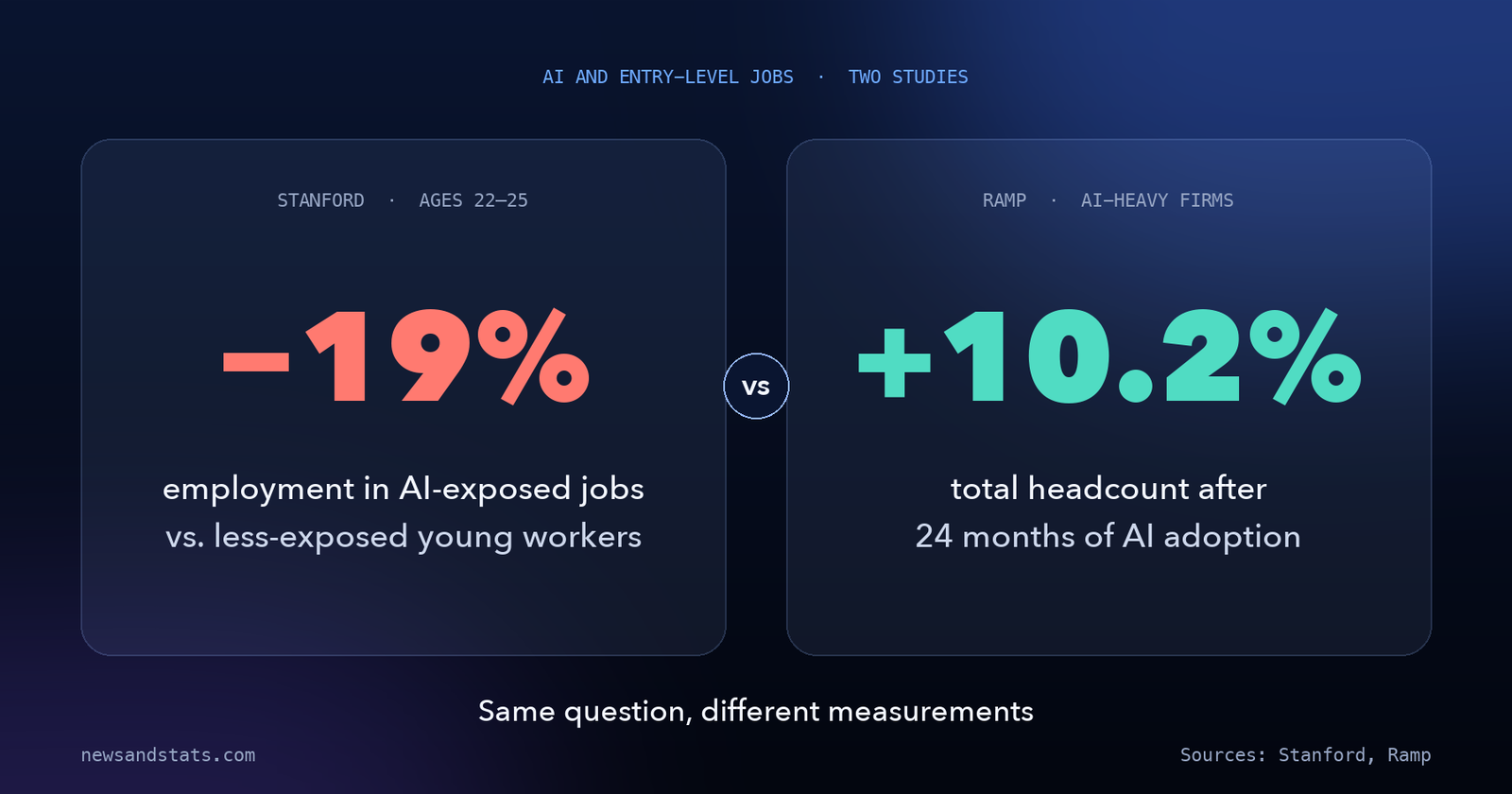
In 2026 two serious studies looked at AI and jobs and seemed to reach opposite conclusions. One says young workers in AI-exposed occupations are falling behind. The other says companies that spend heavily on AI are hiring more people, including more at entry level. Both can be right, and the reason is a good lesson in reading labor data.
Study 1: Stanford’s “Canaries in the Coal Mine?”
Who: Erik Brynjolfsson, Bharat Chandar and Ruyu Chen at Stanford’s Digital Economy Lab. First published in 2025, revised on 12 August 2026.
Data: Payroll records from ADP covering millions of US workers, through June 2026.
Finding: Employment of workers aged 22 to 25 in AI-exposed occupations is 19% below where it would be had it kept pace with young workers in less-exposed jobs. Experienced workers show no comparable gap.
Other details that matter:
- The gap is concentrated in occupations where AI mainly substitutes for human tasks. Where AI mainly complements workers, employment is flat or rising.
- It runs mainly through reduced hiring of young workers rather than more layoffs.
- The authors find no evidence of widespread job loss across the whole economy.
- They describe their results as early and descriptive, not proof of cause.
Study 2: Ramp and Revelio Labs, “A New Look at AI’s Impact on Jobs”
Who: Ramp, the spend-management company, with workforce-data firm Revelio Labs. Dated 30 June 2026.
Data: About 21,500 US firms, matching company spending on AI with workforce data.
Finding: Among firms with the highest AI spending, total headcount was 10.2% higher over the 24 months after adoption. Entry-level headcount rose 12% and managers and officers rose 6.7%. Firms with low AI spending showed no statistically significant change.
Other details that matter:
- “High intensity” means roughly the top third of firms by AI spending per employee, around $30 per employee per month in the first months.
- The study covers white-collar jobs, and most of the gains show up in technology-sector firms.
- Gains take time. A co-author said they did not show up for at least six to twelve months.
Why they can both be true
| Stanford | Ramp | |
|---|---|---|
| Unit measured | People, by age and occupation | Companies, by AI spending |
| Question | Are young workers in AI-exposed jobs doing worse than similar young workers elsewhere? | Do firms that spend more on AI end up with more or fewer staff? |
| Scope | All US employers in the ADP data | Companies that appear in Ramp’s spending data, mostly white-collar and tech-heavy |
| Result | 19% below trend for ages 22-25 | +10.2% headcount, +12% entry level |
The studies ask different questions, so they do not directly contradict each other. Several things could reconcile them:
- Different level of analysis. A firm can grow overall while the hiring pipeline across the wider economy shifts away from young workers in particular jobs.
- Different samples. Ramp’s firms skew toward tech companies that are already growing fast. The Stanford data covers the whole economy.
- Who adopts AI. Companies that can afford to spend heavily on AI may simply be the healthy ones. Ramp’s researchers tried to address this by comparing early adopters with firms that adopted later, but selection is hard to remove completely.
- Substitute versus complement. Stanford’s most useful finding is that the answer depends on what AI is doing in a given job. Where it replaces tasks, hiring falls. Where it helps people do more, it does not.
A third data point
A separate SignalFire report found that in 2024 big tech companies cut hiring of new college graduates by 25% versus the year before, while increasing hiring of people with two to five years of experience by 27%. It is consistent with the Stanford pattern, though it measures one sector and one year, and it cannot by itself show AI was the cause.
What to watch
- Hiring, not layoffs. Both the Stanford result and the patterns above are about who gets hired, not who gets fired. Layoff headlines can miss it.
- Occupation, not “AI exposure” in general. Whether a job’s tasks are being substituted or complemented is the question that predicts the outcome.
- The lag. If Ramp’s co-author is right that gains take six to twelve months, 2026 data may understate where AI adoption ends up.
- Seniority. Stanford finds experienced workers are not affected. The open question is where the next generation of experienced workers comes from if entry-level hiring thins.
Sources
- Brynjolfsson, Chandar and Chen, “Canaries in the Coal Mine? Six Facts about the Recent Employment Effects of Artificial Intelligence,” Stanford Digital Economy Lab (revised 12 August 2026)
- Ramp and Revelio Labs, “A New Look at AI’s Impact on Jobs” (30 June 2026)
- SignalFire, “State of Talent Report 2025,” as reported by Tech.co