
If your phone, laptop or cloud bill has crept up this year, memory chips are a likely culprit. DRAM, the short-term working memory in almost every electronic device, is in a shortage, and AI is the reason. Here is what the data shows.
A $155 billion quarter
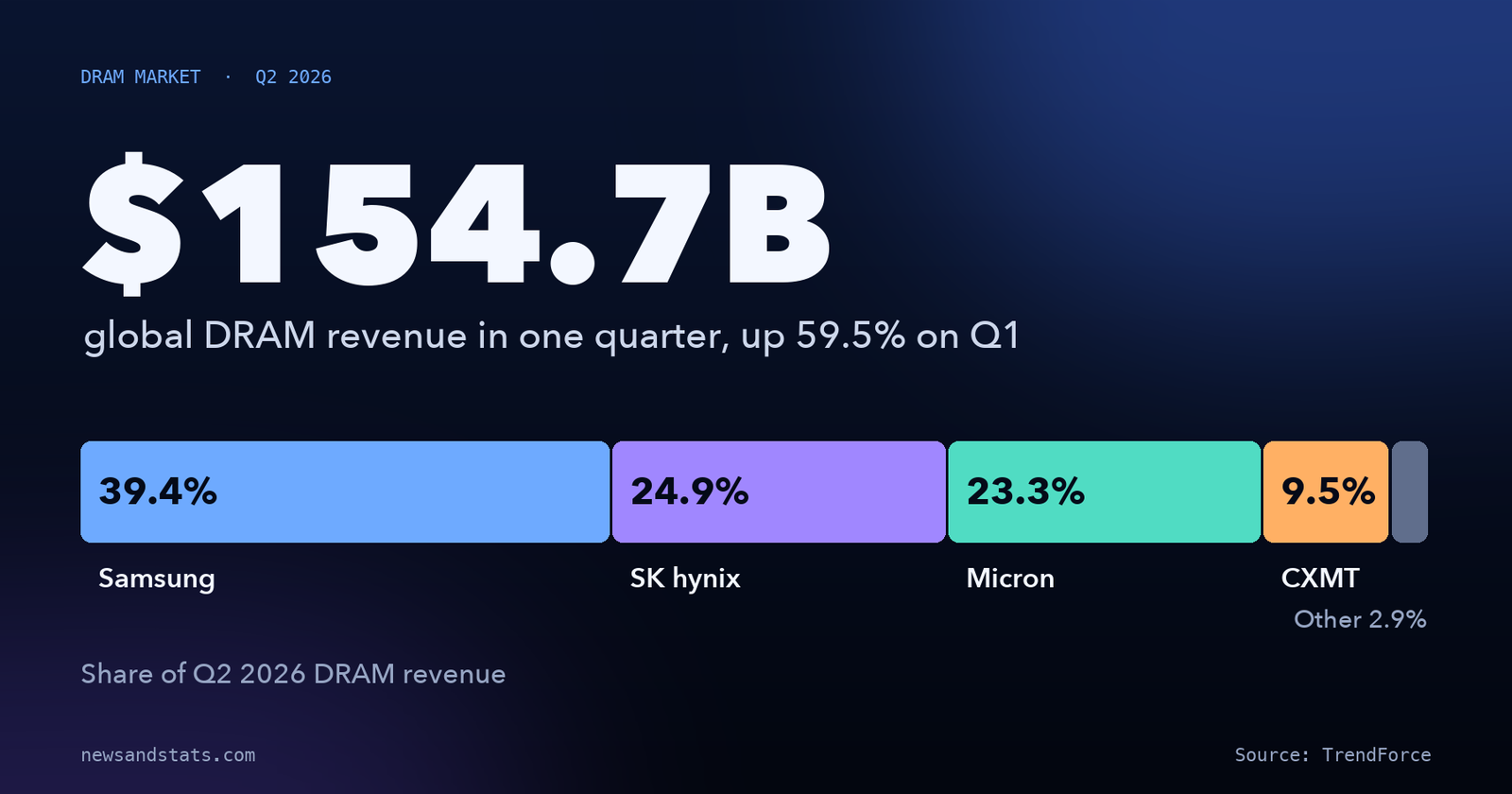
In the second quarter of 2026, the global DRAM industry booked about $154.7 billion in revenue, up 59.5% from about $97 billion in the first quarter, according to TrendForce. Revenue rose far faster than the amount of memory shipped. Prices did most of the work. TrendForce’s own explanation is that supply expansion keeps lagging demand and that supplier inventories are at historic lows.
For context, Counterpoint Research reported that DRAM prices rose 80% to 90% in the first quarter of 2026 alone.
Who sells the memory
| Supplier | Q2 2026 revenue | Growth vs Q1 | Share of revenue | Share in Q1 |
|---|---|---|---|---|
| Samsung | $61.0B | +63.4% | 39.4% | 38.5% |
| SK hynix | $38.6B | +37.9% | 24.9% | 28.8% |
| Micron | $36.0B | +65.5% | 23.3% | 22.4% |
| CXMT (China) | $14.6B | +99.3% | 9.5% | 7.6% |
| Nanya | $2.6B | +68.3% | 1.7% | 1.6% |
| Others | about $1.9B | n/a | about 1.2% | n/a |
Source: TrendForce, Q2 2026 DRAM industry revenue, published 7 September 2026.
Three things stand out.
- Samsung is back in front. Its share rose to 39.4%, helped by an early start on mass production of the next-generation HBM4.
- SK hynix lost share while growing. Its revenue grew 37.9%, but it fell from 28.8% to 24.9%. TrendForce attributes this to a heavy mix of high-bandwidth memory, which lowered its average selling price growth. Counterpoint, which measures differently, puts the three leaders at 39%, 26% and 25%.
- China’s CXMT nearly doubled revenue. It grew 99.3% and now holds 9.5%, a sign of how much extra demand the big three cannot cover.
What is HBM, and why does it matter
High-bandwidth memory (HBM) is the stacked memory that sits next to AI processors. It is harder to make than ordinary DRAM, so each wafer yields fewer bits, which means every HBM chip a manufacturer makes takes capacity away from the DRAM in laptops, phones and servers.
SemiAnalysis estimates HBM costs about three times as much as other memory types and can be half or more of the cost of a packaged AI GPU. Micron said that its HBM and other cloud-related memory went from 17% of its DRAM revenue in 2023 to nearly 50% in 2025, and projects the HBM market growing from $35 billion in 2025 to $100 billion by 2028.
The result is a squeeze that has spread beyond AI. Smaller makers such as Nanya and Winbond are benefiting as demand spills over to older DDR3 and DDR4 memory.
How long will it last
Prices are still rising, but more slowly. TrendForce expects conventional DRAM contract prices to rise a further 13% to 18% in the third quarter of 2026, a moderation from the earlier surge.
On the longer view, the supply picture depends on factories that have not been finished yet:
| Fab | Location | Expected |
|---|---|---|
| SK hynix HBM fab | Cheongju, South Korea | 2027 |
| Micron HBM fab | Singapore | 2027 |
| Micron (retooled fab) | Taiwan | second half of 2027 |
| Samsung | Pyeongtaek, South Korea | 2028 |
| SK hynix HBM and packaging | West Lafayette, Indiana | end of 2028 |
| Micron DRAM complex | New York | full production 2030 |
Intel CEO Lip-Bu Tan said in February that he expects no relief until 2028. And as one economist told IEEE Spectrum, prices tend to fall more slowly than they rise, so they could stay high even after new capacity arrives.
There is a risk on the other side too. If AI spending slows just as these factories finish, the industry could swing from shortage to oversupply, as memory has done in earlier cycles.
What it means
- For consumers: expect higher prices and slower price cuts on phones, laptops and PCs.
- For AI companies: memory, not just GPUs, is a bottleneck on how fast data centers get built.
- For the industry: a three-way race (Samsung, SK hynix, Micron) with China’s CXMT growing fast on the edge.
Sources
- TrendForce, Q2 2026 DRAM industry revenue report (7 September 2026), via Evertiq
- Counterpoint Research, Q2 2026 Global Memory Tracker (August 2026)
- IEEE Spectrum, “How and When the Memory Chip Shortage Will End” (10 February 2026)