Four companies are on course to spend roughly three-quarters of a trillion dollars on data centers, chips and servers this year. When 2026 began, their combined plan was a little over $640 billion. After the latest round of earnings in July, it is $735 billion to $750 billion, and every update since January has gone up.
This post goes through what each company is spending, what it is buying, whether the revenue is arriving, and how the bills are being paid.
Company by company
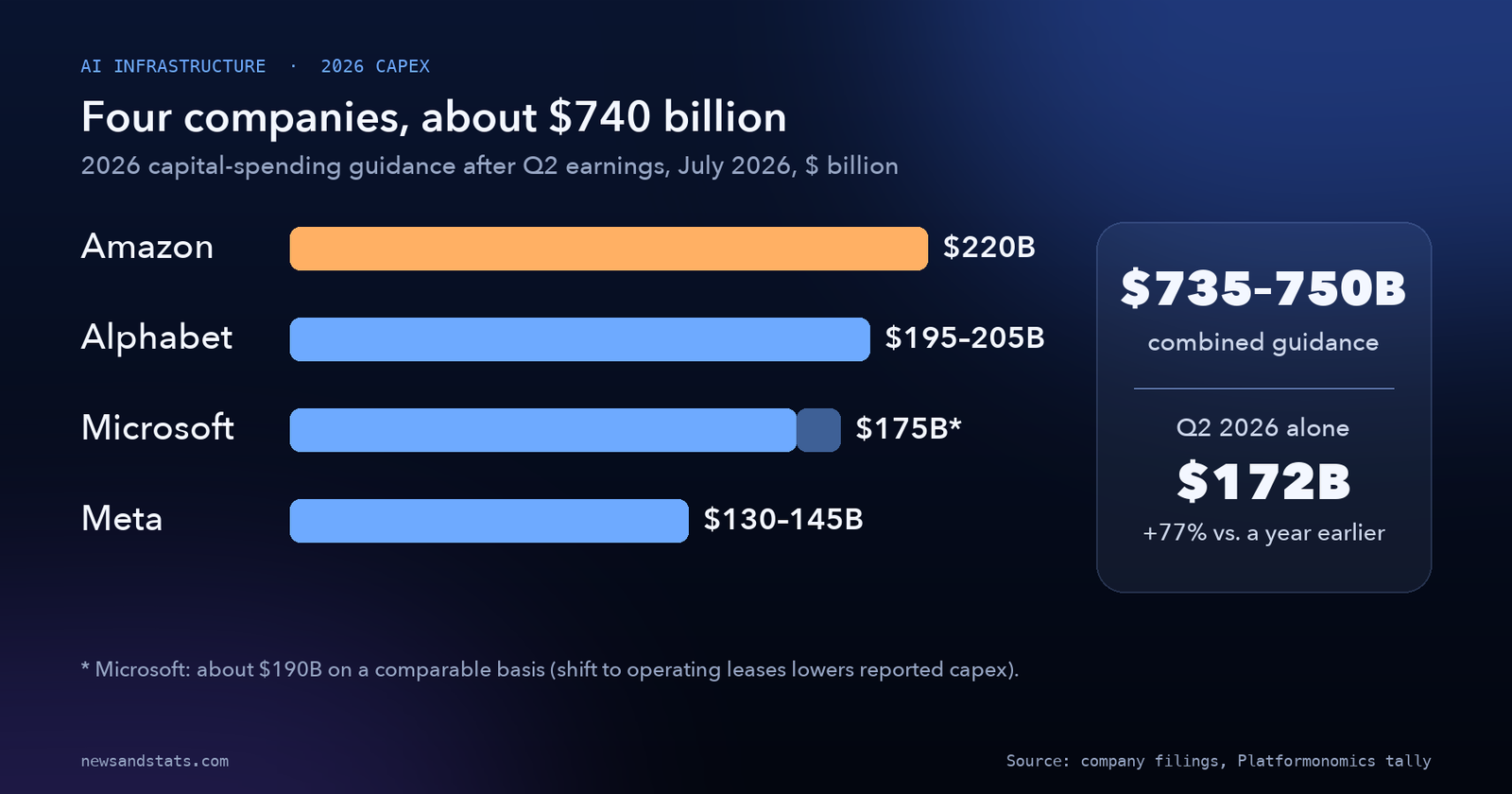
Capital expenditure, or capex, is money spent on long-lived assets: land, buildings, servers and networking. Here is where each company stood after its second-quarter results, based on an independent tally of company filings by Platformonomics:
| Company | Q2 2026 capex | Change vs a year earlier | 2026 guidance | Earlier guidance |
|---|---|---|---|---|
| Amazon | $54.8B | +65% | about $220B | $200B (January and April) |
| Alphabet | $44.9B | +100% | $195B to $205B | $175B to $185B (January); $180B to $190B (April) |
| Microsoft | $41.0B | +69% | $175B (about $190B comparable) | over $140B (January); $190B (April) |
| Meta | $31.1B | +83% | $130B to $145B | $115B to $135B (January); $125B to $145B (April) |
Amazon, Microsoft and Meta count finance leases in these figures. Combined, the four companies spent about $172 billion in the second quarter alone, up 29% on the first quarter and 77% on a year earlier. In the first half, they spent just under $305 billion.
A few details from the calls:
- Amazon raised its guidance by $20 billion and attributed the increase to higher memory chip costs. It also said that even at $220 billion it “will still not have enough capacity to meet all the demand” in 2026. Of its $54.8 billion quarter, about $48.6 billion was for AWS.
- Alphabet said about 60% of its technical infrastructure spending went to servers and 40% to data centers and networking. It expects capex to “increase significantly” again in 2027.
- Microsoft said about two-thirds of its quarterly spending was for short-lived assets, mainly processors and GPUs. Its reported $175 billion is lower than the $190 billion it guided to in April only because of an accounting change: more future data-center leases will be classed as operating leases, which do not count as capex.
- Meta announced a data-center venture with BlackRock in El Paso. Tallies such as Platformonomics expect Meta’s real spending to be higher than its reported capex, because joint ventures keep part of the cost off its balance sheet.
The ratchet: every update has gone up
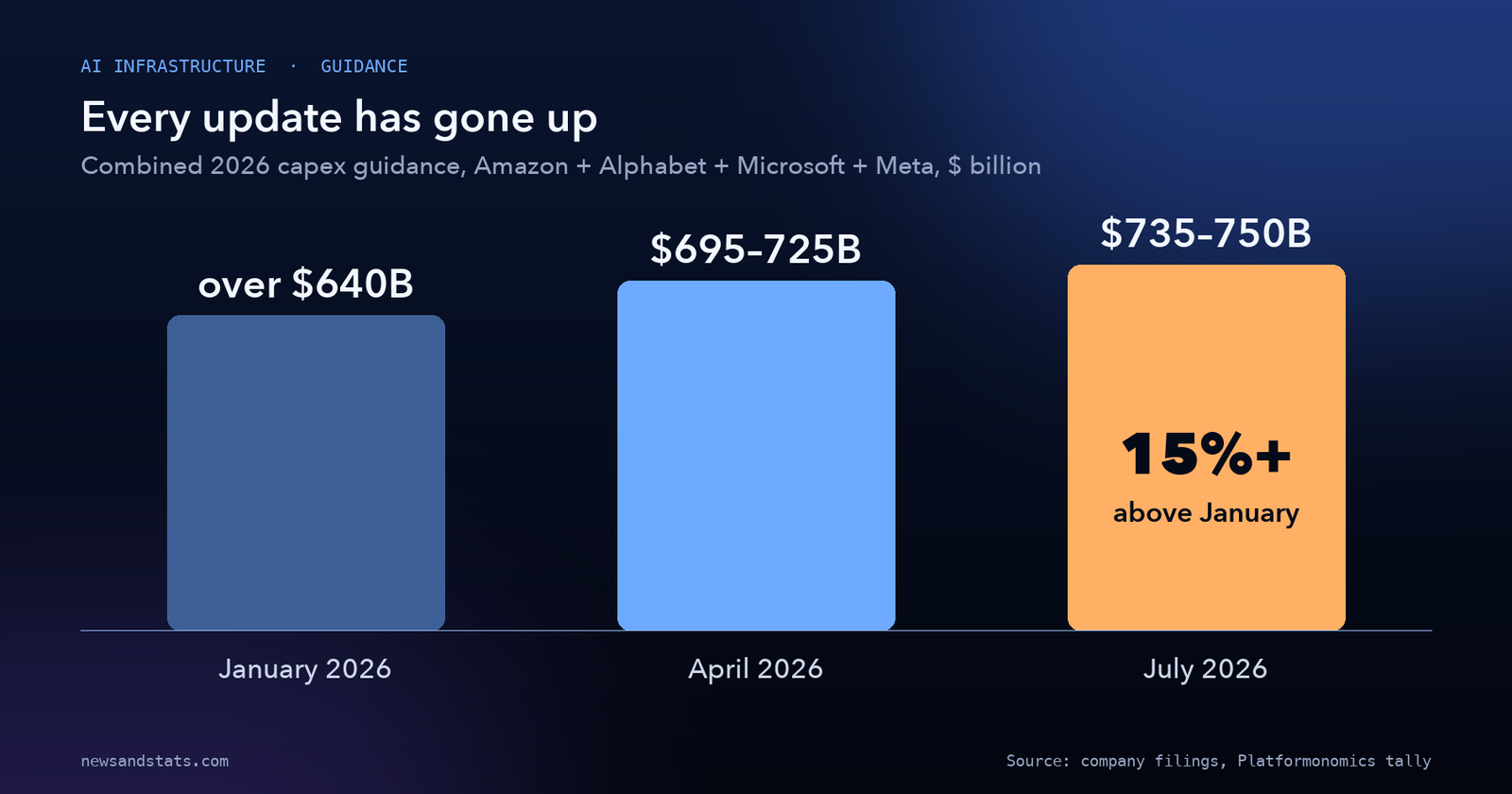
At the start of the year, the four companies’ combined guidance was a little over $640 billion. In April it was $695 to $725 billion. After July’s results, it is $735 to $750 billion, roughly 15% or more above where the year began. None of the four has cut its plan.
The trend extends beyond 2026. Alphabet has said capex will rise significantly again next year. Moody’s has estimated that US hyperscalers will spend about $700 billion in 2026, six times the 2022 level, and a further $870 billion in 2027, though it warns that electricity shortages are likely to constrain AI capacity through 2027. Those Moody’s figures are as reported by trade press, and its $700 billion covers a different group of companies, so it is not directly comparable to the four-company total above.
What the money buys
Much of this is chips. Nvidia’s fiscal second quarter, which ended on 26 July, produced revenue of $96.2 billion, up 106% from a year earlier, with data-center revenue of $89.0 billion, up 117%. Its guidance for the next quarter is about $108 billion, and it said it is assuming no data-center compute revenue from China.
Memory is a growing part of the bill. Amazon and Microsoft have both cited higher component prices, in particular memory, as a reason for raising spending. We covered the cause in our post on the DRAM shortage: DRAM industry revenue rose 59.5% in the second quarter as AI demand soaked up supply. The implication is that part of the capex increase is simply higher prices for the same equipment, not more equipment. Paying more per chip is not the same as building more capacity.
The mix also matters for how fast the spending ages. Servers and GPUs are short-lived assets, replaced every few years. Buildings last decades. A higher share going to servers means a heavier depreciation charge later.
Is the revenue arriving?
The demand signals are strong:
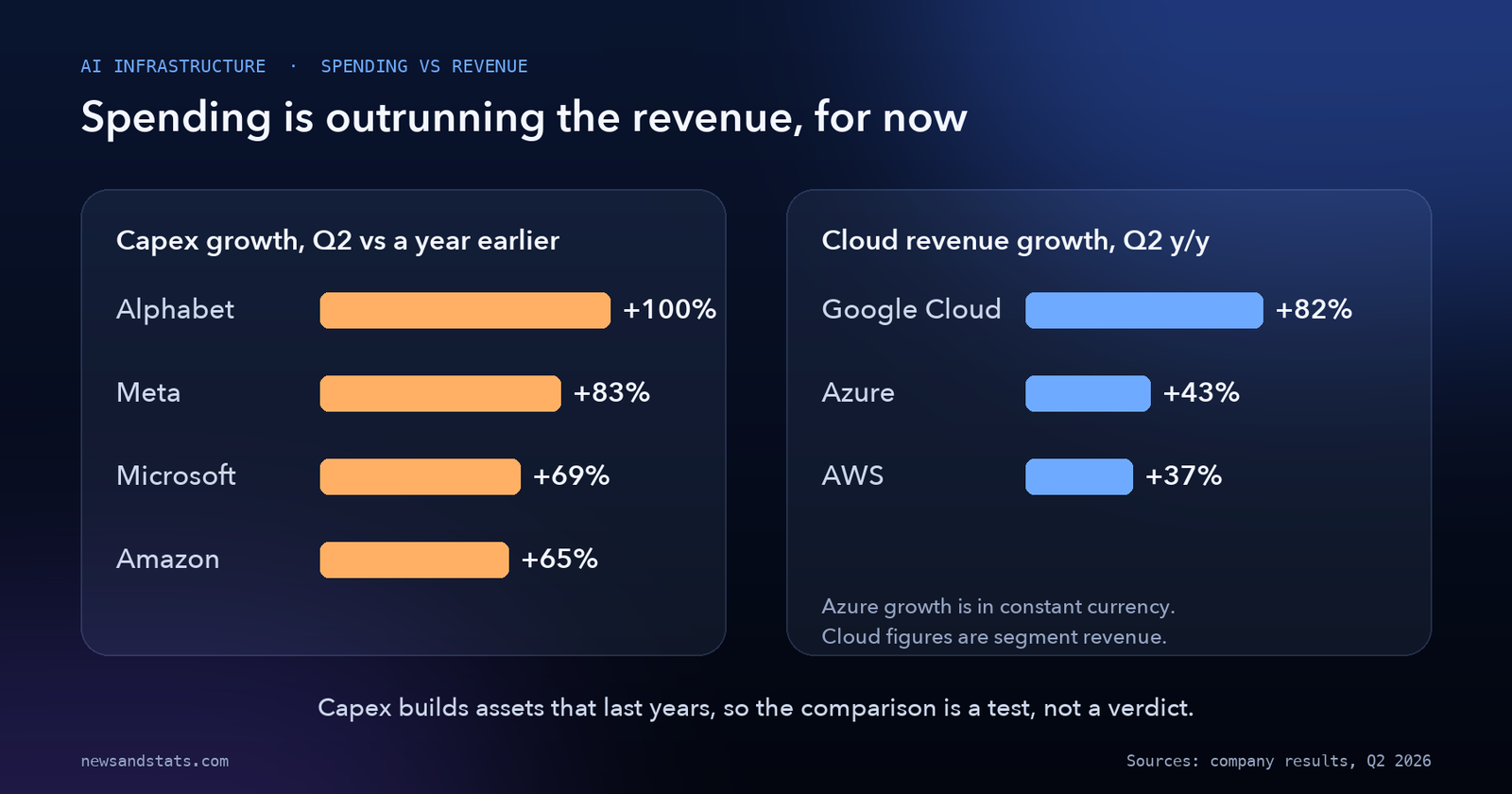
- Google Cloud revenue rose 82% to $24.8 billion in the second quarter, with an operating margin of 35.6%, up from 20.7% a year earlier. Its backlog of contracted future revenue reached $514 billion, up from $460 billion in the first quarter.
- AWS grew 37% to $42.2 billion, its fastest growth in 18 quarters, with operating income of $16.6 billion, a margin of 39.4%. Management said 2027 data-center capacity is already largely reserved.
- Azure grew 43% in constant currency and passed $100 billion in annual revenue for the first time. Microsoft’s commercial backlog was reported at $678 billion, a company-wide figure.
Even so, capex is growing faster than cloud revenue at each company that reports both, as the chart above shows. Alphabet’s capex rose 100% while Google Cloud grew 82%; Microsoft’s capex grew 69% against Azure’s 43%; Amazon’s grew 65% against AWS’s 37%. That does not mean the spending is a mistake, because capex builds assets that earn revenue for years. It does mean the payback depends on growth continuing.
A rough scale check helps. If you annualize the second-quarter cloud revenues, Google Cloud is about $99 billion, AWS about $169 billion, and Azure is at least $100 billion, for a total of around $370 billion. Planned 2026 capex of about $740 billion is therefore roughly twice the combined annual run-rate of the three largest clouds. That comparison is crude: cloud revenue is not all AI revenue, capex also supports Meta’s own AI work (which has no cloud business), and assets last longer than one year. But it shows how much future growth is already priced into the spending.
Where the money lands: the supply chain
Every dollar of capex becomes someone else’s revenue, and the suppliers are posting numbers to match. As a scale reference, Nvidia’s data-center revenue of $89.0 billion in its latest quarter is equal to about half of the $172 billion the four hyperscalers spent in the same period. That is only a rough comparison, because Nvidia also sells to other cloud providers, AI labs and governments, and the hyperscalers spend on buildings, networking and their own chips as well. But it shows how much of the capex boom flows through a single supplier.
Memory makers are the next winners. TrendForce’s figures put global DRAM revenue at $154.7 billion in the second quarter, up 59.5% from the first, with Samsung, SK hynix and Micron taking more than 85% of it. Further down the chain are the makers of power equipment, cooling systems and cables, and the construction firms and utilities that connect data centers to the grid. Their order books are a useful early read on whether the spending is continuing.
The same concentration cuts the other way. If one or two of the four slow their spending, the effect lands on a small group of suppliers whose own plans, such as new memory factories, assume the boom continues. That is part of why investors watch the hyperscalers’ guidance as closely as they watch their cloud revenue.
The 2027 question
The numbers so far describe 2026, but the harder question is what happens next year. Alphabet has said its capex will increase significantly in 2027. Moody’s, via trade-press coverage, projects US hyperscaler capex of about $870 billion. Amazon has said its 2027 data-center capacity is largely reserved already, with some commitments stretching to 2028, and Alphabet has said most of its signed chip-supply deals will convert to revenue in 2027.
That timing matters. Spending in 2026 is being justified by revenue that largely arrives in 2027 and after. If the contracts convert on schedule, backlogs of $514 billion at Google Cloud and several hundred billion more at Amazon and Microsoft would turn into reported revenue, and today’s capex would look prudent. If customers delay, if power or memory constraints push deliveries back, or if the AI labs that signed multi-year commitments cannot keep paying, the gap between spending and revenue widens at precisely the point when free cash flow is already thin.
Who pays: cash flow and debt
The simplest answer is that the companies pay with their own cash, but the cushion is thinning. Free cash flow, the money left after capex, has deteriorated:
- Alphabet’s second-quarter free cash flow was negative $5.9 billion, though its trailing twelve-month total was still $53.3 billion.
- Meta’s second-quarter free cash flow was just $784 million.
- Amazon’s trailing twelve-month free cash flow has turned negative.
- Across the four companies, trailing free cash flow is down 24% from a year earlier.
Analyst estimates of how much of operating cash flow capex now absorbs vary. UBS has said it is on track to take nearly 100% this year, against a ten-year average of about 40%. Bank of America puts it at 94%, up from 76% in 2024. Both figures reach us through secondary sources, but the direction is clear.
The gap is being filled with borrowing and creative accounting. Morgan Stanley has projected about $570 billion of AI-linked bond issuance in 2026, with roughly $236 billion already placed by the end of May, according to a trade-press summary. FactSet estimates that the share of capex funded by new debt rose from about 9% in fiscal 2024 to about 32% on a trailing basis by mid-2026. Reuters has quoted portfolio managers saying hyperscaler bonds trade at wider spreads than similarly rated companies, which suggests investors want extra compensation for the risk.
Leasing is a quieter route. Microsoft says more of its future data-center leases will be operating leases that do not count as capex, and Meta is using joint ventures. Neither is improper, but both make reported capex a less complete measure of what is being built, as Platformonomics notes.
The depreciation question
When a company buys a server, it spreads the cost over the server’s assumed useful life. A longer assumed life means a smaller annual charge and higher reported profit. So the assumed life of AI hardware is a live argument.
Microsoft said it will extend the useful life of data-center and office buildings from 15 to 25 years from its next fiscal year, though it expects little effect on near-term operating income. Buildings and servers are different, however. Investor Michael Burry has argued that big tech companies depreciate Nvidia GPUs over five to six years when their economic life is closer to two or three, and has estimated about $176 billion of understated depreciation across 2026 to 2028. That is an attributed estimate, not an accounting finding. Amazon moved in the other direction in early 2025, shortening the life of some servers from six years to five. JPMorgan Asset Management has estimated that restating GPU and networking spending over three years would cut 2025 earnings per share by roughly 7% at Amazon, Meta and Microsoft, 6% at Alphabet and 17% at Oracle. Defenders note that a GPU can stop being cutting-edge for training while staying useful for other work, so one number does not fit all.
Nobody outside the companies knows the true answer yet, which is why it is a risk worth watching rather than a settled problem.
The physical limits: power and memory
Money is not the only constraint. Gartner estimates global data-center electricity use at 565 terawatt-hours in 2026, up 26% from 447 TWh in 2025. It says AI capacity is now limited by the availability of power. Large power transformers have lead times of around 2.5 years, and some grid-connection queues exceed five years.
Memory is the other bottleneck. As the DRAM post explained, new memory fabs from Micron, SK hynix and Samsung do not arrive until 2027 to 2030, and Intel’s chief executive has said he sees no relief until 2028. Until then, higher component prices raise the cost of every data center, and Amazon has already said so.
What to watch
- The next earnings round. Results for July to September will show whether guidance moves up again, and what the companies say about 2027. Alphabet has already signalled a significant rise.
- Free cash flow. If more of the four turn negative for a full year, debt issuance has to rise.
- Credit spreads. Wider spreads on hyperscaler bonds would be the first sign investors are demanding more for the risk.
- Memory prices. Further rises mean more of the capex increase is price, not capacity.
- Power availability. Delays in grid connections would push revenue out while spending continues.
- Backlog conversion. Google Cloud’s $514 billion backlog and the large commitments at AWS and Microsoft only matter if they convert to revenue on schedule.
The bottom line
Spending of $735 billion to $750 billion on AI infrastructure in one year is without precedent for four companies, and the plans keep rising. The demand evidence is real: cloud growth has accelerated, backlogs are enormous and capacity is sold out well into 2027. But capex is growing faster than the revenue it supports, free cash flow is shrinking, borrowing is rising and part of the increase is just more expensive memory. The bet works if cloud and AI revenue keep compounding for several more years. If they slow, the assets, and the debt that financed them, remain.
Sources
- Platformonomics, “Follow the CAPEX: Q2 2026 Scoreboard” (company filings and earnings calls, July 2026)
- Company Q2 2026 earnings releases and calls: Alphabet (22 July), Microsoft, Meta (29 July), Amazon (30 July), as summarized by Platformonomics and UpperEdge
- Nvidia, press release for the second quarter of fiscal 2027 (SEC Form 8-K, 26 August 2026)
- TrendForce, Q2 2026 DRAM industry revenue (7 September 2026)
- Moody’s Ratings on hyperscaler capex, as reported by DatacenterDynamics and others
- Morgan Stanley, UBS, Bank of America and FactSet estimates on debt and cash flow, as summarized in AI Weekly, Scenarica and HeyGoTrade
- Gartner, “Data center electricity consumption to grow 26% in 2026” (10 June 2026)