
Headline debt-to-GDP ratios tell only half of a government’s fiscal story; the rest depends on who owns the bonds and how soon they come due. On November 20, 2026, Eurostat released updated general government gross debt structure data (gov_10dd_ggd and gov_10dd_rmd) for the end of 2025, revealing sharp institutional and maturity divides across the European Union.
Non-resident investors held more than half of all general government debt in 16 EU member states at the end of 2025—reaching 90% in Cyprus—while resident financial corporations held over half in 7 countries, led by Czechia and Sweden at 69% each. At the same time, the share of government debt maturing within one year or less climbed in 18 out of 26 reporting EU countries between 2024 and 2025, increasing near-term refinancing exposure across the bloc in World in Numbers.
Who owns EU government debt: foreign investors vs. domestic banks
Eurostat’s November 20, 2026 release divides general government gross debt holders into three primary institutional buckets: resident financial corporations (such as domestic banks, insurers, and pension funds), non-residents (the rest of the world sector, including foreign investors and official lenders), and resident non-financial sectors (non-financial corporations, households, and non-profit institutions serving households).
| Institutional Debt Holder Sector (End of 2025) | EU-Wide Pattern | Highest Member States (Share of Total Debt) |
|---|---|---|
| Non-residents (rest of the world) | Over 50% in 16 EU countries | Cyprus (90%), Estonia (78%), Latvia (74%), Lithuania (72%), Greece (71%) |
| Resident financial corporations | Over 50% in 7 EU countries | Czechia (69%), Sweden (69%), Croatia (61%), Poland (56%), Malta (54%) |
| Resident non-financial sectors | Under 10% in most EU countries | Malta (24%), Hungary (23%), Portugal (19%), Italy (14%), Ireland (12%) |
Source: Eurostat, Structure of government debt (gov_10dd_ggd), November 20, 2026.
Foreign ownership dominates smaller euro-area and Baltic sovereigns. Cyprus tops the EU with 90% of its general government debt held by non-residents, followed by Estonia (78%), Latvia (74%), Lithuania (72%), and Greece (71%). In total, 16 EU member states rely on external creditors for more than half of their sovereign financing.
By contrast, seven EU countries rely on resident financial corporations for more than half of their government debt. Czechia and Sweden tie at the top with 69% each, ahead of Croatia (61%), Poland (56%), and Malta (54%). Several of those economies—Czechia, Sweden, and Poland—operate outside the eurozone with domestic currencies and deep local banking and pension systems that absorb sovereign issuance at home.
Croatia and Poland illustrate a middle tier between the Czech-Swedish peak and the 50% threshold: at 61% and 56% respectively, domestic financial institutions hold clear majorities of government debt without reaching the 69% concentration seen in Prague and Stockholm. Malta sits at the boundary of the group at 54%, but as the next section shows, its resident financial corporations figure is only part of the country’s domestic funding picture once non-financial holders are added in.
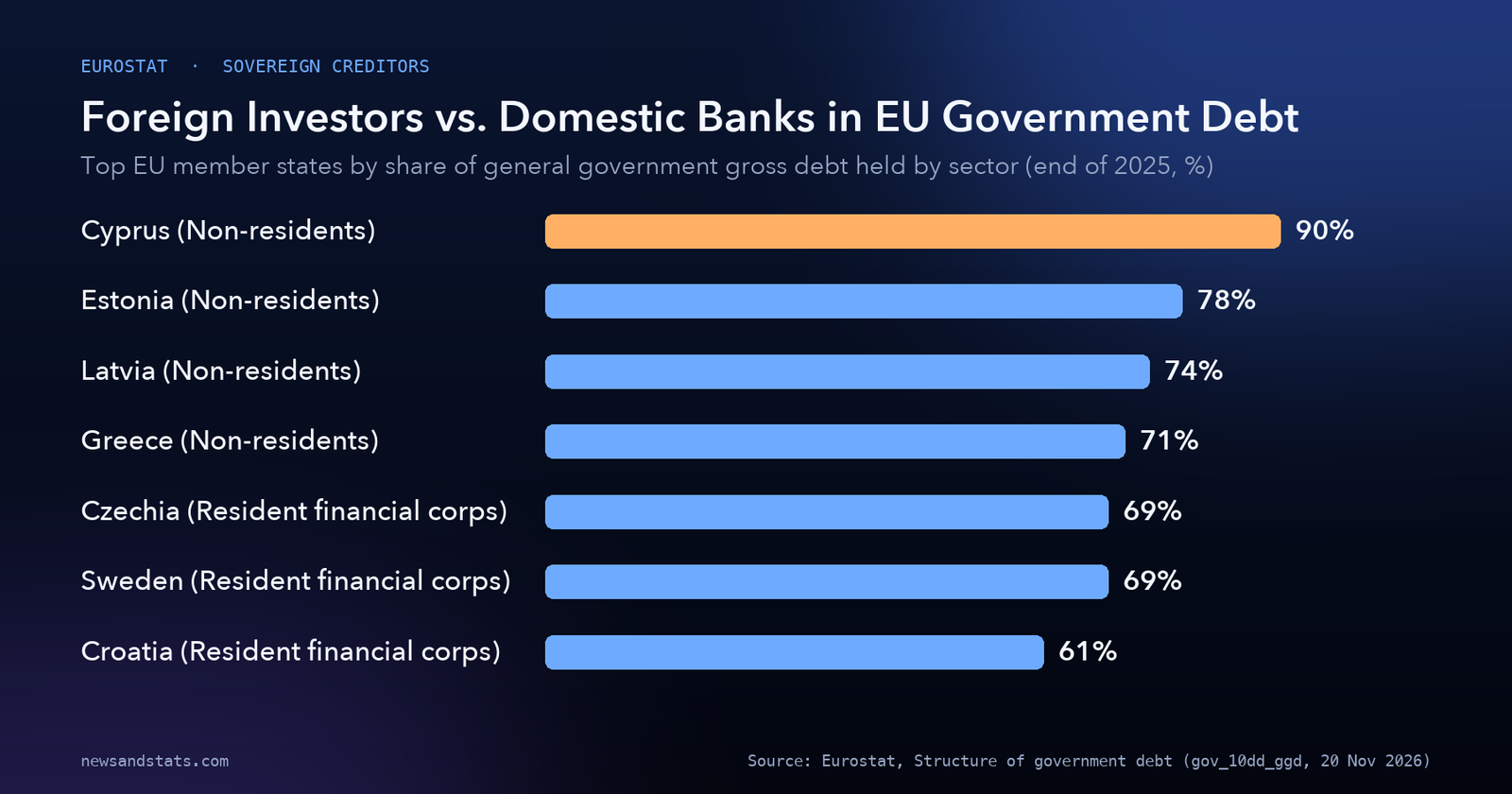
Source: Eurostat (gov_10dd_ggd), November 20, 2026.
The retail and corporate domestic base: Malta’s 24% and Hungary’s 23%
In most European Union countries, domestic households and non-financial businesses hold less than 10% of general government debt. Five member states stand out as clear exceptions where retail bond programs and domestic non-financial demand anchor a substantial slice of public borrowing.
Malta leads the bloc with 24% of its general government debt held by resident non-financial sectors at the end of 2025. Combined with the 54% held by Malta’s resident financial corporations, domestic investors hold 78% of Maltese government debt—leaving just 22% in non-resident hands. Hungary ranks second in non-financial domestic ownership at 23%, followed by Portugal (19%), Italy (14%), and Ireland (12%), reflecting targeted retail treasury bond programs in Budapest, Lisbon, and Rome.
Short-term remaining maturity: Sweden at 38% vs. Slovakia at 6%
Who holds the debt determines creditor stability; remaining maturity determines how fast higher interest rates feed into government budgets. Eurostat’s remaining maturity dataset (gov_10dd_rmd) measures the share of total general government gross debt scheduled for redemption within one year or less.
At the end of 2025, Sweden recorded the highest short-term remaining maturity share in the EU at 38%, followed by Portugal (27%), Ireland (26%), and Estonia (20%). At the opposite end, Slovakia locked in the longest-dated near-term profile with just 6% of its debt due within one year, closely followed by Greece (7%) and Lithuania (9%).
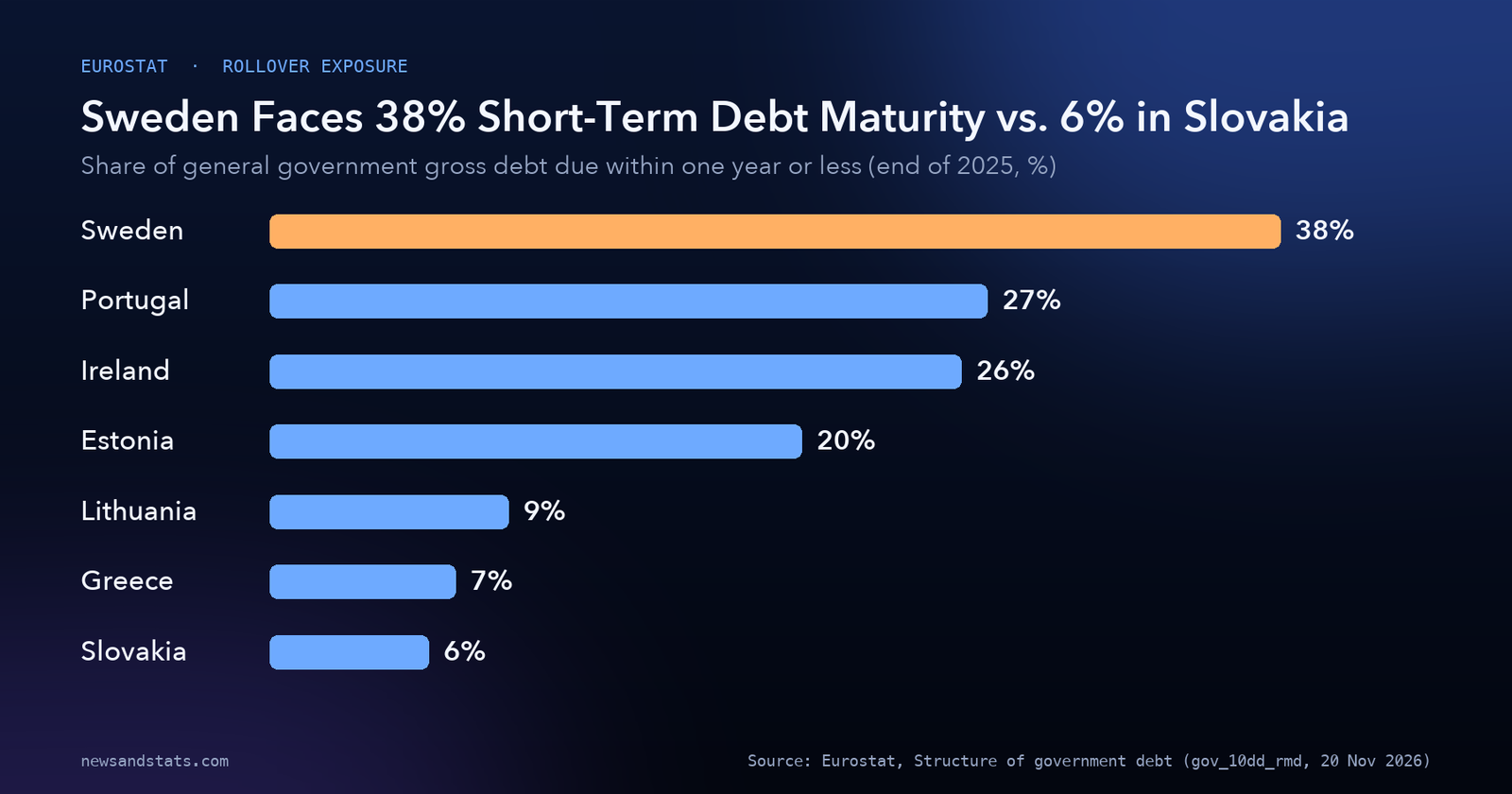
Source: Eurostat (gov_10dd_rmd), November 20, 2026.
The gap between Sweden (38%) and Slovakia (6%) spans 32 percentage points—a 6.33-fold difference in the share of sovereign debt facing rollover within 12 months. For Greece, a 7% short-term maturity share offsets its 71% non-resident ownership, insulating annual budgets from sudden refinancing spikes even when foreign ownership is high. Conversely, Estonia combines 78% non-resident ownership with a 20% short-term maturity share, placing a fifth of its debt stock up for near-term redemption. Portugal and Ireland sit between those two extremes, at 27% and 26% short-term maturity respectively, yet neither appears among the EU’s five highest non-resident-ownership countries, showing that rollover risk and foreign-ownership risk do not always move together.
The 2024–2025 shift: 18 of 26 countries shortened their debt profiles
Across the 26 EU countries with comparable remaining-maturity data for both 2024 and 2025, 18 countries—or 69.2%—saw their share of short-term remaining debt increase. Only 8 countries—30.8%—managed to reduce the share of debt maturing within one year.
Ireland posted the steepest increase at +3.4 percentage points (implying a rise from 22.6% at the end of 2024 to 26.0% at the end of 2025), followed by Estonia at +3.2 percentage points (up from an implied 16.8% to 20.0%). The Netherlands, Malta, and Slovenia tied for third among increases, each rising 3.1 percentage points year on year.
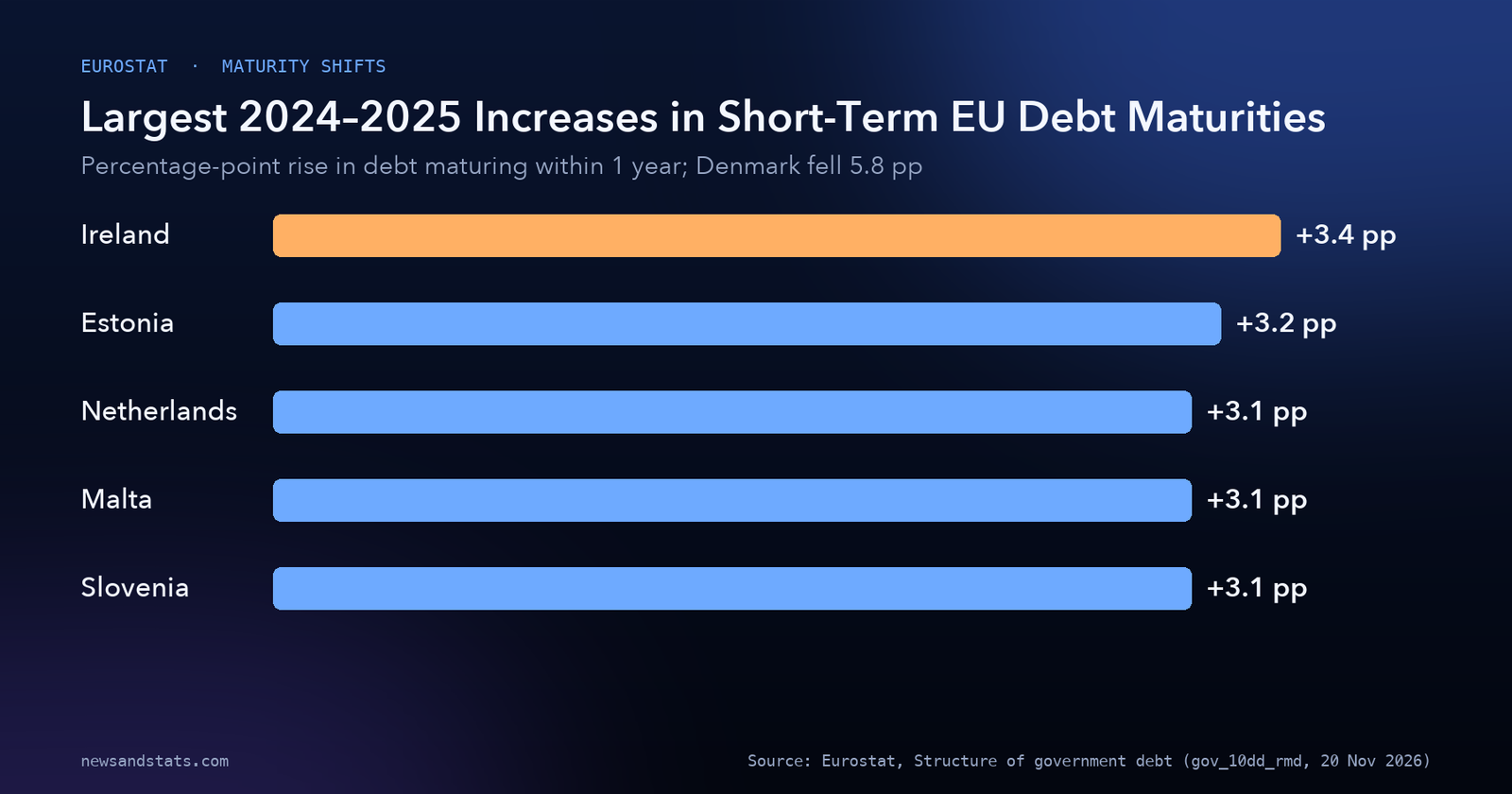
Source: Eurostat (gov_10dd_rmd), November 20, 2026.
Among the eight member states that lengthened their debt maturity profiles and cut near-term rollover exposure, Denmark recorded the largest drop at -5.8 percentage points. Croatia followed at -3.4 percentage points, and Slovakia—already the EU’s lowest in short-term maturity share—reduced its one-year-or-less share by a further 2.9 percentage points. The spread between Ireland’s +3.4-point increase and Denmark’s -5.8-point decrease amounts to 9.2 percentage points in a single year.
Why debt structure matters in a high-yield, energy-shocked economy
A broad shift toward shorter remaining maturities across 18 EU countries carries immediate fiscal consequences when sovereign bond yields are elevated. Every percentage point of debt rolling over within 12 months reprices at current market interest rates rather than legacy low-coupon rates—compressing fiscal space just as European governments manage industrial transition and energy-import costs tied to the 2026 energy shock.
These structural trade-offs also mirror global sovereign financing pressures. While EU member states benefit from deep euro and domestic capital markets—unlike low-income countries facing debt distress that rely on scarce external concessional funding—European treasuries still face trade-offs between locking in longer-dated yields and financing public investment for geoeconomics of development priorities and supply-chain competitiveness highlighted in our global trade outlook.
What to watch
- 2026–2027 rollover costs in the 18 shortening sovereigns: Whether Ireland (26% due within 1 year, +3.4 pp), Estonia (20%, +3.2 pp), and Sweden (38%) extend issuance tenors in 2027 or absorb higher short-end refinancing costs.
- Retail bond retention in high non-financial markets: Whether Malta (24%), Hungary (23%), Portugal (19%), Italy (14%), and Ireland (12%) maintain household and corporate appetite for sovereign bonds as deposit rates adjust.
- Foreign creditor sensitivity in the Baltics and Cyprus: How external bondholders—holding 71% to 90% of sovereign debt in Cyprus, Estonia, Latvia, Lithuania, and Greece—respond to EU fiscal rules and regional growth trends.
- Slovakia and Greece as maturity benchmarks: Whether other EU treasuries replicate the sub-10% short-term maturity profiles achieved by Slovakia (6%), Greece (7%), and Lithuania (9%).
The bottom line
Eurostat’s November 20, 2026 government debt data reveals two distinct vulnerabilities beneath Europe’s sovereign balance sheets. First, creditor concentration splits the bloc between 16 countries where foreign investors hold over half of public debt—reaching 90% in Cyprus—and 7 countries where domestic financial institutions hold over half, led by Czechia and Sweden at 69%. Second, short-term remaining maturity shares rose in 18 of 26 reporting EU countries between 2024 and 2025, leaving treasuries from Stockholm (38%) to Dublin (26%) more exposed to near-term interest-rate resets.