Ten low-income countries are already in debt distress, and 22 more are at high risk of joining them, according to the IMF’s own list of debt sustainability ratings. That list, jointly produced with the World Bank and updated as of 30 September 2026, rates 68 of the 70 countries eligible for the IMF’s concessional lending window. It is one of the most consequential rankings in global finance: it shapes how much aid money a country gets, on what terms, and how long a debt restructuring takes. This piece opens that list, country by country, and checks how current it actually is.
1. What “debt distress” means on this list
The IMF and World Bank built the Debt Sustainability Framework for Low-Income Countries (LIC-DSF) in April 2005 as a joint tool to guide how much low-income countries can safely borrow. The framework has been updated periodically since, most recently in September 2026, with a fully revised version due to roll out in the summer of 2027; in the meantime, assessments continue under the current framework.
Each country is first sorted into one of three “debt-carrying capacity” groups — Weak, Medium or Strong — based on a composite score for the strength of its policies, institutions and economic resilience. Countries with stronger capacity are held to higher debt-burden thresholds. A debt sustainability analysis (DSA) then projects a country’s debt burden and debt-service costs over the next ten years, under both a baseline scenario and stress tests, and compares the results against those thresholds. The underlying debt-burden indicators measure the stock of external debt and the cost of servicing it against a country’s GDP, exports and fiscal revenue. A “mechanical risk signal” is triggered whenever one of those indicators breaches its threshold for more than one year within that ten-year window. IMF and World Bank staff then apply judgment on top of that mechanical signal to set the final rating: low, moderate, high, or in debt distress.
2. The headline count: 10 in distress, 22 at high risk
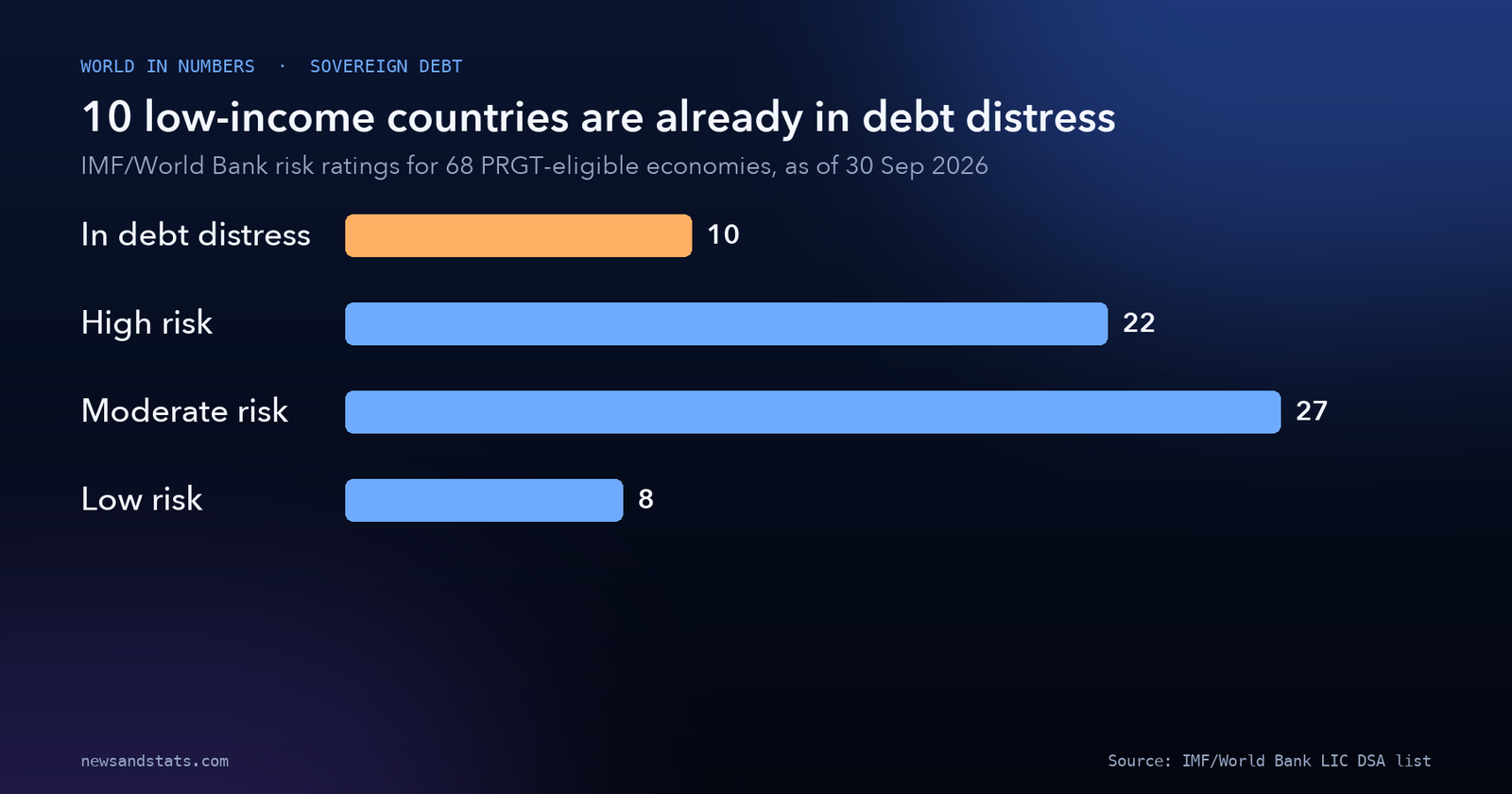
Source: IMF/World Bank LIC DSA list, as of 30 September 2026.
Of the 70 countries eligible for the IMF’s Poverty Reduction and Growth Trust (PRGT), 68 are rated under the LIC-DSF (Syria has no DSA yet, and St. Lucia uses a different framework). Of those 68, the IMF’s own list states that 10 are in debt distress and 22 are at high risk, as of 30 September 2026. One country, Eritrea, has never published a DSA at all, so it carries no rating. Counting the remaining rows of the table directly gives 27 countries at moderate risk and 8 at low risk; the source document’s own summary line instead states 26 and 9, a one-country gap that most likely reflects a reclassification made after that summary sentence was last updated. This article uses the row-by-row count. Either way, roughly half of all rated low-income countries sit at moderate or low risk — a reminder that “low-income” and “financially fragile” are not the same thing, a point worth keeping in mind alongside India and China’s economic gap at the other end of the income scale.
Which low-income countries are in debt distress right now?
| Country | Latest DSA published | IMF assessment |
|---|---|---|
| Republic of Congo | 3 April 2026 | Sustainable |
| Djibouti | 22 September 2025 | Unsustainable |
| Ethiopia | 13 July 2026 | Unsustainable |
| Grenada | 4 February 2025 | Sustainable |
| Lao P.D.R. | 20 February 2026 | Unsustainable |
| Malawi | 6 August 2025 | Unsustainable |
| São Tomé and Príncipe | 23 December 2025 | Sustainable |
| Sudan | 1 July 2021 | Sustainable |
| Yemen | 3 April 2026 | Unsustainable |
| Zimbabwe | 2 October 2025 | Unsustainable |
Source: IMF/World Bank LIC DSA list, as of 30 September 2026.
Geographically, the ten span almost every region the PRGT serves: Malawi, Zimbabwe, São Tomé and Príncipe and the Republic of Congo in Sub-Saharan Africa, Ethiopia in the Horn of Africa alongside Djibouti, Sudan in North Africa, Lao P.D.R. in Southeast Asia, Grenada in the Caribbean, and Yemen in the Middle East. This is not a problem confined to one continent or one kind of economy; it spans oil producers, small island states and conflict-affected states alike.
3. “In debt distress” is not the same as “unfixable”
Here is a distinction the headline count hides: being in debt distress, or at high risk of it, is a description of a country’s current debt burden, not necessarily a verdict that it cannot be repaired. The IMF only publishes a separate sustainability assessment — “Sustainable” or “Unsustainable” — for countries rated high risk or in debt distress; moderate- and low-risk countries get no such assessment, because the framework only asks the sustainability question once a country is already in trouble.
Tallying that assessment column across the 32 countries at high risk or in distress shows 23 rated “Sustainable” and 9 rated “Unsustainable” (this article’s own count of the same table). In plain terms, the IMF’s own staff judge that most of the countries in its worst two risk tiers, including 4 of the 10 already in distress, can still return to a sustainable debt path with the right policies and financing; only 9, including Djibouti, Ethiopia, Malawi, Yemen and Zimbabwe, are judged unsustainable on current policies. Two of the 10 distressed countries — the Republic of Congo and Grenada — carry an “unresolved arrears” footnote rather than an outright unsustainable verdict, and Ethiopia is flagged as being in a debt restructuring tied to an IMF-supported program.
4. The 22 countries at high risk: not there yet, but close
A high-risk rating means the ten-year projections show a country’s debt or debt-service indicators breaching sustainability thresholds under the baseline or a stress scenario, without the country yet being in actual arrears or restructuring. The group spans some of the world’s most fragile states (Afghanistan, Chad, the Central African Republic, Haiti, South Sudan) alongside small island economies (Kiribati, Tonga, Tuvalu) and larger, more diversified ones (Kenya, Zambia). Of these 22, only Maldives, Mozambique and St. Vincent and the Grenadines carry an “Unsustainable” assessment; the other 19 are judged sustainable, meaning a breach of thresholds in a model projection, not an active crisis, is what put them on this list.
5. Most low-income countries are not in trouble
It is easy to read a list like this and assume every poor country is drowning in debt. By this article’s count of the table, 27 of the 68 rated countries sit at moderate risk and 8 at low risk — more than half the list. Moderate risk means projected indicators stay under their thresholds in the baseline but would breach them under at least one stress scenario; low risk means no breach even under stress. Among the low-risk group sit Côte d’Ivoire, Honduras, Moldova, Nepal and Uzbekistan — economies that, on this specific measure, currently look no more precarious than many middle-income countries tracked in the IMF’s October 2026 World Economic Outlook.
6. How fresh is this list, really?
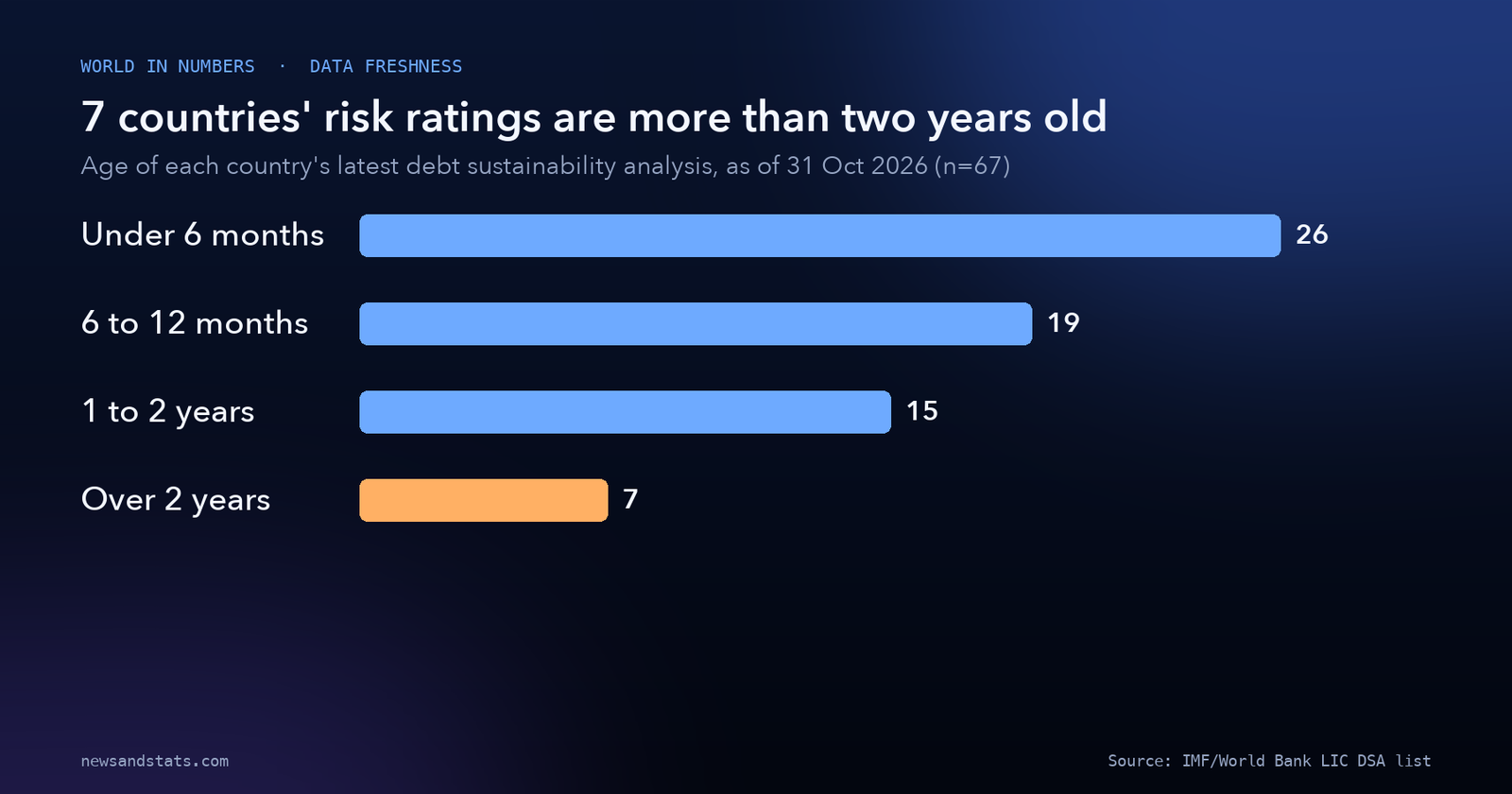
Source: IMF/World Bank LIC DSA list, as of 30 September 2026. Ages calculated against 31 October 2026 (this article’s own calculation from the table’s publication dates).
A risk rating is only as good as the review behind it. Comparing each country’s “latest publication date” against today shows that 26 of the 67 rated countries (Eritrea excluded, since it has no DSA at all) had a DSA published within the last six months, 19 within six to twelve months, and 15 between one and two years ago. Seven countries have gone more than two years without a fresh review: Senegal (last reviewed July 2023), Guinea, Maldives and South Sudan (all 2024), and Afghanistan, Myanmar and Sudan, whose most recent DSAs date to 2021 — before several of the events that have since reshaped their economies. Sudan’s current “Sustainable” assessment, for instance, is dated 1 July 2021, nearly two years before fighting broke out between Sudan’s army and the Rapid Support Forces paramilitary group in Khartoum on 15 April 2023, a war that has continued since. A rating that old describes a country that, in several of these cases, no longer exists in quite the same shape.
This is not a flaw unique to Sudan. Several of the stalest ratings belong to countries where data access, conflict or political upheaval has made a fresh IMF/World Bank mission difficult to carry out, which means the countries hardest to assess are often the ones where an outdated rating matters most.
7. Why the rating matters: money is attached to it
This is not an academic exercise. The LIC-DSF determines how low-income countries are financed and, when needed, how their debts get restructured. The IMF lends to low-income countries mainly through the Poverty Reduction and Growth Trust, whose Executive Board approved a reform package on 15 October 2024 after PRGT credit outstanding roughly tripled over the previous five years of overlapping shocks. That reform set a long-term, self-sustained annual lending envelope of SDR 2.7 billion (about $3.6 billion), more than double the envelope available before the Covid-19 pandemic, and introduced a new interest-rate mechanism, effective 1 May 2025, that charges zero interest to the poorest roughly half of all PRGT-eligible countries. Near-term lending is expected to stay somewhat above that long-term envelope before declining, as the countries on this list recover from a run of overlapping global shocks and rebuild their own financial buffers. In a sovereign debt restructuring, the same framework is also used to size the debt relief a country needs to restore sustainability — which is exactly why the list’s classifications, and how current they are, carry real financial weight for the World in Numbers economies that depend on this financing.
What to watch
- Whether the IMF publishes updated DSAs for Afghanistan, Myanmar or Sudan, whose current ratings are more than five years old.
- Whether Eritrea, the one PRGT-eligible country with no DSA at all, gets a first assessment.
- How the revised LIC-DSF, due for full roll-out in summer 2027, changes the thresholds or the four-category structure described above.
- Whether any of the 22 high-risk countries gets reclassified into debt distress, or any of the 10 distressed countries completes a restructuring and exits the list.
- Whether PRGT demand stays high enough to test the new SDR 2.7 billion annual lending envelope, alongside the broader financing picture covered in the IMF’s October 2026 outlook.
The bottom line
On the IMF’s own numbers, 10 of 68 rated low-income countries are already in debt distress and 22 more are at high risk, but most of those 32 are still judged capable of returning to a sustainable path. Most of the full list — 27 at moderate risk and 8 at low risk, by this article’s count — is not in acute trouble at all. The bigger catch is currency: a third of the list was last reviewed more than a year ago, and seven countries, including Sudan, whose current assessment predates its ongoing war, have not been reassessed in over two years. A debt-risk list is only as useful as its last update, and for some of the world’s most fragile economies, that update is overdue.
Related reading
- The world economy in 8 numbers: what the IMF’s October 2026 outlook says: the global growth and inflation backdrop against which these 68 countries are borrowing.
- Who pays for the 2026 energy shock? The numbers, country by country: many of the same fragile, energy-importing economies also face higher fuel-import bills.
- India vs China: the economic gap in 10 numbers: how the two largest developing economies compare with the much smaller, more fragile ones on this list.