International travel barely grew in the first half of 2026. UN Tourism, the United Nations’ tourism agency, recorded just 0.4% growth in international arrivals between January and June, down from 2% growth in the first quarter alone. The main cause was a sharp drop in travel to the Middle East, where conflict disrupted flights and pushed up costs across the region. The slowdown followed a record 2025, when international arrivals reached 1.52 billion. This is the global tourism slowdown of 2026, told through the numbers UN Tourism and the World Travel & Tourism Council (WTTC) have published so far this year.
1. 0.4%: the number at the center of the 2026 global tourism slowdown
UN Tourism estimates that international arrivals reached about 690 million in the first half of 2026, roughly 3 million more than in the same period of 2025. That is growth of just 0.4% year on year. The pace fell sharply during the half: arrivals rose about 2% in the first quarter, then fell about 1% in the second. Within the second quarter, arrivals were down about 3% in April and down about 3% again in June.
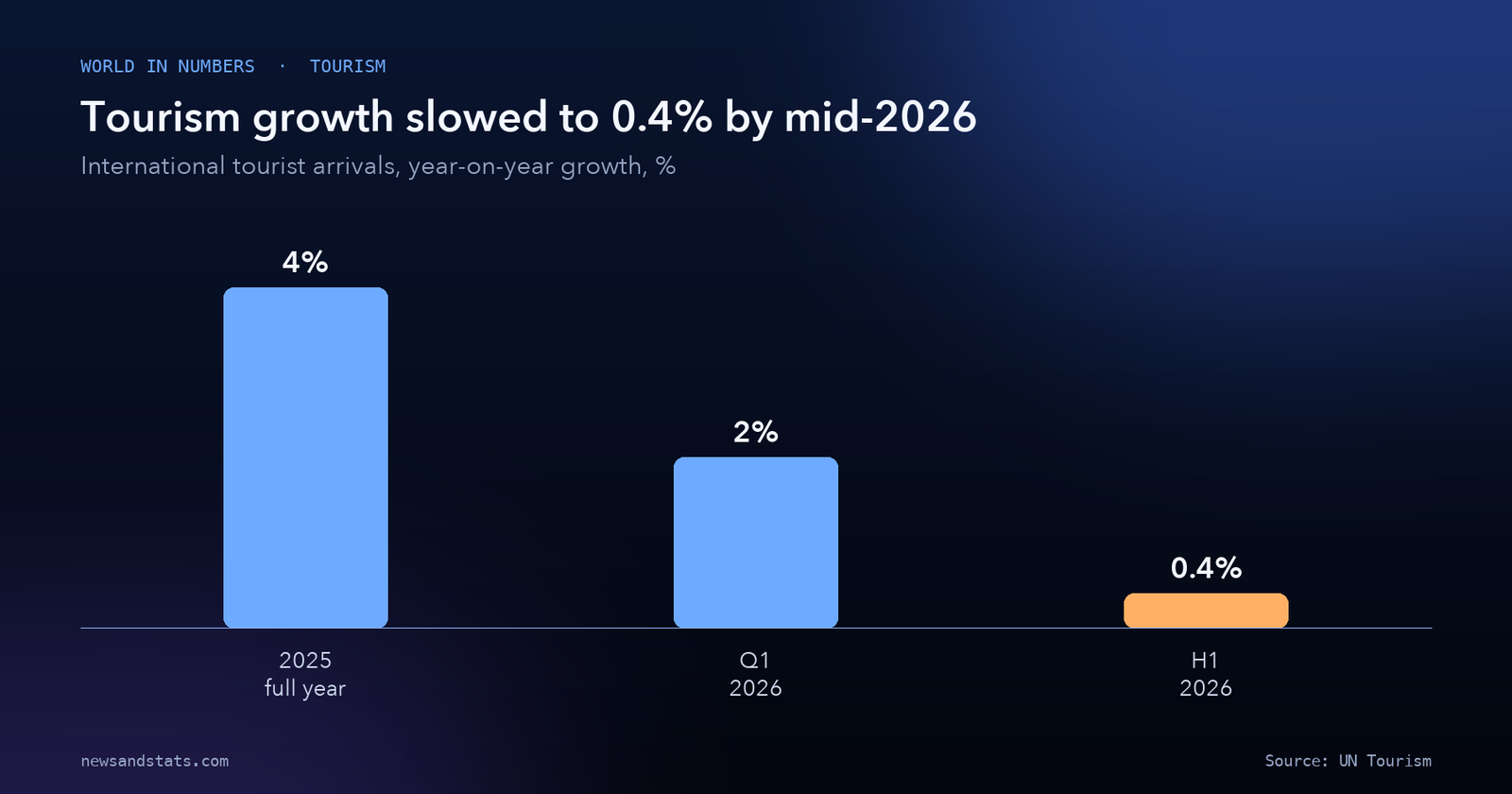
Source: UN Tourism, via Hospitality Net, UN Tourism, via The Star/Xinhua and UN Tourism, via Nation Thailand.
That deceleration led UN Tourism to cut its full-year 2026 forecast to growth of 1% to 2%, down from the 3% to 4% it had projected in January. The reasons cited across these reports are the conflict in the Middle East, disrupted flight routes through the region, weaker demand from some Asian source markets, and rising travel costs.
2. 1.52 billion: the record year that came before
The slowdown is a sharp turn from where 2025 ended. UN Tourism’s first World Tourism Barometer of 2026, issued in January, put full-year 2025 international arrivals at 1.52 billion, up 4% from 2024. Tourism receipts reached an estimated $1.9 trillion, also up 5% from the year before.
Regionally, Europe stayed the largest destination by far, with 793 million arrivals in 2025, up 4% and about 6% above its 2019 level. Asia and the Pacific grew fastest among the major regions, up 6% to 331 million arrivals, though that was still below pre-pandemic levels. Africa grew 8% to 81 million arrivals, the fastest percentage growth of any region, albeit from a smaller base. At the time, UN Tourism expected 2026 to keep growing at a similar 3% to 4% pace.
Source: UN Tourism, via Hospitality Net and UN Tourism, via The Star.
3. −14% to −22%: how the Middle East conflict hit the numbers twice
The region that defines this year’s slowdown is the Middle East. UN Tourism’s first-quarter data, published in June, showed Middle East arrivals down 14% year on year, even as most other regions kept growing: Europe and Africa were each up 4%, Asia and the Pacific up 3%, and the Americas up 2%. By the first half of the year, as reported in September, the Middle East decline had widened to 22% year on year, while the other regions’ growth had cooled only slightly (Africa still +4%, Europe +3%, the Americas +2%, Asia and the Pacific +1%).
Flight data cited alongside the UN Tourism figures shows why. International passenger traffic to and from the Middle East fell sharply as airlines cut capacity through the first quarter, and hotel occupancy in the region fell from 75% in January to 48% in March. Reports attribute the drop to the regional conflict directly disrupting travel and to the knock-on effect on jet-fuel and energy costs, a pressure we detailed in our look at this year’s energy shock and in the Gulf LNG outage that disrupted regional energy supply at the same time.
| Region | Q1 2026 (vs. Q1 2025) | H1 2026 (vs. H1 2025) |
|---|---|---|
| Africa | +4% | +4% |
| Europe | +4% | +3% |
| Americas | +2% | +2% |
| Asia & Pacific | +3% | +1% |
| Middle East | −14% | −22% |
Source: UN Tourism, via Hospitality Net (Q1) and UN Tourism, via Zawya (Q1); UN Tourism, via Hospitality Net (H1) and UN Tourism, via The Star/Xinhua (H1).
Every other region in the table held roughly steady or cooled only modestly between the two periods. The Middle East is the outlier, and it is large enough on its own to drag the global average down from the 2% pace of the first quarter to the 0.4% pace of the whole half.
4. −27%: South Asia’s air-hub shock
The Middle East was not the only region to feel the disruption. In the first quarter of 2026, South Asia recorded a 27% year-on-year drop in international arrivals, the steepest decline of any region UN Tourism tracked. Reports tie this to the same cause: Middle Eastern air hubs handle a large share of connecting traffic into South Asia, and the disruption to flights through the region early in the year cut off a significant route for travelers heading further east. Asia and the Pacific as a whole stood at about 89% of its first-quarter-2019 arrivals level, still short of a full recovery six years on.
5. +9%: who kept growing while the Middle East fell
Not every region felt the slowdown. Oceania posted the strongest first-quarter growth of any region UN Tourism tracked, up 9% year on year, helped by strong demand from its main source markets. Egypt, despite sitting in a region under pressure, recorded 16% arrivals growth in the first quarter, an exception inside a difficult regional picture. Central America grew 18% in the same quarter, among the fastest of any destination grouping reported.
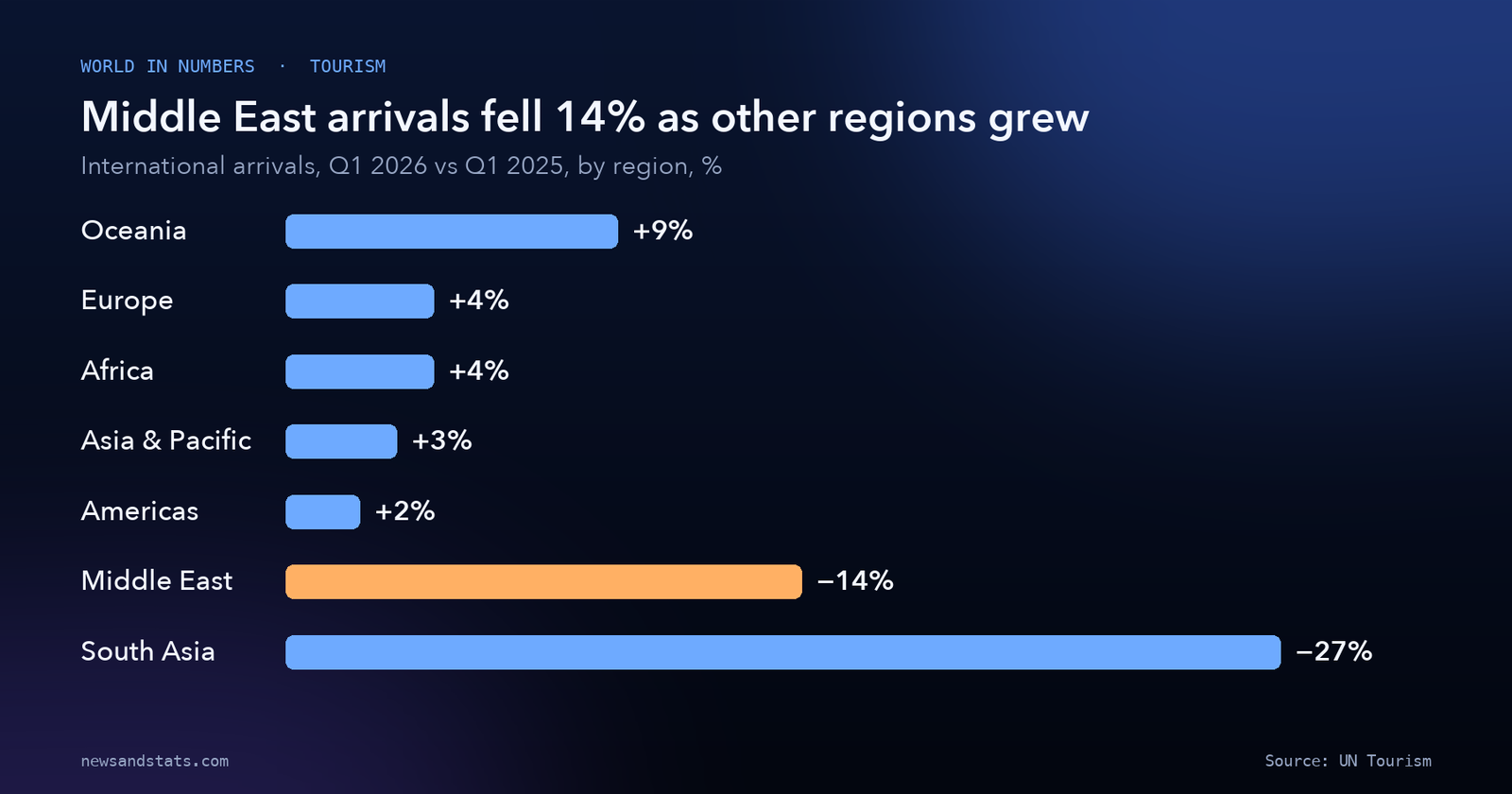
Source: UN Tourism, via Hospitality Net and UN Tourism, via Zawya.
These figures show the slowdown was concentrated, not universal. Asia and the Pacific’s broader growth, even as it cooled, still sits inside a region that remains central to the global economy, a point we explored from a different angle in India vs China: the economic gap in 10 numbers. The 2026 story is less “tourism everywhere is slowing” and more “a conflict in one part of the world pulled the global average down.”
6. $1.9 trillion: the receipts side of the story
Travel is not only measured in trips. UN Tourism’s January report put 2025 international tourism receipts, the money tourists spent abroad, at an estimated $1.9 trillion, up 5% from 2024. That is the clearest sign of how large the industry had grown before the 2026 slowdown began: even modest growth in arrivals, applied to a base that size, moves a very large amount of spending across borders, through airlines, hotels, restaurants and local businesses in destination countries.
No comparable 2026 receipts figure has been published yet in the sources checked for this article, so it is not included here. What has been published is a broader economic forecast for the sector, covered next.
7. 3.2% vs 2.4%: why tourism still beats the economy
Even with the slowdown, the WTTC’s Economic Impact Research, produced with Oxford Economics, forecasts that Travel & Tourism’s contribution to global GDP will keep outgrowing the wider economy in 2026. The WTTC projects the sector will contribute $12 trillion to global GDP in 2026, equal to 9.9% of the world economy, while supporting 376 million jobs worldwide, about one in nine jobs globally. It forecasts Travel & Tourism GDP will grow 3.2% in 2026, ahead of the 2.4% growth it forecasts for the wider global economy, a backdrop that sits alongside the slower overall growth picture set out in the IMF’s October 2026 world outlook.
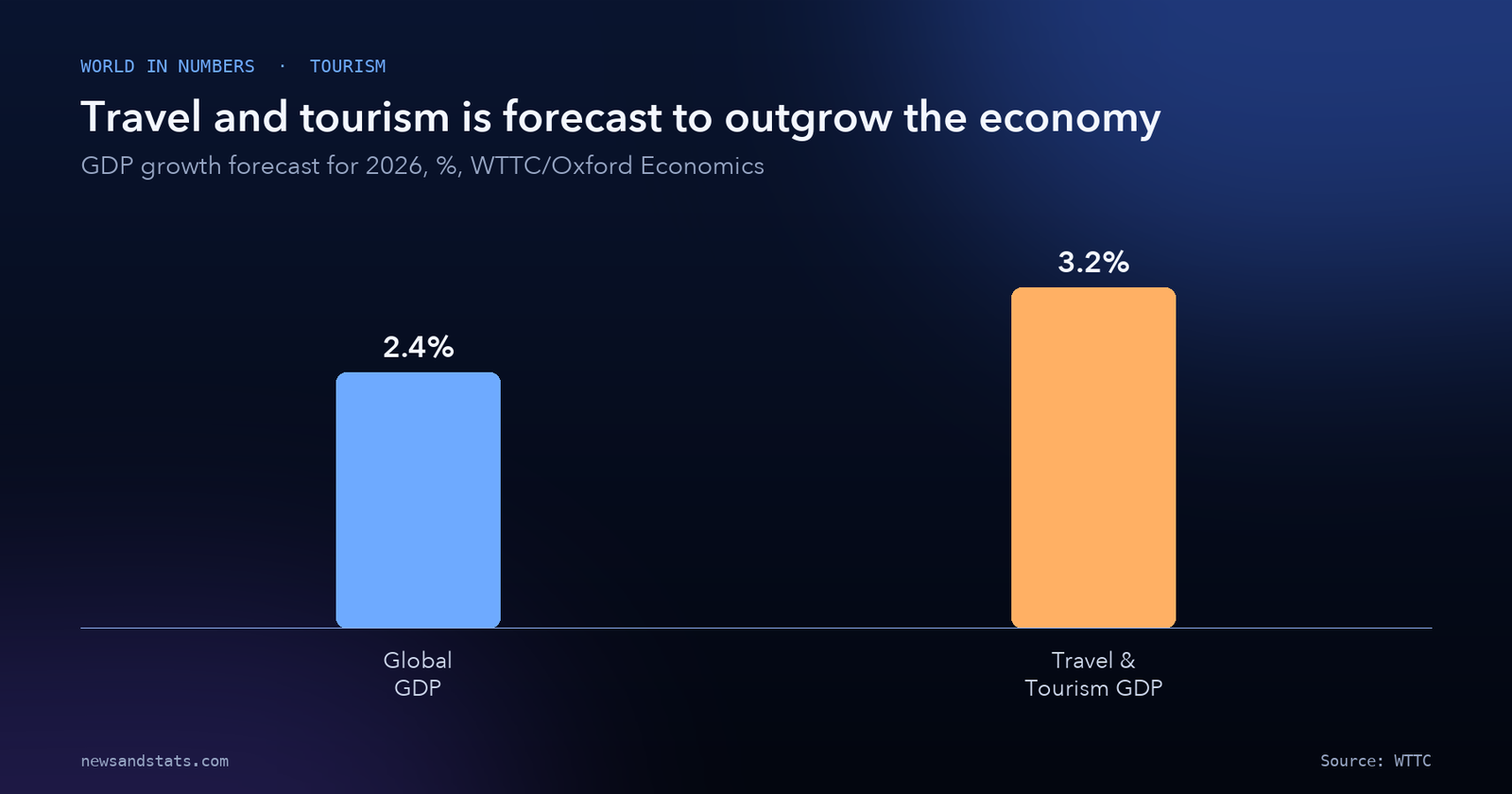
Source: WTTC.
The WTTC’s outlook extends beyond a single year: over the next decade, it forecasts Travel & Tourism GDP will grow 3.6% annually, about 1.5 times the pace it expects for the wider global economy, adding almost 89 million new jobs. In Europe specifically, the WTTC forecasts Travel & Tourism GDP growth of 3.6% in 2026 against wider European GDP growth of just 1%, making tourism one of the larger engines of growth on a continent where the overall economy is expanding slowly.
8. How this gets misread
A single slowdown quarter, or even a slow half-year, is easy to misread as the end of the travel boom. The numbers above do not support that. Growth turned slightly negative in the second quarter mainly because one region, the Middle East, saw a sharp, conflict-driven drop; every other major region UN Tourism tracks was still growing, if more slowly than a year earlier. And the WTTC’s forecast, built independently of the arrivals data, still has the travel sector outgrowing the wider world economy in 2026. The more accurate read is narrower: a regional shock pulled a global average down, not a broad-based downturn in the desire or ability to travel.
It is also worth being precise about what “slowdown” means here. Arrivals growth fell from 2% to roughly flat; it did not go deeply negative worldwide, and most of 2025’s record base of 1.52 billion arrivals was retained rather than lost. The forecast cut, from 3% to 4% down to 1% to 2%, is a downgrade in the pace of further growth, not a prediction that arrivals will fall from 2025’s level.
What to watch
- The next UN Tourism barometer update. UN Tourism typically updates its barometer roughly every quarter; watch for whether the Middle East decline narrows or widens, and whether the 1% to 2% full-year forecast holds.
- Middle East flight capacity. Hotel occupancy in the region fell from 75% in January to 48% in March 2026; a recovery in airline capacity through the region would be an early signal of a travel rebound there.
- Whether South Asia’s connecting-traffic shock persists. A 27% first-quarter drop tied to disrupted Middle East air hubs is unusual; watch whether South Asia’s arrivals recover as regional routing options expand.
- The WTTC’s next Economic Impact Research update. Its 2026 forecast of $12 trillion and 9.9% of global GDP was issued in May 2026; a later revision would show whether the sector-level outlook has held up against the arrivals slowdown.
- Travel costs. UN Tourism names rising travel costs as a headwind alongside the conflict; sustained high jet-fuel and energy prices would be a reason for the slowdown to persist even if the Middle East conflict eases.
- Europe’s 2026 tourism GDP contribution relative to its overall economy, given the WTTC’s forecast of 3.6% growth in tourism GDP against just 1% for Europe’s wider economy this year; see our World in Numbers coverage for the broader economic picture.
The bottom line
International tourism went from a record 1.52 billion arrivals and 4% growth in 2025 to just 0.4% growth in the first half of 2026, and UN Tourism has cut its full-year forecast accordingly, from 3% to 4% down to 1% to 2%. The slowdown is concentrated in one region: Middle East arrivals fell 14% in the first quarter and 22% across the first half, while most other regions kept growing, some strongly. Travel spending and the WTTC’s own economic forecasts, which put the sector on track to contribute $12 trillion and 9.9% of global GDP this year while growing faster than the wider economy, suggest this is a regional shock inside a still-expanding industry rather than a broad reversal.
Related reading
- Who pays for the 2026 energy shock? The numbers, country by country: the Brent crude and fuel-cost pressures that UN Tourism names as a headwind for travel demand in 2026.
- The Global LNG Supply Wave Is Still Coming, but the Gulf Outage Has Delayed Its Relief: more on the Gulf energy disruptions that coincided with the region’s tourism decline.
- The world economy in 8 numbers: what the IMF’s October 2026 outlook says: the broader global growth backdrop against which the WTTC compares its travel-sector forecast.
- India vs China: the economic gap in 10 numbers: more on the Asia-Pacific economic weight behind the region’s tourism numbers.