In 2025, European Union residents aged 15 and older took 1.2 billion overnight trips for personal or business purposes, and more than four out of every five of those journeys stayed on the ground. According to official tourism transport statistics published by Eurostat on November 19, 2026, land transport accounted for 81.4% of all EU trips, air travel made up 17.2%, and waterways represented 1.4%.
For European transport Industries—from automakers and passenger rail operators to regional airlines and ferry networks—the 2025 modal breakdown underscores how stubbornly road-centric European mobility remains. Even with decades of high-speed rail investment and aggressive decarbonization targets, private cars carried nearly five times as many overnight trips as railways across the bloc.
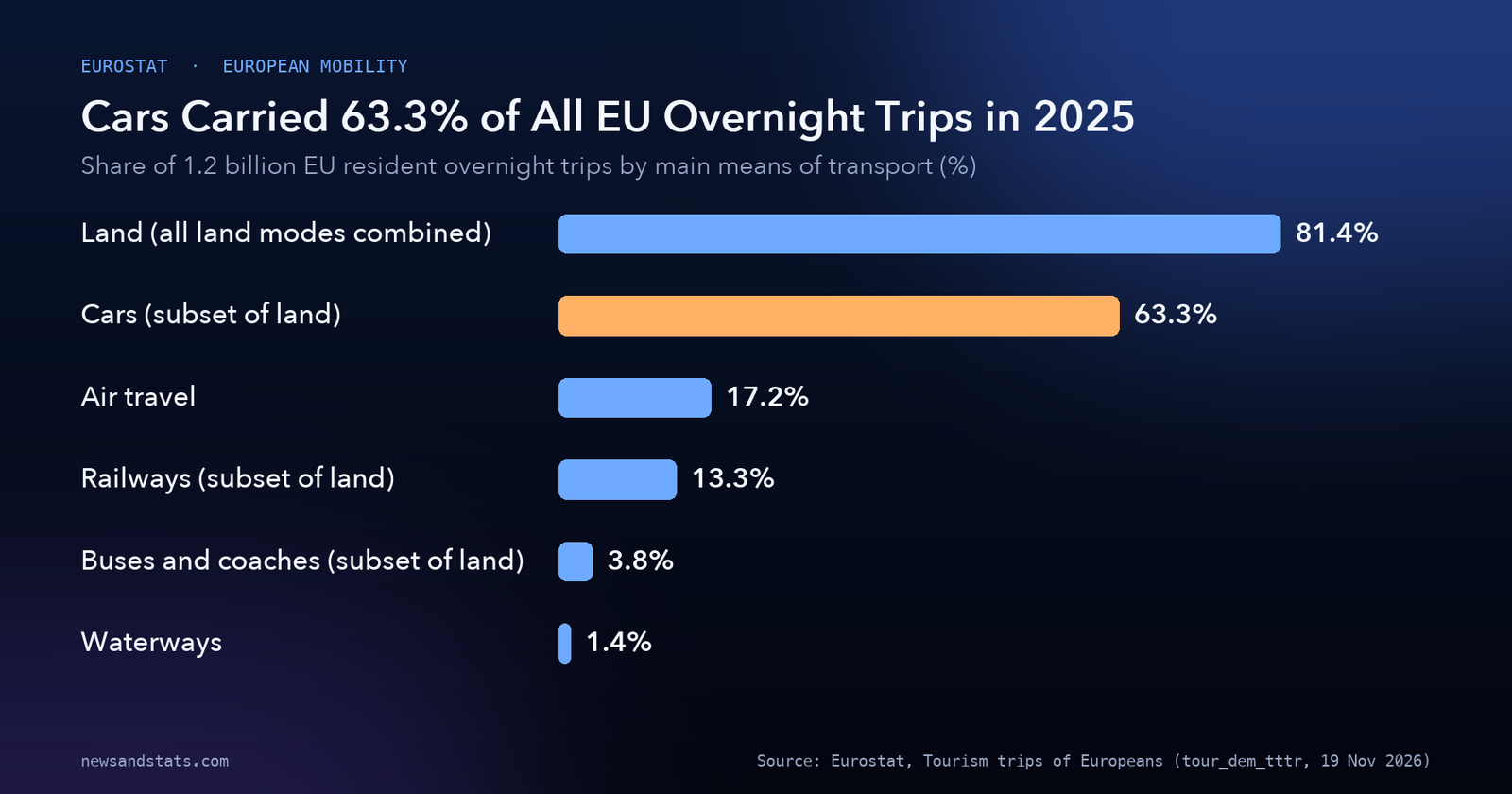
The EU-wide breakdown: cars hold 63.3%, air reaches 17.2%, rail sits at 13.3%
Eurostat’s November 19, 2026 release (based on dataset tour_dem_tttr) tracks every overnight trip made by EU residents aged 15 and over by the main mode of transport used to reach their primary destination. Applying those official percentages to the 1.2 billion trip total illustrates the sheer scale gap separating road, air, rail, and sea travel.
| Transport mode | Share of 2025 EU trips | Implied trip volume (from 1.2B total) | Share within total |
|---|---|---|---|
| Land (all land modes combined) | 81.4% | 976.8 million trips | Primary macro category |
| Cars (subset of land) | 63.3% | 759.6 million trips | Dominant individual mode |
| Air travel | 17.2% | 206.4 million trips | 1.29x rail share |
| Railways (subset of land) | 13.3% | 159.6 million trips | 3.9 pp behind air |
| Buses and coaches (subset of land) | 3.8% | 45.6 million trips | Smallest itemized land mode |
| Waterways | 1.4% | 16.8 million trips | Concentrated in island/coastal states |
Source: Eurostat, Tourism trips of Europeans (tour_dem_tttr), November 19, 2026. Note: Itemized land modes sum to 80.4%, leaving 1.0% in other land transport.
Cars alone generated 63.3% of all overnight trips—an implied 759.6 million journeys—making private automobiles 4.76 times more common than rail travel (13.3%, or an implied 159.6 million trips) and 16.66 times more common than buses and coaches (3.8%, or 45.6 million trips). Air travel captured 17.2% of total trips (an implied 206.4 million journeys), outpacing rail by 3.9 percentage points, or 29.3% in relative share.
Source: Eurostat (tour_dem_tttr), November 19, 2026.
The aviation leaders: island nations and small hubs
At the member-state level, geography dictates aviation dependence. While air travel averaged 17.2% across the European Union as a whole, residents of the bloc’s island nations relied on flights for more than two-fifths to three-fifths of all overnight trips in 2025.
Malta led the entire European Union with air travel accounting for 61.6% of all trips—44.4 percentage points above the EU average. Cyprus ranked second at 51.1%, making Malta and Cyprus the only two EU member states where aviation accounted for more than half of all resident overnight trips. Ireland ranked third among island economies at 41.8%.

Source: Eurostat (tour_dem_tttr), November 19, 2026.
High air travel shares also appeared in small, high-income continental and Nordic countries with compact domestic footprints and high outbound travel propensities. Luxembourg recorded a 38.5% air share (21.3 percentage points above the EU average), and Denmark recorded 36.6% (19.4 percentage points above the EU average). For airlines and airport operators, these five markets represent structural demand where rail substitution is geographically impossible or cross-border distances favor flight.
Land dominance in Central and Eastern Europe
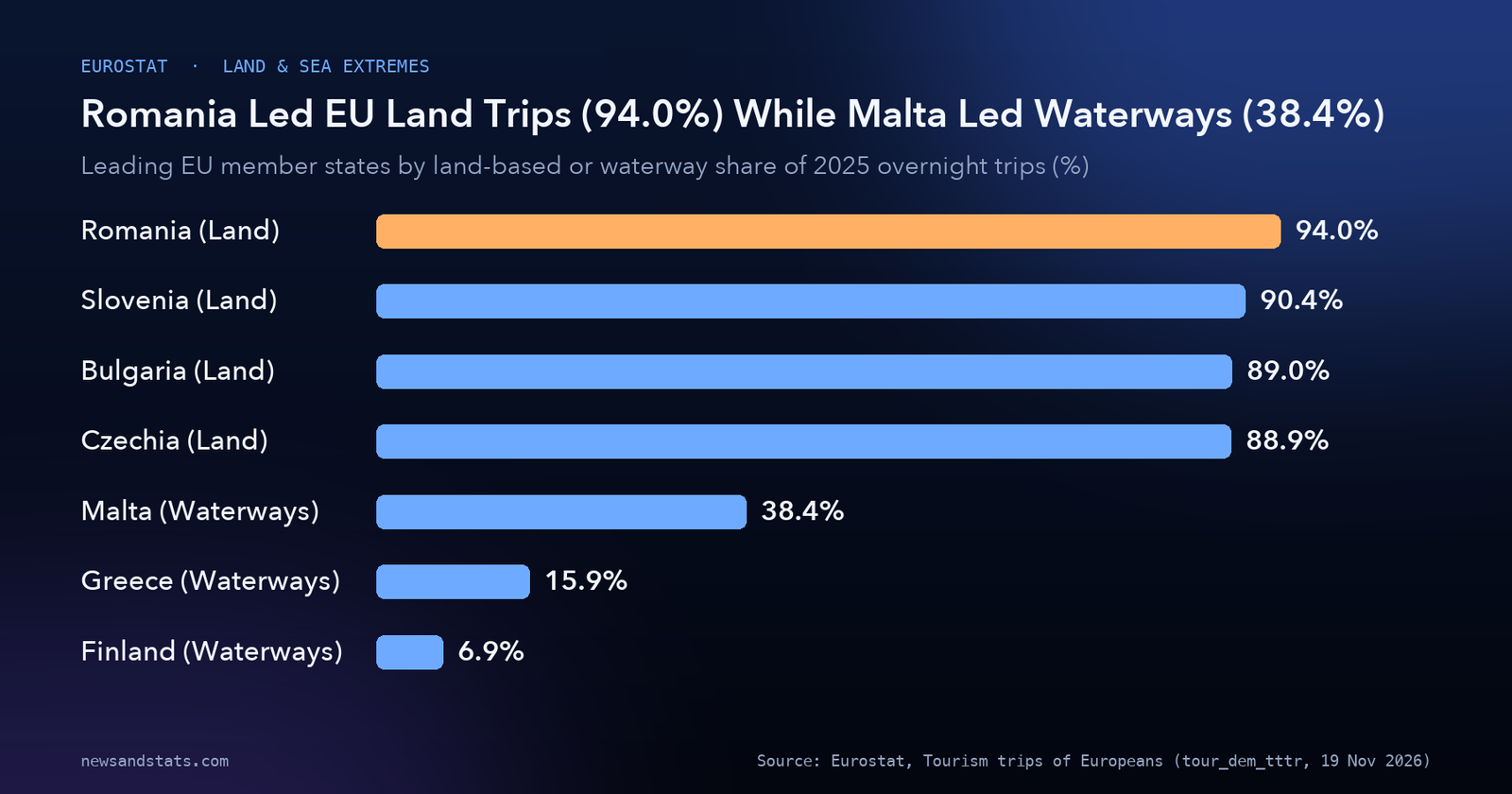
At the opposite end of the spectrum, Central and Eastern European member states posted the highest shares of land-based trips in 2025, far exceeding the 81.4% EU average. Romania led the bloc with 94.0% of all overnight trips taken by land—leaving only 6.0% for air and waterways combined.
Slovenia ranked second at 90.4%, followed closely by Bulgaria at 89.0% and Czechia at 88.9%. Across all four countries, contiguous borders, shorter average domestic and regional trip distances, and lower per-capita aviation intensity keep nearly nine out of ten overnight journeys on roads and rail lines.
Buses and coaches, the smallest itemized land mode at 3.8% of all EU trips, play a disproportionately larger role in exactly these land-dominant markets, where coach networks often connect smaller towns that lack direct rail links. Together with the 1.0 percentage point of EU trips that fall into unitemized land categories—neither car, rail, nor bus—the itemized and residual land figures reconcile with Eurostat’s 81.4% land total, leaving no meaningful gap in the bloc-wide accounting between the headline modal share and its individual components.
Maritime and inland waterways: Malta’s 38.4% and Greece’s 15.9%
Although waterways accounted for just 1.4% of total EU overnight trips in 2025 (roughly 16.8 million trips bloc-wide), maritime transport plays a critical lifeline role in archipelagic and coastal member states. Malta again topped the ranking, with waterways accounting for 38.4% of all resident overnight trips.
Combined with Malta’s 61.6% air travel share, air and sea together accounted for 100.0% of Malta’s overnight trips—leaving 0.0% for land-based overnight travel by main mode. Greece ranked second in waterway usage at 15.9% of all trips (more than 11 times the 1.4% EU average), driven by Aegean and Ionian ferry networks, while Finland ranked third at 6.9%, reflecting Baltic Sea ferry connections to Sweden and Estonia.
Source: Eurostat (tour_dem_tttr), November 19, 2026.
Methodology matters: trip counts vs. passenger-kilometers
Eurostat’s methodological notes highlight an important distinction for transport planners and investors analyzing the 2025 data. Under tour_dem_tttr, a tourism trip requires at least one overnight stay by a resident aged 15 or older, and the recorded mode is strictly the single transport type that covered the longest distance to reach the main destination.
Because the modal split is calculated on trip counts rather than distance traveled, short domestic car trips carry the same weight per journey as a long-haul flight. That explains why cars hold a 63.3% share of trips while aviation’s 17.2% share of trips understates its share of total passenger-kilometers and jet-fuel demand.
The same counting method widens the gap between cars and the bloc’s smallest itemized land mode: at 63.3% versus 3.8%, cars outnumber buses and coaches by 16.66 times on a trip-count basis, even though a single long-distance coach journey can carry a busload of passengers that would otherwise have taken dozens of separate car trips.
Industrial and energy implications for European transport
The 2025 modal split carries direct consequences for Europe’s energy security and decarbonization investments. With 63.3% of overnight trips still dependent on passenger cars and 17.2% on aviation, European household mobility remains heavily exposed to oil price volatility and refining margins—a vulnerability analyzed in our 2026 energy shock report.
Shifting those 759.6 million car journeys toward battery-electric vehicles requires rapid charging-corridor and power-grid expansion, tying passenger road transport directly to the fuel dynamics tracked in our IEA November 2026 oil report coverage. Meanwhile, rail’s 13.3% share shows substantial headroom for cross-border high-speed service expansion across continental Europe, whereas island economies like Malta, Cyprus, and Ireland depend on sustainable aviation fuels and electric regional vessels—part of the broader tourism and mobility shifts examined in our global tourism slowdown 2026 and global trade outlook reporting.
What to watch
- 2026 fuel cost pass-through: Whether higher 2026 motor fuel and jet-fuel costs shift short-haul European overnight trips from cars (63.3%) and air (17.2%) toward railways (13.3%) and coaches (3.8%).
- Cross-border rail vs. short-haul air: Whether European high-speed rail corridors gain share against air travel in continental hubs such as Luxembourg (38.5% air) and Denmark (36.6% air).
- Island decarbonization mandates: How EU maritime and aviation fuel mandates affect ticket costs and trip volumes in air- and sea-dependent island states—Malta (61.6% air, 38.4% water), Cyprus (51.1% air), and Ireland (41.8% air).
- EV fleet turnover in land-heavy markets: How fast electric vehicle adoption scales in land-dominant countries such as Romania (94.0% land), Slovenia (90.4%), Bulgaria (89.0%), and Czechia (88.9%).
The bottom line
Eurostat’s November 19, 2026 transport data confirms that across 1.2 billion overnight trips in 2025, European travel remained overwhelmingly anchored on the road: land transport captured 81.4% of trips and private cars alone took 63.3%, compared with 17.2% for air travel, 13.3% for rail, 3.8% for buses and coaches, and 1.4% for waterways. Beneath those bloc-wide averages lies a sharp geographic split between island nations reliant on air and ferries and Central and Eastern European states where roughly nine in ten trips stay on land—defining two very different decarbonization challenges for European transport industries.