The commercial space industry has crossed from an era of bespoke aerospace exploration into a regime of high-volume industrial mass production. According to space analytics firm BryceTech in its report Smallsats by the Numbers 2026, commercial smallsat launches reached an unprecedented peak in 2025, fundamentally altering orbital mechanics, satellite architectures, and launch vehicle economics worldwide.
Covering a decade of launch data from 2016 through 2025, BryceTech’s analysis reveals that low Earth orbit (LEO) has become an industrialized extension of global telecommunications networks. Satellites under 1,200 kilograms now represent virtually all spacecraft propelled into orbit, while reusable heavy-lift rockets have upended the traditional economics of launch vehicle sizing. Here are the eight numbers from BryceTech’s latest reports that define the modern commercial space economy.
1. 4,466 smallsats: An all-time record for orbital deployment
The defining benchmark of space industrialization is the sheer volume of hardware placed into orbit. In 2025, a record 4,466 small satellites launched into space worldwide.
This single-year total of 4,466 smallsats marks the highest deployment volume ever recorded in aerospace history. A decade earlier, annual satellite launches were counted in the dozens or low hundreds. Today, commercial assembly lines manufacture and deploy dozens of operational spacecraft every single week.
This surge in orbital hardware reflects the broader hyperscaler infrastructure boom, where technology conglomerates and satellite network operators view low Earth orbit as high-bandwidth, low-latency digital infrastructure designed to connect remote enterprises, ships, aircraft, and rural households.
2. 98% of all spacecraft: The near-total dominance of smallsats
The shift from massive, bus-sized geostationary satellites toward modular orbital platforms is virtually complete. According to BryceTech, smallsats represented 98% of all spacecraft launched globally in 2025.
Even more striking is the distribution of mass. Historically, traditional heavy satellites accounted for the vast majority of payload weight. In 2025, smallsats accounted for 85% of total spacecraft upmass propelled into space.

Source: BryceTech, Smallsats by the Numbers 2026.
Our calculation: non-smallsat traditional spacecraft accounted for only 2% of total spacecraft launched and 15% of orbital upmass.
By standardizing satellite buses, utilizing commercial off-the-shelf (COTS) electronics, and planning for operational lifespans of five years rather than fifteen, satellite operators trade radiation-hardened longevity for continuous technological iteration. Instead of designing a billion-dollar geostationary platform intended to operate for two decades without hardware upgrades, modern constellation operators deploy iterative satellite generations every 18 to 24 months.
3. 79%: LEO broadband megaconstellations drive the market
The overwhelming driver of smallsat launch volume is consumer and enterprise broadband. BryceTech reports that low Earth orbit broadband megaconstellations accounted for 79% of all smallsat deployments in 2025.
SpaceX’s Starlink network represents the overwhelming core of this volume, deploying thousands of interconnected satellites equipped with inter-satellite optical laser links, high-gain phased array antennas, and krypton or argon ion thrusters. Other commercial constellations, including Eutelsat OneWeb and Amazon’s Project Kuiper, are building out initial orbital shells.
Our calculation: out of 4,466 total smallsats launched in 2025, broadband megaconstellations accounted for approximately 3,528 satellites, leaving approximately 938 smallsats for all other scientific, commercial Earth observation, and military missions combined.
This concentration illustrates that the commercial smallsat market is largely synonymous with satellite communications. As explored in our analysis of advanced manufacturing and semiconductor supply chains, mass-producing thousands of phased-array user terminals and satellite routing chips requires high-volume semiconductor fabrication and automated surface-mount assembly.
4. 96% on heavy rockets: The small launcher paradox
A central commercial paradox identified by BryceTech is the failure of dedicated small launch vehicles to capture smallsat market share. In 2025, only 4% of smallsats launched on dedicated micro or small launch vehicles.
The remaining 96% of smallsats deployed on medium through super-heavy launch vehicles.

Source: BryceTech, Smallsats by the Numbers 2026.
Our calculation: heavy and medium rockets launched 24 times more smallsats than dedicated small launchers in 2025 (96% divided by 4%).
Between 2018 and 2022, dozens of venture-backed aerospace start-ups attempted to build small rockets designed to carry dedicated payloads to orbit, promising bespoke orbits and tailored schedules. However, reusable heavy-lift rockets—chiefly SpaceX’s Falcon 9, operating both dedicated megaconstellation flights and commercial Transporter rideshare missions—demolished the cost structure of small rockets. By offering rideshare slots at dramatically lower prices per kilogram, heavy rockets priced dedicated micro-launchers out of all but the most time-critical defense missions.
The manufacturing infrastructure supporting these rocket buildouts faces real-world energy constraints. As analyzed in our review of power grid bottlenecks and transmission constraints, aerospace production centers, cryogenic air separation plants, and engine testing facilities require substantial, uninterruptible electrical utility connections.
5. 305 operators and 133 first-timers: Expanding market participation
While launch vehicles and megaconstellation volumes are concentrated, the institutional base of satellite operators is diversifying. BryceTech reports that the global smallsat operator base expanded to 305 organizations in 2025.
Notably, this total included 133 organizations that deployed their very first small satellite in 2025.
Our calculation: first-time satellite operators represented 43.6% of all active smallsat organizations deploying spacecraft during the year.
This influx of new entrants spans sovereign defense agencies, commercial synthetic aperture radar (SAR) operators, agricultural monitoring firms, university research laboratories, and developing nations deploying national remote-sensing capabilities. Standardized CubeSat and SmallSat form factors—combined with turnkey satellite-as-a-service providers like Spire Global, Loft Orbital, and EnduroSat—allow non-aerospace organizations to purchase orbital capacity without building in-house spacecraft fabrication facilities.
6. 58%: United States providers lead the global orbital launch market
In the orbital launch sector, geographic market share is heavily concentrated in North America. According to BryceTech’s quarterly assessment Global Orbital Space Launches Q2 2026, United States launch providers conducted 47 out of 81 global orbital launches in the second quarter of 2026, capturing 58% of the worldwide launch market.
Six separate United States launch providers conducted orbital flights during the quarter, led by SpaceX alongside Rocket Lab, United Launch Alliance, and other commercial and defense operators.
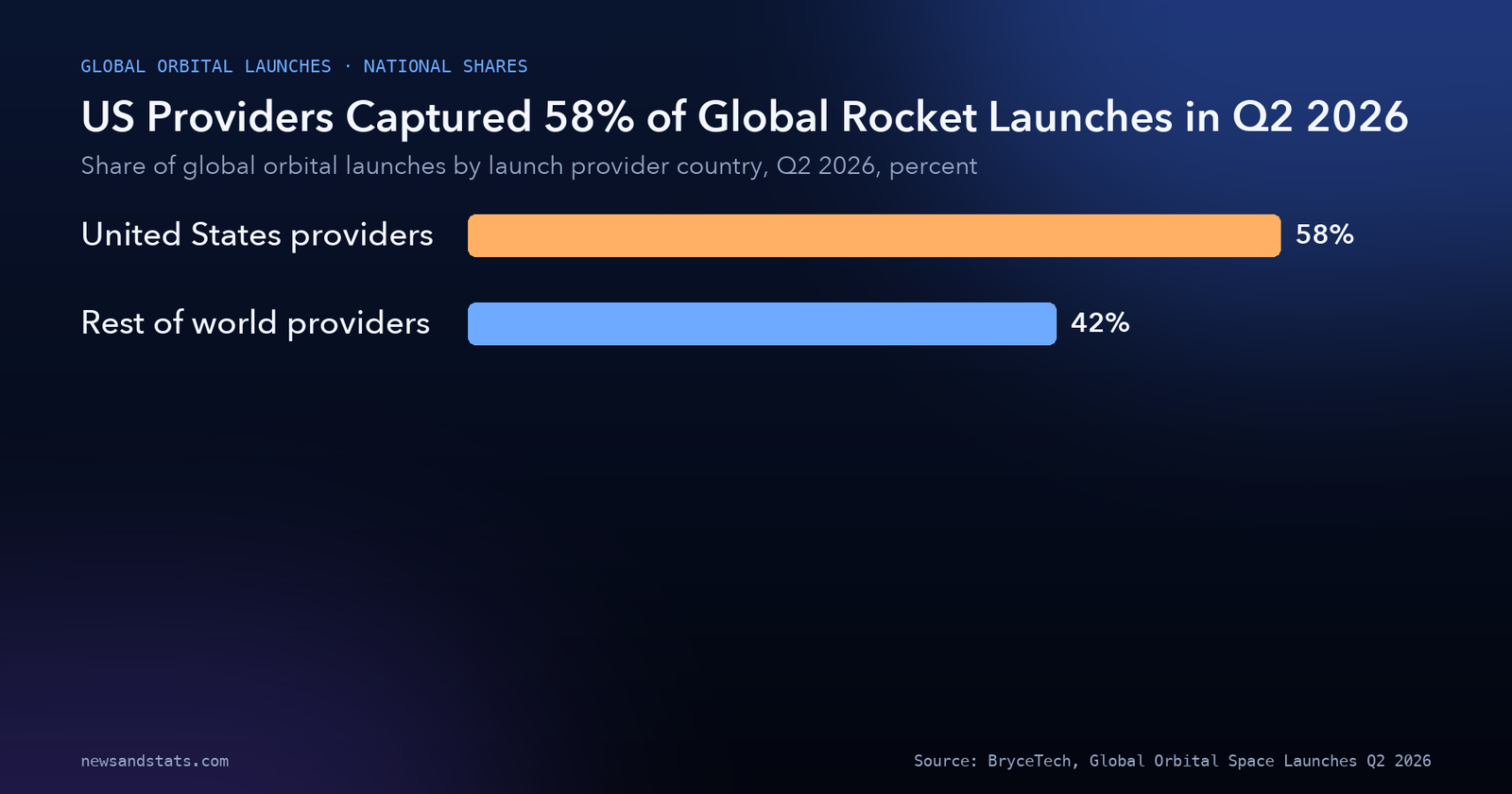
Source: BryceTech, Global Orbital Space Launches Q2 2026.
Our calculation: global orbital launch activity reached 81 flights in Q2 2026, expanding by 3% compared with Q2 2025. US providers out-launched all other nations combined (47 launches versus 34 for the rest of the world).
China remained the second most active space nation, conducting orbital flights across state-run Long March architectures and commercial launchers. As detailed in our comparison of the economic gap between India and China, China’s commercial space sector is deploying state-backed broadband constellations—such as the Guowang and Qianfan (Thousand Sails) networks—to establish sovereign orbital telecommunications networks independent of Western satellite infrastructure.
7. 86%: Communications satellites dominate orbital payload activity
The primary purpose of satellites deployed into orbit is data transmission. BryceTech reports that in Q2 2026, communications satellites accounted for 86% of all spacecraft launched worldwide.
Smallsats under 1,200 kg comprised 98% of all deployed payloads during the quarter. Earth observation, scientific research, technology demonstration, and space domain awareness made up the remaining 14% of spacecraft deployed.
The materials required for satellite electronics and propulsion systems intersect directly with global mineral markets. As examined in our investigation of the rare earth supply chain, satellite reaction wheels, solar array drive mechanisms, and high-efficiency ion thrusters require critical rare earth permanent magnets, creating supply chain dependencies on specialized refining hubs.
8. 732,519 kilograms: The quarterly mass sent to orbit
The physical scale of space logistics is measured in upmass—the total mass of satellites and spacecraft lifted into orbit. In the second quarter of 2026, global launch vehicles lofted an estimated 732,519 kilograms of payload upmass across 1,150 separate spacecraft.
While quarterly spacecraft counts eased by 4% year-over-year and upmass dipped by 2%, BryceTech emphasizes that this does not indicate market contraction. Rather, quarterly totals fluctuate based on specific constellation manufacturing batches and deployment schedules.
Our calculation: global rockets propelled an average of 8,050 kilograms of payload upmass into orbit during every single day of the second quarter of 2026.
The broader institutional catalog of global space analytics is published on BryceTech’s flagship Publications portal, which provides government agencies, satellite operators, and institutional investors with independent space economy benchmarks.
How to read the BryceTech space numbers
Navigating commercial orbital launch and satellite metrics requires recognizing five essential technical distinctions:
- Smallsat definition is governed by mass, not size. BryceTech defines a smallsat as any spacecraft with a launch mass of 1,200 kilograms or less. This category spans CubeSats weighing under 10 kg up to large broadband satellites weighing hundreds of kilograms.
- Spacecraft count differs from payload upmass. Launching 1,150 spacecraft does not mean all satellites are equal in capability. A single heavy satellite can weigh more than 50 CubeSats combined, making upmass a vital complementary metric to spacecraft counts.
- Dedicated launches differ from rideshares. A dedicated launch carries payloads for a single customer to an exact orbit. A rideshare launch—such as SpaceX’s Transporter missions—deploys dozens of smallsats for multiple operators into a shared orbital plane, lowering costs at the expense of customized trajectory delivery.
- Orbital launch attempts differ from successful orbital insertions. BryceTech’s launch accounts track successful flights that reach orbit. Suborbital test flights or launches that fail before achieving orbital velocity are excluded from operational launch tallies.
- Constellation cadence drives quarterly volatility. A 4% quarterly decline in spacecraft counts reflects normal gaps between satellite production batches rather than softening customer demand for satellite communications services.
The global commercial space landscape at a glance
The following table summarizes the primary metrics established in BryceTech’s 2026 reports across smallsat deployments, launch vehicle classes, quarterly launch cadences, and operator demographics.
| Metric | Measured value | Reporting period | Key operational or market driver | Source |
|---|---|---|---|---|
| Annual global smallsats launched | 4,466 spacecraft | Calendar 2025 | All-time record for worldwide deployments | BryceTech Smallsats 2026 |
| Smallsat share of all spacecraft | 98% of spacecraft | Calendar 2025 | Industrial mass manufacturing dominates | BryceTech Smallsats 2026 |
| Smallsat share of total upmass | 85% of upmass | Calendar 2025 | Heavy traditional satellites relegated to niche | BryceTech Smallsats 2026 |
| LEO broadband megaconstellation share | 79% of smallsats | Calendar 2025 | Driven by Starlink, OneWeb, and Kuiper | BryceTech Smallsats 2026 |
| Medium to super-heavy launcher share | 96% of smallsats | Calendar 2025 | Reusable heavy rockets demolish small launch costs | BryceTech Smallsats 2026 |
| Micro and small launcher share | 4% of smallsats | Calendar 2025 | Confined to niche time-critical defense missions | BryceTech Smallsats 2026 |
| Total active smallsat operators | 305 organizations | Calendar 2025 | Global diversification across commercial and state hubs | BryceTech Smallsats 2026 |
| First-time smallsat operators | 133 organizations | Calendar 2025 | 43.6% of active operators deployed first satellite | BryceTech Smallsats 2026 |
| Global orbital launches in Q2 2026 | 81 launches | Q2 2026 | Grew 3% year-on-year over Q2 2025 | BryceTech Q2 2026 Report |
| United States orbital launches Q2 2026 | 47 launches | Q2 2026 | Six US providers captured 58% global share | BryceTech Q2 2026 Report |
| Total spacecraft launched Q2 2026 | 1,150 spacecraft | Q2 2026 | Down 4% reflecting batch manufacturing cycles | BryceTech Q2 2026 Report |
| Total payload upmass in Q2 2026 | 732,519 kg | Q2 2026 | Averaged over 8,000 kg sent to orbit daily | BryceTech Q2 2026 Report |
| Communications share of spacecraft | 86% of payloads | Q2 2026 | Space functions as orbital telecom infrastructure | BryceTech Q2 2026 Report |
| Smallsats under 1,200 kg share Q2 2026 | 98% of payloads | Q2 2026 | Confirms structural permanence of smallsat era | BryceTech Q2 2026 Report |
Sources: BryceTech, Smallsats by the Numbers 2026 and Global Orbital Space Launches Q2 2026.
What to watch
- The deployment cadence of Amazon’s Project Kuiper, observing whether full-scale constellation deployment expands global smallsat numbers beyond 5,000 annually.
- The commercial scaling of next-generation heavy and super-heavy reusable launchers, including SpaceX’s Starship, Blue Origin’s New Glenn, and Europe’s Ariane 6.
- The development of China’s sovereign megaconstellations (Guowang and Qianfan), monitoring Chinese launch cadence and overseas ground station agreements.
- Regulatory and orbital safety frameworks regarding space debris mitigation, collision avoidance, and spectrum coordination in crowded LEO shells.
- Financial performance and consolidation among dedicated small launcher start-ups navigating competition from heavy rideshare missions.
- The expansion of direct-to-cell satellite services, assessing consumer adoption of direct satellite smartphone messaging and broadband.
The bottom line
The commercial space sector has transitioned into an industrial telecommunications factory: a record 4,466 small satellites launched in 2025, capturing 98% of all spacecraft and 85% of total orbit mass as broadband megaconstellations drove 79% of deployments. Reusable heavy rockets have rewritten aerospace economics, deploying 96% of all smallsats and marginalizing dedicated micro-launchers to a 4% share. With the United States capturing 58% of global orbital launches in Q2 2026 and lofting over 730,000 kg of payload in a single quarter, low Earth orbit is no longer an experimental destination—it is a permanent, high-density industrial layer of the global digital economy. For the wider macroeconomic context framing capital deployment, explore our review of the macroeconomic environment from the IMF, and visit our Industries section for continuing analysis of global manufacturing and infrastructure networks.
Related reading
- The Global LNG Supply Wave Is Still Coming, but the Gulf Outage Has Delayed Its Relief: global energy supply chains, export liquefaction, and infrastructure buildouts.
- Five Million Robots in Factories: The Global Automation Surge in 8 Numbers: advanced manufacturing robotics, factory automation, and industrial production.
- India vs China: the economic gap in 10 numbers: manufacturing capacity, national infrastructure investment, and economic growth compared.