Software engineering has crossed a decisive structural threshold: autonomous artificial intelligence agents have shifted from experimental assistants into primary contributors. Rather than merely offering single-line autocomplete suggestions inside code editors, software agents are now independently drafting multi-file modifications, orchestrating background test suites, and submitting complete pull requests. According to GitHub in its flagship publication Octoverse: Commits, pushes, reach new highs in 2026 as developers build with agents, the platform’s global developer community expanded to more than 225 million registered accounts in 2026.
The sheer volume of software activity expanded alongside this population growth. Developers pushed code changes to GitHub 17.9 billion times over the past twelve months—a volume exceeding 2024 and 2025 combined. Even more strikingly, by September 2026, more than 40% of all pull requests on the platform began with an autonomous coding agent drafting the initial implementation. Drawing on verified primary telemetry from GitHub’s annual analysis as well as its earlier benchmark study Octoverse: A new developer joins GitHub every second as AI leads TypeScript to #1, here are the eight numbers that explain how AI agents, expanding global developer hubs, and typed programming languages are reshaping modern software development.
1. 225 million: Global developer community expands across every continent
The foundational benchmark of global software capacity is the total number of builders collaborating on code. In September 2026, GitHub officially surpassed 225 million registered developers, adding tens of millions of new builders over the trailing twelve months.
This demographic expansion represents a sustained acceleration. After reaching 180 million developers in 2025, the platform saw unprecedented geographic broadening. While software engineering was historically concentrated across North America and Western Europe, emerging technology hubs are closing the gap at an unprecedented rate.

Source: GitHub, Octoverse 2026.
The United States maintains the largest single national community with 38.3 million developers, followed closely by India with 32.0 million. Together, the two nations account for more than 70 million developers. Beyond the two leaders, Brazil reached 10.2 million developers, becoming the fourth country globally to cross the 10-million threshold after adding 3.28 million developers in 2026 alone. China stands in third place with 12.4 million developers.
Our calculation: the top four countries—the United States, India, China, and Brazil—now account for 92.9 million developers, representing 41.3% of GitHub’s total global user base.
Furthermore, developer longevity remains remarkably robust despite the influx of newcomers. Developers who pushed code in the past twelve months have been on GitHub for an average of 36 months. Among developers who opened a pull request in August 2026, more than 75% returned to push code in September. The average developer now works across 10% more repositories than they did one year ago, demonstrating deeper engagement across distributed projects.
2. 40%: Autonomous agents initiate two in five pull requests
The most radical workflow transformation documented in the 2026 report is the rapid migration toward agentic software authoring. In September 2026, more than 40% of all pull requests created on GitHub began with an autonomous coding agent’s first draft.
This transition occurred with remarkable speed over a single six-month window:
- In March 2026, agent-started pull requests accounted for just 17% of total platform pull requests.
- By September 2026, the agent-started share surged to more than 40%.
- In absolute volume, developers initiated 110 million agent-drafted pull requests in September 2026 alone—approximately six times the volume recorded in March.
This shift marks a structural evolution from interactive autocomplete to asynchronous delegation. Rather than typing out code character by character while an AI suggests completions, developers increasingly specify requirements in natural language or issue tickets, allowing an autonomous agent to generate the initial branch and pull request. Review has become the primary mechanism through which human engineers evaluate, shape, and refine machine-generated code.
The scope of work handled by agents is also expanding beyond superficial patches. Agent-started pull requests modify multiple files in 87% of cases, compared to 79% for pull requests initiated without detected agent assistance.
Crucially, agentic contributions are landing into production branches faster and with higher success rates. In February 2026, 83% of agent-involved pull requests were merged within two weeks, trailing the 86% merge rate for human-authored code. By September 2026, the two-week merge rate for agent-authored pull requests climbed to 90%, surpassing the human benchmark of 86%. As tracked in broader foundation model evaluation benchmarks, improvements in reasoning architectures have directly translated into higher software integration reliability.
3. 34.3 billion: Total commits triple over two years
The influx of autonomous agents and automated tooling has created an explosion in total software production. Across all public and private repositories on GitHub, total commits reached 34.3 billion over the trailing twelve months.
This figure represents more than three times the commit volume recorded two years earlier. Code pushes also set a new high-water mark, reaching 17.9 billion pushes in 2026—a total larger than calendar years 2024 and 2025 combined. Merged pull requests more than tripled over the same two-year span, reaching 1.3 billion merged changes, which translates to an average of 3.5 million merged pull requests every single day.
Activity accelerated dramatically midway through the year. Beginning around June 2026, platform activity bent sharply upward as models with advanced reasoning capabilities and persistent cloud harnesses became widely available. From June 2026 onward, approximately 55% of all code commits originated from brand-new repositories, reflecting widespread greenfield prototyping and automated project generation.
Continuous integration and automated maintenance kept pace with this code surge:
- GitHub Actions executed 1,440 workflow jobs every single second, totaling 124 million job executions per day—more than triple the volume recorded in 2025.
- Dependabot merged more than 30 million pull requests to patch dependencies and remediate security vulnerabilities, approximately doubling its 2025 velocity.
- Repositories configured with an agent configuration file recorded an average of eight times as many commits as new repositories created without an agent setup file.
Much like the expansion of physical automation in industrial robotics, software development is experiencing a compounding velocity loop where automated agents generate code and automated CI/CD pipelines continuously validate, test, and package it.
4. 32.0 million: India narrows the gap with the United States
Geographic software leadership is undergoing a historic realignment. India’s developer population expanded to 32.0 million in September 2026, adding more than 10 million developers in a single year to narrow the gap with the United States (38.3 million).
In its 2025 forecasting model, GitHub projected that India would reach 57.5 million developers by 2030, while the United States was projected to reach 54.7 million. Just one year into that five-year projection window, both nations have outpaced baseline expectations:
- The United States added more than 10 million developers in 2026, closing 38.6% of the distance toward its 2030 projection.
- India added more than 10 million developers in 2026, closing 28.3% of the distance toward its 2030 target.
Our calculation: India now trails the United States by 6.3 million developers, compared to a gap of more than 10 million developers in prior reporting periods.
The rapid growth across the Asia-Pacific region is not confined to India. Indonesia expanded its developer community to 6.34 million, surpassing established European engineering hubs such as Germany (6.30 million) and France (4.75 million). Japan reached 7.15 million developers, while the United Kingdom reached 6.47 million.
When measuring actual code contributions to public open-source repositories, adjusted for profile location and network routing, the United States ranks first, followed by India in second place, China in third, Brazil in fourth, and Germany in fifth. This geographic realignment mirrors broader demographic and economic trajectories between India and China, as digital skilling programs and widespread internet penetration transform emerging markets into dominant software engineering powerhouses.
5. 3.62 million: TypeScript consolidates its lead over Python and JavaScript
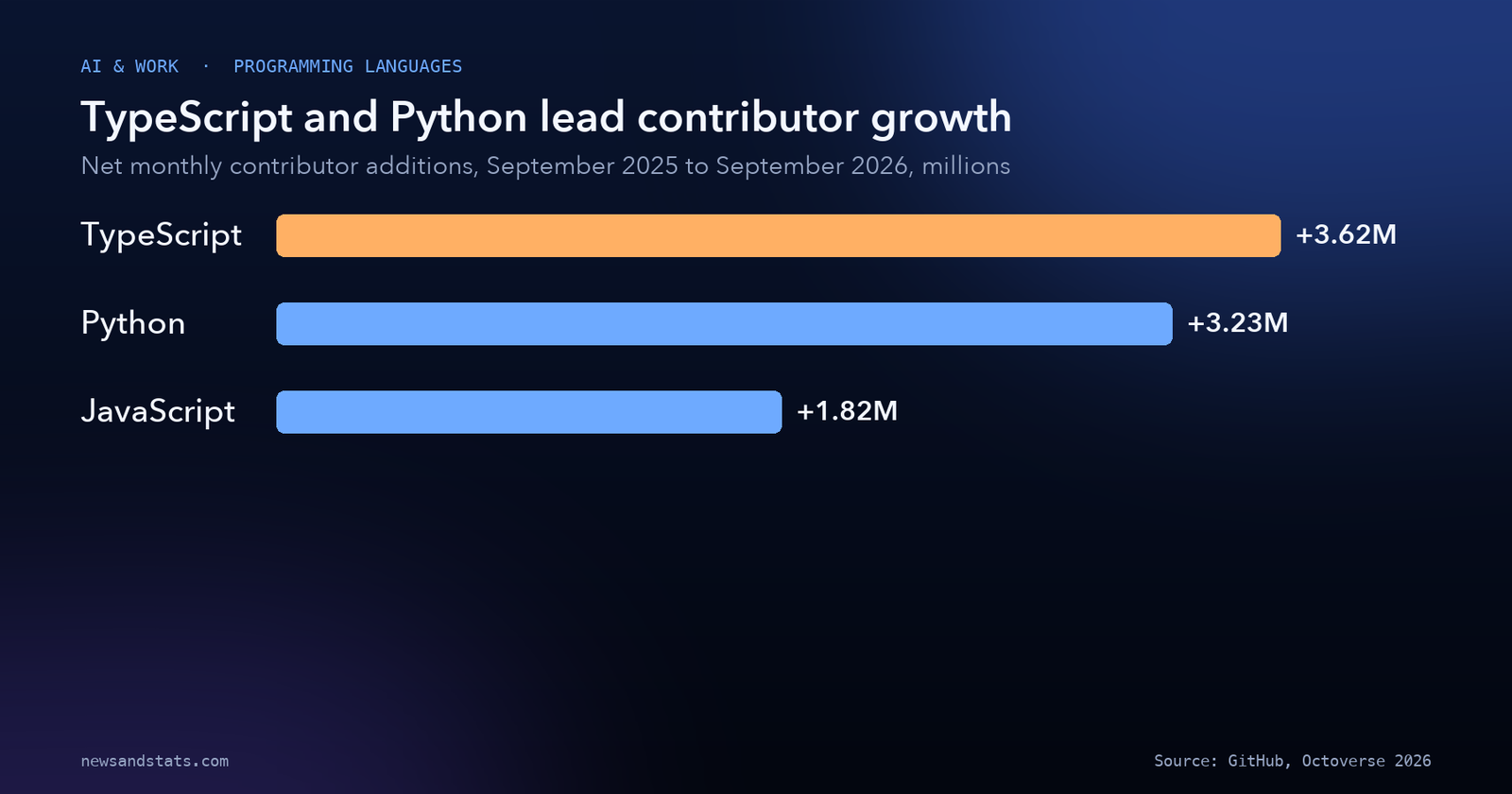
Programming language dynamics have reached a new equilibrium. After first overtaking both Python and JavaScript in August 2025 to become the most used language by monthly contributors on GitHub, TypeScript maintained the number-one position throughout 2026.
Between September 2025 and September 2026, TypeScript added 3.62 million net monthly contributors, outpacing Python (+3.23 million) and JavaScript (+1.82 million). Rust emerged as the fastest-growing language by percentage among major programming languages, doubling its active contributor base over the trailing twelve months.
Source: GitHub, Octoverse 2026.
The sustained rise of TypeScript highlights how AI coding agents are actively altering programming language selection. Because typed languages enforce strict structural contracts and type signatures, they provide immediate compile-time feedback that allows coding agents to detect and self-correct errors before runtime.
The correlation between AI tooling and typed languages is evident across GitHub’s repository telemetry:
- Among repositories created in 2026, TypeScript was the primary language in 35% of projects exhibiting an observed agent signal, compared to only 24% of repositories created without an agent signal.
- In repositories created prior to 2026, TypeScript was primary in 27% of projects with an agent signal versus 17% without.
- In merged pull requests, detected AI involvement reached 40% to 44% in TypeScript, Python, and Rust, whereas traditional enterprise languages such as Java, C#, and C++ exhibited lower AI involvement shares ranging between 21% and 34%.
GitHub’s predictive modeling projects that both TypeScript and Python will approach approximately 13 million monthly contributors each by September 2027, while JavaScript will reach 7.4 million, leaving all other programming languages in the top ten below 2.2 million monthly contributors.
6. 61%: Copilot users embrace multi-model orchestration
Developer interaction with artificial intelligence models has transitioned from vendor lock-in to dynamic model switching. In September 2026, 61% of GitHub Copilot users who manually selected a model used more than one distinct model across their coding sessions, up from 50% four months earlier in May 2026.
Rather than relying on a single general-purpose system, developers now actively route tasks to specialized model families based on speed, cost, and analytical complexity. The roster of accessible architectures expanded rapidly, with paid Copilot users utilizing 29 distinct models in May 2026 and 47 distinct models by September 2026. No single model carried more than 25% of developer-selected requests in September.
Source: GitHub, Octoverse 2026.
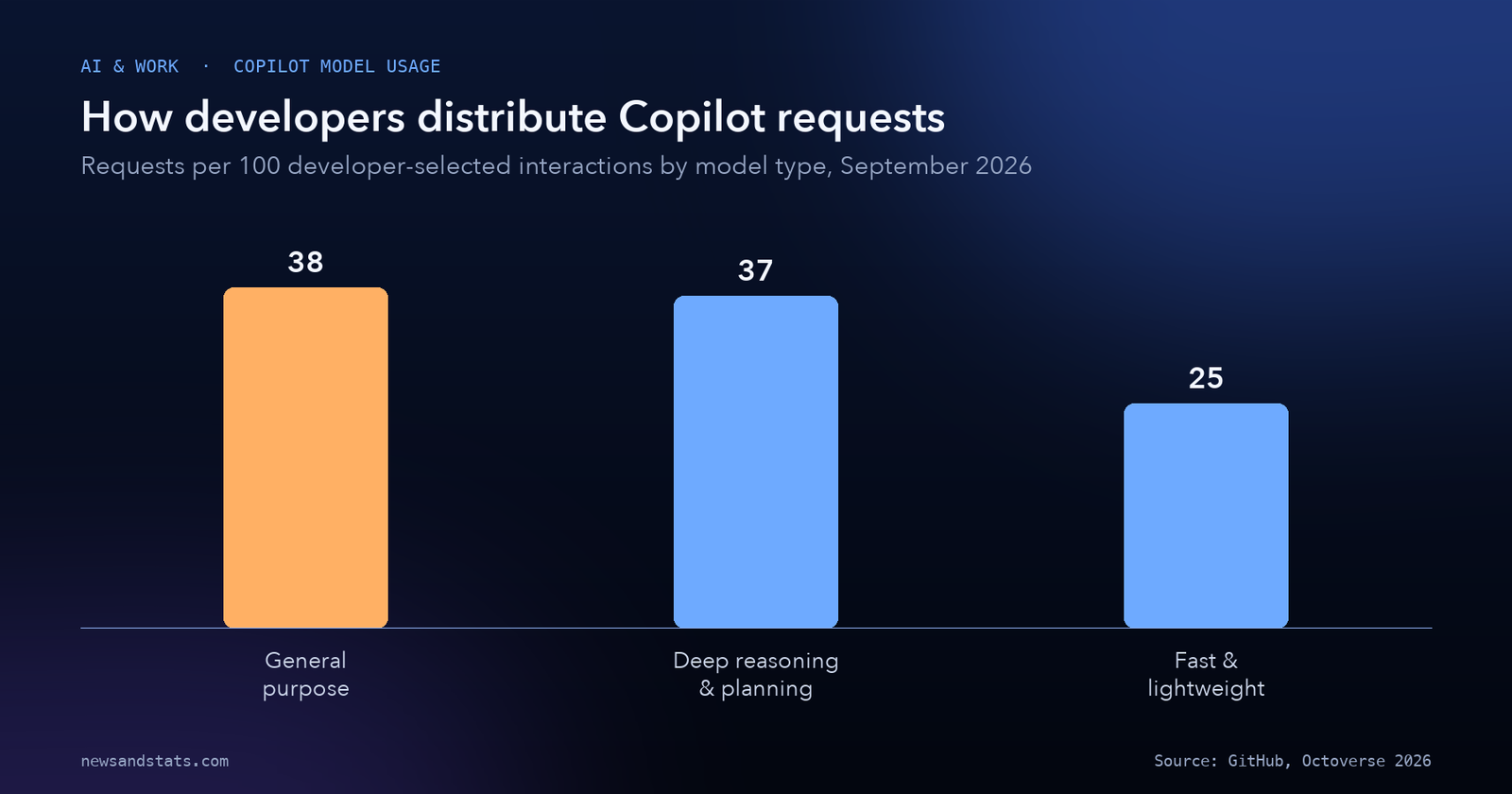
Across every 100 developer-selected requests in September 2026:
- 38 requests were routed to general-purpose models (such as Claude Sonnet 5 or Grok 4.7).
- 37 requests went to deep reasoning and planning models (such as Claude Opus 5.5 or GPT 5.5) for complex architectural refactoring and logic verification.
- 25 requests were handled by fast and lightweight models (such as Gemini 3.8 Flash or Claude Haiku 5.5) for rapid inline completions and low-latency edits.
Automation is also taking over the selection process itself. In September 2026, 63% of paying GitHub Copilot developers used auto model selection at least once, allowing automated orchestration to select the optimal model for each step of planning, coding, and review. This orchestration layer, initially tested in Project HydraFusion across almost 60,000 sessions, has launched generally as GitHub Copilot Fusion.
The underlying infrastructure required to support these multi-model workflows reflects the massive hyperscaler capital investments in AI hardware, as developers expect low-latency access to frontier reasoning models directly inside their local and cloud development environments.
7. 65x: Traditional industrial sectors embrace open-source code
A common misconception is that AI-assisted software development is confined to tech startups and software enterprises. By categorizing public repositories created between 2022 and 2026 using the North American Industry Classification System (NAICS), GitHub revealed an extraordinary expansion across traditional heavy industries.
Compared to their 2022 baseline, public repository creation across non-software sectors grew by multiples:
- Mining, quarrying, and oil and gas extraction repositories expanded by roughly 65 times from a small initial base.
- Administrative and support services grew by 17 to 18 times.
- Construction repositories expanded by 17 to 18 times.
- Professional, scientific, and technical services grew roughly 5 times over its 2022 baseline, climbing from fourth to second place among all industry categories, trailing only the information sector.
- Manufacturing repositories almost tripled, expanding by nearly 3 times over the same four-year period.
Interestingly, AI adoption patterns vary substantially by industrial vertical:
- In administrative services, mining, health care, and agriculture, more than 40% of public repositories explicitly mention artificial intelligence, yet agent-opened pull requests remain rare, accounting for less than 3% of activity.
- Construction presents the opposite pattern: approximately 25% of construction repositories mention AI, but 9% of pull requests are opened by agents—the highest agent pull request share of any industrial vertical, with manufacturing following closely behind.
This divergence reveals that in heavy physical sectors, domain specialists are utilizing autonomous coding agents to build tailored operational tools—such as 3D-printable equipment organizers, agricultural computer-vision pipelines, and industrial heat-recovery calculators—bringing software automation directly to the physical factory floor.
8. 2.5 billion: Public open-source contributions double in twelve months
Despite concerns that proprietary AI models and autonomous agents might erode the open-source commons, open-source activity on GitHub expanded at its fastest rate in history. Public open-source contributions reached 2.5 billion in 2026, more than doubling the 1.12 billion public contributions recorded in 2025.
Autonomous agent adoption has empowered individual maintainers to manage unprecedented workloads. For example, open-source maintainer @kinlane logged more than 1 million contributions across public repositories by utilizing agentic workflows to maintain machine-readable API catalogs. Similarly, @kim-em recorded more than 178,000 contributions to mathlib, a formal community library of computer-verified mathematics, while @andig logged over 21,000 contributions maintaining evcc, an open-source electric vehicle charging and home energy management controller.
Open-source developers are also building the foundational architecture required for agentic interoperability. Public repositories mentioning reverse engineering or interoperability grew by more than 300% year-over-year, climbing from approximately 30,000 repositories in 2025 to more than 130,000 repositories in 2026.
Security and review tooling have scaled alongside this contribution volume:
- Push protection ran 5.8 billion secret scans across repositories in 2026, screening for exposed API keys and credentials at nearly four times its 2025 volume.
- Usage of AI-assisted code review and GitHub Advanced Security each grew by more than 90% year-over-year.
- Stacked pull requests, introduced in preview on 30 July 2026 to break large agentic code modifications into reviewable units, were adopted by more than 264,000 developers by September 2026.
How to read software developer telemetry
Interpreting platform-level software engineering data requires understanding five core methodological distinctions established in GitHub’s Octoverse research:
- Pushes versus commits versus contributions. A code push represents a network transmission sending one or more saved commits to GitHub. Contributions encompass a broader set of collaboration events, including pushing commits, opening issues, commenting on discussions, and reviewing pull requests. Because a single push can contain dozens of commits, total commits (34.3 billion) significantly exceed total pushes (17.9 billion).
- Agent-started versus agent-assisted pull requests. An agent-started pull request is initiated directly by an autonomous coding agent drafting the original branch and opening the request. Agent-assisted workflows include interactive inline completions or chat suggestions within a human-opened pull request. Telemetry captures detectable agent signatures, representing a conservative lower bound for actual AI usage.
- Monthly contributors versus total account stock. Language rankings and growth rates are measured by distinct monthly active contributors committing code in a given language, rather than total historical account counts or static repository tags. An individual developer contributing to both TypeScript and Python projects is counted once within each language ecosystem.
- Public open-source versus private enterprise telemetry. More than four-fifths of total collaboration events take place inside private repositories, while the remainder occurs in public repositories. Industry sector rankings, open-source project tables, and language bubble charts are derived from public repository samples, whereas headline commit and pull request totals reflect both public and private activity.
- Developer location attribution. Country-level rankings are mapped from self-reported profile locations using standardized ISO country codes, filtered by a minimum threshold of 100 active developers, and cross-referenced with push volume ratios to correct for virtual private network (VPN) routing.
The 2026 GitHub Octoverse at a glance
The following table summarizes the verified benchmarks, activity volumes, agentic adoption rates, and demographic distributions published in GitHub’s 2026 Octoverse report.
| Metric | Measured value | Reporting benchmark | Core workflow or structural driver | Primary source |
|---|---|---|---|---|
| Total registered developers | More than 225 million | September 2026 | Added tens of millions of new global builders | GitHub Octoverse 2026 |
| Annual code pushes | 17.9 billion pushes | Past 12 months | Exceeds calendar 2024 and 2025 combined | GitHub Octoverse 2026 |
| Total platform commits | 34.3 billion commits | Past 12 months | Tripled from two years ago across public and private repos | GitHub Octoverse 2026 |
| Merged pull requests | 1.3 billion pull requests | Past 12 months | Averaged 3.5 million merged pull requests per day | GitHub Octoverse 2026 |
| Agent-started pull request share | More than 40% of PRs | September 2026 | Surged from 17% in March 2026 (110M in September) | GitHub Octoverse 2026 |
| Agent multi-file edit share | 87% of pull requests | September 2026 | Compared to 79% for non-agent pull requests | GitHub Octoverse 2026 |
| Agent two-week merge rate | 90% merge rate | September 2026 | Up from 83% in February 2026 (surpassing 86% human rate) | GitHub Octoverse 2026 |
| Agent repo commit multiplier | 8 times more commits | Calendar 2026 | Repos with agent configuration files vs repos without | GitHub Octoverse 2026 |
| GitHub Actions job frequency | 1,440 jobs per second | Calendar 2026 | Reached 124 million daily workflow executions | GitHub Octoverse 2026 |
| Dependabot merged PR volume | More than 30 million PRs | Calendar 2026 | Doubled 2025 automated dependency remediation pace | GitHub Octoverse 2026 |
| New repository commit share | 55% of all commits | June-Sept 2026 | Driven by rapid agentic prototyping and greenfield repos | GitHub Octoverse 2026 |
| Average developer platform age | 36 months | Past 12 months | Reflects high retention among active code contributors | GitHub Octoverse 2026 |
| Public open-source contributions | 2.5 billion contributions | Calendar 2026 | More than doubled 2025 volume of 1.12 billion | GitHub Octoverse 2026 |
| United States developer population | 38.3 million developers | September 2026 | Added over 10 million developers in 2026 | GitHub Octoverse 2026 |
| India developer population | 32.0 million developers | September 2026 | Added over 10 million developers in 2026 | GitHub Octoverse 2026 |
| Brazil developer population | 10.2 million developers | September 2026 | Fourth nation to surpass 10M (+3.28M added in 2026) | GitHub Octoverse 2026 |
| TypeScript contributor addition | +3.62 million monthly | Sept 2025-2026 | Ranked #1 programming language on GitHub | GitHub Octoverse 2026 |
| Python contributor addition | +3.23 million monthly | Sept 2025-2026 | Ranked #2 programming language on GitHub | GitHub Octoverse 2026 |
| Copilot multi-model user share | 61% of users | September 2026 | Rose from 50% in May 2026 across 47 active models | GitHub Octoverse 2026 |
| Copilot auto model selection share | 63% of paying users | September 2026 | Orchestrates planning, coding, and review models | GitHub Octoverse 2026 |
| Push protection secret scans | 5.8 billion scans | Calendar 2026 | Nearly quadruple the security scan pace of 2025 | GitHub Octoverse 2026 |
Source: GitHub, Octoverse 2026 Full Report.
What to watch
- Agent-to-human review ratios, monitoring whether the surge in agent-generated pull requests creates review bottlenecks or cognitive fatigue for human senior maintainers.
- Automated vulnerability injection rates, tracking whether agent-drafted multi-file pull requests increase secret exposure or authorization bugs like broken access control.
- India’s trajectory toward the number-one global developer ranking, observing whether current growth rates allow India to surpass the United States before the projected 2030 milestone.
- Language convergence around type systems, evaluating whether Python’s growth in AI continues to accelerate type annotations and static analysis adoption to match TypeScript’s agentic advantages.
- The expansion of autonomous cloud execution agents, watching whether developers transition entirely from local editor autocompletion to asynchronous background agents operating on cloud infrastructure.
- Model provider competition within developer environments, observing whether multi-model orchestration prevents individual foundation model labs from establishing monopolistic developer lock-in.
The bottom line
The 2026 GitHub Octoverse report confirms that software engineering has entered the agentic era. With more than 225 million registered developers and 17.9 billion code pushes in twelve months, the global developer community is growing faster and building across more diverse industries than ever before. Autonomous coding agents have established themselves as mainstream collaborators, initiating more than 40% of all pull requests and landing multi-file implementations into production at higher success rates than unassisted human developers. By pairing typed languages like TypeScript with multi-model orchestration, engineers are increasingly operating as system architects and code reviewers rather than manual syntax writers. As open-source contributions double to 2.5 billion and emerging software powerhouses like India and Brazil rapidly close the developer demographic gap, software creation has become more accessible, distributed, and productive than at any point in history. For ongoing data-driven coverage of workplace automation, technical tooling, and workforce trends, explore our AI & Work section.
Related reading
- Stanford AI Index 2026 in 8 Numbers: The Global AI Investment Surge and the Shrinking US Lead: foundation model benchmarks, AI investment trends, and technical capabilities.
- Global Generative AI Patents in 8 Numbers: China’s 6-to-1 Lead and the Surge to 37,000 Inventions: patent office data, enterprise AI inventions, and international intellectual property competition.
- Is AI hurting entry-level jobs? Two studies, two answers: corporate workforce dynamics, hiring rates, and early-career labor exposure.