In the two weeks that the US Census Bureau last surveyed American businesses, 24.2% said they had used artificial intelligence in some part of their operations. That same survey, for the first time, didn’t call it “artificial intelligence” at all. Following a September executive order, the Census Bureau’s Business Trends and Outlook Survey now asks whether a business used “Super Intelligence or SI (formerly referred to as Artificial Intelligence or AI).” The rename didn’t change what is being measured, but the newest data show a government statistical agency and millions of small-business respondents adjusting to a new vocabulary in real time, even as the underlying story, a widening gap between large and small employers, keeps playing out largely as before. Large firms are pulling further ahead of small ones, and the survey behind both the old and new numbers is, for the first time, picking up static from the switch itself.
1. A new name from Washington
On 29 September 2026, President Trump signed Executive Order 14434, “Inaugurating the Era of Super Intelligence.” The order states that, “to the maximum extent permitted by law,” the executive branch “shall use the terms ‘Super Intelligence’ and ‘SI’ in place of ‘Artificial Intelligence’ and ‘AI'” in official correspondence, public communications, websites, reports and policy documents. It does not change which technologies the term covers: Section 3 of the order defines “Super Intelligence” as the same technologies covered by the existing statutory definition of artificial intelligence in federal law, and it does not require changes to past regulations or contracts. The order also directs the White House science office to propose, within 60 days, a formal legislative definition of “Super Intelligence,” a deadline that falls around 28 November 2026.
The Census Bureau complied quickly. Its Business Trends and Outlook Survey (BTOS), a biweekly survey of roughly 1.2 million US employer businesses, revised its questionnaire for the collection period running from 19 October to 1 November 2026. The core question now reads, in part, that it asks whether a business used “Super Intelligence or SI (formerly referred to as Artificial Intelligence or AI)” in any of its business functions. It is the same question, with a new label attached, feeding the same economic indicator that underpins hyperscalers’ AI infrastructure spending this year.
2. The first numbers under the new name
That 19 October-1 November survey wave was published on 5 November 2026, and it is the first full data release to use the new wording nationally. It found that 24.2% of US employer businesses had used AI/SI in the past two weeks, down slightly from 24.6% in the prior, still-“AI”-worded period of 5-18 October. Over 2026 as a whole, the trend has been clearly upward: the comparable national share was 19.5% in early May, 21.8% in late July and 23.8% by late September, before this latest wave. That is a nine-month climb of roughly five percentage points, built on the steady spread of AI into the data centers that power it and into ordinary back-office work alike.
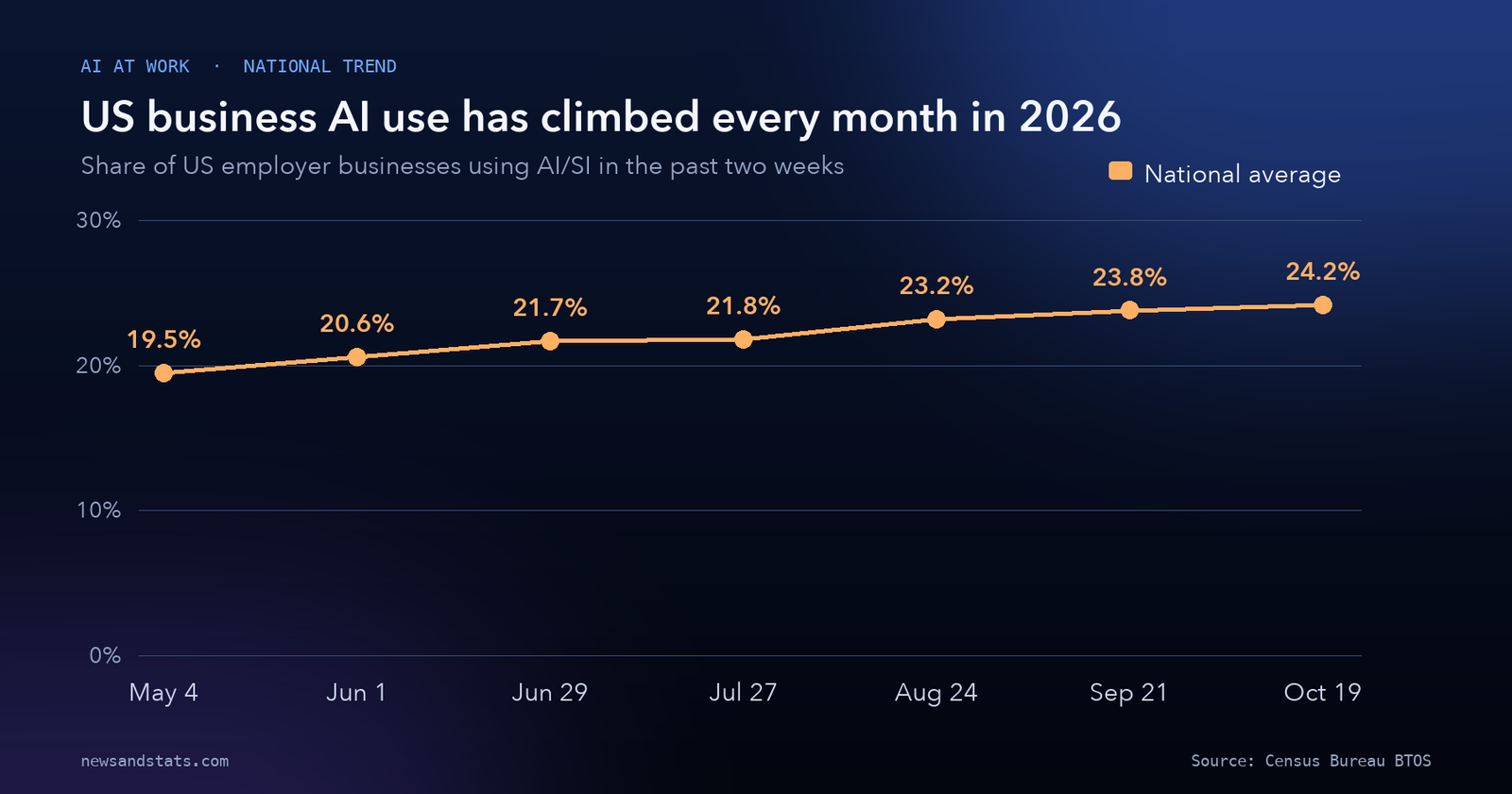
Source: U.S. Census Bureau, Business Trends and Outlook Survey, National data, Response Estimates, periods 202610-202622.
Looking ahead, 27.6% of businesses said in the same survey wave that they expected to be using AI/SI in the next six months, down slightly from 28.6% the period before. Expected use has consistently run a few points above current use throughout 2026, which is itself a modest but real sign that businesses keep anticipating AI adoption faster than they actually adopt it.
3. A rename, and a jump in “I don’t know”
The most striking single change in the newest data isn’t in the adoption rate. It’s in the share of businesses that couldn’t answer the question at all. Nationally, “do not know” responses to the AI/SI usage question held in a narrow band of roughly 9% to 11% through every survey wave from May to mid-October 2026. In the 5-18 October wave, immediately before the wording change, it was 9.6%. In the first wave under the new “Super Intelligence” wording, 19 October-1 November, it jumped to 13.9%, a rise of 4.3 percentage points by my calculation from the Census Bureau’s own published figures. The same pattern shows up by firm size: “do not know” responses rose in every employee-size category the Census Bureau tracks, from large firms with 250 or more employees (21.7% to 24.5%) to mid-sized firms with 20 to 49 employees (12.0% to 16.8%).
None of this proves the new term itself confused respondents; the Census Bureau did not publish an explanation for the shift in this release, and other changes to the survey instrument could also be in play. But the jump coincides exactly with the first wave of “Super Intelligence” wording, after months of a much steadier “do not know” rate, which is the kind of break in a data series that makes year-over-year and even month-over-month comparisons harder to read cleanly going forward.
4. AI adoption by firm size: a 21-point gap from smallest to largest
Set the rename aside, and the clearest pattern in the data is size. In the 19 October-1 November survey wave, 44.1% of businesses with 250 or more employees reported using AI/SI in the past two weeks, compared with just 22.8% of businesses with 1 to 4 employees, a gap of more than 21 percentage points. The relationship is close to a straight line: usage climbs at every step up the size ladder, from 22.8% for the smallest firms to 23.4% for firms with 5 to 9 employees, 25.3% for 10 to 19 employees, 29.2% for 20 to 49 employees, 33.2% for 50 to 99 employees, 40.0% for 100 to 249 employees, and 44.1% for the largest firms.

Source: U.S. Census Bureau, Business Trends and Outlook Survey, Employment Size Class data, Response Estimates, period 202622.
| Firm size (employees) | Currently using AI/SI | Expect to use AI/SI in 6 months |
|---|---|---|
| 1 to 4 | 22.8% | 25.2% |
| 5 to 9 | 23.4% | 26.8% |
| 10 to 19 | 25.3% | 30.3% |
| 20 to 49 | 29.2% | 34.0% |
| 50 to 99 | 33.2% | 43.1% |
| 100 to 249 | 40.0% | 47.2% |
| 250 or more | 44.1% | 53.6% |
Source: U.S. Census Bureau, Business Trends and Outlook Survey, Employment Size Class data, Response Estimates, period 202622.
This pattern isn’t new. Back in May 2026, when the Census Bureau published a detailed look at AI use by firm size covering the prior six months, it found 37% of firms with at least 250 employees reported using AI, against 32% for firms with 100 to 249 employees, and that usage “didn’t change significantly” among firms with fewer than 20 employees over that period, with fewer than one in five of the very smallest firms (1 to 4 employees) using AI at all. The gap, in other words, has been a persistent feature of the data for most of 2026, not a one-time snapshot: large firms started further ahead and have kept extending their lead in percentage-point terms even as every size category has grown.
A separate Census Bureau working paper on the same survey, using a specially weighted “second AI supplement” collected from 17 November 2025 to 8 February 2026, put a sharper point on the imbalance: across that whole window, 18% of firms used AI in some business function on an unweighted, firm-count basis, but that rose to 32% once the data were weighted by employment, because AI use is so concentrated at bigger employers. The paper found adoption reaching 50% to 60% of very large firms, 60% to 70% on an employment-weighted basis, in the Information, Professional Services and Finance sectors specifically.
5. Which industries lead
Firm size isn’t the only thing that predicts AI use. Industry matters just as much. In the same 19 October-1 November 2026 survey wave, the Information sector, as the Census Bureau’s own industry classification system defines it, had the highest adoption rate of any industry the Census Bureau tracks, at 45.0%, followed by Professional Services at 41.6%, Educational Services at 39.5% and Finance and Insurance at 39.2%. All four sit well above the 24.2% national average.

Source: U.S. Census Bureau, Business Trends and Outlook Survey, Sector data, Response Estimates, period 202622.
Real Estate sat closer to the middle, at 28.2%. Retail Trade, at 19.1%, and Accommodation and Food Services, at 12.1%, trailed well behind, the latter at barely a quarter of the Information sector’s rate. The same ordering, knowledge-intensive sectors out front, hospitality and retail at the back, held in May 2026 too, when the Census Bureau reported Information at 39.7% and Finance and Insurance at 33.9%, against roughly 14% for Retail Trade; every one of those sectors has since moved up, but their relative ranking has not changed. That lead tracks closely with where AI infrastructure spending is concentrated, overwhelmingly in software, finance and professional services rather than in retail or hospitality.
6. Retail and hospitality are catching up, slowly
It isn’t that Retail Trade and Accommodation and Food Services are standing still. Retail Trade’s adoption rate has risen from roughly 14% in May 2026 to 19.1% by late October, a meaningful five-point gain over five months. But the sectors that started ahead have grown too, so the gap between, say, Information and Accommodation and Food Services has stayed wide even as every sector’s own number has climbed. Humanoid robots moving onto factory floors represent a different, more capital-intensive kind of automation than the software-based AI/SI use this survey measures, but both trends share the same underlying pattern: capital-intensive, knowledge-intensive operations adopt new technology fastest, and labor-intensive, thin-margin service businesses adopt it more slowly.
7. What AI is actually used for
Current use and sector rankings only tell part of the story. The Census Bureau’s working paper on the November 2025-February 2026 AI supplement dug into how businesses that do use AI actually deploy it. Among adopting firms, the scope of use was limited: 57% integrated AI into three or fewer business functions out of the 15 the supplement asks about. The three most common functions were Sales and Marketing, used by 52% of AI-adopting firms, Strategy and Business Development, used by 45%, and Information Technology, used by 41%.
| Business function | Share of AI-adopting firms using it there |
|---|---|
| Sales and Marketing | 52% |
| Strategy and Business Development | 45% |
| Information Technology | 41% |
Source: U.S. Census Bureau, “The Microstructure of AI Diffusion,” CES Working Paper 26-25, abstract.
At the worker level, the same supplement found that in 23% of firms (41% once weighted by employment), employees used generative AI in their day-to-day tasks, with writing, document analysis and information search the most common uses; 65% of those firms limited that task-level use to three or fewer tasks. That finding lines up with GitHub’s own count of AI coding agents spreading through software teams this year, and with the ILO’s global job-exposure index, both of which point to AI augmenting specific tasks rather than replacing whole job categories. Two-thirds of AI users (66%) told the Census Bureau they relied on AI solely to augment existing tasks rather than substitute for them.
On jobs specifically, the working paper found that AI-related employment decreases were rare, occurring at only 2% of firms, and that where declines did happen, they were concentrated among large firms and among firms that used AI to substitute for, rather than augment, worker tasks. The newest national-level BTOS data back this up at a broader level: in the 19 October-1 November 2026 wave, 87.3% of businesses said AI/SI use had caused no change to their total headcount over the prior six months, 6.6% said it had increased headcount, and 2.5% said it had decreased headcount. That has implications for entry-level hiring, where separate research has found more specific, function-level effects than this broad national figure alone would suggest. The Census Bureau’s working paper also reported a positive statistical correlation between a firm’s commercial performance and how broadly it had integrated AI, across functional deployment, worker-task use and operational investment combined, though a correlation like that does not by itself show which way the causation runs.
What to watch
- The next BTOS release, covering the collection period from 2 to 15 November 2026, is due to publish around 19 November and will be the second data point entirely under “Super Intelligence” wording, the first real test of whether the jump in “do not know” responses fades or persists.
- The 28 November 2026 deadline in Executive Order 14434, by which the White House science office is due to propose formal legislative language defining “Super Intelligence” and “SI” in federal law.
- Whether the Census Bureau publishes a bridge or methodology note explaining the “do not know” jump, which would make year-over-year comparisons easier to trust.
- The next BTOS AI supplement, a deeper periodic module (the last one ran from 17 November 2025 to 8 February 2026) that would show whether the firm-size and sector gaps are narrowing or widening on a more detailed, function-by-function basis.
- Retail Trade and Accommodation and Food Services adoption rates, currently the two laggards, as a signal of whether AI use is broadening beyond knowledge-intensive industries.
- Keep an eye on our AI & Work coverage for how hyperscaler spending and infrastructure buildout translate into adoption at the sector level.
The bottom line
Renaming a federal survey question doesn’t change how many US businesses actually use AI, but the Census Bureau’s own data show a clear break in how confidently respondents answered that question, right at the wave the new wording took effect. Strip the terminology question away, and the underlying numbers tell a consistent story that has held all year: large, knowledge-intensive employers are adopting AI at roughly double the rate of the smallest, most labor-intensive ones, and most of the businesses that have adopted it are using it narrowly, to augment a handful of functions like sales, marketing and IT, not to cut jobs. Whether “Super Intelligence” sticks as the federal government’s preferred term, the gap between large and small businesses, and between knowledge-intensive and labor-intensive sectors, looks far more durable than the label attached to the technology driving it.
Related reading
- Stanford AI Index 2026 in 8 Numbers: the national and corporate AI investment totals behind the adoption rates in this piece.
- Generative AI Job Exposure in 8 Numbers: a complementary look at which occupations are most exposed to AI, rather than which firms have adopted it.
- The $750 billion AI bet: who spends it, and who pays: the infrastructure spending that underlies the adoption curve described here.
- Is AI hurting entry-level jobs? Two studies, two answers: a closer look at the labor-market question this article’s headcount figures only partly answer.