Global AI spending is projected to reach $4,050 billion in 2027, up 47.5% from $2,746 billion in 2026, according to Gartner’s worldwide AI spending forecast released on 12 November 2026. Rather than a software-first boom, hardware dominates the ledger: AI infrastructure alone accounts for 59% of all worldwide AI spending in 2027, climbing 53% year-over-year to $2,397 billion ($2.4 trillion). Every other layer combined—services, software, cybersecurity, agents, models, data science platforms, application development platforms, and AI data—accounts for the remaining $1,652 billion. That 59-to-41 split shows that the physical buildout of compute and servers still outweighs the enterprise tools workers use directly.
1. Where $4,050 Billion in Global AI Spending Goes in 2027
Gartner’s nine-market breakdown reveals how concentrated global AI spending remains at the top three tiers. Out of $4,050 billion projected for 2027, AI infrastructure ($2,397 billion), AI services ($746 billion), and AI software ($649 billion) together account for $3,792 billion. My calculation shows that those three categories represent 93.6% of total 2027 AI spending ($3,792 billion divided by $4,050 billion).
The remaining six markets—AI cybersecurity ($86 billion), AI agents and assistants ($67 billion), generative AI models ($51 billion), AI platforms for data science and machine learning ($35 billion), AI application development platforms ($12 billion), and AI data ($6 billion)—total $257 billion, or 6.3% of the 2027 market (my calculation: $257 billion divided by $4,050 billion, with $1 billion attributable to rounding in Gartner’s headline total). Grouping the two platform lines and AI data into an “Other” tier yields $53 billion ($35 billion plus $12 billion plus $6 billion).

Source: Gartner, Worldwide AI Spending Forecast (12 November 2026), Table 1.
2. AI-Optimized Servers Jump 81.4% as “Memflation” Hits Hardware
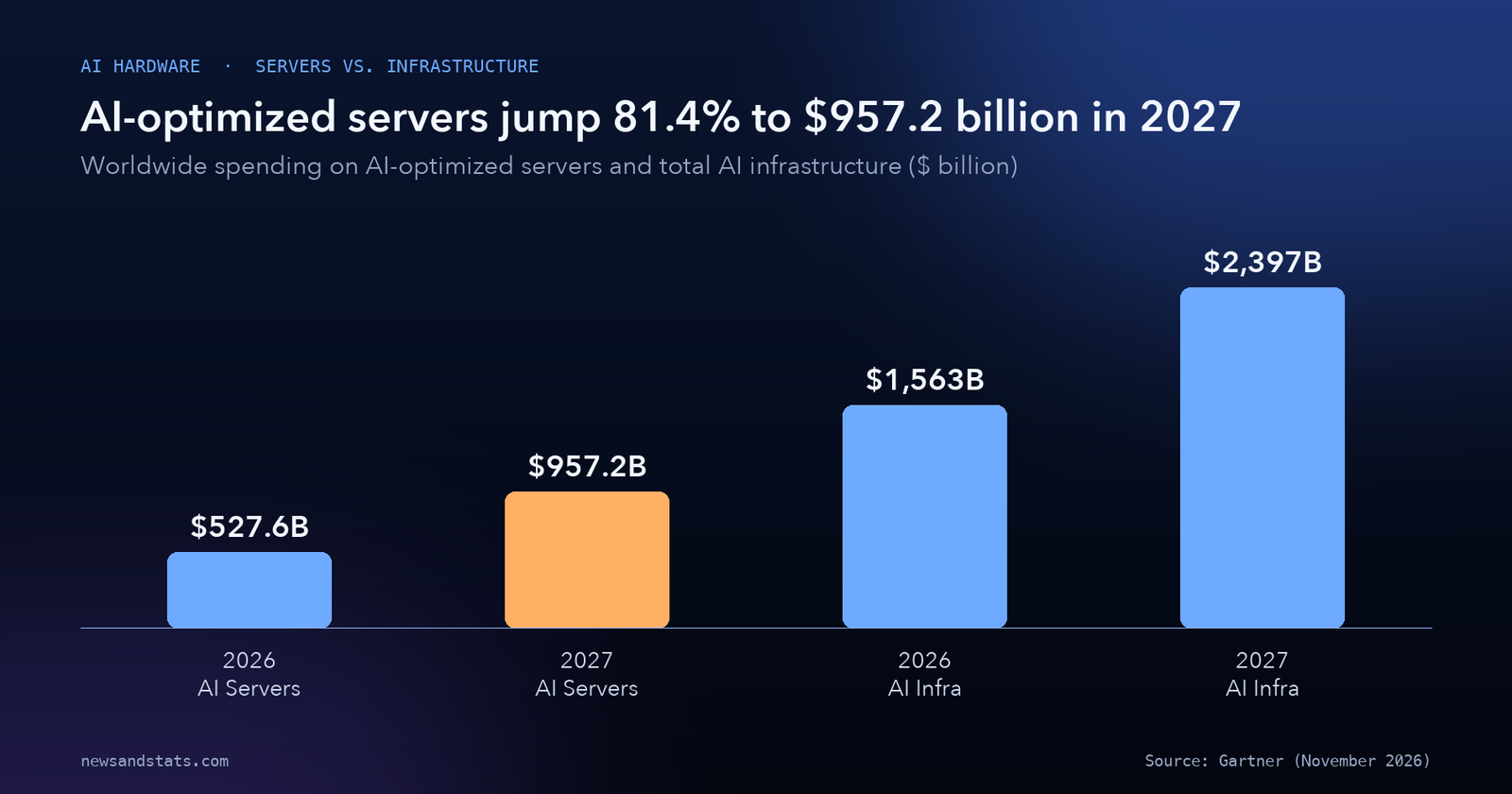
Inside the $2,397 billion AI infrastructure total, AI-optimized servers form the single largest spending line. Gartner projects worldwide spending on AI-optimized servers will rise from $527.6 billion in 2026 to $957.2 billion in 2027. My calculation puts that expansion at $429.6 billion, or +81.4% year-over-year ($429.6 billion divided by $527.6 billion). As a share of total AI infrastructure, AI-optimized servers climb from 33.8% in 2026 ($527.6 billion divided by $1,563 billion) to 39.9% in 2027 ($957.2 billion divided by $2,397 billion).
Gartner attributes this surge to three concrete forces: expanding user requirements for inference workloads, increasingly compute-intensive model training, and what John-David Lovelock, Distinguished VP Analyst and Chief of Research at Gartner, terms the “memflation” of AI-optimized server prices. That price pressure connects directly to the DRAM memory chip shortage and high-bandwidth memory bottlenecks pushing up server bill-of-materials costs. On the buyer side, hyperscalers and neocloud providers lead the buildout as cloud market share competition shifts toward AI-ready capacity.
Source: Gartner, Worldwide AI Spending Forecast (12 November 2026), Text and Table 1.
3. AI Agents Lead Percentage Growth at 123.3% While Services Lag
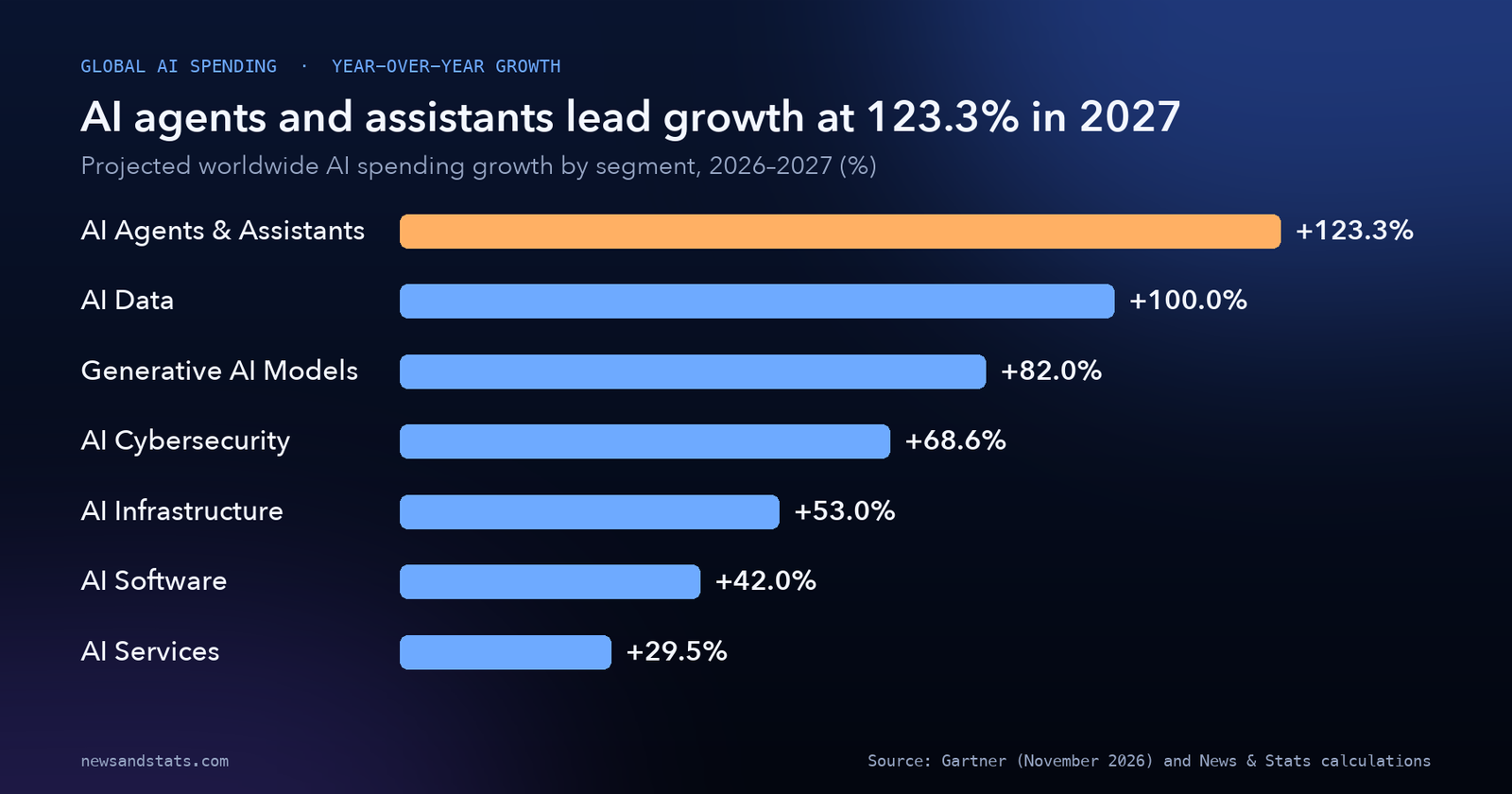
While infrastructure commands the largest dollar total, application-layer tools show the steepest percentage acceleration. AI agents and assistants rank as the fastest-growing segment across all nine Gartner categories, rising 123.3% (my calculation: +$37 billion divided by $30 billion) from $30 billion in 2026 to $67 billion in 2027. AI data spending doubles (+100.0%, from $3 billion to $6 billion), and generative AI models grow 82% from $28 billion to $51 billion (exact: +82.1%).
At the mid-tier, AI cybersecurity increases 68.6% (my calculation: +$35 billion divided by $51 billion) from $51 billion to $86 billion. Meanwhile, the two largest non-hardware categories grow more moderately: AI software expands 42% from $458 billion to $649 billion (exact: +41.7%), and AI services—spanning strategy, data preparation, integration, and deployment—grows 29.5% from $576 billion to $746 billion. That gap between fast-rising software/agent budgets and slower-growing services reflects vendors embedding AI directly into existing enterprise suites as organizations work to close the enterprise AI return gap.
Source: Gartner, Worldwide AI Spending Forecast (12 November 2026), Table 1 and News & Stats calculations.
4. The Complete 2026–2027 Global AI Spending Breakdown
Putting all nine Gartner categories side by side shows both dollar scale and relative momentum across the enterprise stack. From 2026 to 2027, total worldwide AI spending adds $1,304 billion in incremental budgets (my calculation: $4,050 billion minus $2,746 billion, or +47.5%). AI infrastructure supplies $834 billion of that $1,304 billion increase—or 64.0% of all new AI dollars—while AI software (+$191 billion) and AI services (+$170 billion) supply another $361 billion combined. Security governance also expands rapidly as rising shadow AI data breach costs push AI cybersecurity spending up 68.6% to $86 billion.
| Market segment | 2026 ($B) | 2027 ($B) | Net change ($B) | YoY growth |
|---|---|---|---|---|
| AI Infrastructure | 1,563 | 2,397 | +834 | +53.4% |
| AI Services | 576 | 746 | +170 | +29.5% |
| AI Software | 458 | 649 | +191 | +41.7% |
| AI Cybersecurity | 51 | 86 | +35 | +68.6% |
| AI Agents and Assistants | 30 | 67 | +37 | +123.3% |
| Generative AI Models | 28 | 51 | +23 | +82.1% |
| AI Platforms for Data Science and ML | 26 | 35 | +9 | +34.6% |
| AI Application Development Platforms | 10 | 12 | +2 | +20.0% |
| AI Data | 3 | 6 | +3 | +100.0% |
| Total AI Spending | 2,746 | 4,050 | +1,304 | +47.5% |
Source: Gartner, Worldwide AI Spending Forecast (12 November 2026), Table 1 and News & Stats calculations.
5. Foundation Models Hold 81% Share as Domain-Specific Models Surge 99%
Inside the $51 billion generative AI model market projected for 2027, Gartner highlights a structural split between broad foundation models and specialized enterprise models. Overall GenAI model spending grows 82% from $28 billion in 2026 to $51 billion in 2027, driven by agentic workflows, multimodal applications, and industry-specific intelligence.
Domain-specific and specialized AI models represent the fastest-accelerating sub-segment, with spending projected to grow 99% in 2027 as organizations seek higher contextual relevance and accuracy in targeted business workflows. Even with that 99% expansion, foundation GenAI models continue to command 81% of total model spending in 2027, leaving 19% (my calculation: 100% minus 81%) for specialized and non-foundation model spending. In dollar terms, foundation models remain the core intelligence layer powering enterprise agents and software applications.
6. How Global AI Spending Forecasts Get Misread
Three technical details in Gartner’s November 2026 forecast keep readers from misinterpreting the $4,050 billion headline.
First, nominal spending growth reflects price inflation as well as physical capacity. Gartner explicitly cites server “memflation” as a primary driver pushing AI-optimized server outlays from $527.6 billion to $957.2 billion, meaning higher memory and hardware unit prices inflate the dollar total alongside rising server counts. Second, Gartner’s headline totals reflect rounding: the nine individual market lines sum to $2,745 billion in 2026 versus the reported $2,746 billion total, and $4,049 billion in 2027 versus the reported $4,050 billion total (a $1 billion rounding gap in each year). Third, Gartner tracks vendor-side market spending across hardware, software, and services—separate from its AI jobs forecast through 2030—so higher IT budgets do not translate one-for-one into immediate headcount reductions.
7. What the 2027 Budget Shift Means for Enterprise Buyers
Comparing the 2026 and 2027 budget shares reveals how enterprise AI adoption is maturing. In 2026, AI infrastructure accounted for 56.9% of total AI spending (my calculation: $1,563 billion divided by $2,746 billion), AI services accounted for 21.0% ($576 billion divided by $2,746 billion), and AI software accounted for 16.7% ($458 billion divided by $2,746 billion). By 2027, infrastructure climbs to 59.2% ($2,397 billion divided by $4,050 billion, rounded to 59% by Gartner), while AI services drop to 18.4% ($746 billion divided by $4,050 billion) and AI software dips to 16.0% ($649 billion divided by $4,050 billion).
Meanwhile, the smallest software-centric categories gain share rapidly. AI agents and assistants rise from 1.1% of total AI spending in 2026 ($30 billion divided by $2,746 billion) to 1.7% in 2027 ($67 billion divided by $4,050 billion), and AI cybersecurity rises from 1.9% to 2.1%. That shift indicates that while cloud providers absorb the bulk of capital spending on servers and data centers, enterprise IT buyers are directing their fastest budget increases toward autonomous agents, governance, and security.
8. Non-Server Infrastructure and the Platform Layer
Breaking AI infrastructure apart reveals that non-server hardware and data center components still absorb the majority of infrastructure budgets. Subtracting AI-optimized servers ($527.6 billion in 2026 and $957.2 billion in 2027) from total AI infrastructure ($1,563 billion in 2026 and $2,397 billion in 2027) leaves $1,035.4 billion in 2026 and $1,439.8 billion in 2027 for networking, storage, facilities, and supporting infrastructure (my calculation: +$404.4 billion, or +39.1% year-over-year). Even though AI-optimized servers grow more than twice as fast (+81.4% vs. +39.1%), non-server infrastructure still accounts for 60.1% of the 2027 infrastructure bill.
At the other end of the stack, platform and data tooling remain a small slice of the $4.05 trillion market despite rapid growth rates. AI platforms for data science and machine learning rise from $26 billion to $35 billion (holding a 0.9% share in both years), AI application development platforms move from $10 billion to $12 billion (0.4% to 0.3%), and AI data doubles from $3 billion to $6 billion (0.1% in both years).
| Market segment | 2026 share | 2027 share | Shift (pp) |
|---|---|---|---|
| AI Infrastructure | 56.9% | 59.2% | +2.3 pp |
| AI Services | 21.0% | 18.4% | -2.6 pp |
| AI Software | 16.7% | 16.0% | -0.7 pp |
| AI Cybersecurity | 1.9% | 2.1% | +0.2 pp |
| AI Agents and Assistants | 1.1% | 1.7% | +0.6 pp |
| Generative AI Models | 1.0% | 1.3% | +0.3 pp |
| AI Platforms for Data Science and ML | 0.9% | 0.9% | 0.0 pp |
| AI Application Development Platforms | 0.4% | 0.3% | -0.1 pp |
| AI Data | 0.1% | 0.1% | 0.0 pp |
Source: Gartner, Worldwide AI Spending Forecast (12 November 2026), Table 1 and News & Stats calculations.
What to watch
- AI-optimized server pricing: With AI-optimized servers projected to jump from $527.6 billion to $957.2 billion, any easing in memory chip supply will directly affect Gartner’s “memflation” assumption.
- Services vs. software share: AI services grow 29.5% while AI software grows 42%; watch whether packaged AI features reduce reliance on external integration consultants.
- Agentic AI monetization: AI agents and assistants are forecast to jump 123.3% to $67 billion in 2027; quarterly enterprise software earnings will test whether seat-based pricing converts into agent consumption.
- Domain-specific model adoption: Specialized AI models are projected to grow 99% in 2027, testing whether vertical models chip away at foundation models’ 81% revenue share.
- Cybersecurity governance budgets: AI cybersecurity spending climbs 68.6% to $86 billion as organizations formalize controls around model access and data leakage.
The bottom line
Worldwide AI spending is forecast to rise 47.5% from $2,746 billion in 2026 to $4,050 billion in 2027, adding $1,304 billion in a single year. Hardware remains the dominant cost center: AI infrastructure grows 53% to $2,397 billion (59% of the market), led by an 81.4% surge in AI-optimized servers to $957.2 billion. Above the hardware layer, AI agents and assistants (+123.3%), AI data (+100.0%), and generative AI models (+82%) post the fastest percentage gains, while AI services (+29.5%) and AI software (+42%) provide the largest non-hardware dollar pools. Together, the numbers show an AI economy still led by physical compute buildouts even as enterprise spending pivots toward agents, specialized models, and security.
Related reading
- Why memory chips got so expensive: the DRAM shortage in numbers: How memory supply bottlenecks drive the server “memflation” cited by Gartner.
- The State of AI 2026 in 8 Numbers: Individual Gains Meet an Enterprise ROI Gap: Why enterprise return on investment lags individual AI tool adoption.
- Shadow AI Data Breach Costs Hit $6 Million in IBM’s 2026 Report: Why AI cybersecurity spending is projected to reach $86 billion in 2027.