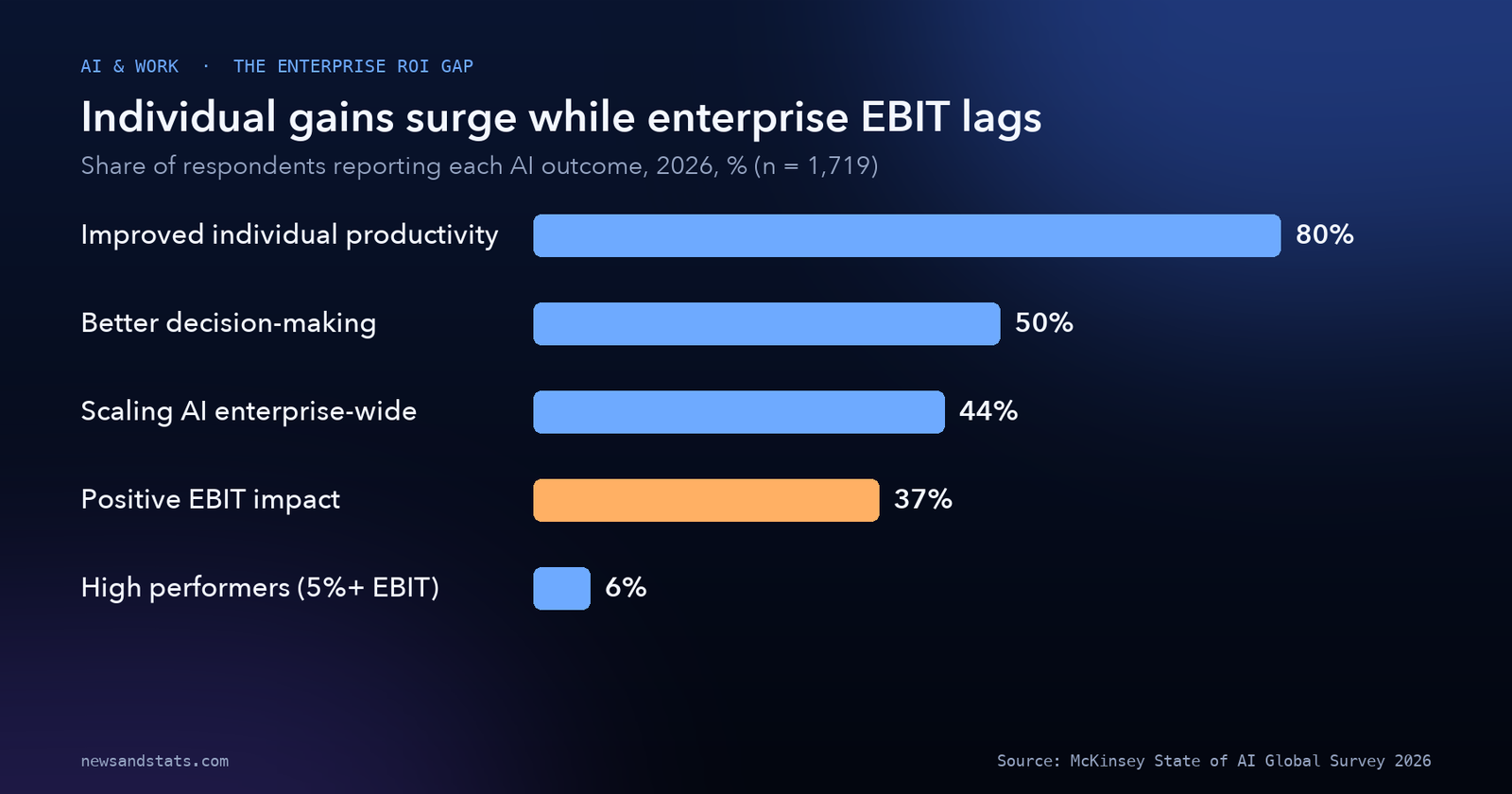
Artificial intelligence has become routine for individual employees, yet most companies are still struggling to turn daily tool use into bottom-line profit. According to McKinsey’s The State of AI: Global Survey 2026, published on 25 August 2026 after surveying 1,719 participants across 97 nations between 4 May and 8 June 2026, 80% of respondents say AI has improved their own productivity. At the enterprise level, however, only 37% report any contribution to earnings before interest and taxes (EBIT), virtually unchanged from 2025. Together, the findings define the State of AI 2026: a widening split between widespread worker fluency, rising agentic coding deployments, emerging token-cost constraints, and the 6% of high-performing firms redesigning workflows to capture real financial returns.
1. 80% Boost Individual Output, Yet Only 37% See EBIT Gains
The central tension in McKinsey’s 2026 data sits between personal productivity and corporate profit. Four in five respondents (80%) report that AI improved their individual productivity, and 50% say it helps them make better decisions and develop new skills—results that hold consistently across organizational levels. Yet workplace strain accompanies those gains: 47% of mid-level managers and individual contributors report experiencing AI-related negative effects, compared with 31% of executives and senior managers.
Source: McKinsey, The State of AI: Global Survey 2026, Despite broader use and individual results.
Corporate financial statements show far slower progress. Only 37% of respondents attribute any positive EBIT impact to AI use—unchanged from 2025, even though enterprise-wide scaling rose 6 percentage points to 44% (my calculation). Even among firms reporting functional gains rather than company-wide EBIT lift, cost reductions cluster in supply chain management, service operations, and manufacturing, while revenue gains cluster in marketing and sales, product and service development, and software engineering. Respondents also report non-financial improvements, most notably in innovation, competitive differentiation, customer satisfaction, and employee satisfaction—echoing the top non-financial gains from 2025. Across the broader AI & Work landscape, individual tool fluency has arrived faster than the operating models needed to monetize it.
2. 44% Scale Enterprise-Wide, With Large Firms Leading 54% to One-Third
Overall adoption has moved well beyond isolated pilots. Nearly nine in ten respondents report regular AI use in at least one business function, while the share using AI in three or more functions rose from 51% in 2025 to 56% in 2026. Enterprise-wide scaling reached 44%, up 6 percentage points from 38% a year earlier (my calculation).
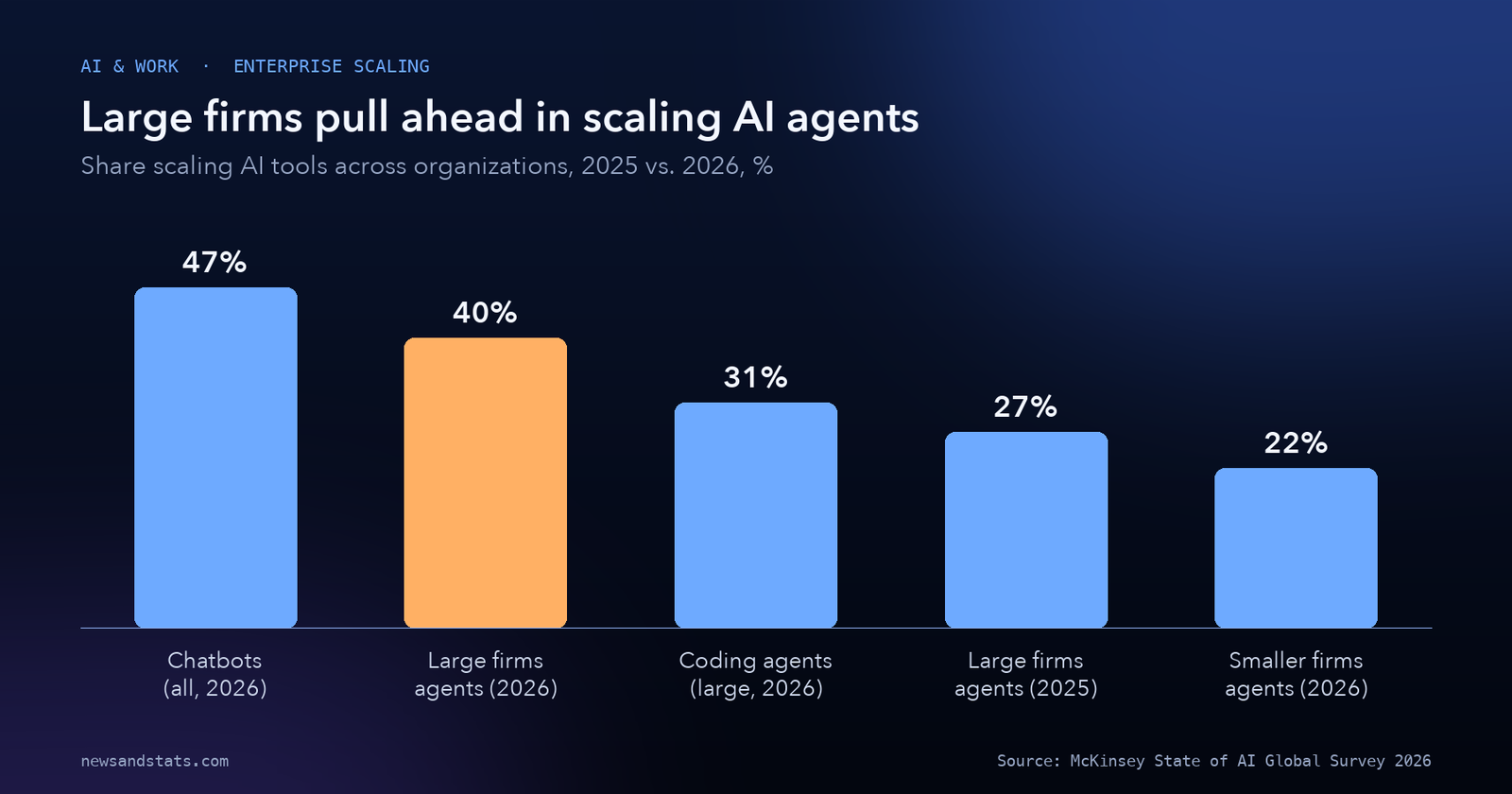
Company size remains a decisive dividing line. Among large organizations with more than $1 billion in annual revenue—which account for 36% of McKinsey’s sample, weighted by each respondent’s nation’s contribution to global GDP—54% report scaling AI across the enterprise, compared with one-third of smaller organizations. That size gap widens further when companies move from general chatbots (scaled enterprise-wide by 47% of all respondents) to autonomous AI agents. In large enterprises, the share scaling AI agents in one or more functions jumped from 27% in 2025 to 40% in 2026, a 13 percentage point gain (my calculation), whereas smaller firms stayed flat at 22%. That divergence echoes official US data tracked in our analysis of AI adoption by firm size.
Source: McKinsey, The State of AI: Global Survey 2026, Use of AI is deepening.
3. 32% Build Software In-House Instead of Buying It
One of the sharpest shifts in the State of AI 2026 is how software coding agents are altering enterprise IT procurement. About two in ten organizations overall—and 31% of large enterprises—are now scaling software coding agents. Those tools are changing the classic build-versus-buy equation: nearly one-third of respondents (32%) say their organizations have decided against purchasing one or more external software products or features because they could build the functionality in-house using agentic coding tools.
In-house replacement is most common in technology and healthcare, followed by professional services and energy and materials. Among AI high performers, nearly half report skipping external software purchases in favor of internal agentic builds, compared with 31% of other organizations. Rather than abandoning external vendors altogether, McKinsey notes that leading companies are becoming more deliberate about where to buy, where to build, and where to maintain enough internal engineering capability to integrate and scale what works. That shift aligns with developer-level trends in GitHub Octoverse 2026, where coding agents are moving from autocomplete assistants to autonomous workflow builders.
4. Only 6% Qualify as AI High Performers
McKinsey defines AI high performers as organizations that attribute at least 5% of their EBIT to AI and describe its impact as “significant.” Despite higher overall adoption, that elite cohort stayed flat at 6% of all respondents in 2026, unchanged from 2025.
| Dimension | AI high performers (6% of sample) | Other organizations |
|---|---|---|
| Fundamentally redesigned workflows | Nearly three-quarters (up from 55% in 2025) | About one-quarter |
| Built software in-house vs. buying | Nearly half | 31% |
| Expect AI investment up 10%+ next year | More than half | 36% |
| Intend business transformation in 3 years | 3.3 times as likely | Baseline (1.0x) |
| Scaling software coding agents | 2.0 times as likely | Baseline (1.0x) |
| Scaling other agentic AI | 2.7 times as likely | Baseline (1.0x) |
Source: McKinsey, The State of AI: Global Survey 2026, High-performing organizations are transforming with AI.
What separates the 6% from the rest is workflow redesign rather than tool count. While roughly 80% of both high performers and other organizations pursue efficiency gains from AI, most high performers also target growth and innovation. Nearly three-quarters of high performers report fundamentally redesigning workflows because of AI, up from 55% in 2025, compared with just one-quarter of other respondents. High performers are 3.3 times more likely to intend to transform their business within three years, twice as likely to have senior leadership commitment and defined impact-measurement processes, more than three times as likely to scale agents across most functions, and more than twice as likely to spend over 15% of their information and communication technology (ICT) budget on AI. Those organizational bottlenecks mirror the OECD AI divide, where capital and process redesign determine who captures productivity gains.
5. 20% Say Operating and Token Costs Constrain AI Use
As companies move from simple chat prompts to multi-step reasoning and agentic coding, variable compute bills are emerging as a practical ceiling. About 20% of respondents (one in five) report that AI-related operating costs—including token consumption—have begun to constrain their organization’s AI use, a rate that holds steady across company sizes and industries. Across individual tool categories—chatbots, AI agents, and software coding agents—roughly 10% of respondents say costs are limiting deployment, while AI high performers report coding-agent cost constraints about three times as often as peers.
Even with tighter “tokenomics,” corporate budgets keep expanding. Even as per-token prices have declined, the volume of tokens consumed and generated by complex reasoning tasks has risen faster. Twenty-eight percent of respondents say their organizations already spend more than 10% of their total enterprise-wide ICT budget on AI technologies, and 60% expect their organizations to increase AI investments over the next year—led by pharmaceuticals and medical products, insurance, and banking and financial institutions. More than half of high performers plan to raise AI spending by 10% or more next year, compared with 36% of other respondents, reinforcing the massive infrastructure demand behind hyperscaler capital spending.
6. Agentic AI Concentrates in Tech, Retail, and Manufacturing
AI agents are not spreading uniformly across corporate departments. Across the full sample, organizations most often scale AI agents inside IT, knowledge management, and software engineering, with technology, media, and telecommunications respondents leading overall agent deployment.
Sector priorities follow clear operational bottlenecks. Consumer goods and retail firms most often deploy agents in marketing and sales activities, while advanced manufacturing companies—including automotive, aerospace, and semiconductor producers—concentrate agentic deployments in supply chain and inventory management as well as manufacturing processes. Meanwhile, high performers pair broader agent scaling (2.7 times peers for non-coding agents) with stricter governance, working more actively to mitigate AI-driven technical vulnerabilities and unauthorized or unintended agent actions.
7. Actual Job Cuts Were Half of Last Year’s Forecast (14% vs. 32%)
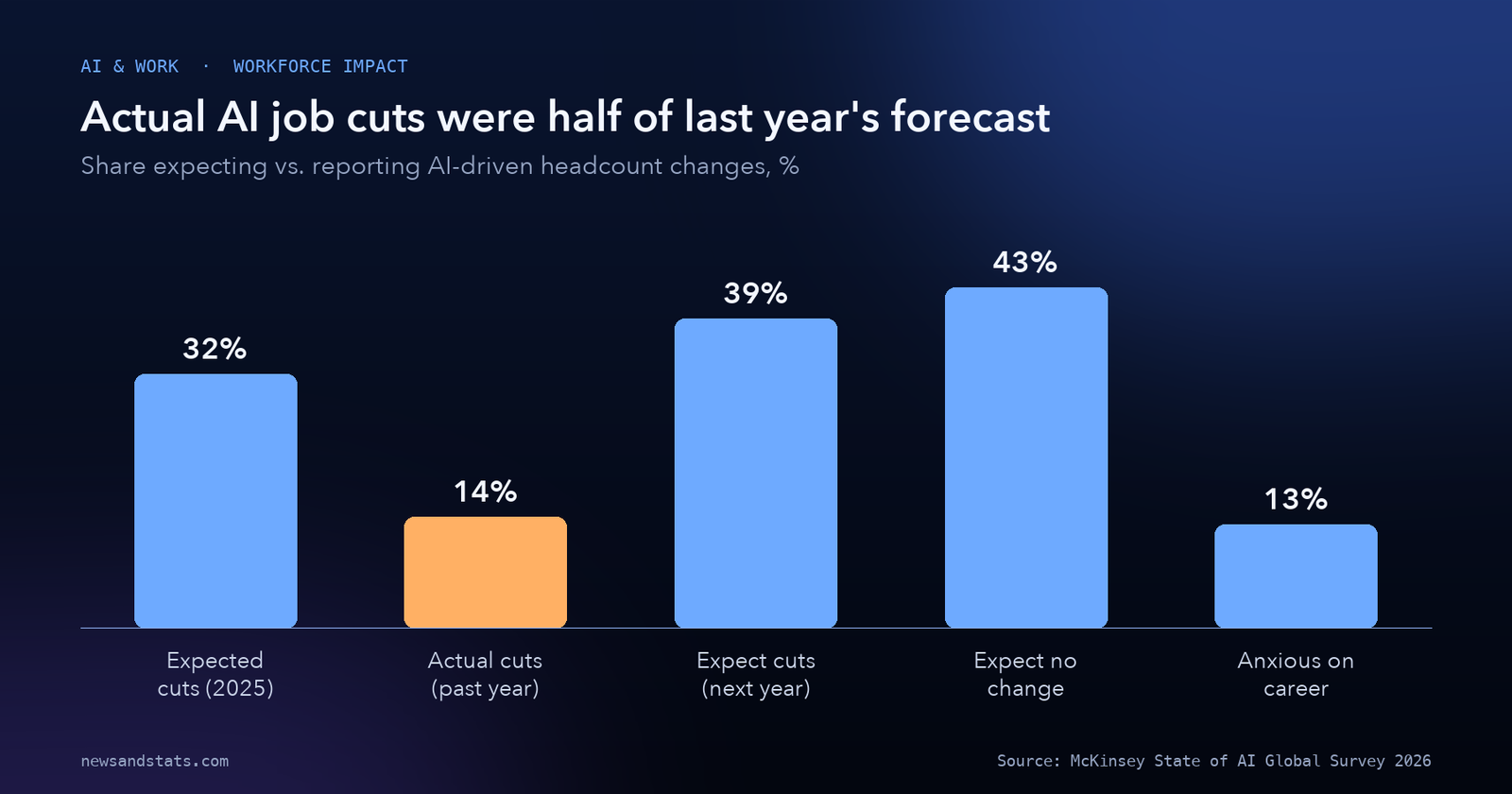
Perhaps the sharpest reality check in McKinsey’s 2026 survey involves headcount. In 2025, 32% of respondents expected AI to reduce their organization’s workforce over the following 12 months. In 2026, only 14% of respondents from AI-using organizations report that AI contributed to an overall decline in workforce size over the past year—less than half of last year’s prediction, an 18 percentage point gap (my calculation)—while two-thirds report little or no AI-related change in total employment. McKinsey verified that the 552 respondents who answered both the 2025 and 2026 surveys showed the exact same pattern.
Source: McKinsey, The State of AI: Global Survey 2026, Previous expectations of AI-driven workforce reductions.
In every individual business function, actual reductions trailed last year’s expectations; in marketing and sales, manufacturing, strategy and corporate finance, and knowledge management, reported declines were roughly half what respondents predicted in 2025. Yet forward-looking expectations remain elevated: 39% of respondents in 2026 expect AI to decrease overall headcount over the next year (with service operations and supply chain management cited most often), while 43% expect little or no change. Individually, workers remain calm: just 13% say AI makes them feel anxious about their own career prospects, a nuanced picture that aligns with Gartner’s 2030 forecast and recent evidence on entry-level jobs.
8. 60% Plan Higher AI Budgets Despite Unchanged EBIT
Conviction in AI’s three-year potential continues to outpace near-term accounting returns. Sixty percent of surveyed organizations plan to raise AI spending in the coming year, even though the share reporting positive EBIT impact held at 37% and the high-performer tier remained stuck at 6%. That gap shows that buying licenses and running pilots no longer differentiates companies; the next phase depends on workflow redesign, cost governance, and measuring financial impact function by function.
What to watch
- Enterprise EBIT conversion in 2027: Whether the 37% share of companies reporting positive EBIT impact and the 6% high-performer tier finally rise as workflow redesign spreads beyond the early minority.
- Token-cost discipline: Whether the 20% share of organizations constrained by AI operating and token costs grows as multi-step agentic coding scales beyond the current 31% rate at large firms.
- SaaS build-versus-buy displacement: Whether the 32% of companies skipping external software purchases in favor of in-house agentic builds expands across non-tech industries.
- Headcount forecasts versus reality: Whether the 39% of respondents expecting AI-driven workforce reductions over the next year materialize or again overshoot actual cuts (14% in 2026).
- Mid-level manager strain: Whether companies address the 47% rate of AI-related negative effects reported by mid-level managers and individual contributors.
The bottom line
McKinsey’s State of AI 2026 survey of 1,719 leaders across 97 countries captures an enterprise market caught between high personal utility and flat corporate returns. Eighty percent of employees say AI boosts their productivity and 44% of organizations are scaling AI enterprise-wide, yet only 37% see any EBIT contribution and just 6% qualify as high performers. Closing that gap requires more than raising the 60% share of firms increasing AI budgets or deploying more coding agents—it demands fundamentally redesigning workflows, managing token costs, and pairing automation with clear financial measurement.
Related reading
- AI Adoption by Firm Size in 2026: The 21-Point Gap Behind Washington’s “Super Intelligence” Rename: Tracks how large enterprises pull ahead of smaller firms in official US adoption data.
- GitHub Octoverse 2026 in 8 Numbers: The 225 Million Milestone and the 40% Agent Surge: Examines the rapid rise of AI coding agents across software engineering workflows.
- AI Won’t Cause a Jobs Apocalypse, but Will Unleash Job Chaos: Inside Gartner’s 2030 Forecast: Compares enterprise workforce restructuring expectations through 2030.