Public narratives surrounding artificial intelligence frequently assume that technological adoption spreads automatically and evenly across modern economies. The reality of enterprise integration is far more fragmented.
According to the comprehensive oecd ai adoption data published by the Organisation for Economic Co-operation and Development on 5 November 2026, artificial intelligence is driving an unprecedented divergence between large corporations and smaller businesses, as well as between younger and older generations.
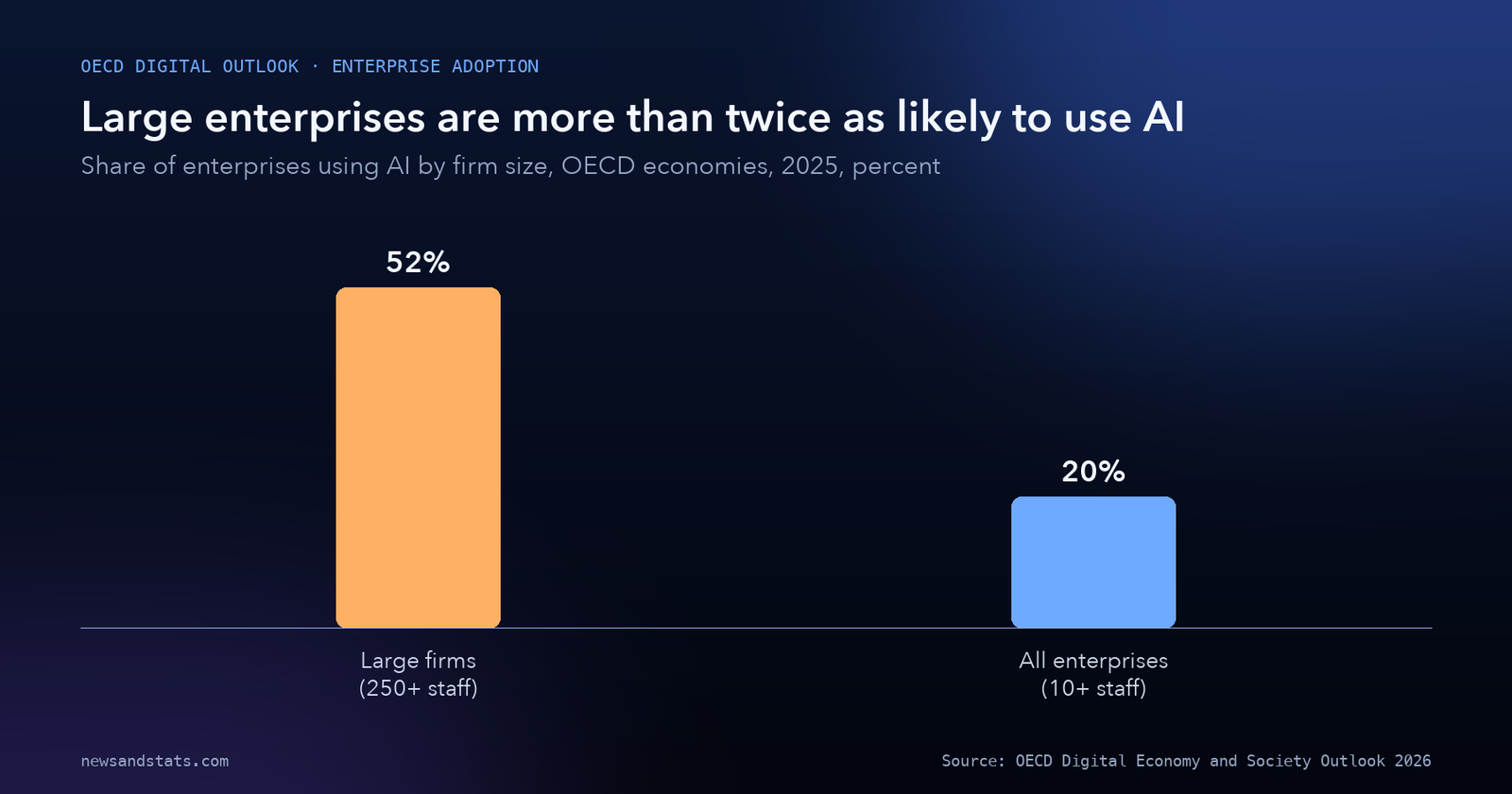
In its flagship report, titled OECD Digital Economy and Society Outlook 2026, the Paris-based intergovernmental organization finds that while artificial intelligence adoption is accelerating across all 38 member economies, its operational deployment is heavily skewed. In 2025, AI was utilized by 52% of large enterprises with 250 or more employees, compared to just 20% of all enterprises with 10 or more staff.
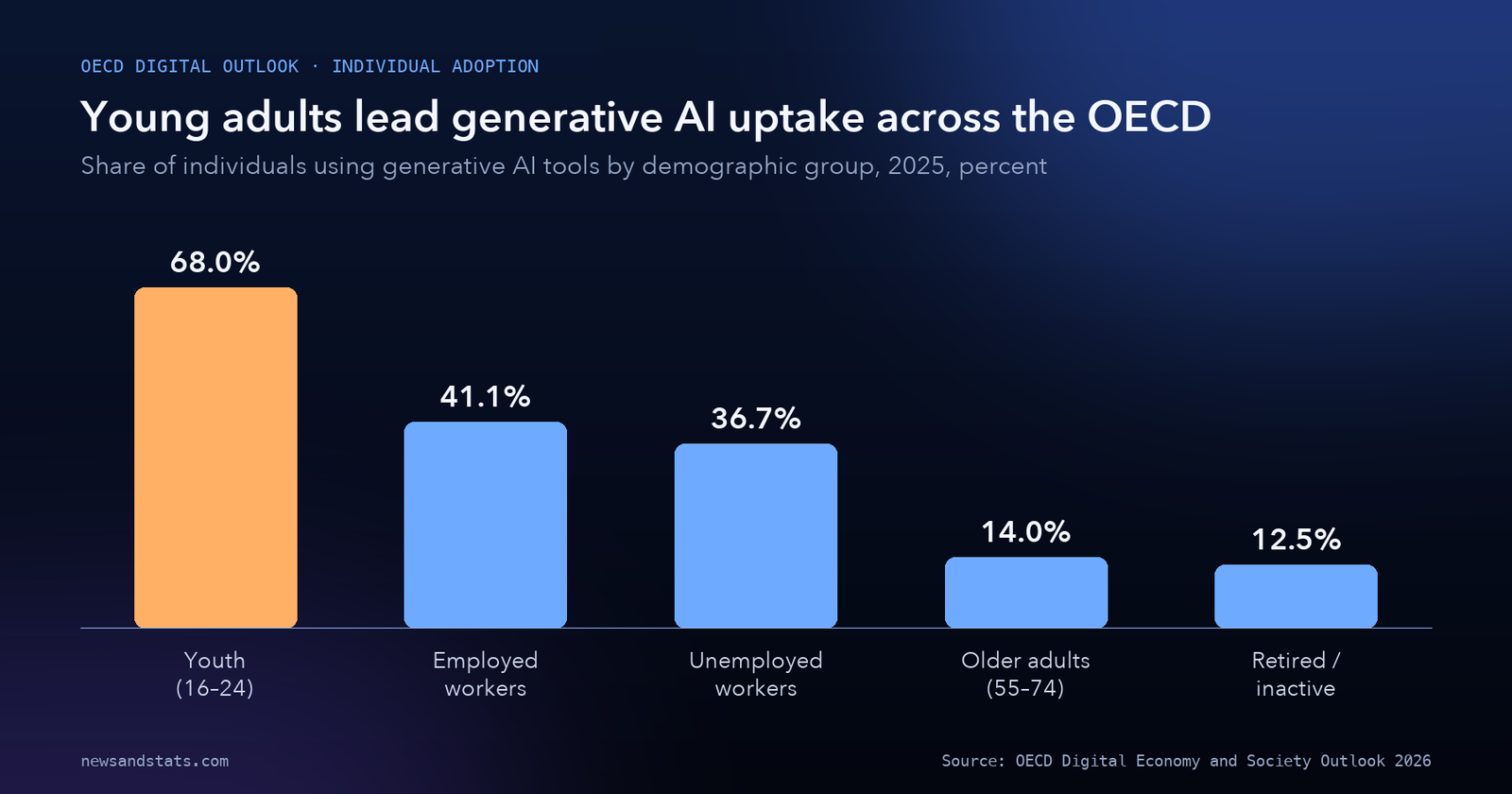
Concurrently, personal adoption of generative artificial intelligence reached 37% of individuals across the OECD in 2025, driven by young adults aged 16 to 24, whose adoption rate hit 68%. Meanwhile, older adults aged 55 to 74 registered an uptake of only 14%. As venture capital funding for specialized AI infrastructure surged by 127.3% to reach $123.9 billion in 2025, OECD governments are scrambling to adapt, shifting from broad regulatory frameworks toward technology-specific governance policies.
1. The 52% versus 20% firm size divide
The primary structural finding of the OECD’s 2026 Outlook is that artificial intelligence has deepened the operational divide between market-leading corporations and small-to-medium enterprises (SMEs).
Across the OECD in 2025, artificial intelligence was utilized by exactly 20% of enterprises with 10 or more employees. However, among large enterprises—defined as firms employing 250 or more personnel—adoption reached 52%.
Source: OECD, Digital Economy and Society Outlook 2026, Enterprise AI adoption indicators.
Subtracting 20% from 52% reveals a 32-percentage-point adoption chasm (my calculation) between large corporations and the broader business economy. Large enterprises are 2.6 times as likely to deploy AI systems as the average firm (my calculation).
This gap mirrors the dynamics documented in our earlier analysis of AI adoption by firm size across US businesses, where large multinational firms leveraged enterprise software budgets and dedicated data engineering teams to operationalize machine learning, while smaller firms remained on the sidelines.
The OECD identifies three primary bottlenecks that restrict small-business adoption:
- Financial and infrastructure constraints: Smaller enterprises lack the capital required to purchase enterprise software licenses, specialized cloud compute, and proprietary model fine-tuning.
- Skills and integration deficits: SMEs rarely possess dedicated machine learning engineers, and integrating autonomous agent tools into legacy on-premise accounting or inventory software proves prohibitively expensive.
- Legal and compliance uncertainty: Navigating data privacy regulations, intellectual property exposure, and emerging digital compliance standards imposes disproportionate overhead costs on smaller operations.
The OECD warns that without aggressive, targeted policy interventions, this divide will widen. While smaller firms are projected to catch up in basic cloud computing adoption by 2030, the gap in advanced AI uptake is expected to persist. By the end of the decade, AI adoption among large firms is projected to be nearly 80% higher than the average across all enterprises.
Speaking in Paris, OECD Secretary-General Mathias Cormann emphasized the macroeconomic stakes:
“AI adoption among firms continues to expand. But to make the most of AI’s potential for productivity and competitiveness, we need to make sure adoption spreads to firms of every size. Our Outlook points to the levers to get there – wider access to cloud services, targeted support for AI and big data analytics, and stronger interoperability and open standards.”
2. Generative AI uptake: 37% overall, but young adults lead at 68%
While enterprise adoption remains bounded by firm scale, individual consumer uptake of generative artificial intelligence tools has expanded at historic speed.
Across the OECD, 37% of individuals surveyed in 2025 reported actively using generative AI tools. However, individual uptake is characterized by profound demographic polarization across age, education, and labor force participation.
Source: OECD, Digital Economy and Society Outlook 2026, Individual generative AI uptake metrics.
The generational divergence represents the single largest divide in the OECD dataset:
- Youth uptake (ages 16–24): Generative AI adoption reached 68.0%, driven by widespread integration into academic study and early-career workflows.
- Student saturation: Among students aged 16 and older, adoption reached 75.0% (three-quarters of the student population).
- Employed workers: Across active employees in the labor market, adoption stood at 41.1%.
- Job seekers: Among unemployed individuals seeking work, adoption stood at 36.7%, as candidates utilized automated tools to optimize resumes, draft applications, and prepare for interviews.
- Older adults (ages 55–74): Adoption collapsed to 14.0%.
- Retired and inactive adults: Adoption reached a low of 12.5%.
Subtracting 14.0% from 68.0% reveals an immense generational gap of 54.0 percentage points (my calculation), cited in the OECD’s statistical releases as 53.6 percentage points after granular weighting. Young adults are 4.86 times as likely to use generative AI as older adults (my calculation).
Socioeconomic factors also shape adoption patterns:
- Educational divide: The gap in generative AI usage between highly educated individuals and those with lower educational attainment is approximately 21.0 percentage points.
- Income divide: The gap between the highest-income quartile and the lowest-income quartile is also approximately 21.0 percentage points.
- Gender parity: In sharp contrast to income and age divides, the gender gap in generative AI adoption across the OECD is relatively narrow, at just 4.2 percentage points.
| Demographic and workforce cohort | Generative AI adoption rate in 2025 | Comparison to OECD average (37%) | Primary operational driver |
|---|---|---|---|
| Students (aged 16 and older) | 75.0% | +38.0 percentage points | Academic research, coursework drafting, coding assistance |
| Young adults (aged 16–24) | 68.0% | +31.0 percentage points | Digital-native workflows, social search, content generation |
| Employed labor force | 41.1% | +4.1 percentage points | Workplace productivity, email synthesis, data analysis |
| All individuals (OECD average) | 37.0% | Baseline | General generative AI diffusion benchmark |
| Unemployed job seekers | 36.7% | -0.3 percentage points | Job search optimization, resume tailoring, skill training |
| Older adults (aged 55–74) | 14.0% | -23.0 percentage points | Limited workplace exposure, perceived lack of utility |
| Retired and inactive population | 12.5% | -24.5 percentage points | Digital disengagement, non-professional routine |
Source: OECD, Digital Economy and Society Outlook 2026, Demographic breakdown tables.
3. The older generation paradox: connected to internet, disconnected from AI
A critical nuance uncovered in the OECD report is that the generational divide in AI adoption cannot be attributed to a lack of basic internet connectivity.
Between 2015 and 2025, older adults across OECD economies successfully bridged the traditional digital connectivity divide:
- In 2015, only 58% of adults aged 55 to 74 utilized the internet.
- By 2025, internet penetration among this demographic surged to 87%.
Subtracting 58% from 87% demonstrates a 29-percentage-point expansion in basic internet access (my calculation) over the decade. Nearly nine out of ten older adults in advanced economies are active online.
Yet despite high internet connectivity (87%), generative AI adoption among this group remains pinned at just 14%. Subtracting 14% from 87% reveals an internet-to-AI conversion gap of 73 percentage points (my calculation).
When surveyed by the OECD on why they do not use generative AI, older adults cited three primary reasons:
- Perceived lack of utility: 43% of older non-users reported seeing “no need” for artificial intelligence tools in their daily lives.
- Skills deficit: 12% of older adults cited a lack of digital skills to operate conversational interfaces effectively.
- Awareness gap: 9% of older adults cited a lack of awareness regarding available generative applications.
As explored in our analysis of the global digital divide, basic physical infrastructure (fiber broadband and 5G connectivity) is necessary but insufficient to drive advanced technological adoption. When emerging technologies require prompt engineering, iterative verification, and workflow re-engineering, digital literacy barriers replace physical connectivity divides.
4. Venture capital surge: $123.9 billion poured into AI infrastructure
While public usage and business adoption display severe stratification, private venture capital has concentrated aggressively on the physical compute foundation required to power artificial intelligence.
According to the OECD Outlook, venture capital investment in AI companies specializing in IT infrastructure and data hosting more than doubled in 2025:
- In 2024, global venture funding in this specialized segment totaled $54.5 billion.
- In 2025, venture funding surged to $123.9 billion.

Source: OECD, Digital Economy and Society Outlook 2026, Venture capital investment section.
Subtracting $54.5 billion from $123.9 billion indicates an absolute single-year capital surge of $69.4 billion (my calculation). Dividing $69.4 billion by $54.5 billion reveals an explosive growth rate of 127.3% (my calculation).
This capital reallocation aligns with our findings on hyperscaler capital expenditures, where the world’s largest technology conglomerates committed hundreds of billions of dollars to build next-generation data centers. Venture investors have mirrored this strategy, directing capital away from consumer software applications and toward specialized hosting, context-window optimization, custom silicon design, and server thermal management.
The OECD stresses that computing capacity has become an essential prerequisite for economic competitiveness. When access to high-performance GPU clusters is monopolized by well-capitalized firms, smaller startups and academic institutions are locked out of developing sovereign or domain-specific frontier models.
5. Technology-specific digital governance: 1,497 national policy initiatives
Faced with the rapid diffusion of generative models and the concentration of compute infrastructure, governments across the OECD have overhauled their digital regulatory strategies.
Based on an audit of 1,497 distinct digital policy initiatives identified across 42 countries in 2025, the OECD identifies a historic paradigm shift: national policymakers have abandoned generic, technology-neutral digital frameworks in favor of technology-specific regulatory instruments.
Key governance shifts documented in the 2026 Outlook include:
- AI as the primary regulatory target: Artificial intelligence was the single most frequently cited digital technology across all 1,497 policy initiatives in 2025, surpassing general cloud computing and telecommunications.
- Rise of specialized hardware policy: Quantum technologies, semiconductor manufacturing, and orbital communications satellites emerged as leading policy priorities, reflecting national economic security concerns.
- The institutionalization of digital governance: Among countries maintaining a formal national digital strategy, 60% assigned primary execution authority to a dedicated digital ministry in 2025, up from just 24% in 2016.
- Cybersecurity’s ascent: Digital government remained the leading policy priority over the past decade, but cybersecurity climbed to second place overall in 2025, reaching its highest rank in ten years of OECD data collection.
Subtracting 24% from 60% reveals a 36-percentage-point expansion in dedicated digital ministries (my calculation) over nine years. Governments no longer treat digital transformation as a secondary responsibility split between commerce and telecommunications agencies; they have established specialized cabinet-level departments to coordinate AI deployment, data sovereignty, and cyber defense.
This regulatory evolution connects directly to the dynamics analyzed in our look at the global AI talent race: nations that establish clear digital governance, streamlined accreditation, and targeted compute subsidies attract international research talent, while fragmented regulatory environments drive technical human capital abroad.
6. Cloud, compute, and the 2030 divergence
The OECD report underscores that artificial intelligence cannot function in isolation; it depends on an integrated digital stack comprising cloud services, high-speed connectivity, and big data architecture.
Across the OECD, the overall Information and Communication Technology (ICT) sector expanded by an estimated 5% in 2025. Furthermore, more than 50% of enterprises across member economies now utilize cloud computing services.
However, the synthesis of advanced technologies remains heavily gatekept:
- While basic cloud adoption exceeds 50%, the combined integration of AI, cloud computing, and big data analytics is almost exclusively concentrated in large enterprises and knowledge-intensive sectors (finance, pharmaceuticals, and telecommunications).
- Smaller firms frequently adopt isolated point solutions—such as basic conversational chatbots or automated email assistants—without integrating their core business databases into unified cloud analytics.
As examined in our investigation of data center power demand, the transition from basic software-as-a-service (SaaS) to compute-intensive agentic workflows requires immense electricity and server capacity.
Looking ahead to 2030, the OECD warns that without concerted policy intervention, a structural bifurcation will solidify:
- Frontier firms: Large corporations with deep capital reserves will deploy integrated multi-modal models that redesign business workflows, achieving permanent productivity advantages.
- Lagging SMEs: Small and medium enterprises will remain restricted to superficial automated tools, constrained by software subscription costs and lack of in-house technical talent.
What to watch
- SME targeted AI compute subsidies: Monitor whether OECD governments introduce subsidized cloud vouchers and shared GPU clusters specifically earmarked for small-and-medium enterprises.
- The 2027 digital ministry expansion: Track whether the share of nations with dedicated digital ministries expands beyond 60% as international AI safety treaties take effect.
- Venture capital infrastructure reallocation: Watch whether the $123.9 billion invested in AI hosting and infrastructure yields sustainable enterprise revenue or triggers a market consolidation.
- Older adult digital literacy curriculums: Follow whether national education initiatives succeed in lowering the 53.6-percentage-point generational divide through community-based AI training programs.
- Cloud-AI-data integration metrics: Observe whether mid-sized manufacturing and logistics firms succeed in combining cloud infrastructure with predictive machine learning models by 2028.
The bottom line
The OECD Digital Economy and Society Outlook 2026 dispels the myth of frictionless, universal digital transformation. While venture funding for AI infrastructure surged by 127.3% to $123.9 billion and youth usage reached 68%, enterprise adoption remains sharply divided: 52% of large corporations deploy AI compared to only 20% of all businesses. Furthermore, older adults face a 53.6-percentage-point usage deficit despite broad internet connectivity. Closing this divide requires more than technological advances; it demands targeted SME capital support, open interoperability standards, and proactive digital literacy policies. For continuous coverage of automation and workplace transformation, explore our AI & Work reporting.
Related reading
- AI Adoption by Firm Size in 2026: The 21-Point Gap Behind Washington’s “Super Intelligence” Rename: empirical Census Bureau metrics on firm-level AI deployment.
- The Global AI Talent Race in 8 Numbers: China’s 57% Surge and America’s Magnet: researcher mobility, PhD pipelines, and institutional compute access.
- The Global Digital Divide in 8 Numbers: 2.6 Billion Offline: global connectivity disparities and the shift from access to capability.
- The $750 billion AI bet: who spends it, and who pays: capital expenditure breakdowns across major hyperscale operators.
- Data Center Power Demand Is Set to Double by 2030. The Grid Is the Bottleneck.: electrical capacity constraints governing global AI expansion.