On November 19, 2026, UN Climate Change, Climate Champions, and Action Agenda Axis 1 partners launched the COP31 Electrification Delivery Package in Antalya, Türkiye, consolidating real-economy commitments from more than 150 countries plus the European Union, 37 cities, and over 260 businesses. Together, the participating countries represent over two-thirds of global GDP, and the participating businesses generate more than $4 trillion in annual revenue.
Rather than a single treaty pledge, the package aggregates delivered infrastructure, capital allocation plans, and sector targets across power grids, electricity access, road freight, maritime shipping, and heavy industry. The numbers inside the November 19, 2026 UNFCCC release show an accelerating buildout across major Industries, alongside a multi-trillion-dollar gap between current utility spending and what full system electrification demands by 2035.
The coalition by the numbers: 150+ countries and $4 trillion in corporate revenue
The COP31 Electrification Delivery Package marks the first time a UN Climate Summit formally placed real-economy electrification at the center of the Action Agenda’s closing delivery package. Coordinated by the Global Climate Action Agenda’s Axis 1 Coordination Group—comprising the World Business Council for Sustainable Development, Sustainable Energy for All, the International Energy Agency, the International Renewable Energy Agency (IRENA), and the United Nations Industrial Development Organization (UNIDO)—the package tracks voluntary action across six continents.
| Coalition segment | Scale reported at COP31 | Key benchmark or scope |
|---|---|---|
| National governments | 150+ countries plus the EU | Over two-thirds of global GDP |
| Cities | 37 cities | Progress in 2026 or actions for 2027 via C40 and Global Covenant of Mayors |
| Participating businesses | 260+ companies | Over $4 trillion in combined annual revenue |
| Business policy coalition | 185 companies | $1.73 trillion revenue calling for 35% electrification by 2035 |
| Utilities alliance (UNEZA) | $156 billion+ annual plans | Grids, renewables, and storage; up 35% vs. 2024 |
| Industrial project FIDs | 36 projects across 13 countries | Commercial-scale deep-decarbonization in 12 months to Nov 2026 |
Source: UNFCCC COP31 Electrification Delivery Package press release, November 19, 2026.
The economic driver behind corporate participation is energy import exposure. According to Global Renewables Alliance figures cited in the UNFCCC release, three-quarters of the world’s population live in countries that rely on imported energy, paying an extra $1.8 billion per day for fossil fuels. Shifting transport, heating, and industrial heat onto domestically generated clean electricity directly reduces that import bill—while also lowering unit energy costs, with electric vehicles costing up to nine times less to fuel than petrol cars.
Source: UNFCCC COP31 Electrification Delivery Package, November 19, 2026.
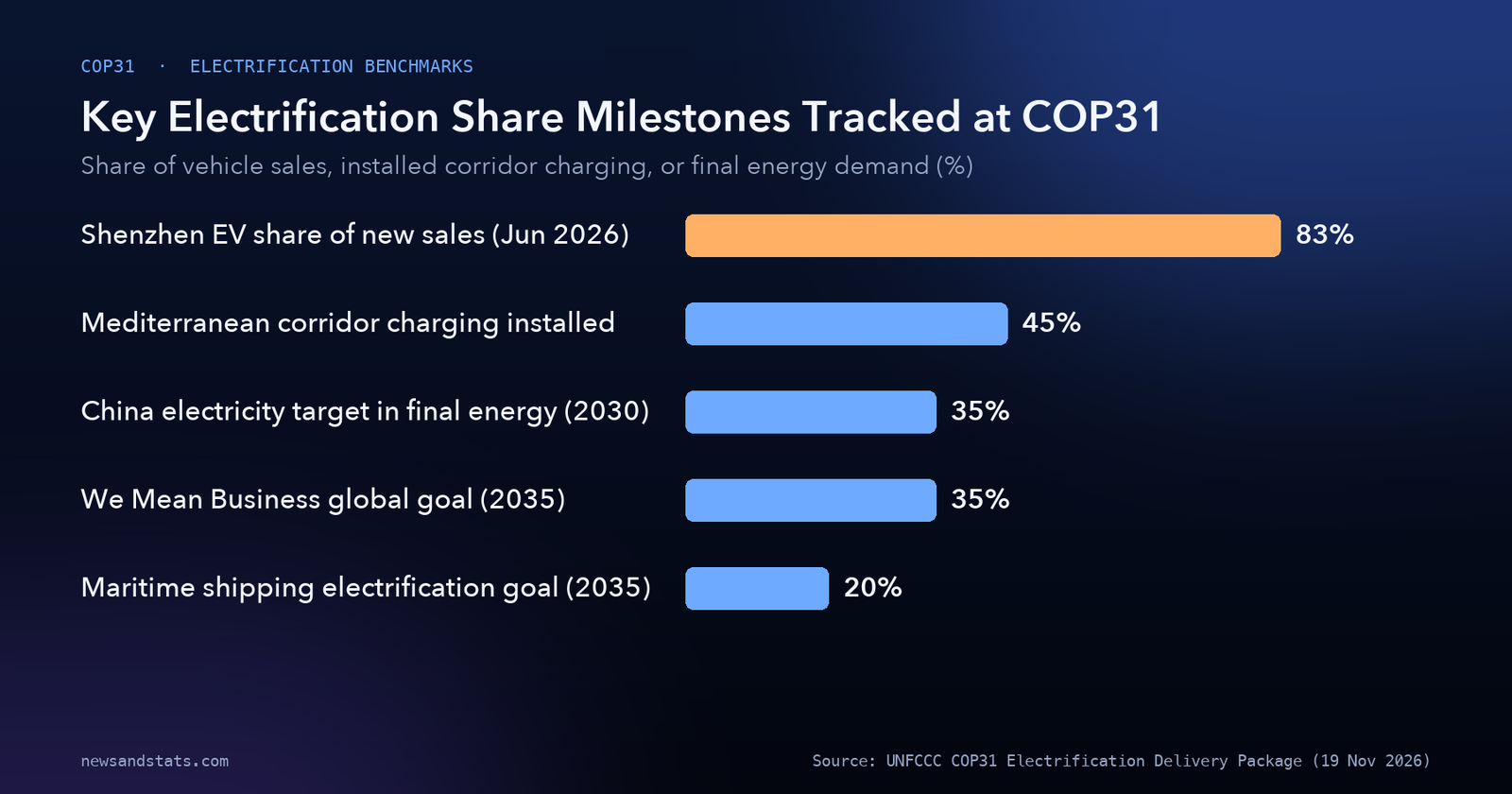
Across the corporate sector, 185 companies representing $1.73 trillion in combined annual revenue signed the We Mean Business Coalition’s Seizing the Electric Advantage statement, urging governments to set a course for 35% global electrification by 2035. At the national level, Chinese Vice President Han Zheng reaffirmed China’s goal for electricity to account for 35% of final energy consumption by 2030 at the COP31 Leaders’ Summit.
Power grids: 21,000 km built, $156 billion planned, and a $10 trillion 2035 requirement
Grid infrastructure remains the decisive bottleneck across the energy transition, a constraint already highlighted in our coverage of the 2026 energy shock and rising data center power demand. At COP31, members of the Utilities for Net Zero Alliance (UNEZA) reported deploying more than 21,000 km of new grid in 2025—a 50% increase over 2024—enough transmission and distribution line to stretch more than halfway around the Earth.
UNEZA members also announced combined annual investment plans of at least $156 billion across grids, renewables, and storage. That figure is 5% higher than the prior year’s annual plan and 35% higher than in 2024, implying a 2024 baseline of approximately $115.6 billion. In parallel, China’s State Grid investment program totals CNY 4 trillion over 2026–2030, a 40% increase over the preceding five-year period.
Even with those utility expansions, IRENA Director-General Francesco La Camera noted in the COP31 announcement that global grid investment must more than double to reach a cumulative $10 trillion by 2035. To address planning and technical bottlenecks in developing markets, Türkiye and IRENA launched D-GRIDs to support distribution-grid planning, digitalization, and resilience, while the Green Grids Initiative’s Grids Technical Assistance Solutions Hub is connecting countries with more than 20 specialist organizations.
Small island nations also posted early grid and clean-power milestones. Through the SIDS Lighthouses Initiative, Small Island Developing States reached 11.2 GW of installed renewable energy capacity in 2025, surpassing their 10 GW target for 2030 five years ahead of schedule. At COP31, partners established a new collective target of 30 GW by 2035—requiring nearly a threefold expansion (2.68x) from the 2025 installed base over the next decade.
Electricity access: 655 million unserved and the healthcare power deficit
While grid-connected economies focus on capacity expansion and storage—building on clean-technology shifts tracked in our global trade outlook—basic electricity access remains an acute development gap. According to World Health Organization data cited in the UNFCCC release, around 655 million people worldwide still lack electricity access. Furthermore, Sustainable Energy for All (SEforALL) reports that close to 1 billion people globally are served by health facilities with either no power or unreliable electricity.
SEforALL and its Universal Energy Facility reported that they are already more than halfway toward a 25,000-connection pledge for 2028 made less than a year ago. In Sierra Leone, SEforALL’s Salone Off-Grid Renewable Energy Acceleration initiative holds an additional 30,000 connections in the pipeline through 2028, projected to reach more than 200,000 people—an average of roughly 6.7 people per connection.
Transport: 2.1 million H1 EV sales and 29,000 km of freight corridors
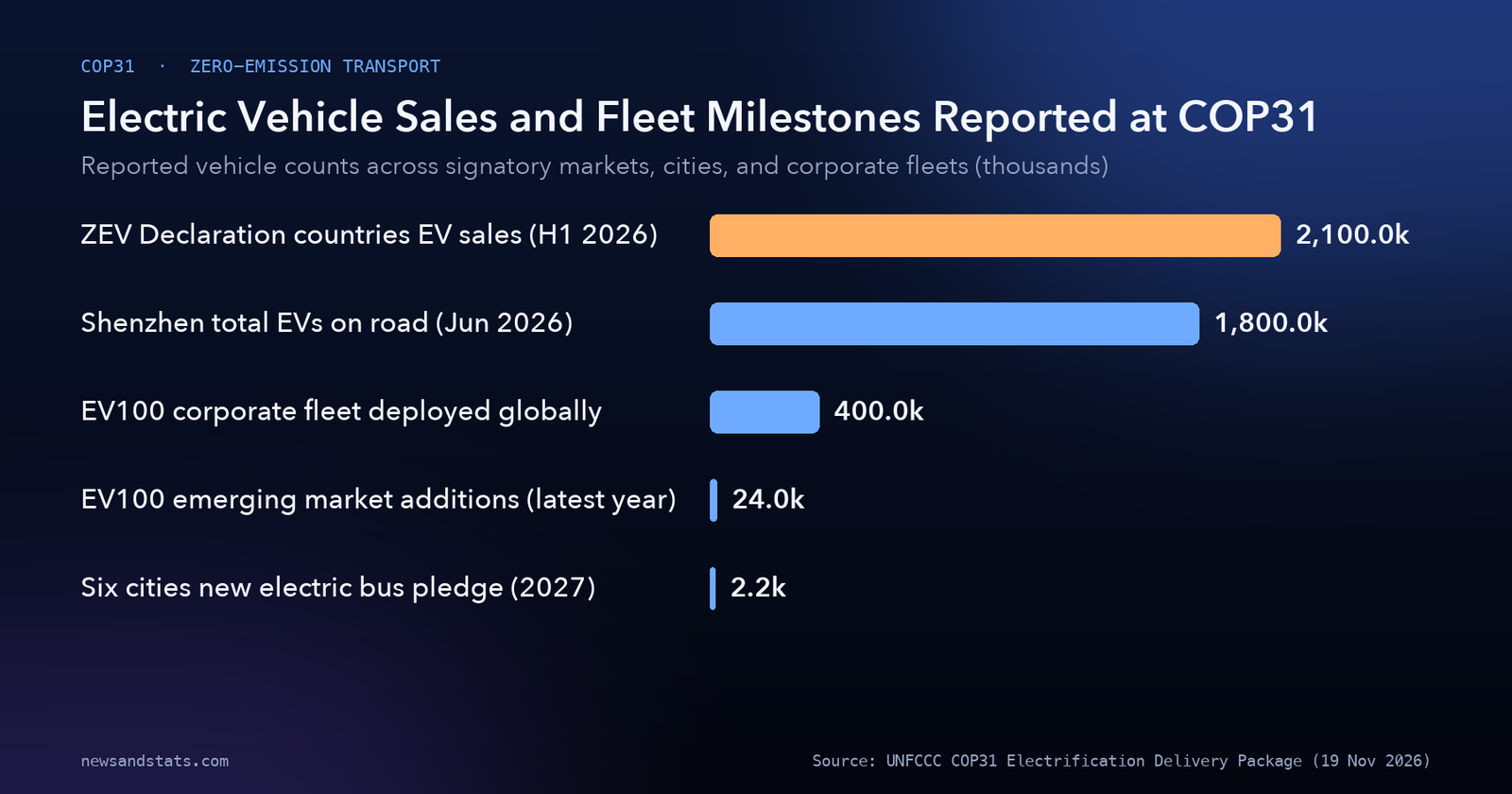
Transport electrification data in the COP31 package spans passenger vehicles, urban transit, corporate fleets, heavy-duty trucking, and maritime shipping. Across countries that signed the ZEV Declaration, electric vehicle sales reached 2.1 million in the first half of 2026. At the city level, Shenzhen had almost 1.8 million EVs on its roads by June 2026, according to C40 Cities data, with electric vehicles accounting for 83% of all new vehicle sales in the city. Six cities also committed to deploying 2,200 new electric buses in 2027.
Source: UNFCCC COP31 Electrification Delivery Package, November 19, 2026.
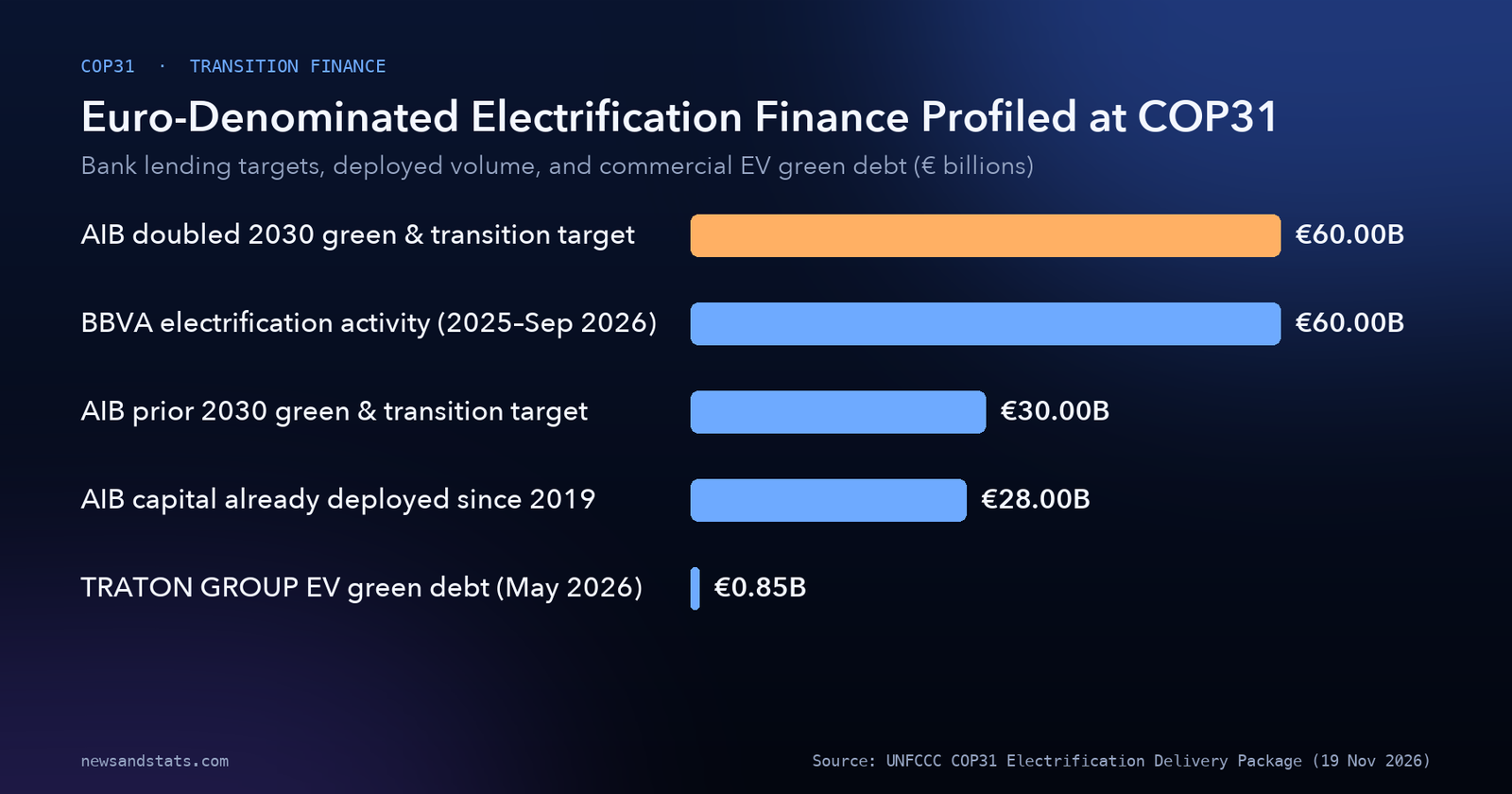
Corporate fleets are scaling in tandem. Climate Group’s EV100 members have deployed approximately 400,000 fully electric vehicles globally, including almost 24,000 EVs added in emerging EV markets during the latest reporting year across more than 120 members. In commercial trucking, TRATON GROUP—parent of Scania and MAN—secured €850 million in green financing in May 2026, split between its first €500 million green bond and a €350 million green loan earmarked for battery-electric commercial vehicles.
Long-haul road freight infrastructure is moving from corridor mapping to physical charger installation. The Global Green Road Corridors Initiative reported 13 zero-emission freight corridors in development across six continents, covering more than 29,000 km of roads—surpassing its 2026 goal of at least 10 corridors. On the Mediterranean Corridor linking southern Spain and southern France, 45% of planned charging capacity is already installed.
In maritime transport, more than 30 supporters backed a new Maritime Electrification Breakthrough Goal, targeting electricity to supply at least 20% of shipping’s final energy demand by 2035. Commercial shipboard battery deployment also advanced with a cooperation agreement between Höegh Autoliners and BYD Energy Storage to install marine battery systems aboard the Aurora No. 12 vessel, scheduled to enter service in May 2028.
Heavy industry: 36 final investment decisions across 13 countries
Heavy industry—historically the hardest-to-abate segment of global energy demand—recorded a notable shift from early-stage pledges to financed construction. According to Mission Possible Partnership’s Global Project Tracker cited by the UNFCCC, a record 36 commercial-scale, deep-decarbonization industrial projects reached final investment decisions (FIDs) across 13 countries during the 12 months through November 2026.
Concrete corporate logistics deployments are accompanying those industrial plant investments. In India, UltraTech Cement announced plans to expand its logistics fleet to more than 600 electric trucks by December 2026, hauling approximately 5 million tonnes of clinker and other materials annually across seven states. Meanwhile, UNIDO launched the Global Green Industrialization Agenda at a leaders’ event hosted by Türkiye and co-hosted by Egypt, Germany, and the United Kingdom to align policy, skills, and technology transfer for emerging economies—complementing the clean-technology trade dynamics examined in our UNCTAD climate trade report.
Transition finance: £5 billion AMPLIFi target, €60 billion bank pledges, and Asian clean power
Financing commitments announced or profiled in the COP31 Electrification Delivery Package span multilateral concessional vehicles, European commercial banks, and targeted emerging-market funds. Note that the UNFCCC explicitly cautions that financial figures cover different periods, currencies, and stages of deployment and should not be summed into a single package total.
Source: UNFCCC COP31 Electrification Delivery Package, November 19, 2026.
Among Euro-denominated commitments, AIB doubled its 2030 green and transition lending target from €30 billion to €60 billion, building on €28 billion already deployed since 2019—meaning €32 billion remains to be deployed between 2026 and 2030. BBVA reported channeling nearly €60 billion in sustainable business activity linked to electrification—covering power generation, supply, grids, storage, and end-use electrification—between January 2025 and September 2026.
In emerging markets, the Climate Investment Funds (CIF) announced that its new AMPLIFi financing mechanism is operational with its first projects and a £400 million anchor contribution from the United Kingdom, targeting up to £5 billion in total mobilization (a 12.5x leverage multiple) for clean power, grids, storage, and electrification. The World Bank is co-chairing the newly launched Electrify Now Finance Coalition to build investable pipelines and de-risk projects across developing economies. Separately, Octopus Energy launched an Asia Electrification Fund targeting $600 million, backed by $50 million in initial commitments from Japanese investors, with its first investment supporting a Philippine developer’s pipeline of 450 MW of solar capacity and 350 MWh of battery storage.
What to watch
- Grid permitting and D-GRIDs rollout: Whether IRENA’s D-GRIDs initiative and the Green Grids Initiative hub accelerate distribution-grid approvals fast enough to narrow the gap between UNEZA’s $156 billion annual utility plans and the $10 trillion cumulative grid investment required by 2035.
- AMPLIFi and Electrify Now pipeline conversion: Whether the UK’s £400 million anchor contribution to CIF AMPLIFi successfully crowds in the targeted £5 billion across emerging markets, and how quickly the World Bank-co-chaired Electrify Now Finance Coalition brings bankable grid and storage deals to financial close.
- 2027 commercial fleet and bus deliveries: Delivery execution on the 2,200 electric buses committed by six cities for 2027, UltraTech Cement’s 600+ electric truck expansion in India by December 2026, and charger buildout across the remaining 12 global zero-emission road freight corridors beyond the Mediterranean Corridor’s 45% mark.
- Post-COP31 industrial FID follow-through: Whether the 36 deep-decarbonization industrial projects that reached FID across 13 countries over the past year stay on schedule for commissioning alongside UNIDO’s Global Green Industrialization Agenda.
The bottom line
The COP31 Electrification Delivery Package shows measurable industrial momentum across three fronts: utilities expanded new grid builds by 50% in 2025 to more than 21,000 km while lifting annual investment plans to $156 billion; zero-emission transport scaled to 2.1 million H1 EV sales in ZEV Declaration countries and 29,000 km of freight corridors in development; and 36 commercial-scale industrial decarbonization projects reached final investment decisions. Yet the package’s own benchmarks make clear that current spending remains far below what a fully electrified global economy requires—leaving grid expansion, emerging-market finance mobilization, and universal electricity access as the defining tests between 2026 and 2035.