The consumer hardware economy is experiencing the most severe supply shock in mobile history.
According to the official global smartphone shipments report published by International Data Corporation (IDC) on 15 October 2026, worldwide smartphone volumes plummeted by 22.0% year-on-year in the third quarter of 2026. Total industry shipments fell to 255.3 million units, down sharply from 327.3 million units in the third quarter of 2025. IDC verified that this 22.0% contraction represents the steepest year-on-year quarterly decline ever recorded in its Worldwide Quarterly Mobile Phone Tracker series.
Subtracting 255.3 million units from 327.3 million units reveals that global consumers and retail channels absorbed 72.0 million fewer smartphones in a single three-month window (my calculation).
This contraction was not caused by a sudden collapse in consumer communication needs. Instead, it is the direct collateral consequence of the generative artificial intelligence boom. Over the past twelve months, memory component costs have surged by approximately 350%, as hyperscale server clusters absorbed global semiconductor capacity. Faced with escalating component bills, mobile original equipment manufacturers (OEMs) raised retail shelf prices, culled low-margin budget models, and delayed product refreshes, sending shockwaves through the consumer technology sector.
1. The 255.3 million unit quarter: how shipments plunged 22%
For more than a decade, quarterly smartphone shipments have operated within predictable seasonal bands, peaking ahead of the fourth-quarter holiday shopping period.
In the third quarter of 2026, that traditional cadence fractured completely:
- Worldwide volume fell to 255.3 million units: Down 22.0% compared to the 327.3 million units delivered in the third quarter of 2025.
- Largest decline on record: IDC confirmed that third-quarter performance surpassed all previous cyclical downturns, including the early semiconductor supply chain disruptions of 2020.
- The 72.0 million unit deficit: The annualized volume removed from the market in just ninety days exceeds the entire annual smartphone production of several European nations combined.
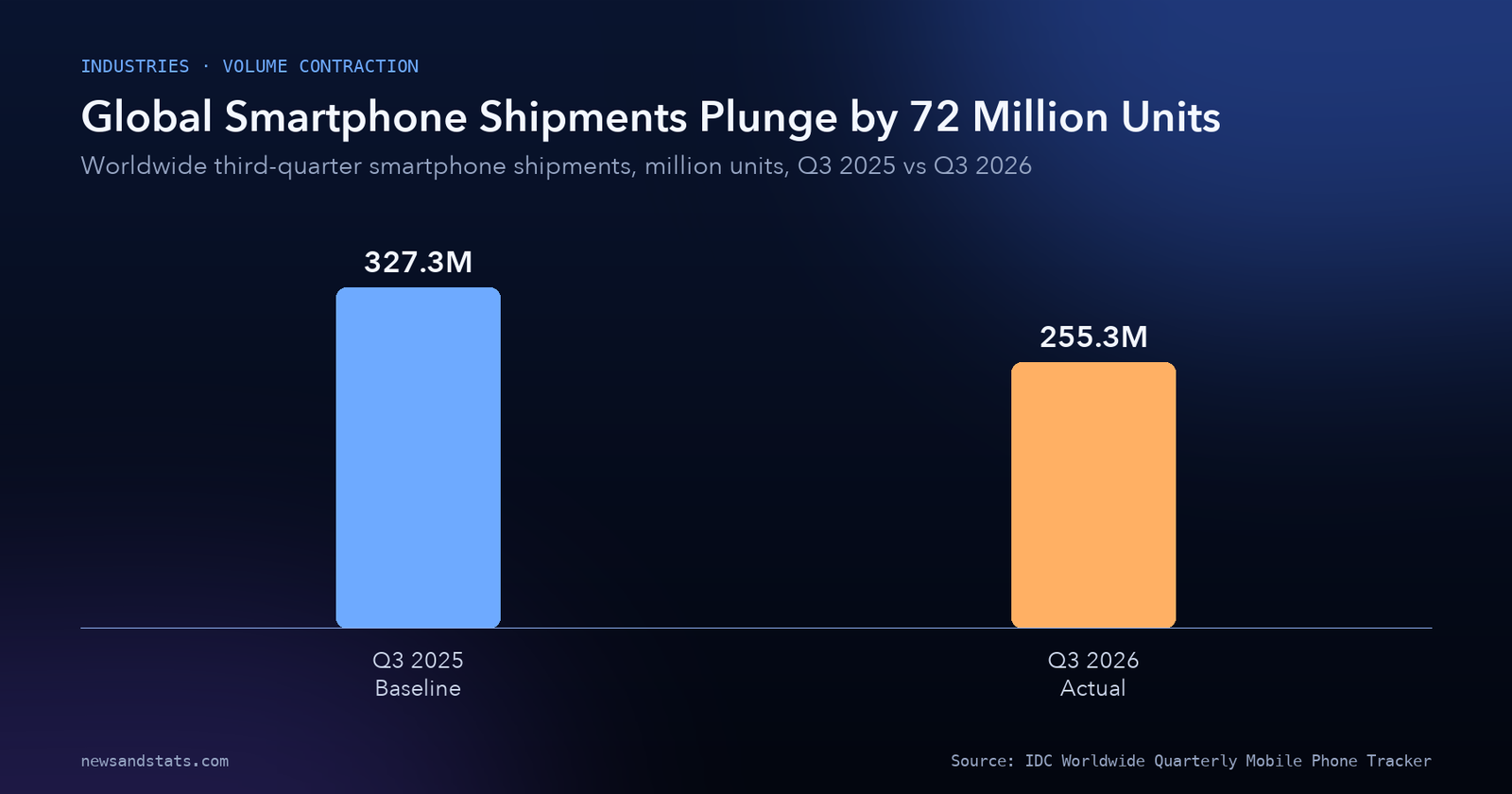
Source: IDC, Worldwide Quarterly Mobile Phone Tracker, Preliminary worldwide smartphone shipments table.
Nabila Popal, Senior Research Director for Worldwide Devices at IDC, summarized the market inflection during the Boston release:
“The sharp downturn the industry has been bracing for finally materialized in the third quarter this year, with shipments declining a record 22% YoY. However, the worst is yet to come. Current indicators suggest that the market has not yet reached the bottom. Memory costs have surged approximately 350% since last year and are still rising, creating substantial pressure on vendor margins and shipments.”
Dividing the 72.0 million missing handsets by the 327.3 million prior-year baseline confirms that more than one out of every five potential handset purchases was deferred or priced out of the market (my calculation).
2. The AI memory crisis: 350% component inflation hits mobile hardware
The direct catalyst behind the smartphone industry’s contraction sits thousands of miles away from handset assembly lines, inside high-density artificial intelligence data centers.
To power frontier large language models, enterprise hyperscalers have engaged in an unprecedented procurement drive for High-Bandwidth Memory (HBM) and enterprise-grade DDR5 DRAM. As documented in our earlier analysis of the DRAM memory chip shortage, the world’s leading memory fabricators—SK hynix, Samsung Electronics, and Micron—reallocated silicon wafer capacity away from standard mobile LPDDR5 and NAND flash storage toward server modules.
The consequences for mobile hardware manufacturers have been devastating:
- A 350% memory cost surge: Benchmark mobile memory component prices escalated by roughly 350% between late 2025 and October 2026.
- Compounding component inflation: In prior quarters, memory spot costs exhibited sequential increases of 50% to 100%. While sequential inflation moderated to a low double-digit pace in the third quarter, prices stabilized at historic peaks.
- Mobile bill-of-materials shock: Memory typically represents 15% to 20% of a budget smartphone’s total bill of materials (BOM). When memory prices expand 350%, the manufacturing cost of entry-level devices escalates sharply, completely erasing operating margins for mass-market Android vendors.
This component squeeze illustrates the physical constraints driving the hyperscaler capital expenditure boom. Handset makers cannot outbid cloud conglomerates for semiconductor capacity. While cloud providers absorb elevated memory tariffs to deploy AI servers, consumer device manufacturers must pass these expenses directly to retail shoppers.
Francisco Jeronimo, Vice President for Worldwide Devices at IDC, noted this consumer transmission mechanism:
“The third quarter shows the full impact and damage of the memory crisis. The pressure is now moving from vendors to consumers. As higher prices reach the shelf, many buyers are keeping their current devices longer.”
3. Premium consolidation: Samsung and Apple capture 45% of shipments
While the overall market experienced a severe contraction, the downturn accelerated market concentration at the very top of the industry pyramid.
Samsung and Apple demonstrated remarkable commercial resilience, successfully leveraging premium brand equity, deep supplier agreements, and captive silicon engineering to protect their operating scale.
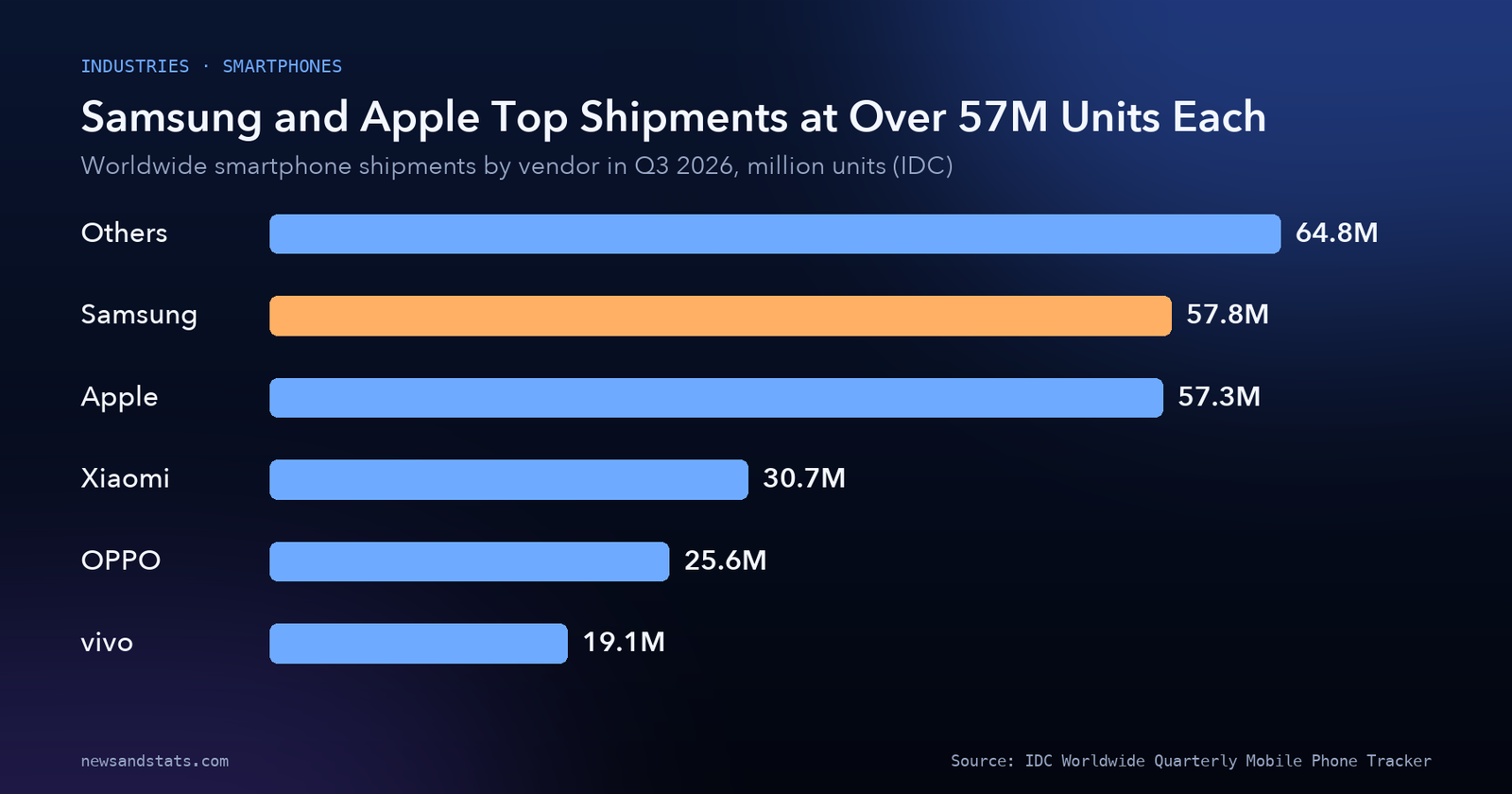
Source: IDC, Worldwide Quarterly Mobile Phone Tracker, Vendor shipment volume breakdown.
The performance of the market leaders highlights the advantage of premium exposure:
- Samsung retained the number one global position: Shipping 57.8 million smartphones in Q3 2026. While volume declined by 5.8% year-on-year from 61.4 million units in Q3 2025, Samsung expanded its global market share from 18.7% to 22.6%. Samsung’s internal memory fabrication provided crucial structural cost insulation against the broader crisis.
- Apple captured the number two position in a statistical tie: Delivering 57.3 million iPhones in Q3 2026. Apple’s shipments slipped by just 4.0% year-on-year from 59.7 million units, while its market share expanded from 18.2% to 22.4%. Apple’s affluent customer demographic proved largely insensitive to retail price adjustments.
- The 45.0% duopoly share: Summing Samsung’s 57.8 million units and Apple’s 57.3 million units gives a combined total of 115.1 million smartphones (my calculation).
- The market share expansion: Summing Samsung’s 22.6% share and Apple’s 22.4% share reveals that the two giants controlled 45.0% of the entire world smartphone market in Q3 2026 (my calculation).
Subtracting the 36.9% combined share held by Samsung and Apple in Q3 2025 (18.7% plus 18.2%) from their 45.0% share in Q3 2026 reveals an 8.1-percentage-point expansion in combined duopoly market concentration (my calculation).
This dynamic reinforces the structural polarization documented in our coverage of the global semiconductor sales surge. Premium consumers purchasing high-end flagship devices continue to upgrade, while buyers in mass-market entry tiers have exited the market or postponed replacement cycles indefinitely.
4. The Chinese vendor squeeze: Xiaomi, OPPO, and vivo drop up to 34.5%
If Samsung and Apple weathered the storm through premium insulation, Chinese Android manufacturers absorbed the full, unmitigated impact of the memory crisis.
Vendors such as Xiaomi, OPPO, and vivo built their global market presence by delivering high-specification devices at aggressive, low-margin price points across emerging markets in South Asia, Southeast Asia, Latin America, and Africa. When memory component costs quadrupled, their operating models collapsed.
The quarterly shipment losses across Chinese OEMs were catastrophic:
- Xiaomi shipments fell 29.2%: Dropping from 43.4 million units in Q3 2025 to 30.7 million units in Q3 2026. Xiaomi’s market share contracted from 13.2% to 12.0%, as the vendor was forced to raise retail prices across its Redmi lineup.
- OPPO shipments collapsed 34.5%: Plunging from 39.1 million units in Q3 2025 to 25.6 million units in Q3 2026. OPPO’s market share slipped from 11.9% to 10.0%, representing the sharpest contraction among top-tier manufacturers.
- vivo shipments dropped 31.5%: Declining from 27.9 million units in Q3 2025 to 19.1 million units in Q3 2026, with its market share falling from 8.5% to 7.5%.
- Tier-two vendors and smaller brands contracted 32.5%: Handset shipments in the “Others” category dropped from 96.0 million units to 64.8 million units, with market share falling from 29.3% to 25.4%.
Summing the volume lost across Xiaomi (12.7M), OPPO (13.5M), and vivo (8.8M) reveals that these three Chinese brands lost a combined 35.0 million units of quarterly shipment volume (my calculation).
This regional vulnerability aligns with the trade realignments analyzed in our examination of global trade outlook and merchandise trade. In developing markets where consumer purchasing power is sensitive to everyday inflation, an unbudgeted $30 to $50 increase in retail phone prices destroys sales velocity, forcing local distributors to reduce inventory orders.
5. Shifting market share: why the duopoly gained in a shrinking market
The arithmetic of the third quarter reveals how a market can shrink dramatically in absolute volume while consolidating profitability into fewer hands.
Because Samsung and Apple experienced modest single-digit declines (-5.8% and -4.0%) while the rest of the market plummeted by 30% or more, the global competitive landscape shifted decisively toward the incumbents.
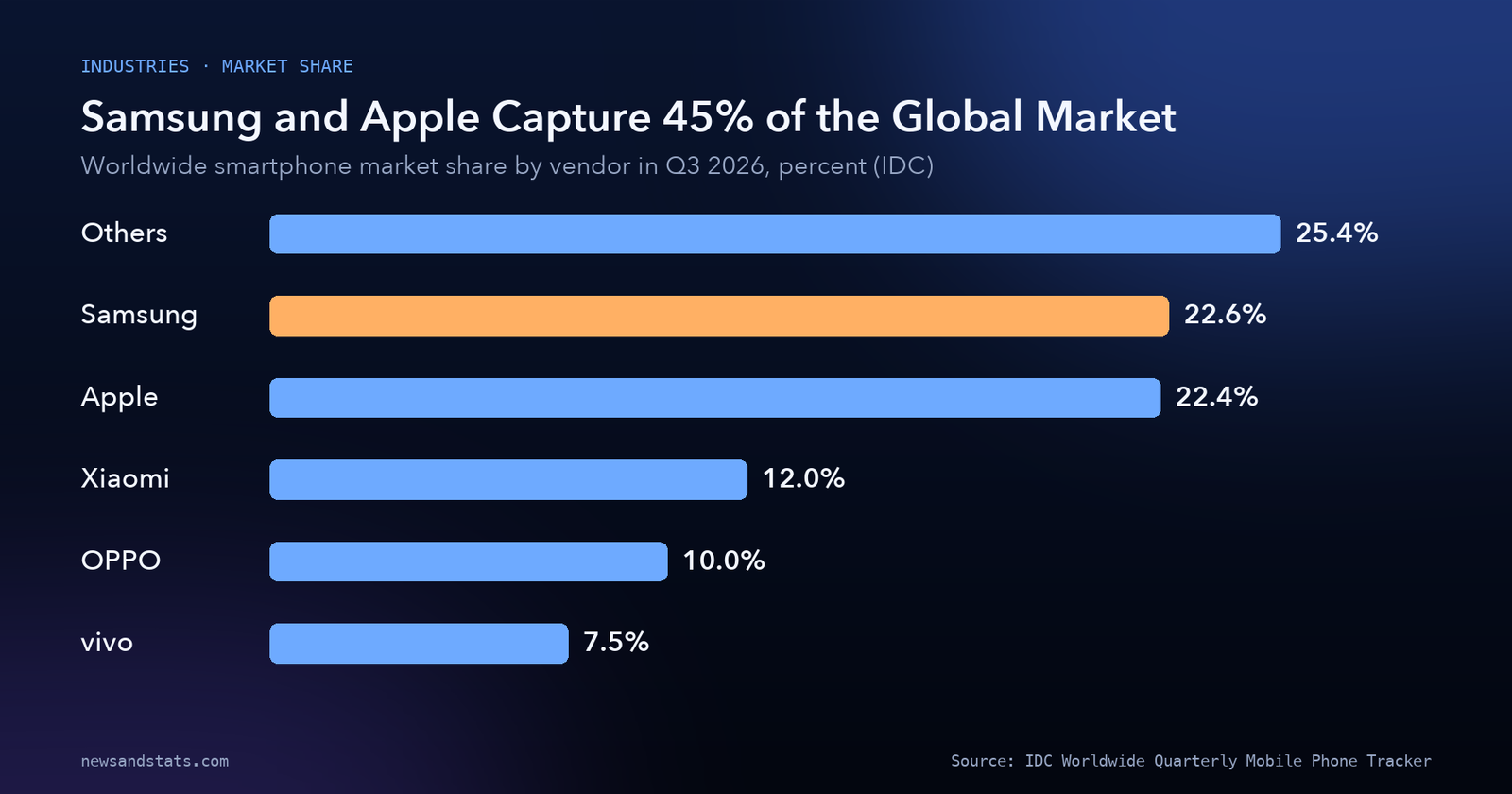
Source: IDC, Worldwide Quarterly Mobile Phone Tracker, Table 1: Market share by vendor.
| Smartphone vendor | Q3 2026 Shipments (M) | Q3 2026 Market share (%) | Q3 2025 Shipments (M) | Q3 2025 Market share (%) | Year-over-year change (%) |
|---|---|---|---|---|---|
| Samsung | 57.8 | 22.6% | 61.4 | 18.7% | -5.8% |
| Apple | 57.3 | 22.4% | 59.7 | 18.2% | -4.0% |
| Xiaomi | 30.7 | 12.0% | 43.4 | 13.2% | -29.2% |
| OPPO | 25.6 | 10.0% | 39.1 | 11.9% | -34.5% |
| vivo | 19.1 | 7.5% | 27.9 | 8.5% | -31.5% |
| Others (smaller brands) | 64.8 | 25.4% | 96.0 | 29.3% | -32.5% |
| Total Global Market | 255.3 | 100.0% | 327.3 | 100.0% | -22.0% |
Source: IDC, Worldwide Quarterly Mobile Phone Tracker, Official quarterly tracker table (October 14, 2026).
Kiranjeet Kaur, Associate Research Director for Worldwide Devices at IDC, noted the tactical responses emerging across sales channels:
“Samsung and Apple continue to gain share as players like Xiaomi, OPPO, vivo shipment declines intensify. As prices rise, consumers who can’t put off a purchase are likely best served by holiday-quarter offers, when promotions and discounts are expected to be at their most attractive, than wait for prices to ease.”
However, Kaur cautioned that some manufacturers attempted to front-load component purchases ahead of anticipated 2027 memory shortages:
“Despite the sluggish sales, some vendors raised production plans ahead of an expected tightening in component supply next year. If demand remains weak, this could lead to inventory build-up heading into 2027, adding a further downside risk to our 2027 forecast.”
6. The recovery horizon: no relief expected until 2028
For consumers hoping that mobile retail prices will quickly normalize, IDC’s research delivers sobering guidance.
The semiconductor fabrication cycle required to build, tool, and qualify new silicon wafer fabs takes between two and three years. With major memory foundries dedicating their forward capital expenditures almost entirely to high-margin AI data center architectures, conventional consumer memory capacity will remain constrained.
IDC’s medium-term outlook establishes several defining parameters:
- Constrained volume through 2027: Handset shipment growth is projected to remain subdued throughout 2027, with annual volumes hovering near historic lows.
- Recovery deferred to 2028 at the earliest: Any meaningful rebound in worldwide device replacement velocity is not expected until 2028, when next-generation memory fabrication plants in the United States, Japan, and South Korea reach commercial volume production.
- Permanent structural cost realignment: OEMs are adapting to a permanent structural reset in component economics. Future smartphones will carry higher average selling prices (ASPs), while budget device tiers are permanently trimmed.
This prolonged replacement freeze has a direct environmental corollary. As examined in our study of the global electronic waste mountain, extending consumer device ownership cycles from an average of 2.5 years to 3.5 or 4 years significantly slows the accumulation of discarded electronics. When consumers keep handsets longer, they inadvertently reduce urban electronic waste flows, even as manufacturer balance sheets suffer.
What to watch
- Fourth-quarter holiday promotional discounting: Monitor whether Apple and Samsung sacrifice hardware margins during the November-December retail peak through aggressive carrier trade-in subsidies, or maintain strict retail pricing.
- Chinese OEM budget line discontinuation: Track whether Xiaomi and Transsion formally discontinue entry-level budget smartphone product lines in India and Sub-Saharan Africa, pivoting production entirely to mid-tier devices.
- LPDDR5 memory contract negotiations: Watch whether contract prices for mobile-grade LPDDR5 memory begin softening in early 2027 as new wafer lines come online, or remain elevated by continuous AI server demand.
- Carrier trade-in and upgrade velocity: Follow financial filings from major telecommunications carriers (Verizon, AT&T, Deutsche Telekom) to assess whether consumer upgrade rates hit new historical lows into mid-2027.
- Channel inventory buildup risks: Observe whether handset OEM inventory levels swell in early 2027 as a result of precautionary component stockpiling, prompting emergency factory production cuts.
The bottom line
The third quarter of 2026 represents a historic turning point for the consumer technology sector: global smartphone shipments plummeted 22.0% to 255.3 million units as a 350% memory cost surge rendered entry-level devices economically unviable. While the volume crash eliminated 72.0 million handset sales in a single quarter, it accelerated industry consolidation, allowing Apple and Samsung to expand their combined market share to 45.0% while budget-focused Chinese manufacturers suffered declines exceeding 30%. With component bottlenecks projected to persist through 2027 and recovery deferred until 2028, the smartphone industry is entering an era of structural retrenchment defined by higher retail prices, extended consumer replacement cycles, and concentrated premium power. For continuous empirical analysis of hardware supply chains, component economics, and manufacturing trends, explore our Industries coverage.
Related reading
- Why memory chips got so expensive: the DRAM shortage in numbers: HBM production lines, memory fab wafer allocation, and semiconductor pricing dynamics.
- Global Chip Sales Near $1.6 Trillion in 2026: worldwide chip revenue records, data center hardware demand, and silicon market forecasts.
- The $750 billion AI bet: who spends it, and who pays: cloud hyperscaler infrastructure budgets, server hardware procurement, and capex dynamics.
- Global Electronic Waste in 8 Numbers: The 62-Million-Tonne Mountain and $62 Billion Lost: discarded hardware volumes, urban mining, and the environmental impact of consumer electronics.
- Global Trade Outlook 2026: AI Beats the War: international merchandise trade flows, electronics supply chains, and consumer demand trends.