Three times in 2026, the body that tracks the global semiconductor industry raised its forecast for how much the industry would sell this year. In May, the Semiconductor Industry Association (SIA) said the industry was “on track to reach $1 trillion in 2026.” By August, it said sales were “expected to exceed $1.5 trillion.” By October, the figure had become “more than $1.6 trillion.” Each revision came because actual sales kept beating the previous one: global semiconductor sales hit $517.7 billion in the third quarter of 2026 alone, a 24.1% jump from the second quarter, according to data the SIA published on 3 November 2026. The reason, in SIA’s own account, is AI: data centers packed with AI chips are consuming semiconductors faster than anyone forecasting the market in early 2026 expected.
$517.7 billion: the quarter that broke the pattern
Global semiconductor sales reached $517.7 billion in the third quarter of 2026, an increase of 24.1% compared with the second quarter, the SIA said in a release dated 3 November 2026, based on data compiled by the World Semiconductor Trade Statistics (WSTS) organization. Within the quarter, September 2026 sales alone were $172.6 billion, a figure SIA reports as a three-month moving average. That was 146.8% higher than September 2025 and 7.9% higher than August 2026. SIA President and CEO Michael Robbins framed the pattern bluntly: sales had increased “by more than 20% quarter-to-quarter for the third consecutive quarter,” and “year-to-year semiconductor sales remained strong across all major regional markets.”
Three consecutive quarters above 20% quarterly growth is unusual for an industry that, in ordinary years, moves in single digits. It has not happened by accident: the quarter-over-quarter numbers trace a steady acceleration through the year, not a one-off spike.
From $298.5 billion to $517.7 billion in six months
Lay the first three quarters of 2026 side by side and the acceleration is explicit. First-quarter sales were $298.5 billion, up 25% from the fourth quarter of 2025, the SIA reported on 4 May 2026. Second-quarter sales then jumped to $403.3 billion, a 35.1% rise, reported on 6 August 2026. Third-quarter sales reached $517.7 billion, the 24.1% increase already described above.
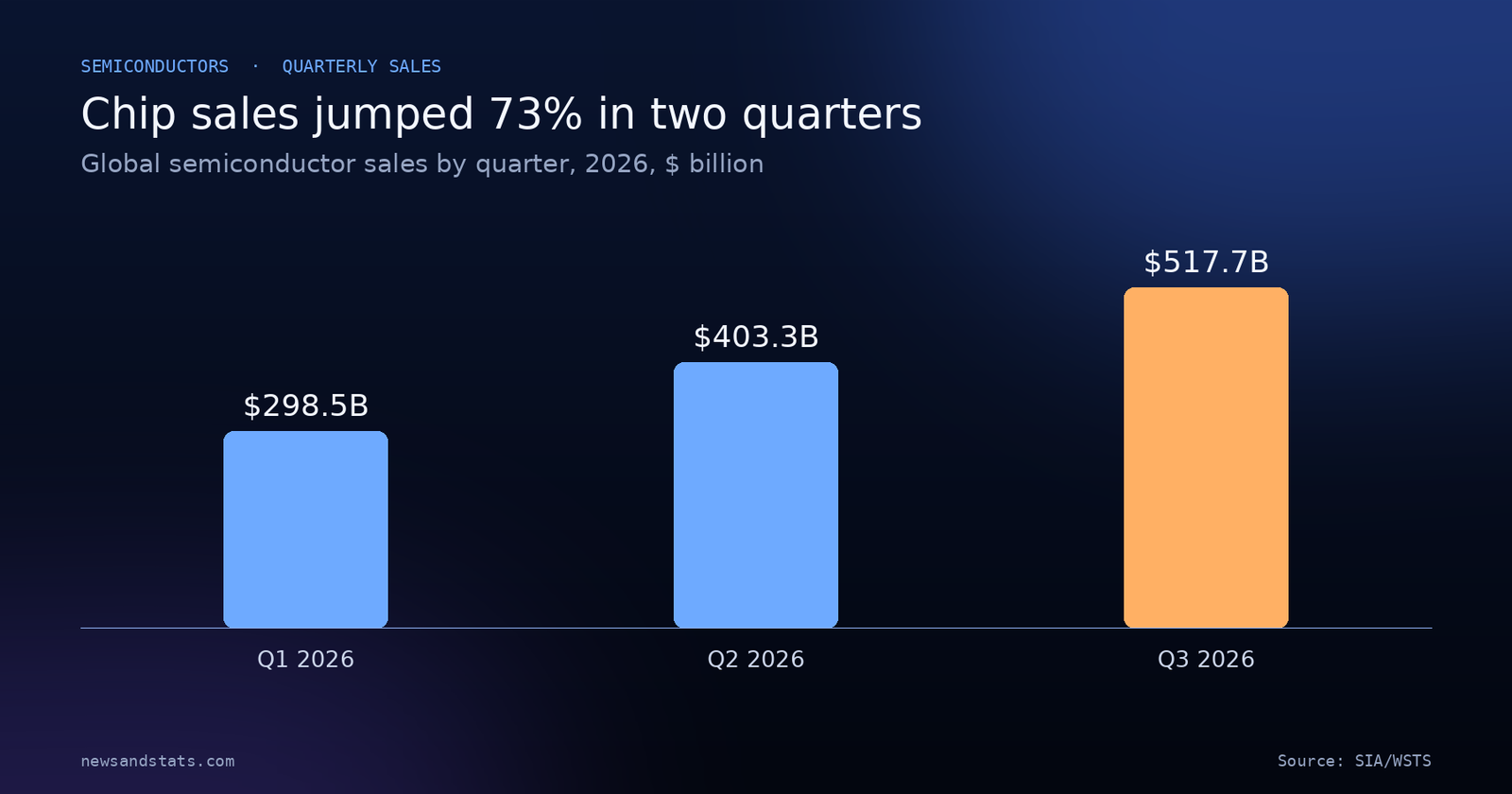
Source: Semiconductor Industry Association, Q2 2026 release and Q3 2026 release.
| Quarter | Global semiconductor sales | Change from prior quarter |
|---|---|---|
| Q1 2026 | $298.5 billion | +25% (vs. Q4 2025) |
| Q2 2026 | $403.3 billion | +35.1% |
| Q3 2026 | $517.7 billion | +24.1% |
Summing those three verified quarterly totals (my calculation) gives $1,219.5 billion in global chip sales through the first nine months of 2026 — more than the industry’s entire 2025 total of $795.6 billion, which the SIA reported in its “2026 State of the Industry Report,” with one quarter of 2026 still to come. On average, the industry sold about $406.5 billion worth of chips per quarter in the first three quarters of 2026 (my calculation, from the $1,219.5 billion total divided by three), against a 2025 quarterly average of about $198.9 billion (2025’s $795.6 billion divided by four) — better than double.
The monthly figures inside each quarter tell the same story at finer grain. March 2026 sales were $99.5 billion, up 79.2% from March 2025’s $55.5 billion; June 2026 sales were $134.5 billion, up 123.6% year-over-year; September 2026 sales were $172.6 billion, up 146.8% year-over-year. The year-over-year growth rate itself kept climbing through the year, which is a different and arguably more telling signal than the dollar totals alone: it means 2026 wasn’t just bigger than 2025, it was pulling further ahead of 2025 as the months passed. By August 2026, the SIA noted the market had grown for 18 consecutive months.
Who bought more chips: every region, but not equally
Growth was not confined to one buyer. In September 2026, year-over-year sales rose in every region SIA tracks, but the Americas pulled clearly ahead: up 191.7%, compared with 141.4% in Asia Pacific/All Other, 124.9% in China, 102.5% in Europe and 73.4% in Japan.
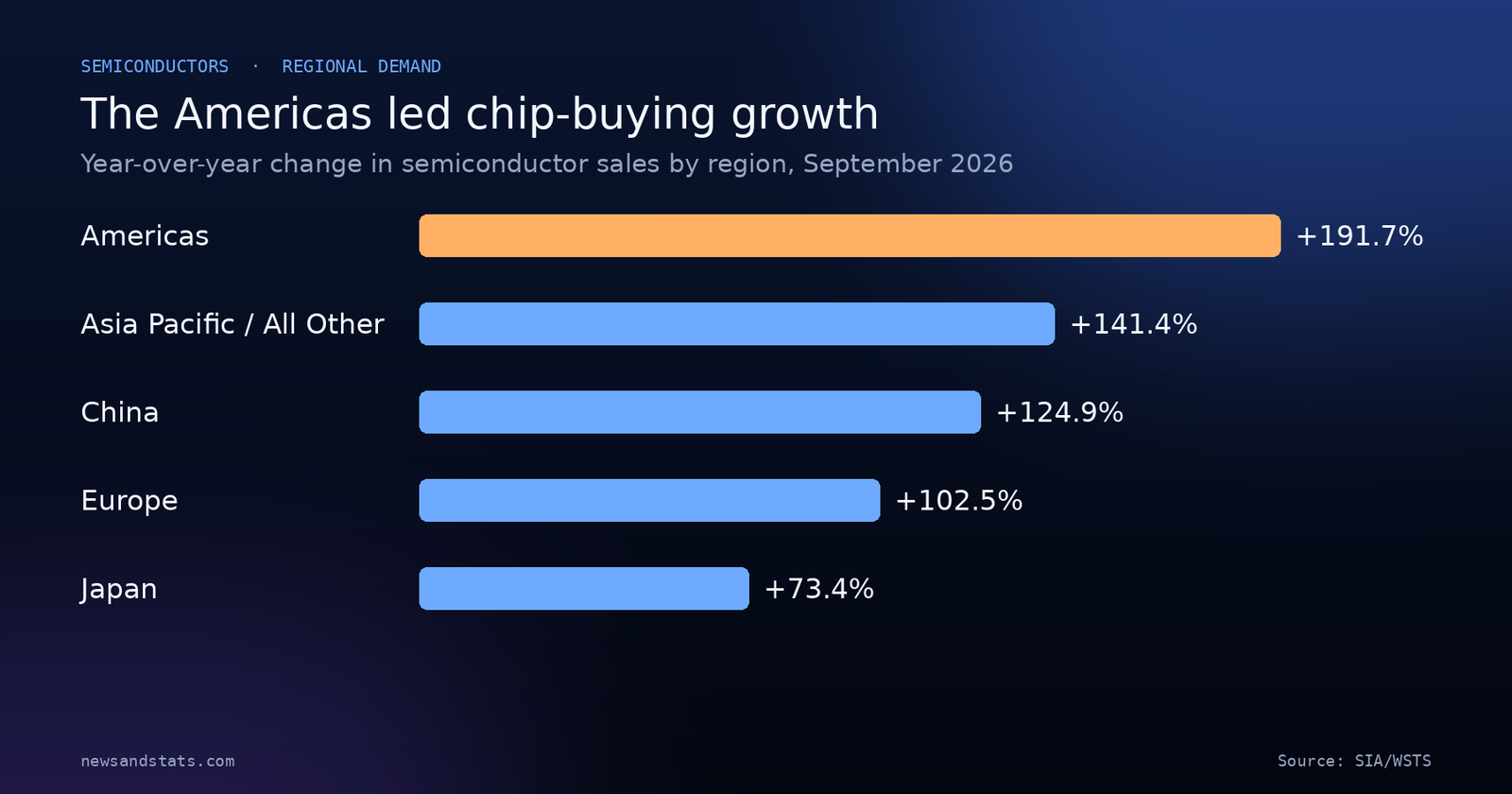
Source: Semiconductor Industry Association, Q3 2026 release.
| Region | Year-over-year sales growth, Sept. 2026 | Month-over-month growth, Sept. 2026 |
|---|---|---|
| Americas | +191.7% | +11.0% |
| Asia Pacific / All Other | +141.4% | +6.9% |
| China | +124.9% | +4.2% |
| Europe | +102.5% | +8.1% |
| Japan | +73.4% | +8.7% |
The Americas’ lead is consistent with where AI infrastructure spending is heaviest: the same region that houses most of the hyperscalers behind the $750 billion AI infrastructure bet is also the region buying semiconductors fastest. That is a correlation stated here, not a causal claim the SIA itself made; SIA’s own commentary attributes the broad-based growth to strength “across all major regional markets” without singling out a specific regional driver.
The forecast that kept climbing
What makes 2026 unusual is not just the growth rate, but how often the industry’s own forecaster had to revise its outlook upward within the same year. In the 4 May 2026 release covering Q1 data, then-SIA president and CEO John Neuffer said global chip sales “remain on track to reach $1 trillion in 2026.” By the 6 August 2026 release covering Q2 data, Neuffer’s assessment had shifted: sales were “expected to exceed $1.5 trillion in 2026.” By the 5 October 2026 release, SIA president and CEO Michael Robbins put the figure at “more than $1.6 trillion” for the full year, in a release that also noted annual sales had “already surpassed $1 trillion through August” alone.

Source: SIA, 2026 State of the Industry Report; Q1 2026 release; Q2 2026 release; October 2026 release.
A forecast revised upward three times in seven months is not how semiconductor cycles have usually behaved; the industry has historically been better known for forecasters overshooting than undershooting. 2026 is running the other way.
Why: one AI server rack holds more than 4,500 chips
The SIA’s own explanation, laid out in its July 2026 “2026 State of the Industry Report,” centers on how chip-intensive AI infrastructure has become. A single AI server rack can contain more than 4,500 packaged semiconductors, which together account for more than 95% of that rack’s total value. Chips now make up more than half of total AI data center capital expenditure, the SIA says, citing research it conducted jointly with Deloitte. That research projects global AI data center infrastructure investment will exceed $4 trillion through 2028, of which up to $2.8 trillion could go toward semiconductors specifically.
That scale of projected chip spending connects directly to two stories already on this site: the $750 billion AI bet by hyperscalers, and the market dynamics shaping cloud providers’ market share, since the hyperscale cloud operators are the biggest buyers of AI-optimized chips. It also lines up with the Stanford AI Index’s investment figures on overall AI spending. None of those three figures are new here; the point is that the semiconductor sales numbers in this article are the supply-side mirror of the same AI buildout documented from the demand side in those pieces. If more than half of every dollar spent building an AI data center goes to chips, and the industry expects to spend more than $4 trillion on AI data center infrastructure through 2028, the arithmetic behind a $1.6 trillion 2026 forecast — and the likelihood of further upward revisions in 2027 — starts to look less surprising than the headline growth rates suggest on their own.
Who makes the chips
Two 2025 figures from the SIA’s state-of-the-industry report put the scale of the US semiconductor industry specifically into context. US-headquartered semiconductor companies recorded $425 billion in sales in 2025, equal to 53.4% of the worldwide market — the highest US share of the global chip market since 1984, according to the SIA. Those companies invested $76.8 billion in research and development in 2025. Separately, the SIA counts more than $770 billion in private-sector semiconductor investment announced since 2020, spread across 160 projects in 30 states — a geographic footprint well beyond the handful of states that have traditionally hosted US chip fabrication. That figure covers announced investment, not necessarily money already spent, and the SIA report does not break down how much of it has been completed as of this article’s publication; an announced project can be delayed, scaled back or completed years after it is first unveiled, so the $770 billion figure describes stated intent to invest rather than verified completed construction. None of this breaks down US chip demand specifically, since the global AI talent race and manufacturing investment are related but separate questions from the sales totals in the sections above: a country can lead in chip sales, chip design talent or chip manufacturing capacity without leading in all three at once, and the SIA figures in this article speak only to sales.
How this gets misread
Two details are easy to get wrong when reading SIA’s numbers. First, SIA’s monthly figures (for March, June, August and September 2026 cited above) are explicitly labeled three-month moving averages, not single-month totals; adding them together to estimate a quarter or year overstates the result, because consecutive months overlap. The quarterly totals used in this article’s main chart ($298.5 billion, $403.3 billion, $517.7 billion) are a different, non-overlapping SIA metric, and they are the ones safe to sum. Second, “semiconductor sales” is a broader category than memory chips: the DRAM shortage driving up memory prices in 2026 is one contributor to the industry’s overall revenue growth, not the whole story — logic chips, analog chips and other product categories are also part of the totals reported here, and SIA’s regional and quarterly releases do not break the total down by product category.
What to watch
- SIA’s next quarterly release, covering Q4 2026 data, which will show whether the full year lands above or below the $1.6 trillion October forecast.
- Whether year-over-year growth keeps accelerating past September’s 146.8% monthly rate or begins to plateau.
- Whether the Americas’ lead in regional growth (191.7% year-over-year in September) holds or narrows as other regions scale up AI infrastructure.
- Further SIA/WSTS forecast revisions for 2026 or early looks at 2027, given the pattern of upward revisions seen this year.
- Data centers’ power demand, since semiconductor demand of this scale depends on continued buildout of the electricity infrastructure to run the chips.
- Whether chip demand growth feeds back into component shortages beyond memory, given how concentrated AI server value is in semiconductors.
The bottom line
Global semiconductor sales reached $517.7 billion in the third quarter of 2026 alone, capping a run of three straight quarters of more than 20% sequential growth and pushing nine-month 2026 sales past $1,219.5 billion. The industry’s own forecaster raised its full-year 2026 estimate three times in seven months, from $1 trillion in May to $1.6 trillion by October, because actual sales kept outrunning the previous call. SIA attributes the surge chiefly to AI infrastructure, where a single server rack can hold more than 4,500 chips worth over 95% of the rack’s value. The growth was broad-based across every region SIA tracks, though the Americas grew fastest. Our Industries coverage will be watching whether the fourth quarter keeps pace or whether this unusually steep acceleration finally levels off.
Related reading
- Why memory chips got so expensive: the DRAM shortage in numbers: memory chips are one product category inside the broader sales totals covered here.
- The $750 billion AI bet: who spends it, and who pays: the buyer side of the same AI infrastructure buildout driving chip sales.
- Cloud market share 2026: AWS leads, but Google Cloud grew fastest: the hyperscale cloud operators that are among the largest buyers of AI-optimized chips.
- Data Center Power Demand Is Set to Double by 2030. The Grid Is the Bottleneck.: the electricity constraint behind how much AI infrastructure, and therefore how many chips, the grid can support.