Companies building the physical backbone of artificial intelligence have raised at least $1.8 trillion across debt, equity, and securitized instruments between 2020 and the first half of 2026, according to BloombergNEF’s Financing Compute report published on 19 November 2026. Nearly half of that six-and-a-half-year total—$794 billion—was raised in a single nine-month burst between Q3 2025 and H1 2026, turning AI data center financing 2026 into one of the largest private-capital and debt-underwriting waves in modern infrastructure.
In AI & Work, those capital flows now carry two measurable pressure points: at least $1 trillion of data center debt matures within the next five years, and the world’s largest AI campuses are hitting city-scale electricity footprints. Pairing BloombergNEF’s 2,000-transaction financing dataset with Epoch AI’s AI Data Centers database (updated 18–20 November 2026) shows how financial leverage and physical gigawatts intersect across 96 tracked mega-sites.
1. AI data center financing 2026: $794 billion raised in nine months
BloombergNEF compiled more than 2,000 transactions across the 125 largest data center developers using Bloomberg Terminal records, third-party filings, and industry interviews. Between 2020 and H1 2026, developers raised at least $1.8 trillion in total financing. The $794 billion raised from Q3 2025 through H1 2026 represents 44.1% of the entire cumulative total since 2020 (my calculation)—averaging $88.2 billion per month over that nine-month stretch (my calculation).
Crucially, the capital stack has shifted away from balance-sheet spending by Big Tech alone. While our earlier look at hyperscaler capital spending tracked direct corporate capital expenditures, BloombergNEF reports that financing for colocation providers now exceeds that of the four major hyperscalers. In H1 2026, private markets supplied 56% of all colocation financing, as asset managers, private credit funds, and infrastructure lenders stepped in to fund multi-hundred-megawatt campuses. Across its 2,000-transaction database covering the 125 largest data center developers, BloombergNEF documents how rising interest rates and developer debt loads have pushed smaller builders toward complex credit-enhancement structures—combining GPU-backed loans, direct guarantees, residual-value guarantees, and customer prepayments—to secure project tenors and sizing that standalone developer balance sheets would not support.
2. The $1 trillion refinancing wall and Nvidia’s $198 billion credit backstop
Rapid debt-funded construction has created a concentrated maturity cliff. BloombergNEF calculates that at least $1 trillion of data center debt matures within the next five years—representing 55.6% of the $1.8 trillion in total financing raised since 2020 (my calculation). For specialized AI cloud operators (“neoclouds”), maturing debt volumes jump 18-fold year over year between 2029 and 2030, while rising interest rates and construction debt weigh on smaller developers such as TeraWulf and Crusoe and have disrupted high-valuation IPO plans for Firmus and Nscale.
| Financing & Risk Metric | Figure Reported | Source & Scope |
|---|---|---|
| Total data center financing raised (2020–H1 2026) | At least $1.8 trillion | BNEF (2,000+ deals, 125 developers) |
| Capital raised in 3Q 2025–1H 2026 | $794 billion (44.1% of total) | BNEF (9-month surge) |
| Private-market share of colocation financing (1H 2026) | 56% | BNEF |
| Data center debt maturing within 5 years | At least $1 trillion | BNEF |
| Neocloud maturing debt jump (2029 vs. 2030) | 18x year over year | BNEF |
| Nvidia direct credit support extended | At least $198 billion | BNEF (guarantees, prepayments, GPU loans) |
Source: BloombergNEF, Financing Compute: The $1.8 Trillion Bet on AI Data Centers, 19 November 2026.
To keep smaller developers bankable at gigawatt scale, deal structures increasingly rely on credit support from investment-grade hardware and cloud backers—including GPU-backed loans, direct guarantees, residual-value guarantees, and prepayments. Nvidia has extended at least $198 billion in direct credit support, committing additional capacity alongside large asset managers. On the Wall Street underwriting side, Morgan Stanley led all banks in data center financing (bolstered by its relationship with Meta), followed by Citigroup and JPMorgan Chase, while TD Bank and Scotiabank posted the fastest dealmaking acceleration in 2026.
3. Inside Epoch AI’s 96-site tracker: 15.8 million H100e and 19.6 GW of power
Physical capacity data from Epoch AI’s AI Data Centers database shows what that $1.8 trillion in financing is building on the ground. As of 18–20 November 2026, Epoch AI tracks 96 large-scale AI data center sites representing 15.8 million H100-equivalents (H100e) of compute and 15.1 GW of IT power capacity—covering an estimated 44% of global deployed AI computing capacity (90% confidence interval: 29% to 77%, up from 22% coverage in Q1 2024).
Including cooling and electrical infrastructure overhead—which pushes total facility power 20% to 50% above IT power—the real-world electrical footprint of those 96 sites reaches 19.6 GW of capacity. That exceeds New York City’s peak electricity demand of 11 GW by 78.2% (my calculation). In practice, average power draw runs at 60% to 80% of capacity due to idle time and maintenance, while individual campuses span from under 50 MW (comparable to Albany, New York) to over 1,000 MW (comparable to San Diego, California)—reinforcing the grid bottlenecks tracked in our data center power demand and cloud market share reporting.
Source: Epoch AI, AI Data Centers Database, updated 18–20 November 2026.
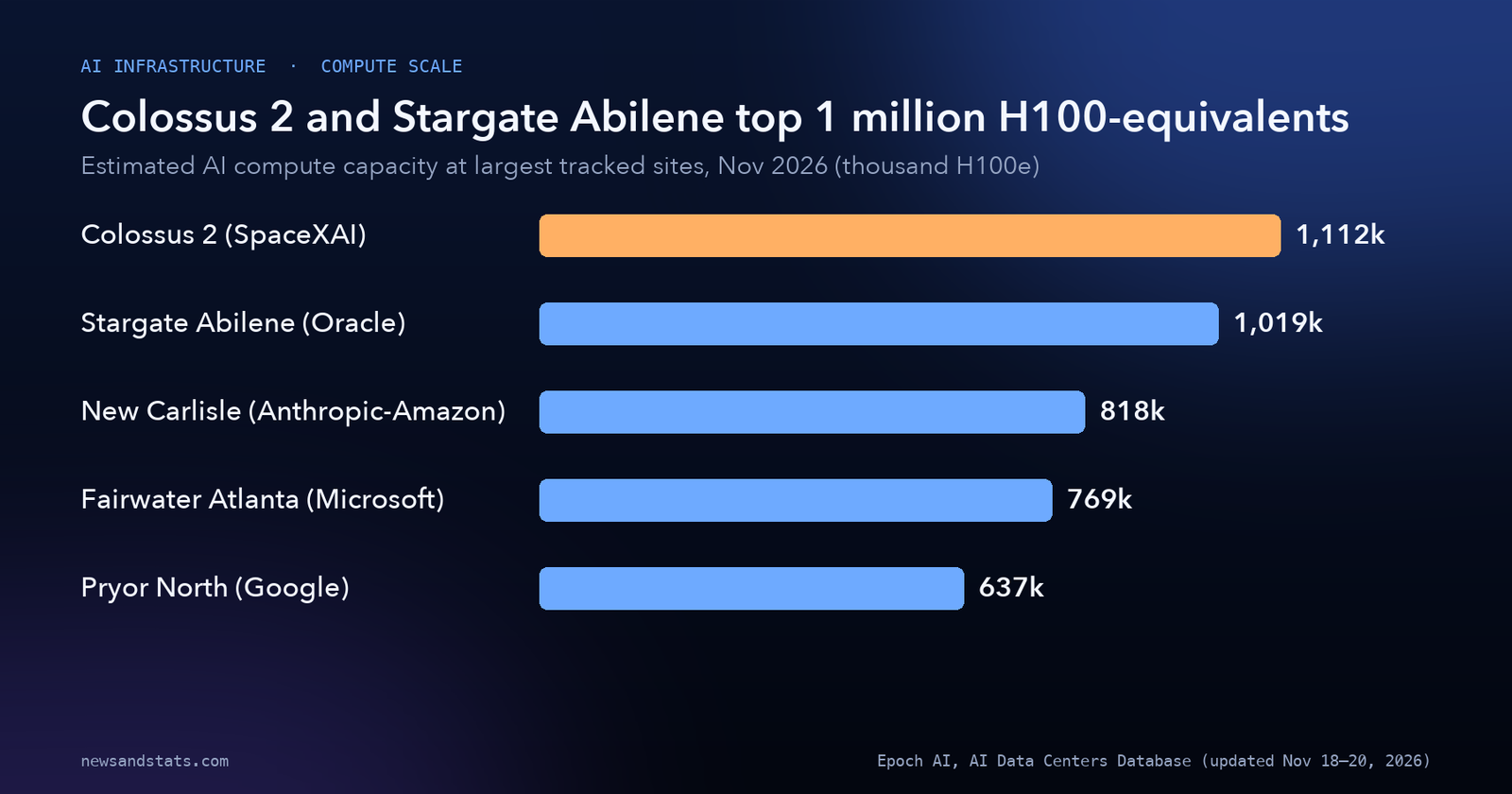
At the single-site level, the top five campuses by compute account for 4,355k H100-equivalents—27.6% of all 15.8 million H100e tracked across the 96-site database (my calculation). SpaceXAI’s Colossus 2 in Memphis, Tennessee leads by compute at 1,112k H100e (and 946 MW of IT power), followed by Oracle’s OpenAI Stargate Abilene campus in Texas at 1,019k H100e (824 MW), Amazon’s Anthropic-Amazon New Carlisle campus in Indiana at 818k H100e (1,037 MW), Microsoft’s Fairwater Atlanta site in Fayetteville, Georgia at 769k H100e (636 MW), and Google’s Pryor (North) facility at 637k H100e. For context, xAI trained its Grok 3 model using 80k H100 GPUs—making Colossus 2’s compute capacity 13.9 times that benchmark (my calculation).
Source: Epoch AI, AI Data Centers Database, updated 18–20 November 2026.
4. Hardware mix and US state concentration: Texas leads with 14 sites
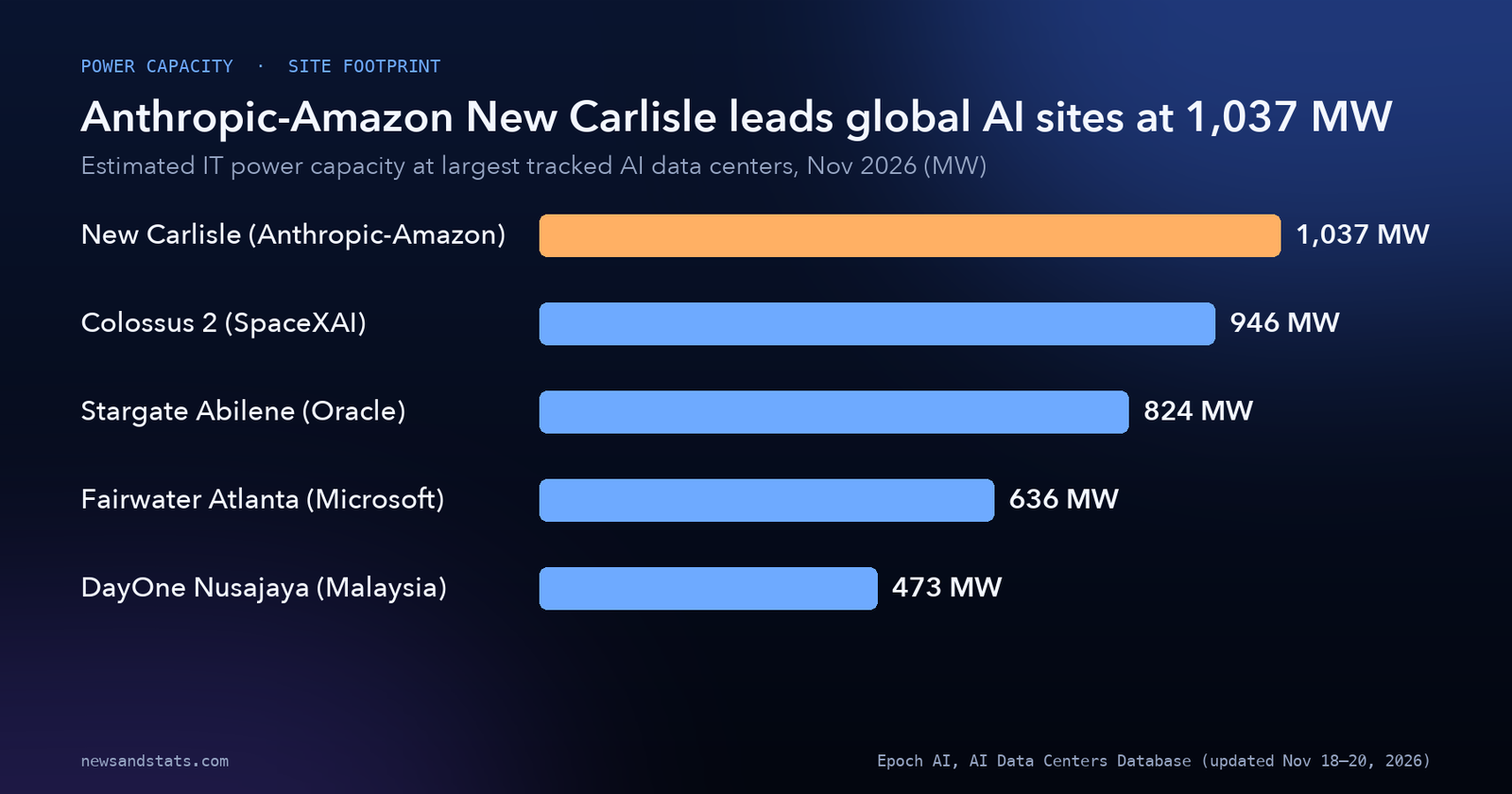
By IT power capacity, Anthropic-Amazon New Carlisle ranks first globally at 1,037 MW—exceeding the 1,000 MW threshold—ahead of Colossus 2 (946 MW), OpenAI Stargate Abilene (824 MW), Microsoft Fairwater Atlanta (636 MW), and DayOne Nusajaya in Johor Bahru, Malaysia (473 MW). Together, those top five sites draw 3,916 MW (3.92 GW) of IT power, or 25.9% of the 15.1 GW IT power total across all 96 tracked facilities (my calculation).
Hardware architectures split along hyperscaler lines, tying directly into the memory and silicon bottlenecks explored in our DRAM memory chip shortage coverage. Major sites deploy Nvidia H100, H200, and B200 GPUs alongside custom silicon: Google relies on custom TPU v5 and v6 chips, Amazon deploys Trainium2 accelerators, and Meta, xAI, and Microsoft primarily use Nvidia GPUs. Epoch AI defines an AI data center as a collection of one or more buildings located near each other—using a general rule of thumb of less than 10 km apart—that share a hardware owner or facility operator and run specialized AI accelerators, whether structured as a single building or a multi-building campus.
Geographically, the United States hosts the largest share of tracked AI mega-sites, clustered near high-capacity power corridors and fiber networks in the Midwest and South. Texas leads all states with 14 covered sites, followed by Ohio (7 sites), Virginia (7 sites), Nebraska (4 sites), and Iowa (4 sites). International mega-sites in Epoch AI’s tracker include DayOne Nusajaya (473 MW) and DayOne Kempas in Malaysia. To track these campuses independently of corporate announcements, Epoch AI cross-references commercial satellite, aerial, and drone imagery against local permitting records, estimating IT power capacity from observed cooling equipment and deriving compute capacity from the energy efficiency of each owner’s chip fleet.
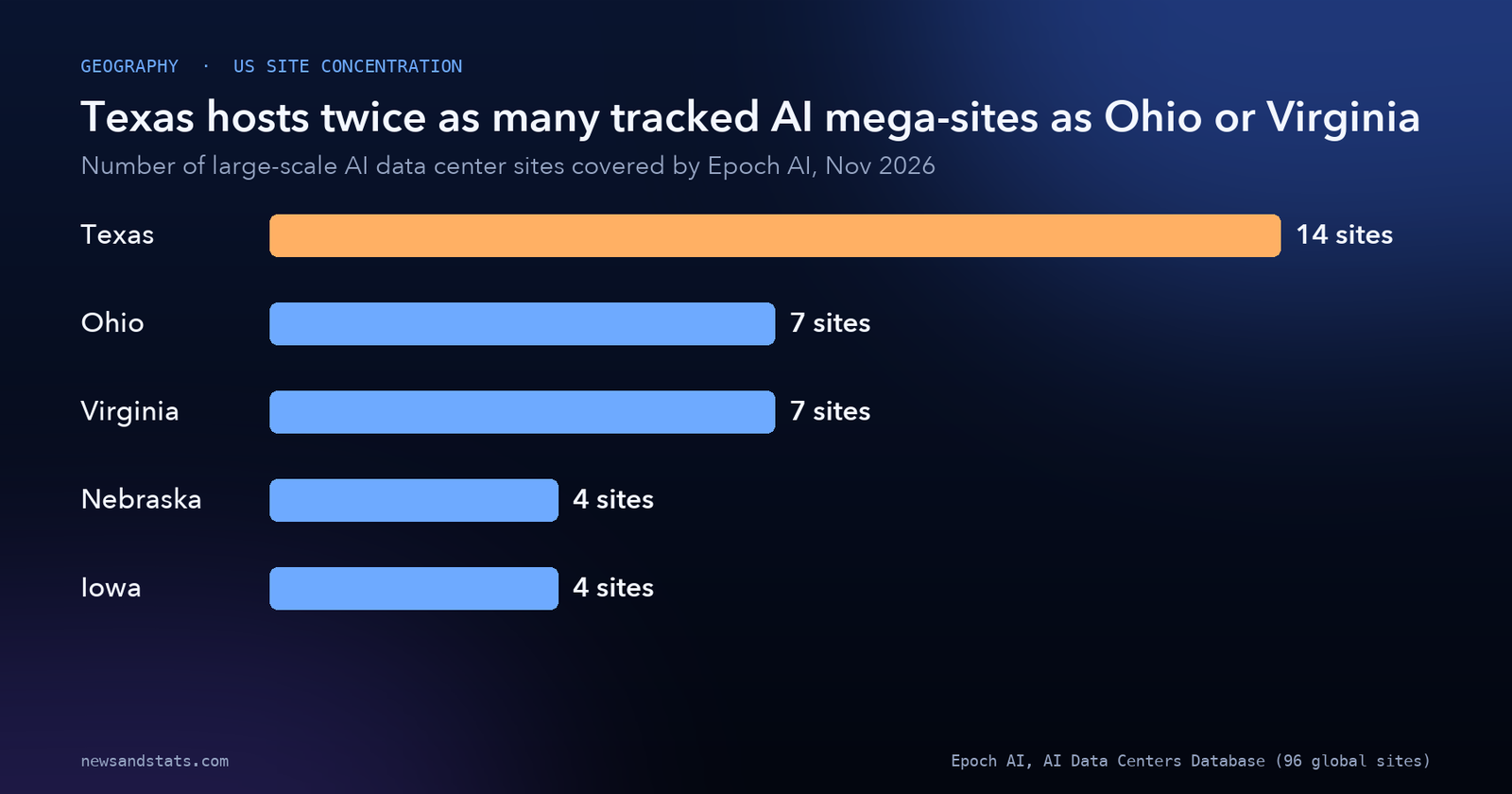
Source: Epoch AI, AI Data Centers Database, updated 18–20 November 2026.
5. How AI compute and financing numbers get misread
Headline figures on AI infrastructure are easy to misinterpret without checking accounting and engineering definitions. First, Epoch AI’s 15.1 GW IT power figure is not total grid draw: adding 20% to 50% for cooling and facility overhead lifts total capacity to 19.6 GW, yet average real-world consumption runs at 60% to 80% of capacity because clusters experience idle time and scheduled maintenance.
Second, peak theoretical compute in 8-bit operations per second (8-bit OP/s) overstates sustained training throughput. Epoch AI notes that actual computational performance typically reaches 20% to 50% of theoretical peak due to communication, memory, and software inefficiencies, and large campuses routinely partition workloads across multiple parallel jobs rather than running a single model. Similarly, Epoch AI’s estimates carry explicit uncertainty bands: 80% of the time, IT power capacity estimates sit within a factor of 1.4x, compute capacity within 1.5x, capital cost within 1.6x, and timeline dates within 6 months.
Third, the $1.8 trillion financing figure in BloombergNEF’s report measures gross capital raised across debt, equity, and securitized instruments since 2020 rather than net unrecovered spending. Even so, the $1 trillion five-year debt maturity wall—paired with private markets supplying 56% of H1 2026 colocation financing and the 18-fold jump in neocloud maturing debt between 2029 and 2030—means refinancing costs depend directly on whether AI workloads generate cash flows before 2029–2030, a tension also highlighted in the Stanford AI Index 2026.
What to watch
- Neocloud debt maturities into 2029–2030: Whether specialized AI cloud operators refinance an 18-fold surge in maturing debt without diluting equity or delaying construction at leveraged developers such as TeraWulf and Crusoe.
- IPO and private-credit stress tests: Whether postponed or challenged listings at Firmus and Nscale recover, and how private-market lenders price colocation debt beyond 2026’s 56% share.
- Nvidia credit-support commitments: Whether Nvidia’s $198 billion in direct credit support—via GPU-backed loans, guarantees, and prepayments—expands further or triggers balance-sheet scrutiny if utilization softens.
- Gigawatt campus energization: Whether 1,037 MW and 946 MW campuses in Indiana and Tennessee secure full utility power on schedule across Texas (14 sites), Ohio (7), and Virginia (7).
The bottom line
BloombergNEF’s 19 November 2026 financing analysis and Epoch AI’s 96-site compute tracker show that AI infrastructure has entered a capital-intensive phase defined by debt maturities and utility-scale power. Developers have raised at least $1.8 trillion since 2020—including $794 billion in just nine months through H1 2026—leaving at least $1 trillion in data center debt maturing within five years and an 18-fold jump in neocloud maturities between 2029 and 2030. On the ground, 96 tracked AI campuses already represent 15.8 million H100-equivalents and 19.6 GW of total facility power—78.2% above New York City’s 11 GW peak demand—making grid delivery and credit-backed financing, including Nvidia’s $198 billion in direct support, the decisive constraints on the next phase of AI expansion.
Related reading
- Data Center Power Demand Is Set to Double by 2030. The Grid Is the Bottleneck.: How AI data center electricity demand collides with utility interconnection queues.
- The OECD AI Divide: Inside the 2026 Digital Economy and Society Outlook: How enterprise AI adoption and digital infrastructure diverge across advanced economies.
- Cloud market share 2026: AWS leads, but Google Cloud grew fastest: How the major cloud platforms compete as AI workloads scale.
- Why memory chips got so expensive: the DRAM shortage in numbers: Inside the HBM and DRAM supply squeeze behind AI server racks.