Software engineering is living through a profound divergence between behavioral adoption and epistemic trust.
According to the official developer AI trust gap telemetry published in the 2026 Stack Overflow Developer Survey, artificial intelligence has become an inescapable foundation of the programming workplace. Drawing on 30,903 verified responses from software professionals across 169 countries, the survey reveals that 80% of developers now spend at least an hour per day interacting with AI systems. Coding assistants and autonomous software agents are embedded in terminals, code editors, and continuous integration pipelines across the globe.
Yet beneath this pervasive workflow integration lies a stark barrier of professional skepticism. When asked whether they trust the output of AI tools for important work decisions, a mere 6.6% of engineers answered affirmatively. Instead, 48.0% of developers state that they trust AI outputs strictly when they can easily verify the results themselves, while another 32.6% confine their trust exclusively to low-risk tasks or non-decision support.
Dividing the 80% daily usage rate by the 6.6% decision trust figure reveals that developers are 12.12 times more likely to use AI daily than to trust it with consequential engineering decisions (my calculation). Software engineers are treating AI models not as autonomous digital coworkers, but as high-speed draft generators requiring continuous human oversight.
1. The daily usage explosion: 80% of developers log on with AI
The integration of generative tools into software engineering has evolved from an exploratory novelty into a standard daily routine.
In the 2026 survey, 80% of respondents reported using AI tools for at least one hour during their workday. Among developers who actively utilize AI coding assistants or autonomous software agents, 73% interact with them every single day. Furthermore, 31% of daily AI users—nearly one in three—report spending four or more hours per day actively paired with artificial intelligence systems.
This intense exposure has generated an overall positive sentiment across the profession. Across 14,428 respondents answering the sentiment module:
- 31.6% report a very favorable attitude toward AI tools in their work.
- 30.4% report a somewhat favorable attitude.
- Summing these groups shows that 62.0% of developers hold a favorable view of AI technology (my calculation).
- 15.3% remain neutral, while 14.6% are somewhat unfavorable and 6.9% are very unfavorable, yielding a total unfavorable share of 21.5% (my calculation).
This daily saturation reflects the broader shift examined in our analysis of developer productivity and agent workflows. Developers are no longer evaluating whether AI can produce syntax; they are actively orchestrating coding agents to generate boilerplate, refactor functions, and parse documentation. However, widespread usage does not indicate blind reliance.
2. The 6.6% decision boundary: how engineers partition trust
The defining insight of the 2026 survey is that software engineers have established strict boundaries around where AI is permitted to operate.
When asked to evaluate their trust in AI tools and autonomous agents across 14,304 respondents, developers drew an unambiguous distinction between execution speed and architectural authority.
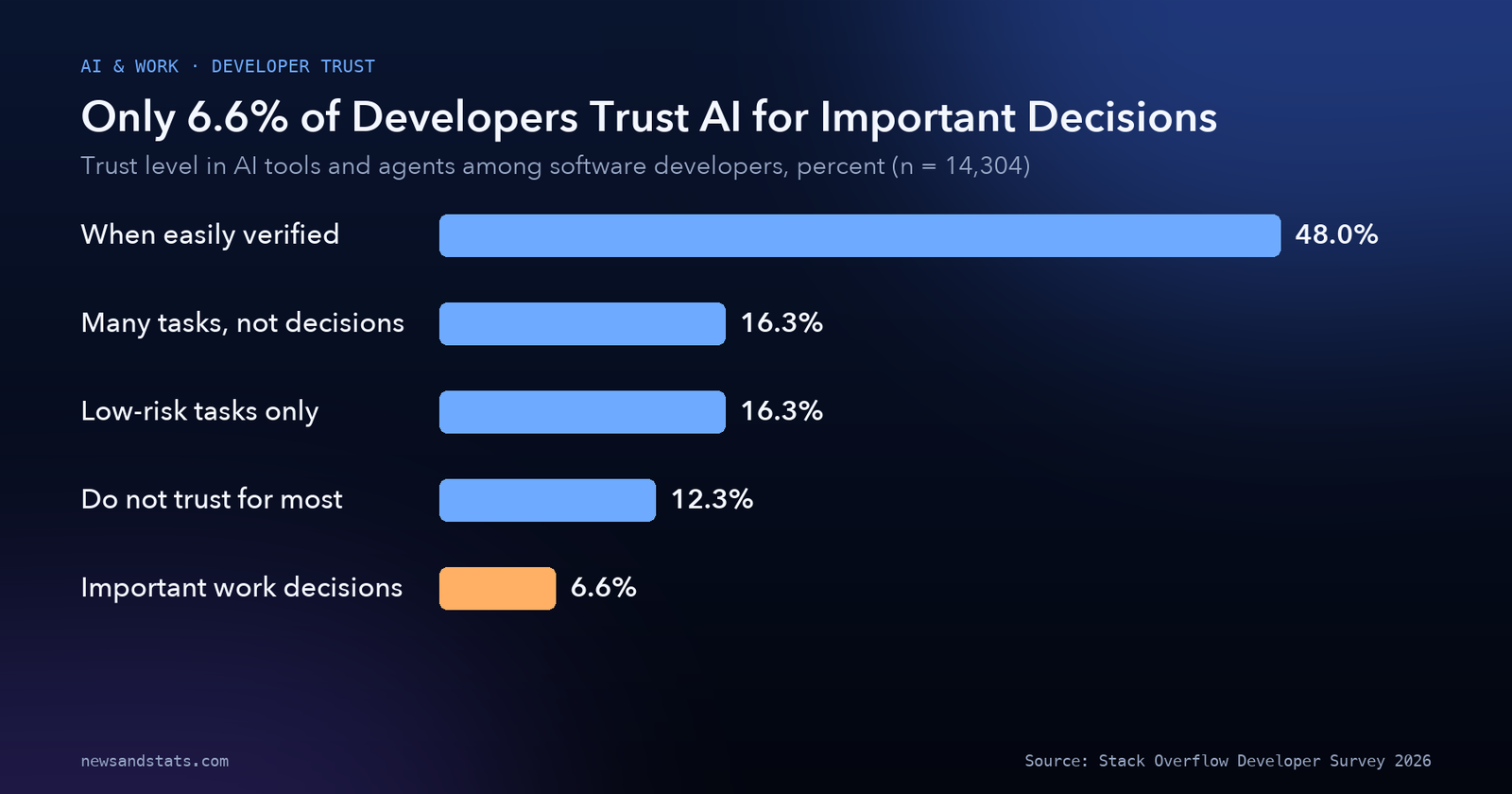
Source: Stack Overflow, Developer Survey 2026, Trust in AI tools module.
The survey data itemizes developer trust levels into five clear operational tiers:
- Trust when easily verified: 48.0% of respondents (6,872 developers) trust AI output only when they can directly and rapidly inspect the generated code.
- Many tasks, but not decisions: 16.3% of respondents (2,329 developers) trust AI across diverse tasks, but explicitly refuse to grant it authority over important work decisions.
- Low-risk tasks only: 16.3% of respondents (2,326 developers) restrict AI usage strictly to non-critical assignments where errors carry negligible consequences.
- Do not trust for most tasks: 12.3% of respondents (1,754 developers) maintain general skepticism, stating they do not trust AI output for the majority of work tasks.
- Full decision trust: Just 6.6% of respondents (949 developers) trust AI systems for many tasks including important work decisions. An additional 0.5% (74 respondents) were unsure or do not use AI tools.
Summing the three conditional categories (48.0% for easily verified output, 16.3% for many tasks excluding decisions, and 16.3% for low-risk tasks) reveals that 80.6% of software developers maintain conditional, constrained trust in AI systems (my calculation).
This finding provides a critical counterweight to the commercial enthusiasm observed in private investment tracked in the Stanford AI Index. While enterprise capital flows heavily into autonomous software agents, working practitioners refuse to delegate system architecture, security perimeters, or database migrations to probabilistic models.
3. Trust requires source attribution: why 93% demand citations
Why do software engineers refuse to trust AI models without manual verification? The survey reveals that epistemic trust in technical workflows depends entirely on provenance.
Across 13,945 respondents who evaluated knowledge sources and AI reliability:
- 52.1% stated that citing sources is very important to establishing trust in an AI-generated answer.
- 26.5% deemed source attribution important.
- 14.0% rated it somewhat important.
- Summing these tiers reveals that 92.6% of developers demand source attribution before accepting AI outputs as trustworthy (my calculation).
When developers encounter a technical challenge, their search habits reflect this demand for verifiable primary sources:
- 82.7% use online search tools to find general guidance, documentation, and technical discourse (13,774 out of 16,654 respondents).
- 69.9% consult an AI agent to assist with problem solving (11,643 respondents).
- 43.7% go directly to maintained repositories such as GitHub or technical documentation sites (7,288 respondents).
- 28.8% send a direct message to a trusted human colleague (4,803 respondents).
- 14.8% post queries into private discussion groups (2,462 respondents).
AI agents have overtaken maintained code repositories as the second most common discovery method, but search engines remain dominant because developers need to verify the underlying sources. This mirrors the corporate infrastructure challenges examined in our coverage of the hyperscaler capital expenditure boom. Large language models synthesize answers by aggregating training data, but in software engineering, a solution without a traceable commit, test case, or authoritative specification remains a production liability.
This dynamic has fundamentally changed how developers interact with Stack Overflow itself. Among 16,985 respondents:
- 64.1% visit Stack Overflow less often for simple questions, allowing AI to generate routine syntax.
- 28.9% ask fewer questions overall.
- 26.5% contribute less content.
- 21.8% report no change in their usage.
- 15.9% actively visit Stack Overflow more often for verification, checking whether AI-generated suggestions originate from established community solutions.
4. The solopreneur surge: single-person software firms jump to 10.5%
While trust boundaries limit AI’s authority within large organizations, AI tooling is simultaneously enabling engineers to strike out on their own.
One of the most surprising economic findings in the 2026 survey is the sharp increase in single-person engineering organizations. When asked about employer size across 21,115 respondents, 10.5% of developers identified as solo operators—freelancers, sole proprietors, or contractors working in an organization of one (2,213 respondents).
In prior survey cycles, this single-person cohort stood at just 3.9%. Dividing 10.5% by 3.9% reveals that the share of self-employed solo software engineers expanded by 2.69 times (my calculation).
Stack Overflow Chief Executive Officer Prashanth Chandrasekar explained this transformation during an interview on Computing’s Ctrl Alt Lead podcast:
“With AI, every individual becomes almost a manager of agents. That’s a sea change from just an individual that’s writing code.”
By leveraging autonomous agents for code generation, interface styling, database schemas, and testing, individual engineers are building complete commercial applications without hiring junior engineering teams.
| Organization size tier | Total respondents (n = 21,115) | Share of developers (%) | Primary operational dynamic |
|---|---|---|---|
| Just me (sole proprietor / freelancer) | 2,213 | 10.5% | Expanded 2.69x as engineers leverage coding agents |
| Less than 20 employees | 3,555 | 16.8% | Agile startup teams with high daily AI density |
| 20 to 99 employees | 3,677 | 17.4% | Core mid-market development teams |
| 100 to 499 employees | 3,474 | 16.5% | Scaled product organizations managing tool sprawl |
| 500 to 999 employees | 1,307 | 6.2% | Mid-enterprise engineering departments |
| 1,000 to 4,999 employees | 2,409 | 11.4% | Enterprise organizations standardizing AI governance |
| 5,000 to 9,999 employees | 1,017 | 4.8% | Large corporate technical divisions |
| 10,000 or more employees | 2,941 | 13.9% | Global multinational engineering workforces |
| Do not know | 522 | 2.5% | Unclassified enterprise contractors |
Source: Stack Overflow, Developer Survey 2026, Employer and organization size data.
This structural shift provides an empirical practitioner view of the macro trends analyzed in our report on the enterprise AI adoption gap by firm size. While large enterprises navigate protracted security reviews, compliance policies, and procurement cycles, solo engineers and small teams deploy AI tools directly into production, dramatically lowering the capital required to launch commercial software products.
Furthermore, remote flexibility remains entrenched across the sector: only 18% of developers report commuting to a physical office every day, leaving 82% working remotely or under hybrid arrangements.
5. The engineering knowledge bottleneck: coworkers beat code repositories
The reluctance to grant AI full autonomy is rooted in a fundamental workplace reality: artificial intelligence models cannot access the tacit knowledge embedded inside human teams.
When developers need to solve complex, work-related technical problems, they turn to human colleagues before checking internal documentation or codebases.
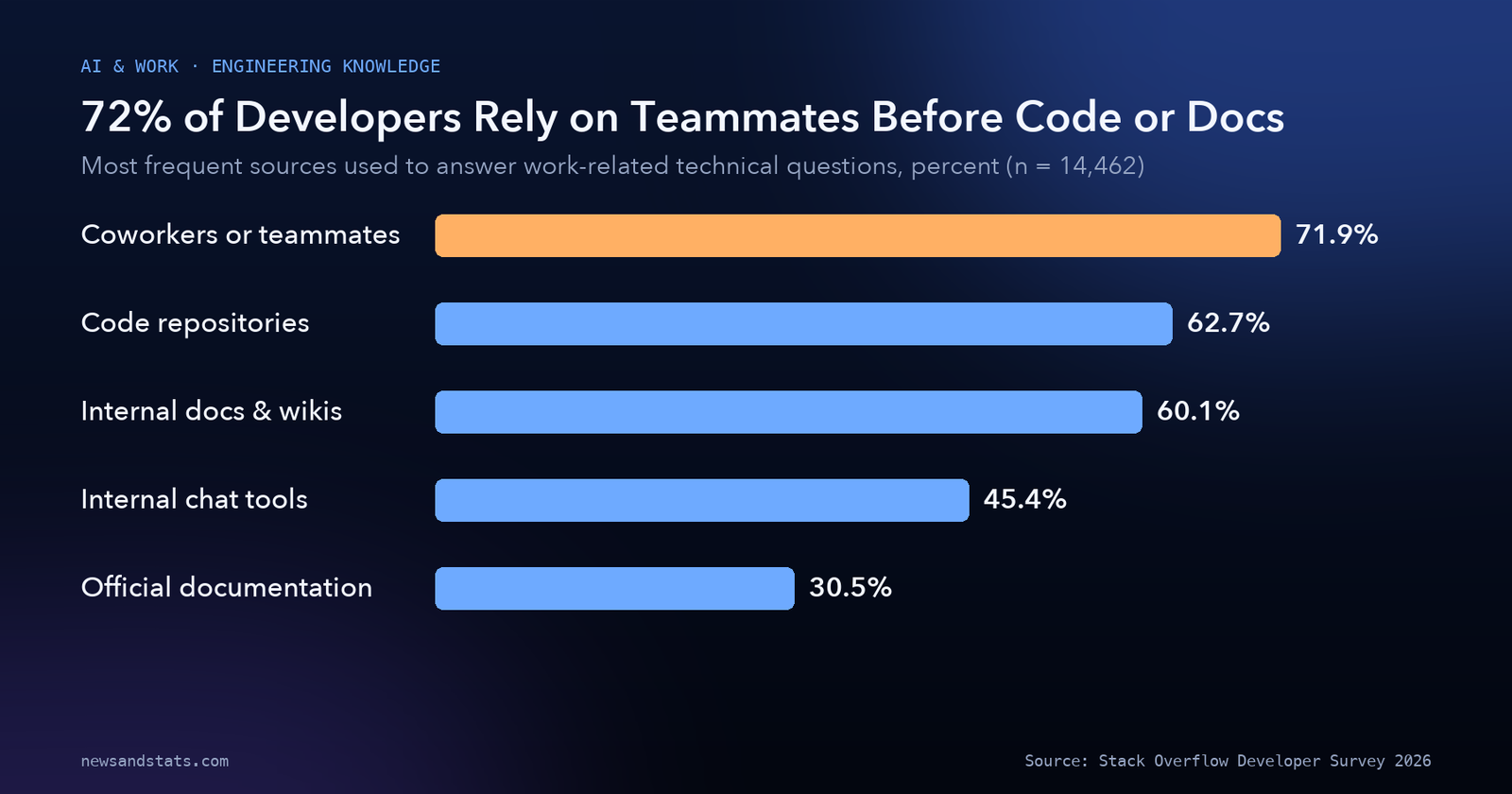
Source: Stack Overflow, Developer Survey 2026, Knowledge sources and trust section.
Across 14,462 respondents evaluating workplace knowledge retrieval:
- 71.9% rely on coworkers or teammates as their primary knowledge source (10,405 developers).
- 62.7% turn to code repositories or code comments (9,065 developers).
- 60.1% consult internal documentation, wikis, or knowledge bases (8,687 developers).
- 45.4% search internal chat tools such as Slack or Microsoft Teams (6,572 developers).
- 30.5% consult official technical documentation (4,415 developers).
Why do 72% of developers rely on human teammates rather than automated tools? The survey exposes chronic friction in organizational knowledge management across 12,374 respondents:
- 63.2% report that existing workplace information is incomplete (7,825 developers).
- 60.9% report that important context lives only in people’s heads (7,541 developers).
- 56.5% find that technical documentation is outdated (6,989 developers).
- 53.4% struggle with information spread across too many fragmented tools (6,603 developers).
- 30.8% simply do not know where to look for essential project context (3,816 developers).
This institutional amnesia severely damages development velocity. When asked how often they discover critical project context only after starting or finishing a task across 12,687 respondents:
- 43.1% discover context late sometimes (5,465 developers).
- 23.4% discover context late often (2,964 developers).
- 12.1% discover context late very often (1,539 developers).
- 16.8% discover context late rarely (2,136 developers).
Summing the often and very often categories reveals that 35.5% of software engineers regularly waste labor by discovering essential context after work has begun (my calculation).
Stack Overflow Chief Product and Technology Officer Jody Bailey highlighted this organizational challenge:
“AI is forcing software organizations to document the judgment they previously relied on people to supply.”
As highlighted in our analysis of occupational exposure to generative AI, AI can synthesize code syntax instantly, but it cannot infer unwritten architectural trade-offs, legacy system constraints, or client business priorities. As long as 60.9% of institutional knowledge remains locked in human heads, AI agents cannot safely make standalone engineering decisions.
6. Python leads the AI language stack at 39%
The rise of AI-assisted engineering is also reshaping language popularity across developer environments.
Among 14,099 developers surveyed regarding technologies used specifically for AI tools and autonomous coding agents:
- Python leads the industry at 39.0% (5,495 developers), solidifying its position as the universal language of AI model interaction, data science, and agent scripting.
- JavaScript ranks second at 38.4% (5,419 developers), powered by full-stack web application development and AI-integrated browser interfaces.
- HTML/CSS captures 33.3% (4,692 developers), reflecting intense demand for front-end interface generation.
- TypeScript ranks fourth at 30.4% (4,293 developers), offering type safety for complex agentic codebases.
- SQL follows at 29.8% (4,207 developers), crucial for structured enterprise data retrieval and vector database pipelines.
- Bash and shell scripting captures 28.6% (4,038 developers), driving automated deployment pipelines and container operations.
- C# accounts for 16.2% (2,277 developers), while Java captures 14.6% (2,052 developers), PowerShell records 14.6% (2,057 developers), and C++ represents 11.3% (1,595 developers).
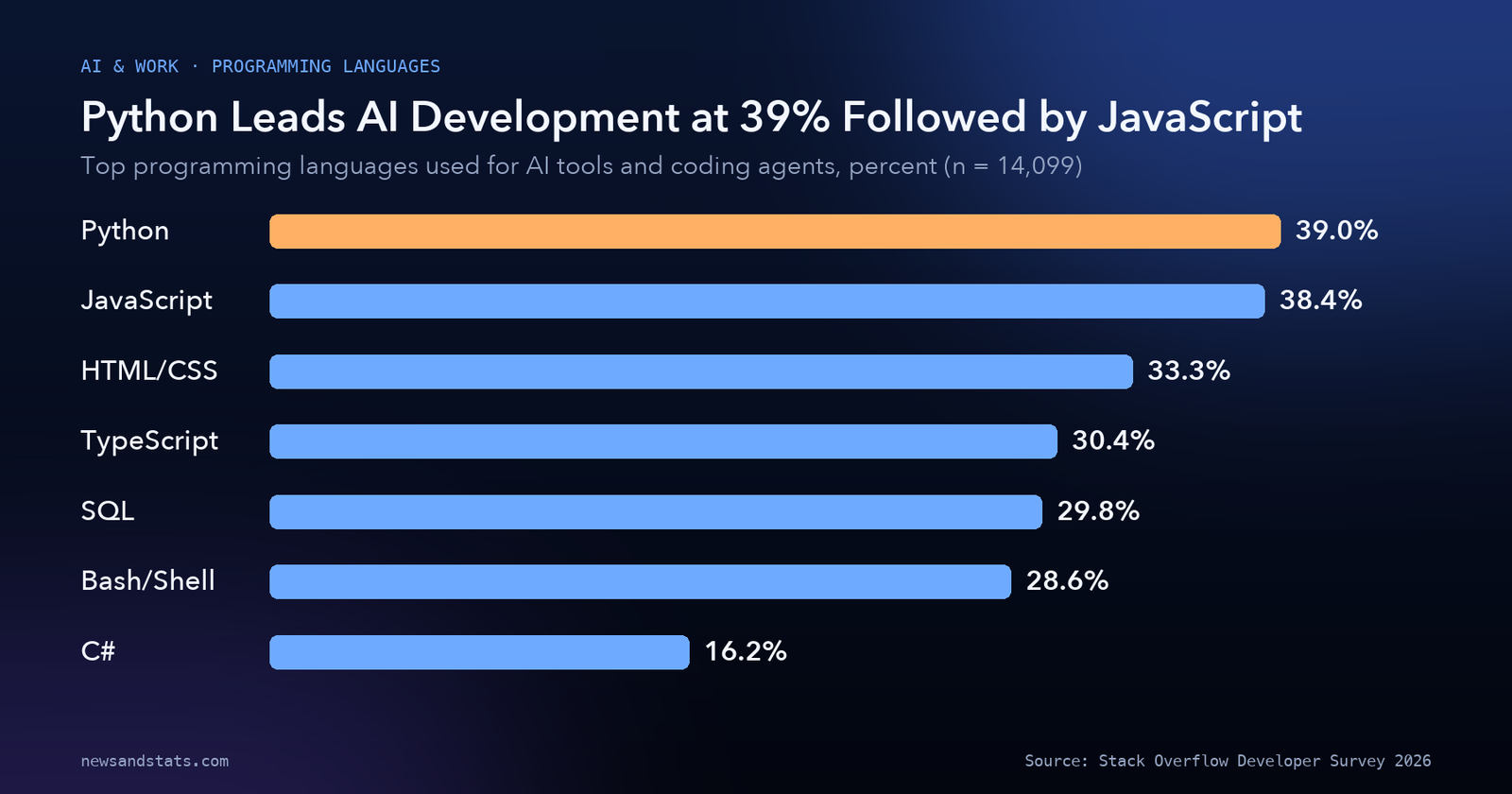
Source: Stack Overflow, Developer Survey 2026, Most popular technologies for AI.
By contrast, when surveying senior engineers with 16 or more years of professional experience across 5,296 respondents, classical database and web languages remain dominant: SQL leads at 63.0% (3,337 developers), closely followed by JavaScript at 62.0% (3,282 developers), HTML/CSS at 56.4% (2,987 developers), Python at 53.2% (2,818 developers), and Bash/Shell at 51.7% (2,740 developers).
The rapid ascent of Python in AI agent workflows mirrors the global intellectual property trends examined in our analysis of the global generative AI patent race. Python’s extensive open-source library ecosystem—spanning PyTorch, Hugging Face, LangChain, and orchestration frameworks—has made it the default control plane for generative AI development.
Developers are also leveraging AI to build their own internal infrastructure rather than purchasing commercial software. Across 13,338 respondents evaluating internal tool development:
- 77.3% build small scripts and automations with AI assistance (10,304 developers).
- 63.0% develop team-level internal tools (8,398 developers).
- 54.4% construct customer-facing product features (7,254 developers).
- 46.0% build cross-team platform tooling (6,130 developers).
- 18.6% use AI to build custom software that replaces paid commercial vendors (2,482 developers).
Nearly one in five engineering teams is now actively replacing paid SaaS software subscriptions with custom, AI-built internal utilities.
What to watch
- Agentic verification tool integration: Monitor whether IDE vendors build automated test-generation and formal verification directly into agent workflows, addressing the 48.0% of engineers who trust AI only when verification is immediate.
- Enterprise context layer deployment: Track adoption of internal context-management platforms designed to extract tacit architectural knowledge from human heads and outdated wikis.
- Solopreneur economic sustainability: Follow whether the surge in single-person engineering organizations (10.5% of developers) sustains viable revenue models or encounters scaling ceilings as software products mature.
- SaaS vendor revenue displacement: Observe whether commercial developer tool vendors experience churn as 18.6% of engineering teams build internal replacements using generative code.
- Developer workplace happiness metrics: Track whether job satisfaction rebounds from its current historic low, where 32.6% of engineers report being unhappy and 45.1% describe themselves as complacent.
The bottom line
The 2026 Stack Overflow Developer Survey establishes that the software industry has embraced AI as an indispensable productivity amplifier while rejecting it as an autonomous decision maker. With 80% of developers using AI daily but only 6.6% trusting it for important architectural and operational decisions, the human engineer remains the ultimate guarantor of software integrity. Until software organizations bridge the internal context gap—documenting the unwritten institutional knowledge that 71.9% of developers still seek from human teammates—AI agents will remain confined to generating verifiable code drafts under close supervision. For ongoing empirical analysis of workplace automation, artificial intelligence, and employment trends, explore our AI & Work coverage.
Related reading
- GitHub Octoverse 2026 in 8 Numbers: The 225 Million Milestone and the 40% Agent Surge: developer telemetry, open-source repository growth, and autonomous pull requests.
- AI Adoption by Firm Size in 2026: The 21-Point Gap Behind Washington’s “Super Intelligence” Rename: US Census Bureau enterprise adoption data across employer headcount tiers.
- Stanford AI Index 2026 in 8 Numbers: The $344.7 Billion Surge and the Shrinking US Lead: private investment trends, frontier benchmark evaluations, and AI corporate expenditure.
- Global Generative AI Patents in 8 Numbers: China’s 6-to-1 Lead and the Surge to 37,000 Inventions: intellectual property filing records, machine learning algorithms, and software patents.
- Generative AI Job Exposure in 8 Numbers: The ILO Global Workplace Index: international occupational exposure indices, automation risks, and cognitive task restructuring.