Global coffee prices in 2026 have swung from the tightest market in years to a surplus, and the whiplash shows up everywhere except the local coffee shop. For four years running, the world drank more coffee than farmers could grow. That changed in the 2025/26 coffee year: the International Coffee Organization (ICO) now estimates that global production outpaced consumption by 3.0 million 60-kilogram bags, the first surplus after four straight years of deficits. Wholesale prices reacted fast. The ICO’s Composite Indicator Price (I-CIP), the benchmark for the world market, averaged 262.18 US cents per pound in September 2026, down 8.7% from August — one of its sharpest monthly drops in years — before easing a further 0.3% in October to 261.26 cents. Yet in the United States, the average pound of ground coffee is still selling for $9.33, barely below the record high set in the spring. The numbers below explain why the futures market and the supermarket shelf are telling two different stories right now.
Coffee Prices 2026: Four Years of Shortage, Now a 3-Million-Bag Surplus
Coffee had been a seller’s market since the early 2020s. According to the ICO’s September 2026 Coffee Market Report, the 2024/25 coffee year closed with world production at 175.9 million bags against consumption of 182.2 million bags — a deficit of 6.3 million bags, continuing a run of shortfalls that had defined the market since 2021/22. That is the condition that pushed prices to multi-year highs and made World in Numbers coverage of coffee worth watching in the first place.
The 2025/26 coffee year broke the pattern. The ICO’s own balance sheet puts global production at 183.6 million bags — 104.4 million of Arabica and 79.2 million of Robusta — against consumption of 180.6 million bags, a surplus of 3.0 million bags. That is a swing of roughly 9.3 million bags in a single year, from a 6.3-million-bag shortfall to a 3.0-million-bag cushion. It is the kind of turnaround that normally takes a market by surprise, and the price chart below shows it did.
The Composite Price Just Had Its Worst Month in Years
Markets priced in the surplus almost immediately. The I-CIP fell from an August 2026 average high enough that a 262.18-cent September reading represented an 8.7% monthly drop, among the steepest single-month declines the index has recorded in years. The slide did not reverse in October: the ICO’s October 2026 report put the month’s average at 261.26 cents per pound, down a further 0.3%, with the index trading in a range of 251.28 to 272.34 cents and closing the month at 252.32 cents.
The decline was not even across coffee types. October’s group indicator prices, in US cents per pound, were: Colombian Milds 357.85 (up 0.5% from September), Other Milds 334.99 (up 1.7%), Brazilian Naturals 294.49 (up 1.5%), and Robustas 164.19 (down 2.0%). Reference futures told a similar story: New York Arabica settled October at 285.10 cents (up 1.6%), while London Robusta closed at 152.56 cents (down 1.1%), widening the Arabica-Robusta arbitrage by 4.9% to 132.54 cents. Robusta, in other words, is the segment still getting cheaper, while the milder Arabica groups ticked up slightly within an overall market that remains far below its 2025 peak. That decline stands out against the World Bank’s commodity outlook, which tracked most major commodities, from crude oil to copper, moving higher through 2026 on the back of the year’s broader energy shock; coffee is one of the few widely traded goods whose benchmark price is falling rather than rising this year.
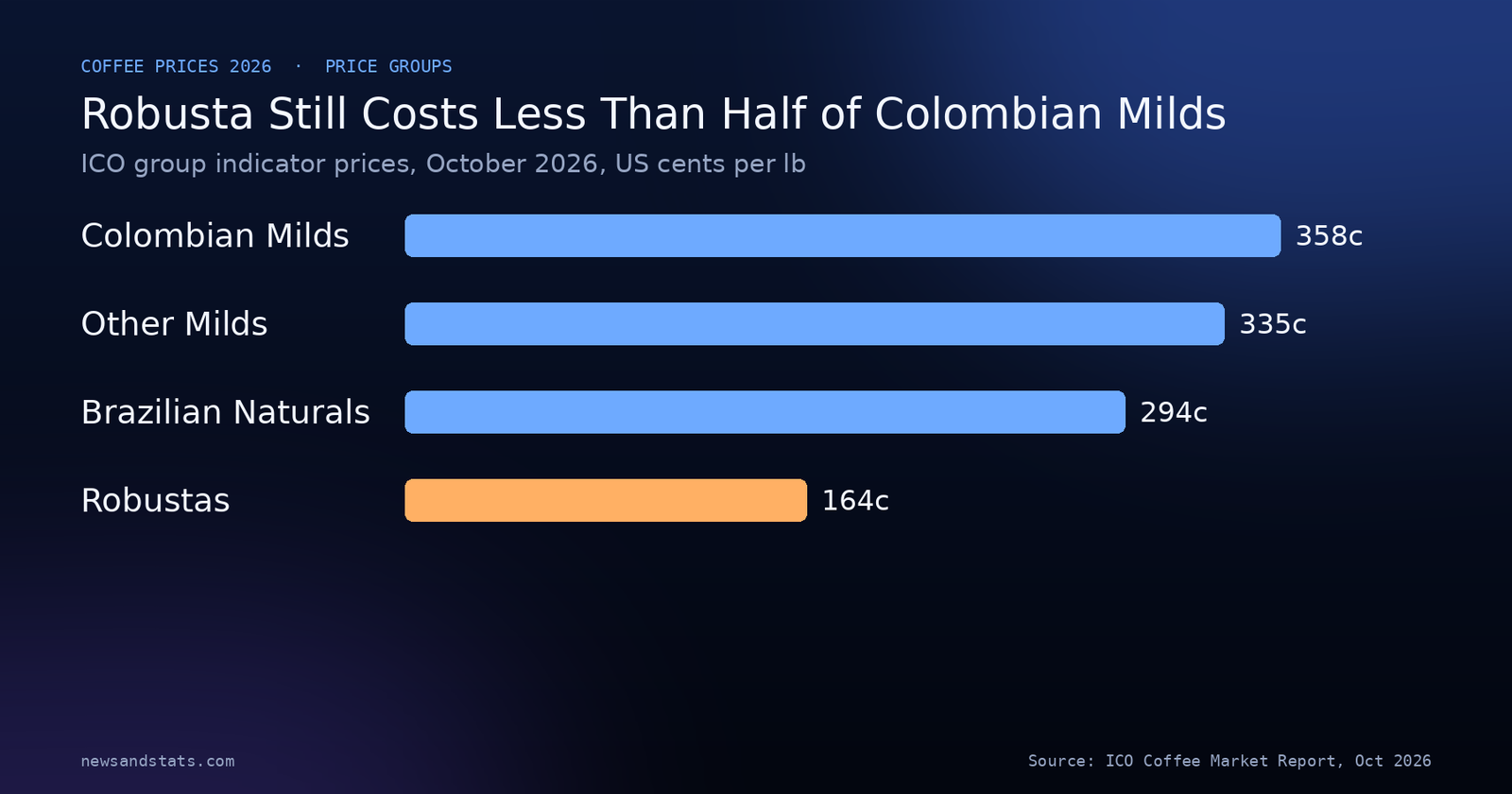
Source: International Coffee Organization, Coffee Market Report, October 2026, Table 1 and reference futures section.
Brazil’s Harvest Is Turning Into the Biggest Ever
The reason the market flipped sits mostly in one country. The US Department of Agriculture’s Foreign Agricultural Service, in its July 2026 “Coffee: World Markets and Trade” report, forecasts Brazil’s 2026/27 production at 71.9 million 60-kilogram bags, up from 63.0 million in 2025/26 — a rise of about 14.1%, by my calculation from those two USDA figures — and a record for the country. The same report forecasts record world production of 189.7 million bags for 2026/27, up from 178.8 million in 2025/26, alongside record world consumption of 179.7 million bags and ending stocks rising to 26.3 million bags from 24.4 million.
Brazil’s own crop-monitoring agency tells a related but not identical story. The ICO’s September 2026 report notes that Conab, the Brazilian government’s supply agency, raised its own 2026/27 estimate to a record 67.6 million bags on 24 September — a record by Conab’s own methodology, but a lower figure than USDA’s 71.9 million. The gap is a reminder that official crop forecasts vary by agency, timing and methodology even when they agree on the broad trend: more coffee, and a lot more of it, is coming out of Brazil this harvest.
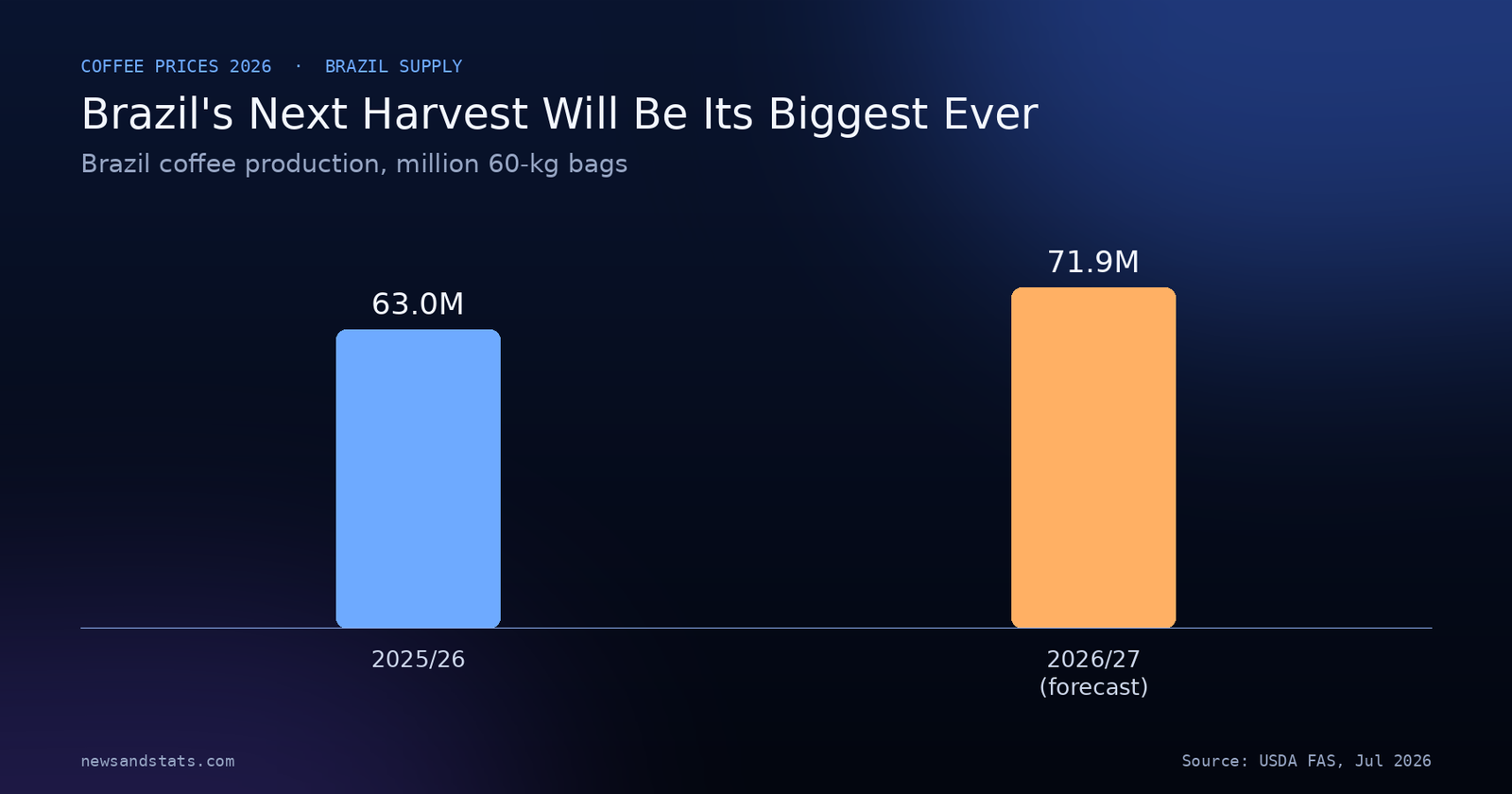
Source: USDA Foreign Agricultural Service, Coffee: World Markets and Trade, July 2026, Production table.
Curiously, Brazil’s own exports did not rise to match. The ICO’s October report shows Brazil’s coffee-year 2025/26 exports, all forms, actually fell 7.3% to 40.20 million bags from 43.36 million in 2024/25, with Brazilian Naturals green-bean exports down 11.0% to 36.52 million bags from 41.04 million. The record crop was still being harvested and sold through much of that coffee year, and rain during the harvest affected bean quality, the ICO noted, creating uneven availability across grades — a detail that matters for roasters even as the aggregate supply number looks reassuring.
Vietnam’s Robusta Is Quietly Gaining Share
Brazil is not the only producer reshaping the market. USDA forecasts Vietnam’s 2026/27 production at 32.5 million bags, up from 31.7 million, and the ICO’s trade data show Vietnam’s Robusta green-bean exports for coffee year 2025/26 rising 26.7% to 26.37 million bags from 20.82 million the year before. Those gains, combined with Brazil’s own rising Robusta output, pushed Robustas’ share of total world green-bean exports to 40.4% in 2025/26 — the first time that share has crossed 40% on ICO record, as cheaper Robusta keeps grabbing ground against the pricier Arabica groups that dominate specialty coffee. That shift is unfolding against a backdrop of shifting global trade patterns in which exporters are increasingly diversified across Asia and South America rather than concentrated in a handful of origin countries.
Global green-bean exports for September 2026 alone rose 5.8% year-on-year to 10.19 million bags, from 9.63 million a year earlier, according to the ICO’s October report — one more sign that more coffee than usual is moving through the pipeline, even as the composite price falls.
Why Your Bag Still Costs $9.33
None of this has fully reached the shelf yet. The Bureau of Labor Statistics’ average price data, hosted by the Federal Reserve Bank of St. Louis, show the average US retail price of 100% ground roast coffee hit $9.72 per pound in April 2026, up from $7.54 in April 2025 — an increase of about 29.0%, by my calculation, and a record for the series. By September 2026 the average price had eased only to $9.33 per pound, against $9.14 in September 2025, a year-on-year gap of just 2.1% by the same calculation. Retail prices, in short, are still elevated and barely off their record even as the wholesale benchmark behind them has fallen 8.7% in a single month.
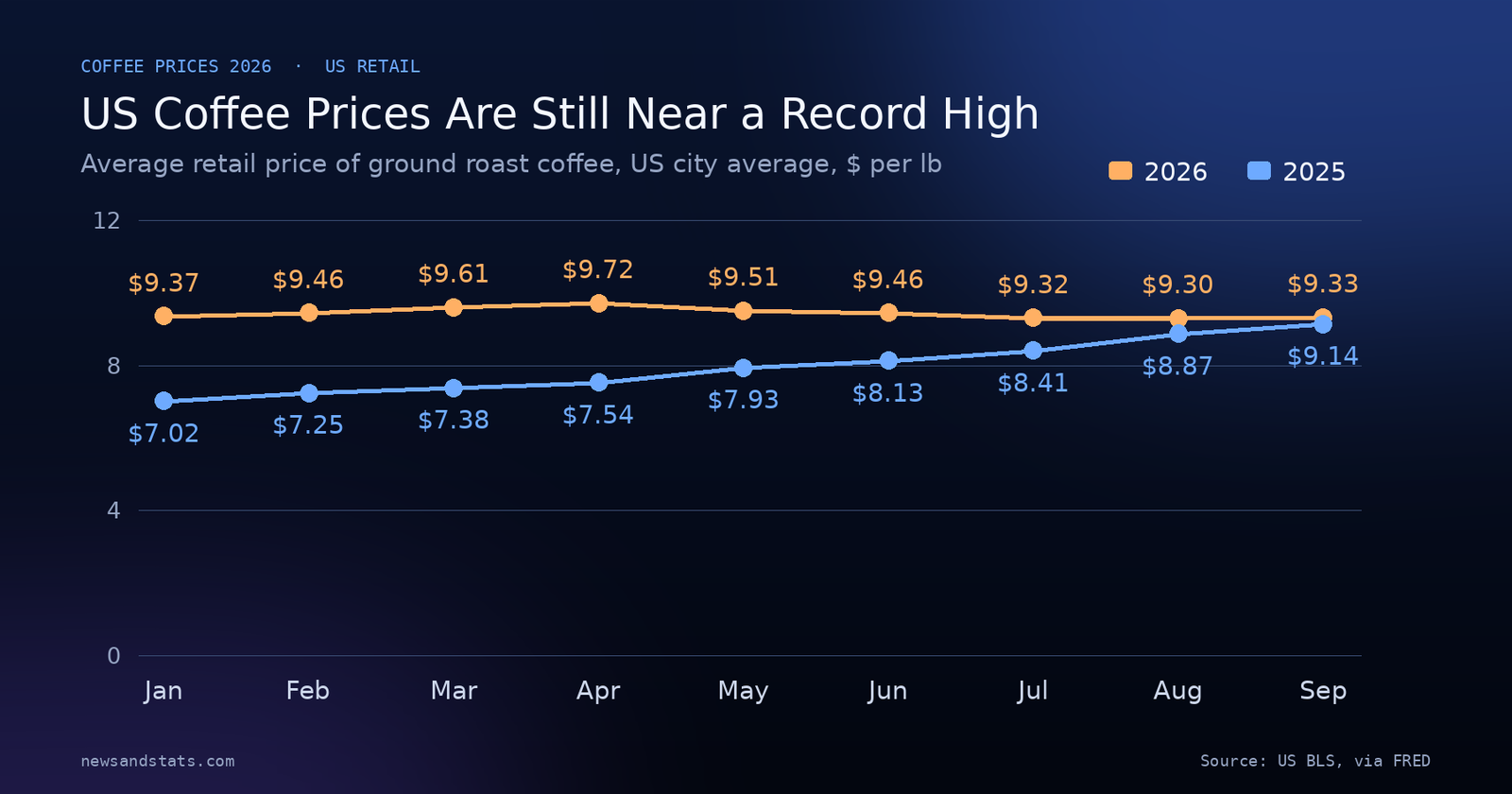
Source: US Bureau of Labor Statistics, Average Price Data (APU0000717311), via the Federal Reserve Bank of St. Louis.
The pattern is consistent with how retail pricing in the coffee trade typically behaves: supermarket prices move on contracts and inventory signed months earlier, so they tend to lag sharp swings in the wholesale market rather than track them week to week. The narrowing year-on-year gap, from 29.0% in April to 2.1% in September, suggests that lag is now working in the other direction, with retail slowly catching down toward a cheaper wholesale market rather than catching up to a more expensive one.
| Metric (USDA FAS, million 60-kg bags) | 2025/26 | 2026/27 (forecast) |
|---|---|---|
| World production | 178.8 | 189.7 |
| World consumption | 173.5 | 179.7 |
| World ending stocks | 24.4 | 26.3 |
| Brazil production | 63.0 | 71.9 |
| Vietnam production | 31.7 | 32.5 |
Source: USDA Foreign Agricultural Service, Coffee: World Markets and Trade, July 2026, Coffee Summary and Production tables.
What the Surplus Does and Doesn’t Mean
A statistical surplus is not the same as abundance everywhere. The ICO’s own commentary flags that certified Arabica stocks at the exchanges remain comparatively tight even as the broader balance improves, and that uneven rainfall during Brazil’s harvest reduced the share of top-grade beans available, even from a record crop. Both details matter because they explain why Arabica-group prices ticked up slightly in October even as the overall composite index kept drifting down: a bigger harvest does not automatically mean more of the specific grades that roasters and specialty buyers want, and a market can run a statistical surplus in bulk bags while still running short of the beans that command the highest prices.
The swing from shortage to surplus also happened faster than the four-year run of deficits that preceded it, which is itself worth noting. Coffee trees take several years to reach full production after planting, so a single good season in Brazil, helped by favorable weather after several difficult years, can move the global balance by millions of bags almost overnight in a way that slower-growing crops cannot. That volatility cuts both ways: the same weather sensitivity that produced this year’s record harvest is the reason forecasters are already watching how a more complicated, less synchronized flowering pattern this year could affect the 2027 crop, according to the ICO’s October report.
The surplus also arrives against a backdrop that is easy to lose in the aggregate numbers: much of the world’s coffee is grown by smallholders in the world’s poorest economies, where a four-year run of high prices brought real income gains that a falling composite price now puts at risk, even as drinkers in rich countries have barely noticed any relief. Coffee is not the only food commodity sending mixed signals this year; the FAO’s broader food-price index eased slightly in October 2026 for different reasons tied to cereals, dairy, and vegetable oils, a reminder that food-price trends vary a great deal by commodity even within the same month.
What to watch
- Whether the ICO’s November 2026 report, typically released in the second week of December, shows the composite price continuing to fall or stabilizing near its October level.
- How Brazil’s and Conab’s final 2026/27 crop numbers reconcile with USDA’s 71.9-million-bag forecast once the harvest is fully tallied.
- Whether Robusta’s 40.4% share of world green-bean exports keeps climbing in 2026/27 as Vietnam’s and Brazil’s Robusta output both expand.
- The next US Consumer Price Index release, due 10 December 2026 for data through November, for the first look at whether retail coffee prices keep narrowing the gap with the wholesale market.
- Certified Arabica stock levels at the exchanges, which the ICO has flagged as tight even as the broader coffee balance has turned to surplus.
- Vietnam’s 2026/27 harvest, under way in October 2026, and whether USDA’s 32.5-million-bag production forecast holds once it is complete.
The bottom line
Coffee prices in 2026 show two markets moving at different speeds. Wholesale prices have fallen fast and far, as a genuine supply-side surprise — Brazil’s biggest harvest on record, reinforced by rising Vietnamese Robusta output — turned four years of global shortage into a 3.0-million-bag surplus almost overnight. Retail prices have not caught up: Americans are still paying close to the record $9.72 a pound set in April, though the year-on-year gap has narrowed sharply as 2025’s high prices roll out of the comparison. If the wholesale slide continues into 2027, the bigger question is how much of it ever reaches the shelf, and how much simply offsets the higher costs roasters locked in during the shortage years.
Related reading
- Global Food Prices Ease: Inside the FAO’s October 2026 Index: the broader food basket eased in the same month coffee’s own benchmark fell sharply, for different reasons.
- Global Commodity Prices: The World Bank’s Surge and Energy Shock Spillover: most commodities rose in 2026; coffee’s wholesale slide runs the other way.
- Global Trade Outlook 2026: AI Beats the War: the broader trade backdrop behind shifting coffee export shares between Brazil, Vietnam and other origins.
- Global Extreme Poverty Stalls as Vulnerability Widens: context on the smallholder economies that grow much of the world’s coffee.