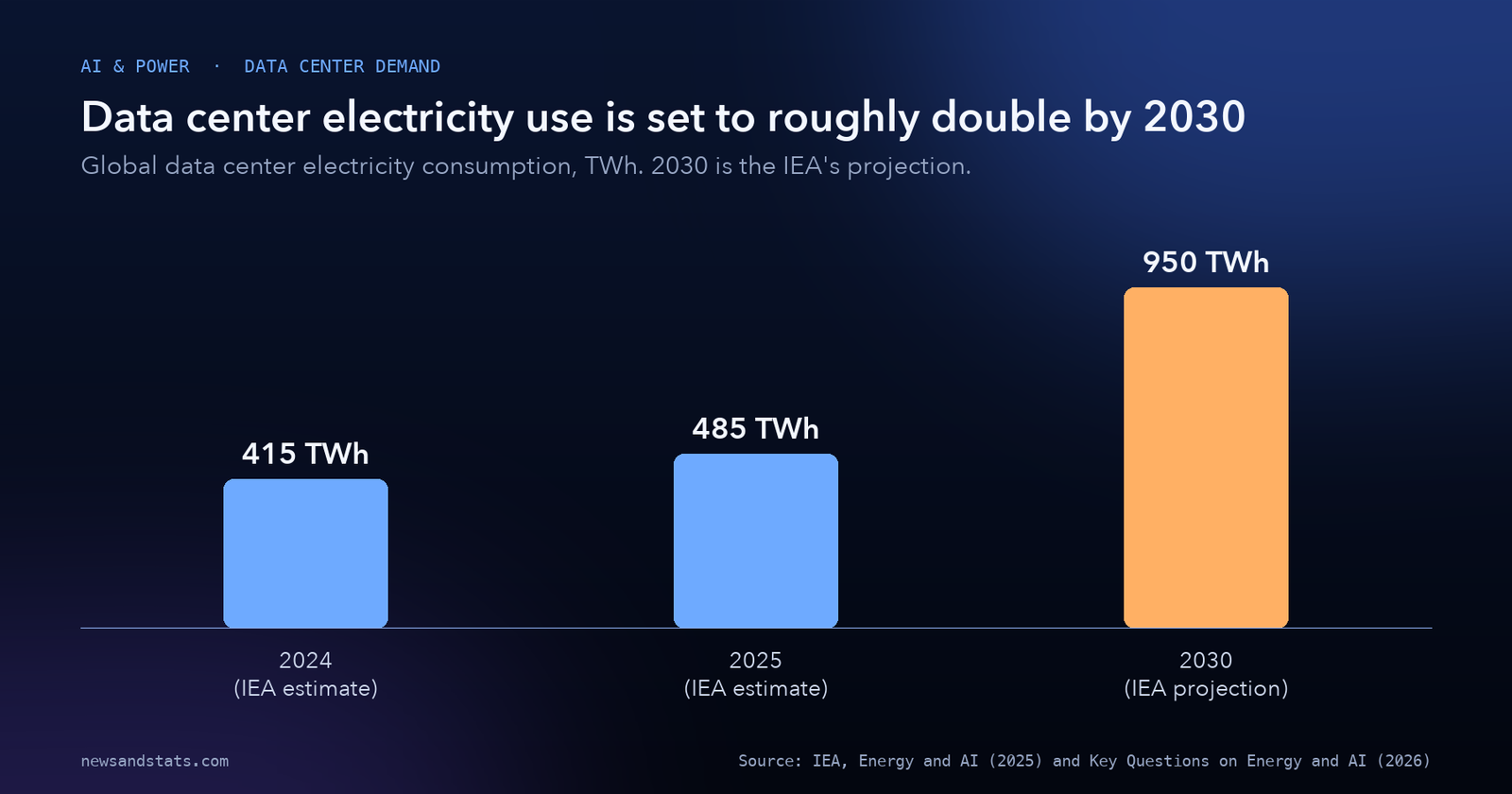
The International Energy Agency (IEA) estimates that data centers used 485 terawatt-hours (TWh) of electricity in 2025, up 17% in a year, and projects about 950 TWh by 2030, roughly double. For most electricity users, growth like that would be a planning problem. For the grid operators who must connect new data centers, it is a timing problem: a task-force paper prepared for the UN Economic Commission for Europe (UNECE) says a data center can be deployed in two to five years, while transmission upgrades often take more than a decade.
This post, part of our AI & Work coverage, sets out what primary sources say about how much electricity data centers use, where the growth is, how large a share of the grid they already take in some places, how the gap between building and connecting shows up in practice, and what companies are doing about it. Where we make our own calculation, we say so. Where a source does not give a number, such as a precise grid-connection waiting time, we do not supply one.
1. 485 TWh: where data center power demand stands
In its 2025 report Energy and AI, the IEA estimated that data centers consumed around 415 TWh of electricity in 2024, about 1.5% of global electricity consumption. Over the previous five years, consumption had grown by 12% a year.
The agency’s April 2026 update, Key Questions on Energy and AI, puts the 2025 figure at 485 TWh. Global data center electricity demand grew 17% in 2025, in line with the IEA’s projections, and the demand of AI-focused data centers grew 50%.
One terawatt-hour is one billion kilowatt-hours. Our calculation from the two IEA estimates: 485 divided by 415 is about 1.17, a rise of roughly 17%, which matches the growth rate the IEA reports.
Source: IEA, Energy and AI and Key Questions on Energy and AI.
2. Data center power demand in 2030: what the projection says
The IEA’s 2025 base case projected that data center consumption would reach around 945 TWh by 2030, just under 3% of global electricity consumption in that year. That implied growth of about 15% a year from 2024 to 2030, more than four times faster than the growth of total electricity consumption from all other sectors.
The 2026 update restates the figure as about 950 TWh, roughly double the 2025 level, and says electricity use by AI-focused data centers triples over the same period. It describes the central projection as remaining close to the trajectory of the 2025 report. It adds that near-term bottlenecks reduce the likelihood of more aggressive scenarios, while the mid- to longer-term outlook has possible upside after 2030.
Our calculations: 950 minus 485 is an increase of 465 TWh, and 950 divided by 485 is about 1.96, so the 2030 projection is just under twice the 2025 estimate. Measured from the 2024 estimate, 945 divided by 415 is about 2.3 times.
The UNECE task-force paper also cites cryptocurrency mining, which it says adds 100 to 130 TWh a year.
3. The United States and China drive the growth
The IEA’s 2025 report projects where the extra demand will come from. Its base case adds about 240 TWh in the United States, up 130% from 2024, and about 175 TWh in China, up 170%. Europe adds more than 45 TWh, up 70%, and Japan about 15 TWh, up 80%. The agency says China and the United States together account for nearly 80% of global growth to 2030.
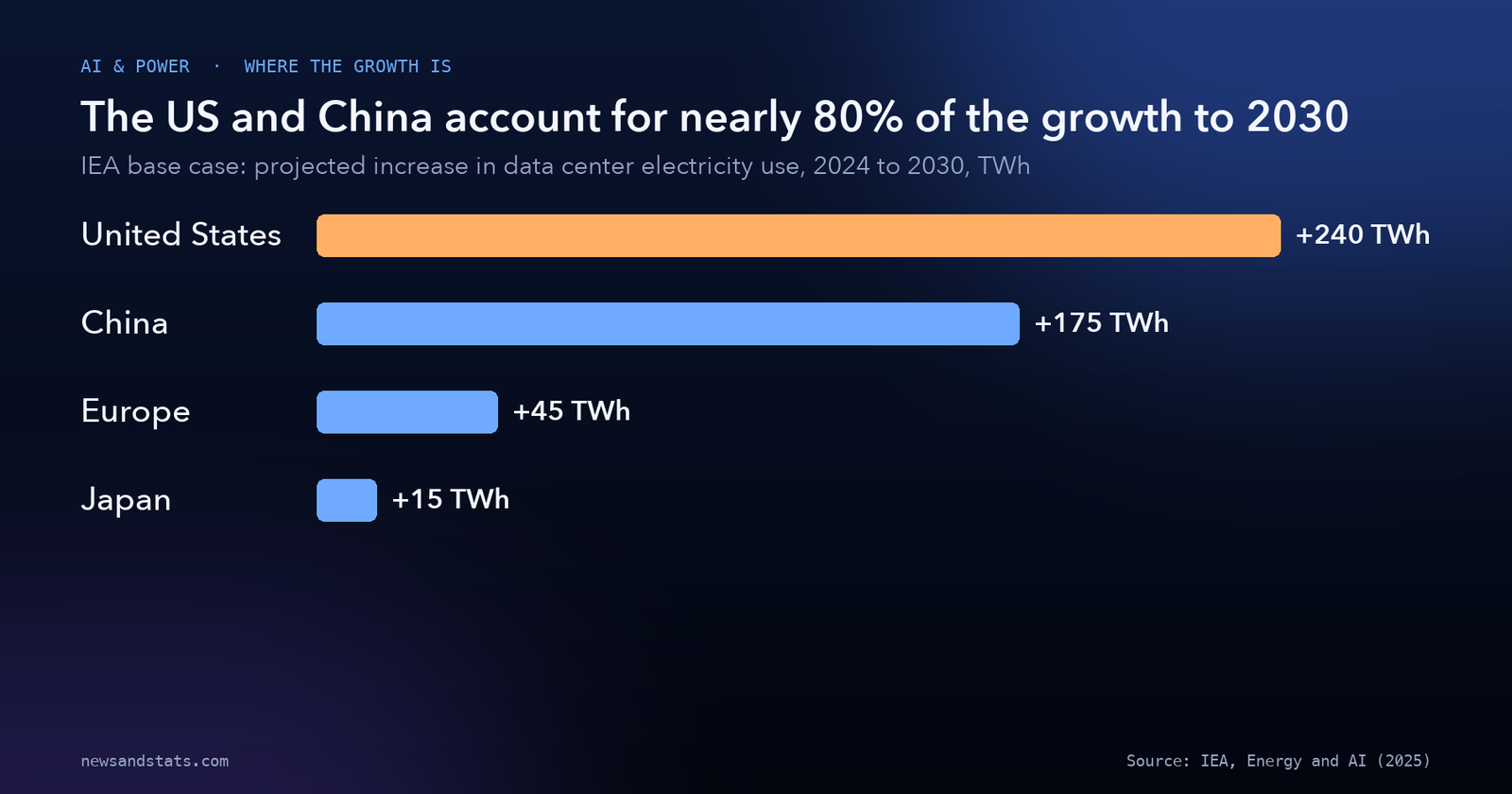
Source: IEA, Energy and AI, base case.
Our calculation: 240 plus 175 is 415 TWh. The total increase implied by the IEA’s 945 and 415 TWh figures is 530 TWh, so the United States and China account for about 78% of it, consistent with the agency’s “nearly 80%”.
For the United States, a second primary source gives the earlier history. A report by Lawrence Berkeley National Laboratory, summarized by the US Department of Energy in December 2024, found that data centers used about 4.4% of US electricity in 2023. Their consumption rose from 58 TWh in 2014 to 176 TWh in 2023, which by our calculation is about three times as much. The same report projects that data centers will use approximately 6.7% to 12% of US electricity by 2028.
4. Ireland: when data centers take a fifth of the grid
National averages hide how concentrated the load can be. Ireland’s Central Statistics Office (CSO) reports that data centers accounted for 5% of the country’s metered electricity consumption in 2015, 21% in 2023 and 22% in 2024.

Sources: Ireland CSO, US DOE summary of the Berkeley Lab report and IEA.
These figures are not strictly comparable with the global and US shares, because each source reports a different year and uses its own method. Even so, the gap is large. Our rough calculation: 22% is about 15 times the IEA’s global share of 1.5% and five times the 4.4% US share.
The UNECE task-force paper notes the policy response. It says Ireland has introduced connection restrictions in Dublin and links new data center connections to new generation capacity, and that the Netherlands has tightened planning decisions because of infrastructure and land constraints.
5. Two to five years versus more than a decade
The central timing problem is stated in a paper developed by the Task Force on Digitalization in Energy for the UNECE’s Committee on Sustainable Energy, as published by the UN Regional Information Centre (UNRIC) on 9 September 2026. It says large-load facilities such as data centers can be deployed within two to five years, while transmission networks often require more than a decade because of planning and permitting constraints. The IEA’s 2025 report gives a similar picture on the data center side: a facility can be operational in two to three years.
The US electricity market operator PJM shows what the load looks like on the ground. According to the US Energy Information Administration (EIA), PJM’s Dominion zone, which covers Virginia, serves the largest concentration of data centers in the world. The zone’s summer peak load was 23,905 MW in 2025, 23% higher than in 2019. Its winter peak was 25,413 MW in the 2025 to 2026 winter, 45% higher than in 2019 to 2020. PJM expects the Dominion zone to see the largest absolute increase in summer peak demand from 2026 through 2030, largely because of data center load.
PJM’s forecast for the whole system has also moved. It expects summer peak load to grow by an average of 5.4% a year over the next 10 years, a downward revision from the 6.3% a year in its 2025 forecast, according to the EIA’s 5 May 2026 article. The EIA does not give the data center share of that growth in MW, so neither do we.
6. Workarounds: on-site gas, and a chip bottleneck
When the grid cannot connect a data center quickly, developers look for other sources. The IEA’s 2026 update says US data center developers are pushing ahead with on-site gas-fired power because slow grid connections constrain them. It says around 15 to 27 GW of such capacity may be built by 2030, mostly in the United States, and that gas turbine orders rose 70% in 2025, a sign of supply-chain chokepoints. We covered gas and LNG prices in our post on the energy shock.
Power is not the only bottleneck. The IEA lists four groups of constraints on the AI buildout: energy supply chains and advanced chip manufacturing; grid connections and planning and permitting systems; capital, since data center investment has outgrown company balance sheets; and social acceptability, electricity prices and environmental concerns. It expects a shortage of high-bandwidth memory for AI chips to persist through at least the end of 2027. We explained why in our post on the DRAM shortage, and the capital point is the subject of our look at hyperscaler capital spending.
7. The nuclear pivot, in two announcements
Two deals announced in 2024 show technology companies contracting for nuclear power. Both are dated announcements, and this post does not verify their current progress.
| Deal | Announced | What the company said |
|---|---|---|
| Constellation and Microsoft | 20 September 2024 | A 20-year power purchase agreement to launch the Crane Clean Energy Center, a restart of a Pennsylvania nuclear plant of about 835 MW, expected to be online in 2028. Restart needs approval from the US Nuclear Regulatory Commission and state and local permits. |
| Google and Kairos Power | 14 October 2024 | An agreement with Kairos Power enabling up to 500 MW of new 24/7 carbon-free power from small modular reactors, with the first reactor aiming to come online by 2030 and more deployed through 2035. |
Sources: Constellation Energy announcement, Microsoft announcement and Google announcement.
Microsoft’s own post describes the Constellation project as the restart of an 835 MW nuclear facility in Pennsylvania that was retired in 2019. Constellation adds that it will pursue a license renewal to extend the plant’s operations to at least 2054.
8. Who pays, and what could go wrong
The UNECE task-force paper puts a price on the buildout. It forecasts data center capital expenditure growing from about $800 billion a year in 2026 to $1.8 trillion a year by 2050. Among its recommendations is to set clear cost-allocation rules to share grid expansion costs fairly among developers, infrastructure providers and consumers. For the companies’ side of the ledger, see our post on hyperscaler capital spending.
The paper also warns about stability. In systems with high shares of renewable generation, it says, AI data centers can have “disproportionate effects on voltage and frequency stability” because their demand can vary quickly. In extreme cases this can cause voltage oscillations, unintended disconnections and cascading failures. Its suggested remedies include better data transparency and standardized reporting, plus flexibility options such as demand response, load shifting, storage, on-site generation and waste heat recovery.
9. How to read these numbers
Five cautions follow from the sources.
- Projections are not outcomes. The 950 TWh figure is the IEA’s base case. The agency itself says near-term bottlenecks reduce the odds of more aggressive scenarios and that there is possible upside after 2030.
- Shares and levels tell different stories. Data centers are about 1.5% of global electricity use in the IEA’s 2024 estimate, but 22% of metered electricity in Ireland in 2024.
- Years and measures differ. The global share is for 2024, the US share for 2023 and the Irish share for 2024, and the sources differ in what they measure (the CSO reports metered electricity consumption, for example), so compare them as orders of magnitude only.
- Even the sources ask for better data. The UNECE task-force paper recommends standardized reporting on large loads. Our reading: a call for standardized reporting suggests the figures are not yet consistent across countries.
- A power-hungry load is not the same as a power-hungry query. The IEA’s 2026 update says energy use per AI query has declined massively, while more energy-intensive uses are becoming popular. The total depends on both.
What to watch
- Whether the IEA’s next update changes the central projection of about 950 TWh, or keeps it close to the 2025 trajectory as the 2026 update did.
- PJM’s summer peak forecast, which fell from 6.3% to 5.4% annual growth between its 2025 and 2026 forecasts, and the data center load in its Dominion zone.
- Whether the Constellation restart stays on the 2028 timeline the company announced, and whether Kairos Power’s first reactor meets the 2030 target Google cited.
- Whether Dublin’s connection restrictions change, and what Ireland’s statistics office reports for the next year’s data center share.
- Gas turbine orders and on-site gas projects, given the IEA’s 70% rise in orders in 2025.
- The high-bandwidth memory shortage the IEA expects to last through at least the end of 2027.
The bottom line
On the IEA’s numbers, data center electricity demand grew 17% to 485 TWh in 2025 and is projected to roughly double by 2030, with the United States and China accounting for nearly 80% of the growth. A UNECE task-force paper argues that the real constraint is timing: facilities can be deployed in two to five years, while the transmission that serves them often takes more than a decade. Ireland shows what a fifth of the grid looks like, and the PJM Dominion zone shows the same load building in the United States. Companies are responding with on-site gas and nuclear agreements, but the sources we could verify describe announcements and projections, not finished capacity. For more on the AI buildout, see our AI & Work section.
Related reading
- The $750 billion AI bet: who spends it, and who pays: the companies’ capital spending behind the buildout.
- Why memory chips got so expensive: the DRAM shortage in numbers: the chip bottleneck the IEA expects to last through 2027.
- Who pays for the 2026 energy shock? The numbers, country by country: fuel and gas prices in 2026.