
Public discourse regarding artificial intelligence and the future of work has long been polarized between apocalyptic warnings of structural mass unemployment and optimistic assertions that automation will painlessly liberate employees from routine chores. Neither narrative reflects the actual operational mechanics of corporate restructuring.
According to the comprehensive gartner ai jobs forecast 2030 presented on 10 November 2026 at the Gartner IT Symposium/Xpo in Barcelona, artificial intelligence will conclude the decade as a net job creator. The research firm projects that AI will drive a net increase of 1.7 million jobs worldwide by 2030, generating 10.6 million new roles while eliminating 8.9 million existing positions.
Yet the net positive headline conceals severe organizational disruption. In the research report, titled AI Won’t Cause a Jobs Apocalypse, but Will Unleash Job Chaos Through 2030, Gartner analysts reveal that outright job destruction represents only a fraction of the workforce impact. Through 2030, more than 20% of global workers—amounting to 435.5 million employees worldwide—will have their roles structurally transformed, requiring them to renegotiate what they do, how they execute tasks, and where their operational responsibilities end. Furthermore, corporate leadership is increasingly leaning on deferred hiring, choosing not to create 5.0 million planned positions by the end of the decade.
1. 10.6 million created versus 8.9 million lost: the decennial balance
Gartner’s decennial employment balance sheet indicates that artificial intelligence will generate 1.7 million more positions than it destroys globally by 2030. Between 2025 and 2030, worldwide technology adoption will create 10.6 million novel positions across technical integration, model supervision, automated quality control, and data engineering. Over the same timeline, 8.9 million roles will be eliminated as workflow automation absorbs routine clerical processing, basic document synthesis, and legacy administrative support.
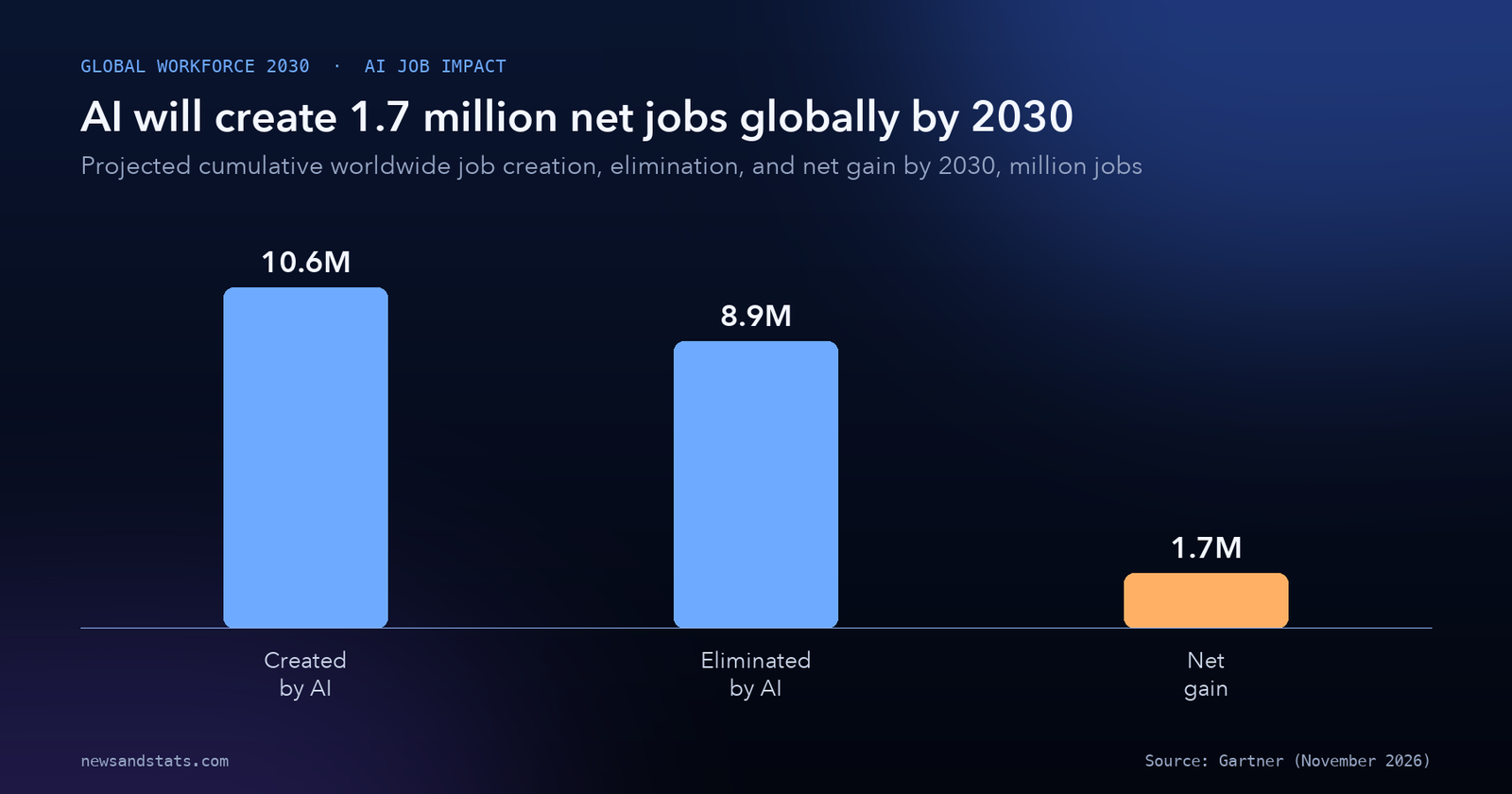
Source: Gartner, AI Won’t Cause a Jobs Apocalypse, but Will Unleash Job Chaos Through 2030, global employment forecast table.
However, this net expansion of 1.7 million positions represents an end-of-decade cumulative outcome, not the immediate operating reality of 2026. In the short term, the global labor market is experiencing an employment deficit. During 2026, global enterprises eliminated 2.2 million jobs directly attributed to AI automation, while creating only 1.6 million new AI-related roles. This produces a net single-year deficit of 600,000 active positions (my calculation), before workforce expansion in the late 2020s turns the cumulative balance positive.
Gartner Distinguished VP Analyst and Chief of Research John Lovelock explains that early automation deployments act as blunt substitutes for discrete clerical duties, generating immediate cost-cutting layoffs. Only when organizations re-engineer full end-to-end workflows does hiring accelerate for personnel capable of maintaining, governing, and optimizing autonomous agent architectures.
2. 435.5 million transformed: the scale of role mutation
While public anxiety concentrates on the 8.9 million workers facing permanent displacement, the far broader economic reality is the mutation of existing employment. Gartner projects that just over 20% of global workers—435.5 million employees worldwide—will remain in their positions while adapting to fundamentally altered job structures through 2030.
Dividing 435.5 million workers by 20% implies a global modeled employment base of approximately 2.18 billion formal workers (my calculation). For these hundreds of millions of employees, automation does not result in a pink slip. Instead, daily operational workflows are reconfigured around automated interfaces:
- Software developers spend less time manually writing boilerplate code and more time reviewing machine-generated diffs, managing context boundaries, and auditing security vulnerabilities.
- Paralegals transition from manual discovery reading to verifying semantic search citations and auditing automated contract redactions.
- Supply chain planners shift from compiling spreadsheet inventories to adjudicating exceptions flagged by predictive logistics models.
Speaking in Barcelona, Gartner Distinguished VP Analyst Helen Poitevin emphasized that high-performing organizations treat AI as an operational catalyst rather than a labor replacement tool:
“Organizations most advanced in AI execution view AI not as a replacement for labor, but as a catalyst to reinvent operations and rebalance workforce and technology capabilities to compete in changing markets. They ensure AI’s economic value goes beyond replacing labor.”
The primary workplace hazard for knowledge professionals is not sudden termination, but functional obsolescence within jobs that have evolved beyond manual execution.
3. The 0.4% to 1.8% boundary: why the apocalypse narrative fails
Sensationalist commentary routinely claims that generative artificial intelligence will render a quarter or a third of the global workforce unemployable. Gartner’s empirical baseline proves that the actual proportion of workers facing permanent technological displacement is tightly bounded.
Across the entire global economy through 2030, job losses directly attributable to artificial intelligence will impact between 0.4% and 1.8% of global workers.
Even under the most aggressive disruption scenario, over 98 out of every 100 workers will not lose their employment to an artificial intelligence model. The vast majority of global employment resides in physical infrastructure, manual trades, clinical patient care, agriculture, and heavily regulated human-facing services where direct algorithmic substitution is impractical or legally prohibited.
This empirical finding aligns with the structural methodology of the Generative AI Job Exposure index, which demonstrates that occupational exposure measures task overlap rather than complete job elimination. Because occupations consist of complex bundles of independent tasks, automating two or three discrete duties alters the workday without eliminating the underlying job position.
4. The 5-million deferred hiring shadow: the uncounted cost
While corporate downsizings capture news headlines, Gartner identifies a less visible but equally consequential workforce friction: deferred hiring.
Deferred hiring occurs when business and technology executives actively choose to postpone or cancel the creation of planned positions because automated software allows existing staff to absorb growing business volumes. John Lovelock defines the distinction:
“Deferred jobs are not the same as lost jobs. They simply aren’t created.”
In 2026 alone, business executives postponed the creation and recruitment of 1.3 million positions worldwide. Cumulatively through 2030, Gartner forecasts that 5.0 million workers will experience delayed hiring due to automated productivity buffers.
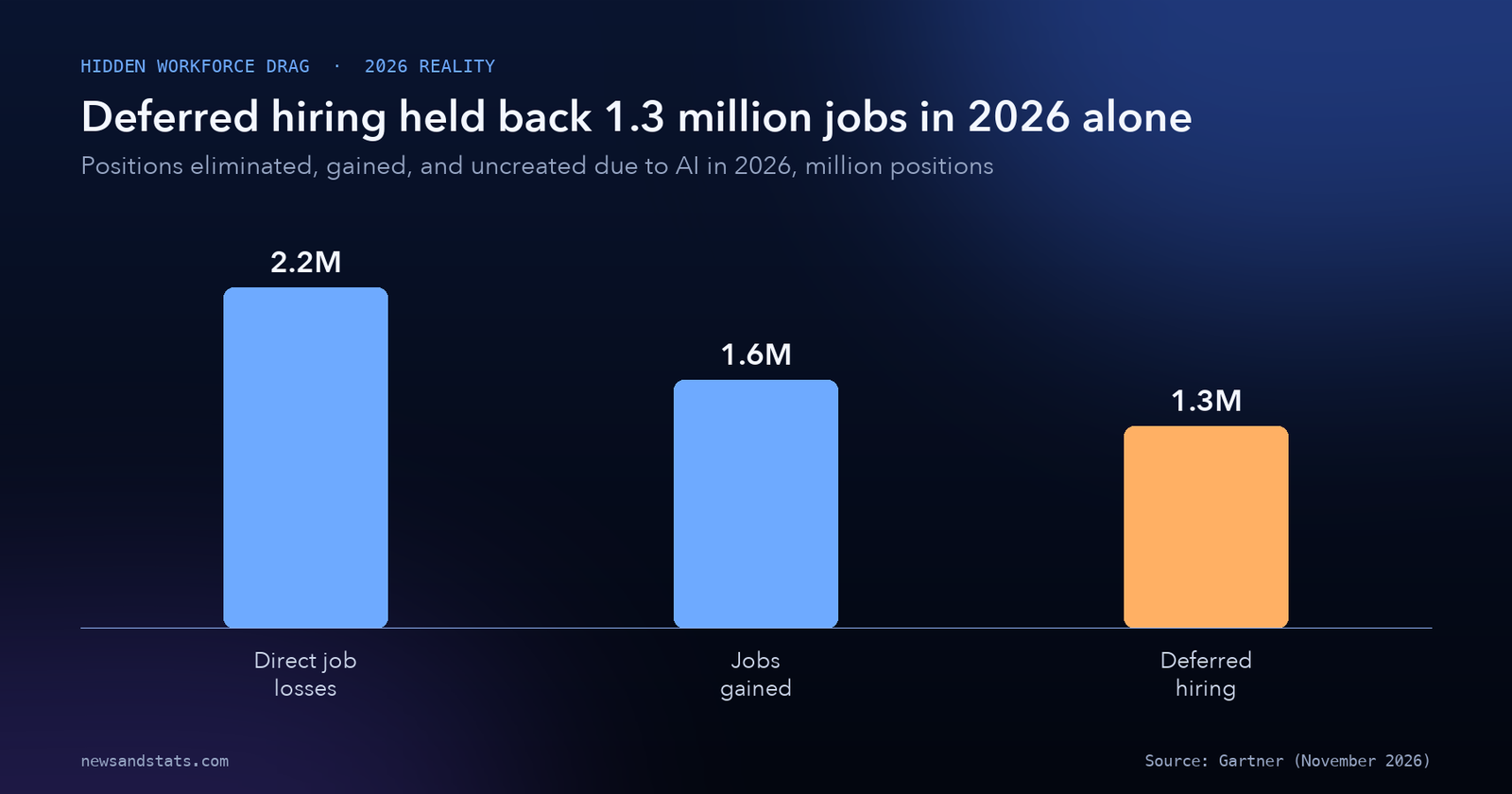
Source: Gartner, AI Won’t Cause a Jobs Apocalypse, but Will Unleash Job Chaos Through 2030, 2026 workforce impact metrics.
This silent hiring freeze concentrates heavily on junior professionals and recent university graduates. Historically, corporations expanded entry-level headcounts to process routine research, basic data aggregation, and preliminary draft drafting. Because generative tools execute these bounded tasks rapidly, organizations suppress entry-level requisitions without executing visible layoffs.
This mechanism directly corroborates research on entry-level employment and graduate hiring, where companies raise hiring standards for junior applicants, demanding immediate architectural competence while eliminating the traditional on-the-job training roles that once developed senior expertise.
5. Three industrial worlds: asset-intensive, public sector, and tech
The macroeconomic net gain of 1.7 million jobs is distributed unevenly across industrial sectors. Gartner segments the global economy into three distinct industry archetypes, each following a divergent employment trajectory:
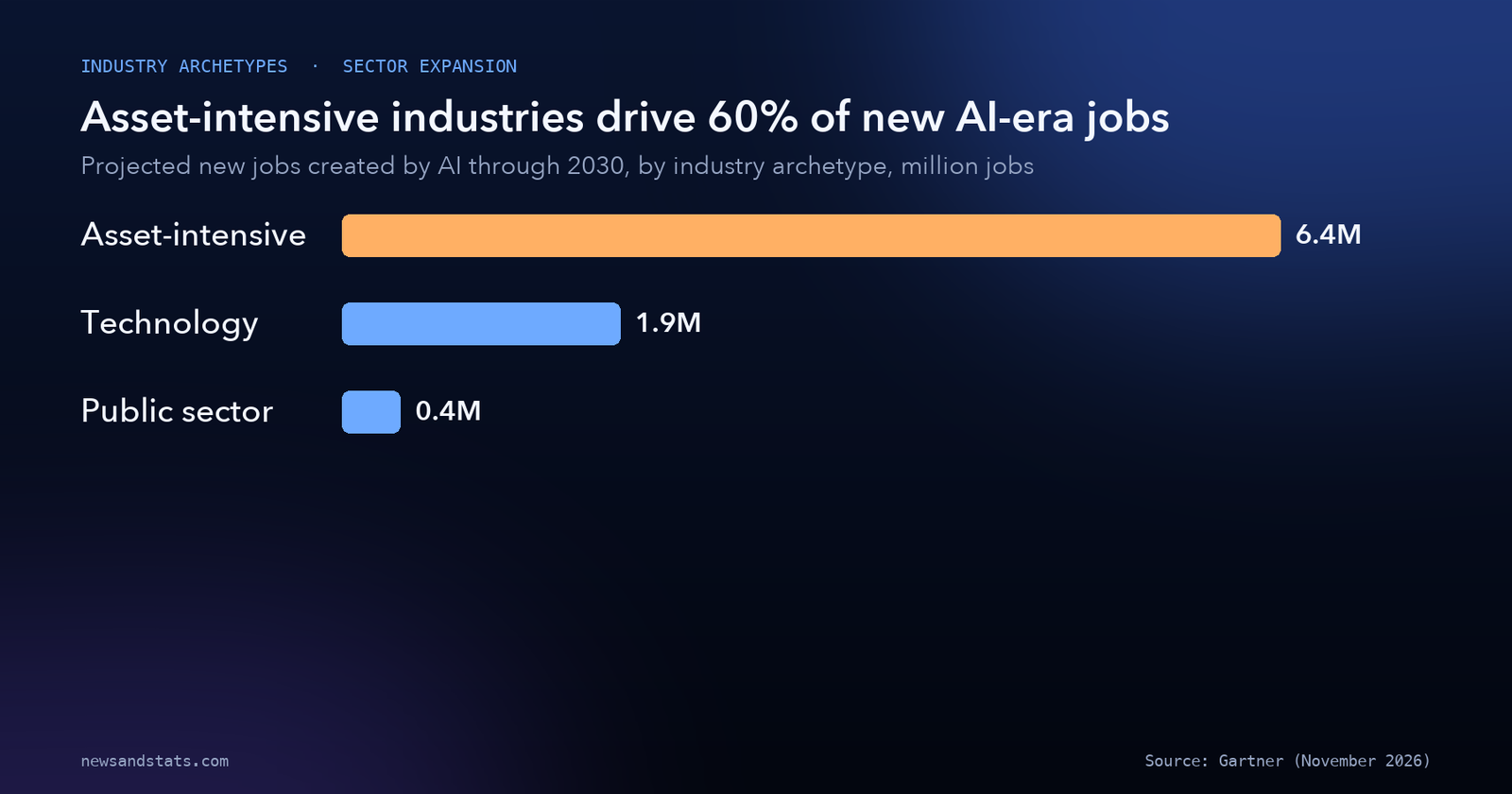
Source: Gartner, AI Won’t Cause a Jobs Apocalypse, but Will Unleash Job Chaos Through 2030, industry sector projections.
Asset-intensive industries: high volume, positive churn (+0.4M net)
Asset-intensive sectors—manufacturing, energy, utilities, transportation, and natural resources—account for the largest percentage of global physical employment. In these sectors:
- 6.4 million new jobs will be created by 2030.
- 6.0 million jobs will be eliminated.
- The net result is an expansion of 400,000 positions, with direct job losses impacting just 0.4% of the sector’s global workforce.
While automation replaces routine assembly inspection, manual telemetry logging, and document handling, it stimulates demand for industrial robotics technicians, predictive maintenance engineers, automated logistics managers, and edge-computing operators.
Public sector: structural skills deficits (-0.5M net)
Government agencies, public healthcare administrations, and municipal institutions face an adverse labor balance:
- 0.4 million new jobs will be created by 2030.
- 0.9 million jobs will be eliminated.
- The public sector suffers a net contraction of 500,000 positions, with job losses affecting 0.4% of public sector employees.
Gartner explicitly warns that public sector investments in artificial intelligence will not be sufficient to offset severe structural skills shortages caused by broader demographic aging and civil service wage constraints. Public agencies automate routine benefits intake and records administration to cope with budgetary pressure, but struggle to recruit the technical specialists needed to deploy advanced digital governance systems.
Technology sector: rapid restructuring and high net expansion (+1.5M net)
The technology industry represents the focal point of occupational disruption:
- Nearly 70% of the technology workforce exhibits high AI exposure, higher than any other sector.
- Technology experiences the highest rate of labor displacement, with 1.8% of global tech workers losing their roles to automation through 2030.
- Yet the sector generates 1.9 million new jobs while eliminating 400,000 positions, producing a substantial net gain of 1.5 million positions.
In the technology arena, AI does not extinguish engineering; it expands software complexity. The demand for machine learning infrastructure engineers, context window optimization specialists, and model security auditors far outstrips the volume of routine coding jobs automated away. This structural expansion reflects the dynamics observed in the global AI talent race, where compensation and cross-border recruitment for specialized technical architects remain highly competitive.
| Industry sector archetype | Jobs created by 2030 | Jobs lost by 2030 | Net job balance | Sector job loss rate | Primary operational driver |
|---|---|---|---|---|---|
| Asset-intensive industries | 6.4 million | 6.0 million | +0.4 million | 0.4% of workforce | Robotics, predictive maintenance, logistics |
| Public sector | 0.4 million | 0.9 million | -0.5 million | 0.4% of workforce | Budgetary automation, structural skills gap |
| Technology sector | 1.9 million | 0.4 million | +1.5 million | 1.8% of workforce | High AI exposure (70%), complex agent systems |
| Rest of global economy | 1.9 million | 1.6 million | +0.3 million | 0.4%–1.8% range | Professional services, finance, commerce |
| Total worldwide economy | 10.6 million | 8.9 million | +1.7 million | 0.4%–1.8% range | Comprehensive decennial transformation |
Source: Gartner, AI Won’t Cause a Jobs Apocalypse, but Will Unleash Job Chaos Through 2030.
6. Helen Poitevin’s warning: avoiding the cross-industry trap
A central strategic warning delivered by Gartner analyst Helen Poitevin concerns the risk of executive overgeneralization:
“AI job impacts are unevenly distributed across geographies, job functions and industries. The worst mistake that a business and IT executive can make is to apply lessons from one industry or role to another which can lead to poor errors in judgment and missed targets. Each industry faces unique challenges and risks that executive leaders must understand and address.”
When retail banking leadership applies workforce reduction metrics derived from software engineering firms, or when healthcare administrators attempt to automate patient intake based on logistics models, operational failures multiply.
As documented in our analysis of AI adoption across different firm sizes, organizational scale and technical maturity govern whether automation delivers operational efficiency or destructive administrative friction. Technology companies can absorb a 1.8% workforce displacement rate because their margins are elastic and their capital expenditure expands rapidly; public sector institutions losing 500,000 net positions risk severe service delivery bottlenecks.
7. How to read AI employment projections
Evaluating future-of-work forecasts requires isolating verified headcounts from speculative modeling:
- Gross displacements versus net changes: Sensationalist headlines frequently cite gross job losses (8.9 million) while omitting gross job creation (10.6 million). Net economic balance requires evaluating both flows simultaneously (+1.7 million).
- Role transformation versus role destruction: The 435.5 million workers whose roles mutate outnumber the 8.9 million workers displaced by a ratio of nearly 49 to 1 (my calculation). The dominant labor challenge is internal workflow retraining, not severance administration.
- The deferred hiring indicator: A decline in open job requisitions (1.3 million deferred in 2026; 5.0 million by 2030) suppresses youth employment opportunities without triggering headline unemployment claims.
- Sector variance: Blanket economy-wide assertions obscure industrial reality. The technology sector expands by 1.5 million net positions while government administration contracts by 500,000 net positions.
What to watch
- Graduate recruitment volumes in 2027: Watch whether corporate campus hiring rebounds or whether the 1.3 million deferred hiring drag expands into permanent structural youth underemployment.
- Corporate reskilling expenditure: Monitor whether enterprise training budgets expand to support the 435.5 million employees whose daily task mixes are mutating.
- Public sector service delivery stability: Track administrative wait times across municipal agencies and tax authorities as civil service headcount contracts by 500,000 net roles.
- The net employment inflection point: Observe whether global labor statistics transition from 2026’s immediate net deficit (-600,000 jobs) into positive annual territory by late 2027.
- Specialized AI role accreditation: Follow the emergence of standardized certifications for AI orchestration, prompt audit, and automated compliance management across asset-intensive industries.
The bottom line
Gartner’s 2030 employment model replaces speculative hysteria with empirical reality. Artificial intelligence will not cause a mass unemployment crisis; with 10.6 million jobs created against 8.9 million eliminated, the global economy will conclude the decade with 1.7 million more positions, while lifetime job displacement remains bounded between 0.4% and 1.8% of the global workforce. The true economic challenge is organizational churn: managing the structural transformation of 435.5 million mutating roles, addressing 5.0 million deferred hiring opportunities, and bridging a 500,000-job deficit in the public sector. For further analysis of economic trends, explore our AI & Work coverage.
Related reading
- Is AI hurting entry-level jobs? Two studies, two answers: the empirical data behind deferred hiring and graduate recruitment freezes.
- Generative AI Job Exposure in 8 Numbers: The ILO Global Workplace Index: task exposure methodologies and occupational vulnerability across advanced and emerging economies.
- The Global AI Talent Race in 8 Numbers: elite technical migration, research compensation, and the competition for senior architectural talent.