Most debates about artificial intelligence and the labor market rely on external surveys or multi-year forecasts. In October 2026, one of the world’s leading AI laboratories published its own internal payroll, commit, calendar, and hiring records to show what happens when AI agents saturate a company.
According to How employment is changing at Anthropic, published on 16 October 2026 by researchers Nathan Wilmers, Regina Catipon, Maxim Massenkoff, and Peter McCrory at The Anthropic Institute, the AI employment shift inside a frontier lab is neither a mass layoff nor business as usual. Anthropic tripled in total headcount over the preceding year, yet its hiring mix, daily workflows, and management priorities transformed rapidly.
At five years old, Anthropic generates 2 to 4 times as much revenue per employee as Meta and Google did at the same five-year mark after their foundings (in 2009 and 2003, respectively, deflated to 2025 dollars). Beneath that revenue efficiency lies a striking reallocation of labor: junior technical hires fell from 27% of new technical recruits to just 9%, while interactive AI agents scaled up to work 6 times as many hours as the human employees directing them.
1. Junior technical hiring falls from 27% to 9%
Even as Anthropic expanded rapidly in absolute headcount, demand for entry-level engineers and researchers cooled sharply once coding models improved.
Internal discussions about declining demand for junior technical staff emerged in core engineering teams in January 2026. Teams using Claude heavily found that routine code generation and bug hunting could be offloaded to models. By April 2026, engineering and research groups had formally deemphasized hiring for lower-band technical roles.
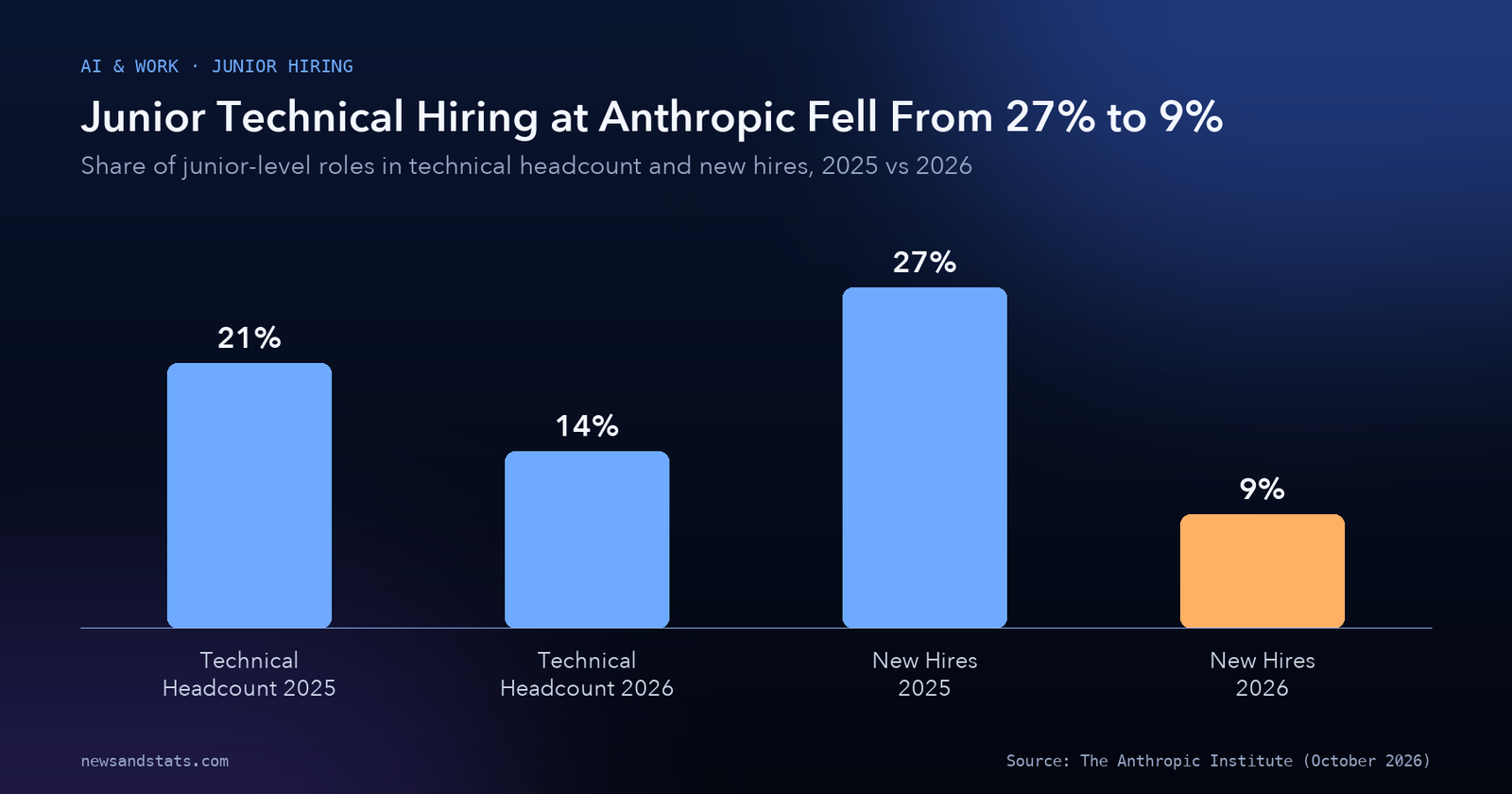
Source: The Anthropic Institute, How employment is changing at Anthropic, Figure 1: Decline of entry-level technical hiring at Anthropic.
The internal staffing data reveals three clear contractions:
- Junior technical headcount share: The proportion of junior-level employees inside technical departments slipped from 21% in early 2025 to 14% in 2026, a 7-percentage-point decline (my calculation).
- Junior share of new technical hires: The share of junior recruits among new technical hires dropped from 27% to 9%—an 18-percentage-point drop, or a threefold reduction (my calculation).
- Manager hiring pullback: In an April 2026 internal survey, roughly one-third (33%) of machine learning managers and one-fifth (20%) of software engineering managers reported hiring less because of AI capabilities.
These inside-the-firm figures add concrete organizational detail to macro studies on entry-level jobs in the wider US economy. At Anthropic, junior employment slowed most sharply in roles that used Claude for the highest-complexity tasks, suggesting that when senior engineers can delegate routine implementation to agents, they need fewer junior assistants to carry out foundational coding.
2. Non-technical staff build software as coding agents diffuse 45x
While technical departments slowed junior hiring, the boundary between technical and non-technical employees began to blur.
Over the year leading to October 2026, technical departments’ share of total company employment fell from 61% to 56%, a 5-percentage-point shift (my calculation). Technical hiring still grew in absolute numbers, but intensive hiring in sales, finance, and recruiting outpaced it.
At the same time, coding-focused AI agents spread rapidly to workers who had never committed code before:
- 45-fold jump in non-technical coding: Among non-technical employees with zero code commits at baseline, coding-focused AI agent sessions leapt from 2 per month in August 2025 to 90 per month in May 2026—a 45x increase (my calculation).
- Managers and non-coders ship code: Within technical departments, the share of staff making zero code commits in the prior 30 days fell by almost half (50%) through April 2026, while code commits from managers doubled (2x).
- Lean product management: The ratio of engineers to product managers widened to roughly 17 to 1, up from 2025 levels.
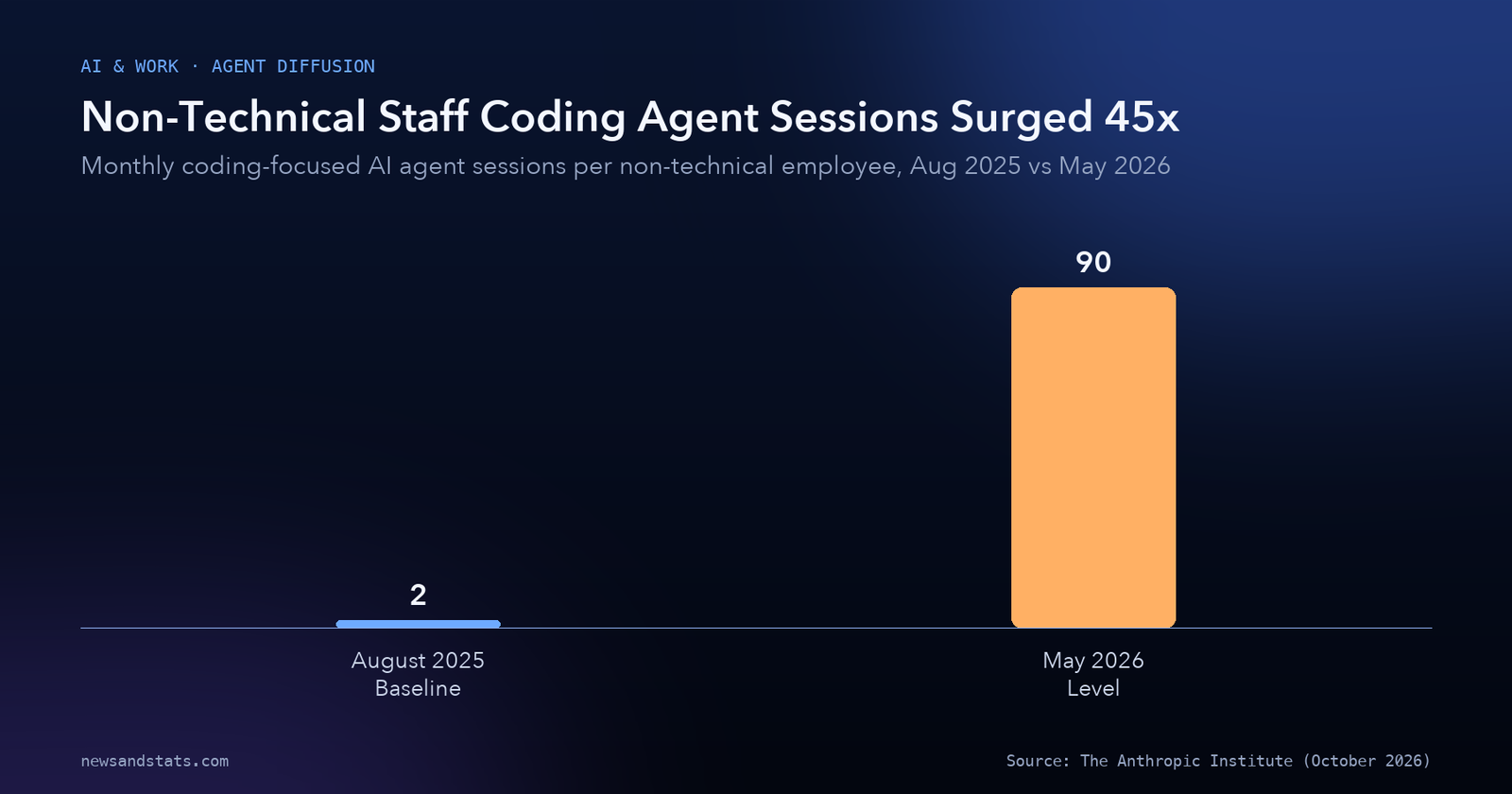
Source: The Anthropic Institute, How employment is changing at Anthropic, Labor demand at the frontier section.
This internal diffusion helps explain why the AI adoption gap by firm size matters so much for productivity. When a sales representative can build a custom pipeline dashboard in three to four hours, or a finance manager builds a purchase-request review agent, administrative headcount no longer needs to scale linearly with revenue. At Anthropic, employees with at least one year of tenure were 50% more likely each month in 2026 to transfer across departments than in 2025, reflecting rapid internal redeployment as automated tools absorbed clerical and routine content tasks.
3. Agent hours overtake humans 6 to 1
The most striking metric in the report tracks the balance of actual working hours between human staff and software agents.
Based on session telemetry counting active inference and tool use (while excluding idle waits longer than 30 minutes), total autonomous and interactive agent work hours surpassed total human work hours for the first time in March 2026. By August 2026, even when narrowing the count strictly to employee-directed interactive sessions and pooled subagents, AI agents worked 6 times as many hours as their human handlers, assuming a standard 40-hour human workweek.
| Operational metric | Baseline / earlier period | 2026 level | Measured shift |
|---|---|---|---|
| Junior share of technical headcount | 21% (early 2025) | 14% | -7 percentage points |
| Junior share of new technical hires | 27% (early 2025) | 9% | -18 percentage points |
| Technical share of total company staff | 61% (2025) | 56% | -5 percentage points |
| Non-technical coding agent sessions | 2 per month (Aug 2025) | 90 per month (May 2026) | 45x increase |
| Interactive agent vs human hours | Surpassed humans (Mar 2026) | 6x human hours (Aug 2026) | 6-to-1 ratio |
| Code commits per engineer | Baseline (6 months prior) | 5x velocity | 5x increase |
| Agent standing instruction files | A few hundred (Jul 2025) | 8,500 (Jul 2026) | Multi-fold expansion |
| Meta-work share of AI sessions | 10% (Fall 2025) | 22% (Spring 2026) | +12 percentage points |
| Median employee meeting time | Baseline (2025) | +20% (+16% for tech ICs) | Rising coordination |
Source: The Anthropic Institute, How employment is changing at Anthropic, October 2026.
This surge in agent execution aligns with GitHub’s 40% coding agent surge across public open-source repositories. Inside Anthropic, however, agents are not confined to code editors: they appeared in nearly half (50%) of active public Slack channels, participating in dedicated human-agent threads while leaving the underlying density of human-to-human Slack replies largely intact.
4. Code commits jump 5x without higher revert rates
Higher output from AI tools raises an obvious quality concern: does faster code generation simply flood repositories with buggy “AI slop”?
To test that risk, Anthropic researchers tracked 192 engineers who adopted coding agents and compared them against 74 engineers who did not adopt agents during the study window. Across the engineering organization, code commits per engineer climbed to 5x their velocity from six months earlier.
Crucially, when the researchers compared code written directly by a human engineer against code committed by that same engineer’s coding agent in the same month and directory, they found no difference in quality-proxy failure rates over the subsequent 90 days—measuring deleted lines, bug-fix deletions, explicit commit reverts, lint-suppression comments, and skipped tests.
Productivity gains extended well beyond software engineering:
- Sales execution: Account executives adopting Claude automations for email drafting and customer relationship management (CRM) logging reported replacing roughly 20% of prior routine tasks, while one representative said automation freed enough time to speak with 30% more customers.
- Harder problem tackling: Whenever Anthropic released a stronger internal model, engineers immediately pushed agents toward harder tasks. The share of sessions scoring above the 90th percentile of difficulty for the prior model jumped by roughly 30%, rising from 10% to 13% of all tasks.
- Work-process satisfaction: In late 2024, 44% of surveyed employees agreed that work processes made them as productive as possible; by November 2025, that share climbed to 58% (and 75% in April 2026, though the survey dropped the qualifier “as possible”).
These empirical within-firm gains mirror the workflow restructuring projected in Gartner’s 2030 jobs forecast. Workers are not sitting idle as agents automate routine execution; they are escalating the difficulty and volume of projects they take on.
5. The attention bottleneck: 80% idle time and rising meta-work
When software agents can generate code and text continuously, human attention becomes the scarcest resource in the building.
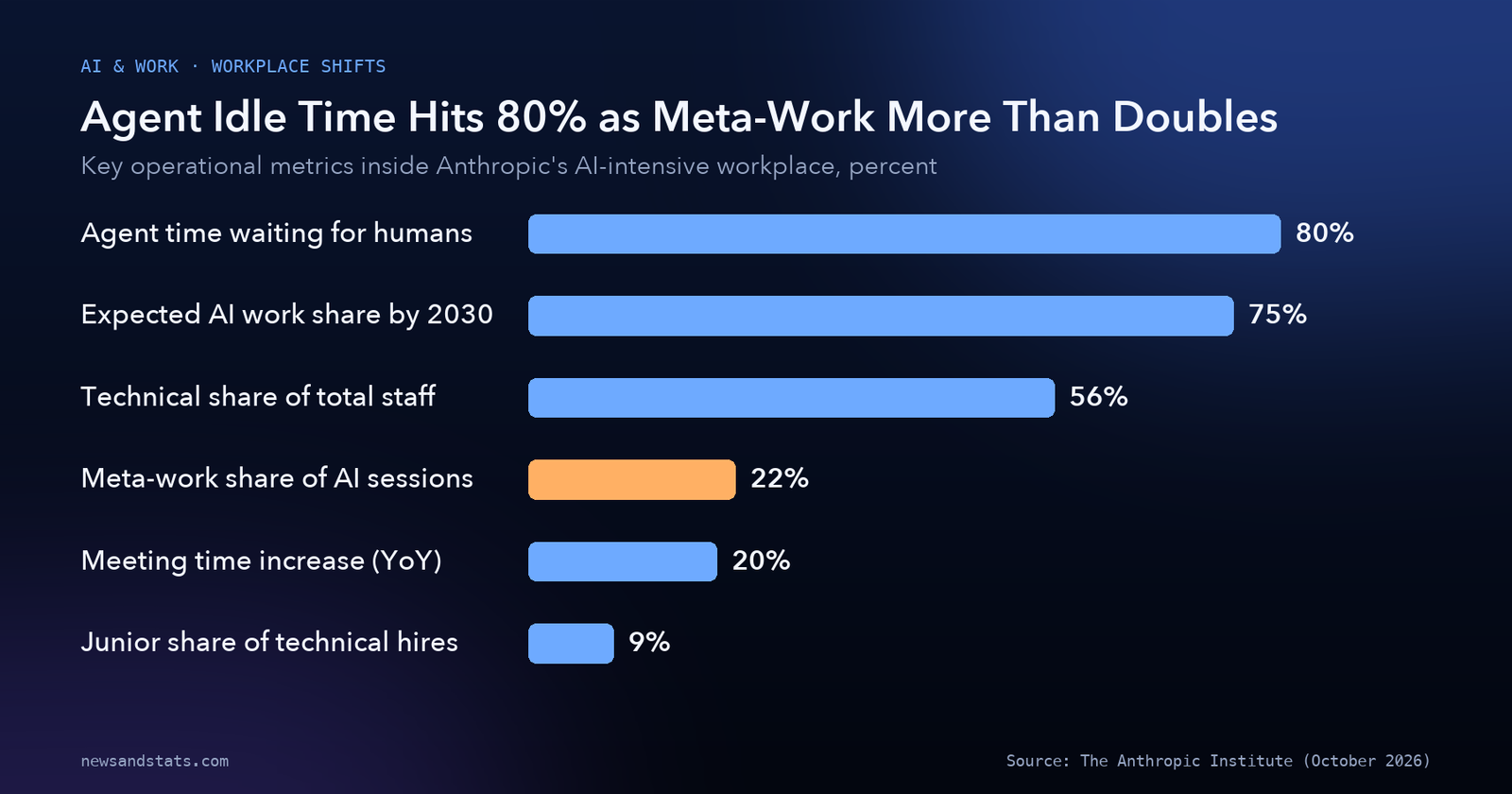
Anthropic’s telemetry shows that interactive Claude sessions spend roughly 80% of their wall-clock duration idly waiting for a human to review output, answer a question, or approve the next step. Converting output tokens into reading time (assuming 0.75 words per token and a reading speed of 250 words per minute) reveals that even for non-technical employees, reading all the text generated by their Claude sessions would consume more than half (over 50%) of a standard workweek.
Source: The Anthropic Institute, How employment is changing at Anthropic, Bottlenecks and process section.
To escape this attention bottleneck, employees shifted their labor toward “meta-work”—building dashboards, writing standing rules, and managing fleets of agents rather than doing object-level tasks directly:
- Meta-work more than doubled: Analyzing 2,000 session summaries showed that meta-work rose from 10% of the average employee’s interactive Claude sessions in fall 2025 to 22% in spring 2026—a 12-percentage-point jump, or a 2.2x increase (my calculation).
- Standing instructions exploded: Written standing instruction files guiding agent behavior grew from a few hundred in July 2025 to 8,500 by July 2026.
- Role transformation: In the April 2026 survey, 27% of respondents cited direct productivity gains from Claude, while 20% explicitly described their job shifting from doing the work to managing Claudes.
Yet managing agents did not eliminate human collaboration. Calendar records show the median employee spends 20% more time in meetings than a year earlier, and even technical individual contributors saw meeting time rise by 16%. Because unlogged decisions leave AI agents without context, employees face constant pressure to document choices in open channels while reserving synchronous meetings for governance, architectural debate, and cross-functional alignment—a split echoed in the ILO global workplace exposure index.
6. Hiring scorecards pivot from expertise to judgment
As agents absorbed technical execution, Anthropic’s hiring managers rewrote what they look for in human candidates.
Using an automated classifier across thousands of interview scorecards since 2024, researchers tracked how interviewer priorities evolved:
- AI tool fluency surged: In 2024, interviewers noted a candidate’s track record with AI tools in just 5% of technical assessments and 7% of non-technical assessments. By 2026, those rates had tripled for technical roles (to 15%, my calculation) and quadrupled for non-technical roles (to 28%, my calculation).
- Autonomy and judgment over domain depth: Among technical candidates, the sharpest increases in scorecard comments centered on autonomy and judgment, while mentions of narrow domain expertise declined as a share of evaluations.
- Mission over execution: Among non-technical candidates, customer and mission orientation rose while commentary on routine execution skills fell.
This shift in human valuation aligns with broader capital trends tracked in Stanford AI Index investment data. Even inside the lab building frontier models—where employees expect AI to handle 75% of their work by 2030, compared with 28% among other Americans—human judgment, accountability, and cross-team coordination remain the core premium skills.
What to watch
- Junior hiring pipelines outside AI labs: Monitor whether large software firms and consulting networks match Anthropic’s drop in junior technical hiring (27% to 9%) over 2027, creating a mid-level talent shortage later in the decade.
- Agent-to-human hour ratios: Track whether asynchronous, autonomous agent runs push total agent-to-human hour ratios well past 6-to-1 as human review interfaces improve.
- Attention-management tooling: Watch whether enterprise software vendors build standardized “agent chief of staff” dashboards to cut the 80% idle wait time in interactive sessions.
- Internal redeployment programs: Observe how major employers design early-warning metrics to reallocate clerical and entry-level staff internally rather than relying on external layoffs.
- Open-documentation workplace norms: Follow whether non-tech enterprises adopt Anthropic’s default-open Slack and decision-logging practices so autonomous agents have fresh context to act on.
The bottom line
Anthropic’s October 2026 internal audit offers the clearest empirical snapshot yet of an AI-saturated workplace. Rather than eliminating human staff—headcount tripled over the past year—AI agents multiplied output per engineer by 5x and lifted non-technical coding sessions 45-fold, while pushing agent working hours to 6 times human hours. The immediate casualty of that productivity wave is entry-level technical hiring, which fell from 27% of new technical recruits to 9%, while surviving roles shifted toward meeting-heavy coordination, meta-work, and high-level judgment. As human attention becomes the binding constraint, organizations that thrive will be those that redesign workflows around open context and clear accountability. For ongoing data-driven reporting on automation, skills, and labor markets, explore our AI & Work coverage.
Related reading
- Is AI hurting entry-level jobs? Two studies, two answers: macro US hiring and corporate spend evidence on junior workers in AI-exposed roles.
- AI Won’t Cause a Jobs Apocalypse, but Will Unleash Job Chaos: Inside Gartner’s 2030 Forecast: enterprise projections on job redesign, deferred hiring, and workforce transformation.
- GitHub Octoverse 2026 in 8 Numbers: The 225 Million Milestone and the 40% Agent Surge: public repository telemetry on coding agents and global developer growth.
- AI Adoption by Firm Size in 2026: The 21-Point Gap Behind Washington’s “Super Intelligence” Rename: Census Bureau data comparing small-business and large-enterprise AI deployment.