Unreliable electricity is not an occasional disruption for businesses in developing economies—it is a recurring tax on output, investment, and survival. Drawing on 292,581 firm interviews across 186 economies from the World Bank Enterprise Surveys (2005–2025), a World Bank study published on 20 November 2026 by economists Joshua Wimpey and Phoebe Ishak finds that 52% of all surveyed firms experienced power outages in the past fiscal year, and 47% describe electricity as an obstacle to their operations.
To cope, roughly 30% of all surveyed firms—and 42% of firms experiencing outages—own or share a backup generator. Yet across a panel of more than 18,000 establishments tracked over 39,000 observations, buying a generator turns out to be a costly partial hedge rather than a cure for power outages in developing economies: generator adopters post 31% higher sales and 16% higher employment, but still report no reduction in outage-related sales losses and become 4.7 percentage points more likely to cite electricity as an operational barrier, compounding the vulnerabilities tracked in our global extreme poverty coverage.
1. Regional concentration: 16.9 monthly outages in South Asia, 5.2% sales lost in Africa
Global averages obscure extreme regional concentration in grid reliability. Across all 186 surveyed economies, 52% of firms report power outages and 47% flag electricity as an operational obstacle. In Sub-Saharan Africa, however, 75% of firms report outages in the main text (74% in the regional comparison chart), averaging nearly 8 outages per month and costing an average of 5.2% of annual sales.
By contrast, in high-income OECD economies, just 27% of firms report outages, averaging 0.3 outages per month and losing only 0.2% of annual sales. On that sales-loss benchmark, Sub-Saharan African businesses bear a burden 26.0 times larger than their high-income OECD peers (my calculation)—more than 25 times the OECD cost, as the World Bank notes.
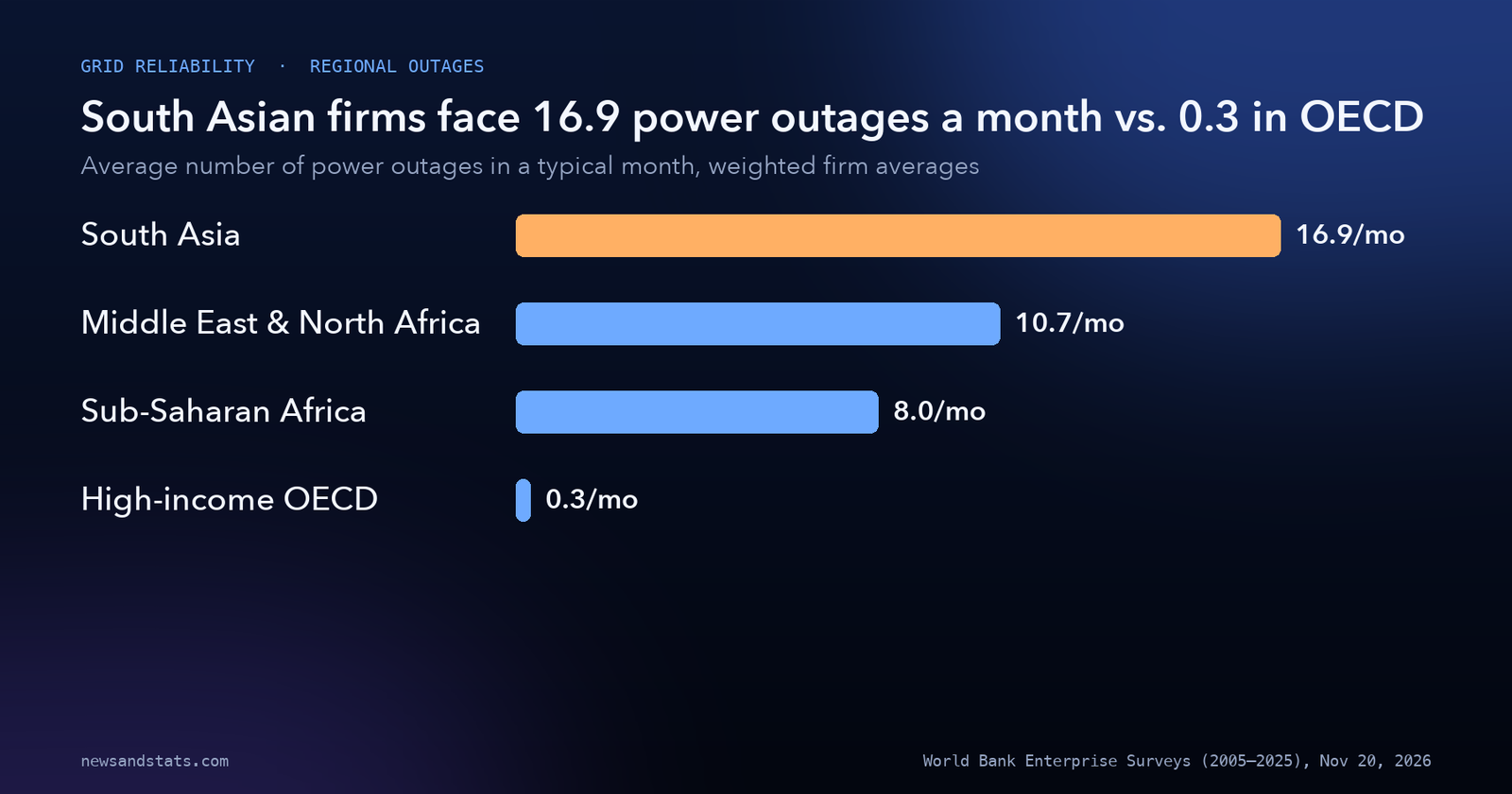
Source: World Bank Enterprise Surveys (2005–2025), Let’s Talk Development, 20 November 2026.
While Sub-Saharan Africa leads on outage incidence and annual revenue loss, South Asia and the Middle East and North Africa post the highest monthly outage frequencies. South Asia averages 16.9 power outages in a typical month—56.3 times the 0.3 monthly rate in high-income OECD economies (my calculation)—followed by the Middle East and North Africa at 10.7 outages per month.
| Electricity Reliability & Generator Metric | Value | Scope / Comparison |
|---|---|---|
| Firms experiencing power outages (global) | 52% | 292,581 interviews across 186 economies |
| Firms citing electricity as an obstacle (global) | 47% | World Bank Enterprise Surveys (2005–2025) |
| Sub-Saharan Africa outage incidence & sales loss | 75% (74% in chart); 5.2% of sales | ~8 outages/month |
| High-income OECD outage incidence & sales loss | 27%; 0.2% of sales | 0.3 outages/month |
| South Asia & MENA typical monthly outages | 16.9/mo (South Asia); 10.7/mo (MENA) | Highest monthly frequency globally |
| Global generator ownership (all vs. outage-hit) | 30% overall; 42% among outage-hit | Correlation 0.46 across 182 economies |
Source: World Bank, Power outages and generators: the cost to developing economies, 20 November 2026.
2. Parallel power systems: 30% overall ownership, 42% where outages hit
Across the global sample, roughly 30% of firms own or share a generator, rising to 42% among firms that experienced power outages. Among generator users, self-generation supplies about a fifth (20%) of total electricity consumption on average—and more than 70% for the top decile of users. In those markets, the generator is not an occasional emergency backup; it is a parallel power system running alongside elevated fuel costs analyzed in our 2026 energy shock reporting.
Across 182 economies with at least 50 surveyed firms, national generator ownership correlates positively with average monthly outages (correlation 0.46). Sub-Saharan African economies such as Nigeria, Chad, and Ghana combine frequent grid failures with generator ownership above 65%, alongside high-outage countries tracked in the World Bank scatter such as the Central African Republic, Comoros, the Democratic Republic of the Congo, Mali, Zambia, Afghanistan, Bangladesh, Nepal, Iraq, Yemen, and Papua New Guinea, whereas high-reliability grids such as Japan and Singapore show minimal generator use. For businesses operating without reliable public supply, power failures do not arrive as isolated emergencies; they arrive as a daily operational routine in which factory machines and refrigerators stop, digital payment terminals go dark, and the effective working day is quietly shortened, forcing firms to treat diesel self-generation as an ongoing operating cost rather than a one-time backup purchase.
3. What changes when a firm buys a generator: +31% sales, +12% productivity
To separate correlation from firm-level transitions, Wimpey and Ishak tracked more than 18,000 establishments across multiple survey waves (39,000 total observations), comparing firms that switched to owning a generator with firms that never owned one while controlling for firm and survey-wave fixed effects.
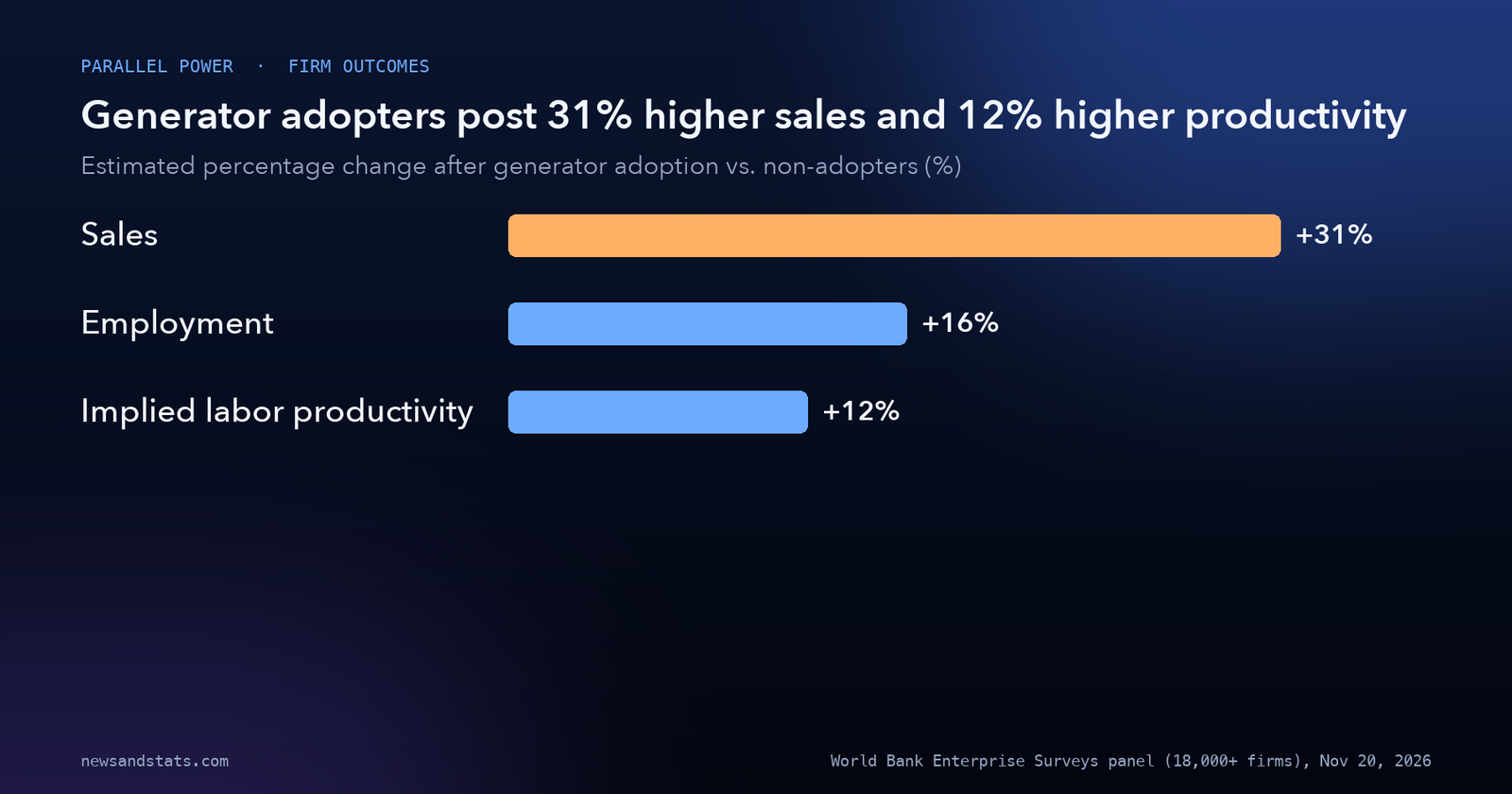
Source: World Bank Enterprise Surveys panel (18,000+ firms), 20 November 2026.
In the World Bank’s difference-in-differences estimates (with 95% confidence intervals excluding zero), generator adoption is associated with a +0.267 log-point gain in sales—about 31% higher sales relative to non-adopters—and a +0.149 log-point gain in employment, or about 16%. Together, those shifts imply labor productivity gains of about 12%. Adopters are also 5 percentage points (+0.050) more likely to invest in fixed assets, supporting the industrial upgrading dynamics tracked in our geoeconomics of development coverage, while firm exit between survey waves falls by 2.7 percentage points (-0.027) from a 3% base rate—an implied 90.0% relative reduction in exit rate (my calculation).
The authors emphasize two important caveats: firms must survive long enough to report adopting a generator (which mechanically lowers measured exit among adopters), and expanding firms are more prone to buy equipment—making these results strong associations rather than pure causal effects. More strikingly, buying a generator does not reduce reported sales losses from outages (+0.080 log points) and makes adopters 4.7 percentage points more likely to call electricity an obstacle, because fuel costs, switching delays, and the initial grid interruption still disrupt cold chains, continuous manufacturing, and digital payment systems.
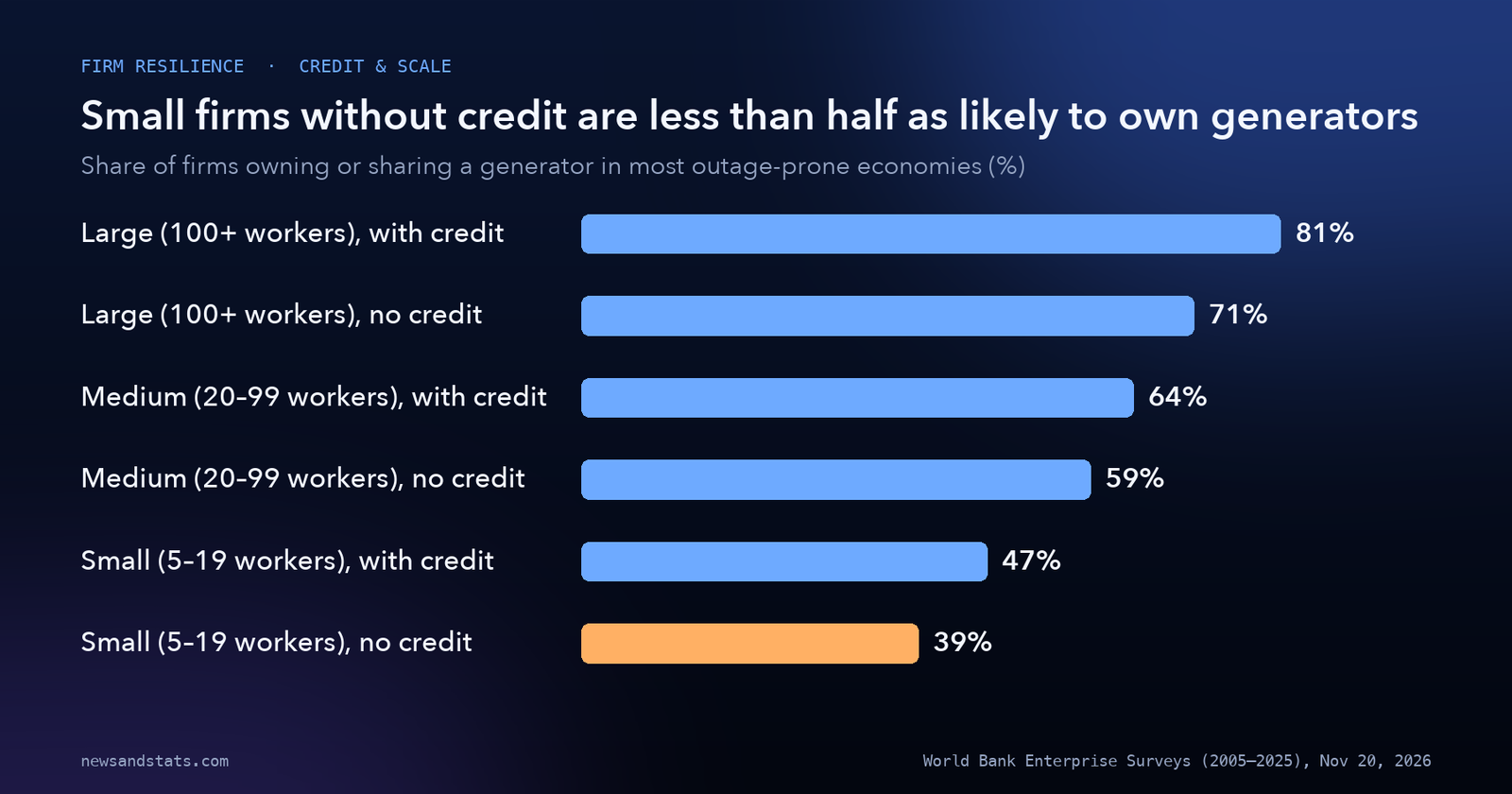
4. Size and credit barriers: 81% of large borrowers vs. 39% of small unbanked firms
Backup power is far from equally accessible across firm sizes. In the third of economies with the most frequent outages, 76% of large firms (100+ workers) own or share a generator, compared with 61% of medium firms (20–99 workers) and 41% of small firms (5–19 workers) in Figure 4 (40% in the text)—a 35-percentage-point gap between large and small firms (my calculation). In economies with fewer outages, generator ownership drops to 41% for large firms, 26% for medium firms, and 15% for small firms, a 26-percentage-point gap (my calculation).
Source: World Bank Enterprise Surveys (2005–2025), Let’s Talk Development, 20 November 2026.
Access to finance compounds that scale divide. Within the most outage-prone third of economies, firms holding a bank loan or line of credit own generators at higher rates across every size tier: 81% versus 71% among large firms (+10 percentage points, my calculation), 64% versus 59% among medium firms (+5 percentage points, my calculation), and 47% versus 39% among small firms (+8 percentage points, my calculation). Because a generator requires lumpy upfront capital plus ongoing diesel outlays, credit-constrained SMEs—often operating in low-income countries facing debt distress—are least able to self-insure against unreliable grids. As a result, credit constraints and infrastructure failures compound one another, allowing larger, banked firms to pull ahead while smaller, unbanked businesses fall behind.
5. How outage and generator data get misread—and what policy misses
High generator ownership is frequently mistaken for successful private-sector adaptation. As Wimpey and Ishak point out, widespread generator ownership instead measures the depth of public grid failure and represents a costly, carbon-intensive duplication of capital that utility grids were meant to supply. Across the 182 economies with at least 50 surveyed firms, the positive relationship between monthly outages and generator ownership (correlation 0.46) highlights a structural divide: economies with near-zero outages such as Japan and Singapore show minimal backup generation, whereas economies such as Nigeria, Chad, and Ghana combine frequent blackouts with generator ownership above 65%. Even as advanced economies wrestle with transmission queues for data center power demand, developing economies face a more basic reliability deficit where firms divert scarce working capital into diesel backup.
Second, self-reported sales losses from outages (+0.080 log points after adoption) can mislead policymakers if read in isolation. Because owning a generator makes managers more aware of outage costs—and because switching delays still interrupt sensitive machinery, cold chains, and payment terminals—reported outage losses persist even when generator-owning firms achieve 31% higher sales and 16% higher employment. In their policy recommendations, the World Bank authors argue that utility performance should be judged by delivered firm-level reliability rather than generation capacity targets alone, that banks and utilities should expand credit and non-diesel energy storage alternatives to help small firms cope, and that governments should track firm survival, employment, and fixed-asset investment rather than self-reported outage losses.
Third, the econometric specification matters when interpreting the panel findings. In the World Bank’s difference-in-differences model, sales, employment, and outage losses are measured in natural logarithms while fixed-asset investment and firm exit are measured as shares, with standard errors clustered by firm alongside firm and survey-wave fixed effects. Controlling for those unobserved firm traits isolates the transition into generator ownership, while still leaving open selection effects since firms must survive between survey waves and often buy generators during periods of business expansion.
What to watch
- Utility reliability metrics over capacity targets: Whether multilateral lenders and national regulators shift utility performance scorecards from installed megawatts to delivered firm-level uptime in South Asia (16.9 monthly outages) and Sub-Saharan Africa (75% outage incidence).
- SME clean-backup credit lines: Whether banks and utilities expand dedicated financing for commercial battery storage and solar-hybrid systems to close the 39% versus 81% generator-access gap between unbanked small firms and banked large firms.
- Cold-chain and continuous-manufacturing losses: Whether falling storage and inverter costs reduce switching-delay losses that diesel generators fail to eliminate.
- Enterprise Survey follow-ups: Whether post-2025 Enterprise Survey waves show declining 5.2% annual sales losses in Sub-Saharan Africa as regional grid investments come online.
The bottom line
World Bank Enterprise Survey data across 292,581 firm interviews in 186 economies shows that power outages in developing economies remain a heavy structural tax, costing Sub-Saharan African businesses 5.2% of annual sales—26 times the 0.2% loss in high-income OECD economies—and hitting South Asian firms 16.9 times a month. While buying a backup generator is associated with 31% higher sales, 16% higher employment, and 12% higher implied labor productivity, self-generation does not erase outage losses and remains concentrated among large, credit-connected firms (81%) compared with unbanked small firms (39%). Closing that gap requires reliable public grids, utility scorecards tied to delivered uptime rather than capacity targets alone, and targeted SME financing for clean backup storage rather than relying on diesel duplication.
Related reading
- Global Trade Outlook 2026: AI Beats the War: How global trade flows and energy-linked supply chains are adjusting in 2026.
- Who pays for the 2026 energy shock? The numbers, country by country: How 2026 fuel price spikes affect import-dependent businesses and households.
- The Geoeconomics of Development in 8 Numbers: Why Global Growth Splits in Two: Why capital investment and infrastructure access diverge across regions.
- Data Center Power Demand Is Set to Double by 2030. The Grid Is the Bottleneck.: How grid reliability and interconnection queues constrain growth at the other end of the power spectrum.