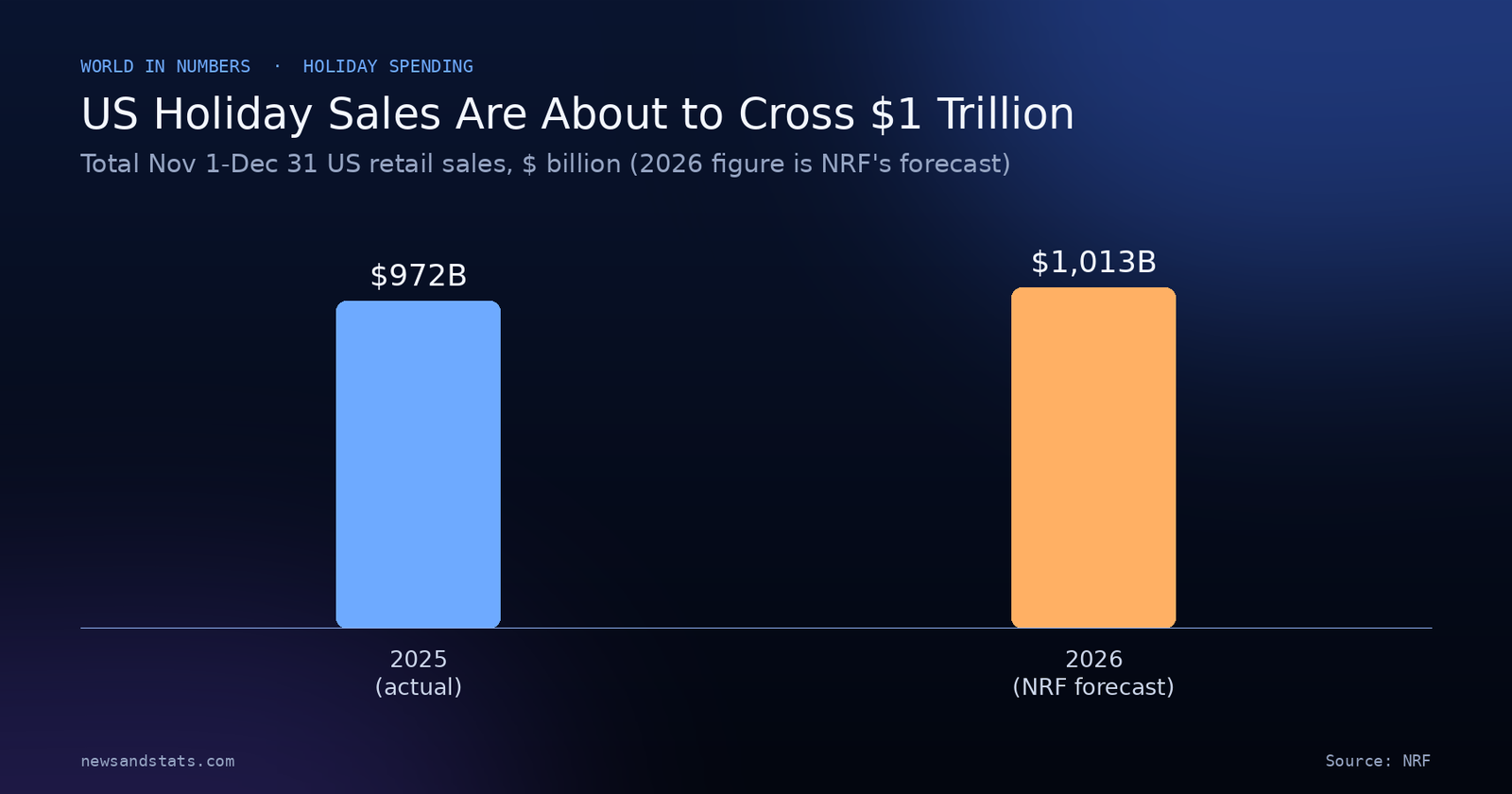
US 2026 holiday spending is forecast to cross $1 trillion for the first time, according to the National Retail Federation, which projects $1.013 trillion in November and December retail sales, up 4.2% from the $972 billion spent during the 2025 season. Separately, Adobe forecasts $275.1 billion of that spending will happen online, and Deloitte’s annual consumer survey finds shoppers expect to spend more even as most of them brace for higher prices. Together, the three reports describe a season where spending keeps climbing, inflation worries keep rising, and artificial intelligence is starting to show up in how people shop.
1. $1.013 Trillion: The Top-Line Number for 2026 Holiday Spending
The NRF’s 2026 holiday forecast, published 15 October 2026, projects that retail sales across November and December will reach $1.013 trillion, a 4.2% increase over 2025. That 2025 season itself rose 3.1% over 2024, to a total of $972 billion. NRF’s definition excludes car dealers, gas stations and restaurants, and the forecast comes from modeling consumer spending, disposable income, employment, wages, inflation and recent monthly retail sales data.
NRF President and CEO Matthew Shay said the forecast “reflects our confidence that consumers will prioritize the holiday season even as they remain mindful of their budgets,” adding that retailers “are prepared to meet that demand with competitive prices, value and choices for every budget.” NRF Chief Economist Mark Mathews struck a similar note, saying the industry heads into the season “with strong spending momentum, as consumers remain the bright spot in the economy,” while cautioning that inflation and rising gas prices “will affect consumers differently across income groups.”
That caution has a backdrop: our own coverage of rising world commodity prices and the IMF’s October 2026 world economic outlook describes a global economy growing unevenly as energy costs and trade tensions weigh on households. Against that backdrop, a 4.2% nominal increase in holiday spending is a bet that American shoppers keep spending through persistent price pressure, not a sign that the pressure itself has eased.
2. Online Spending Alone Will Hit $275.1 Billion
Adobe’s holiday forecast, published 28 September 2026 and built from Adobe Analytics’ tracking of more than 1 trillion visits to US retail sites across 100 million SKUs and 18 product categories, projects $275.1 billion in US online sales between 1 November and 31 December 2026, up 6.7% from 2025.
Within that total, Cyber Week — the five days from Thanksgiving through Cyber Monday — is forecast to bring in $47.5 billion, up 7.4% year over year and equal to 17.3% of the entire season’s online spending. That one five-day stretch is on track to account for close to a fifth of two full months of online holiday sales. Online spending does not simply add onto NRF’s broader total; it is a separate measurement from a separate organization, tracking a narrower, online-only slice of the same season, so the two figures describe overlapping but not identical ground.
3. The Three Biggest Shopping Days, by the Numbers
| Day | 2026 forecast online spend | YoY growth |
|---|---|---|
| Thanksgiving Day | $6.9 billion | +8.5% |
| Black Friday | $12.9 billion | +9.2% |
| Cyber Monday | $15.1 billion | +6.2% |
Source: Adobe Analytics, 2026 holiday shopping forecast, day-by-day projections.
Adobe still expects Cyber Monday to be the single biggest online shopping day of the year, at a forecast $15.1 billion. But Black Friday is forecast to grow faster, at 9.2% versus Cyber Monday’s 6.2%, continuing a trend that has been narrowing the gap between the two days. Thanksgiving Day itself, once a quiet lead-in to the weekend, is forecast to bring in $6.9 billion, up 8.5% — the second-fastest growth rate of the three days.
Source: NRF, 2026 holiday sales forecast, press release.
4. Where the Online Dollars Go: Category by Category
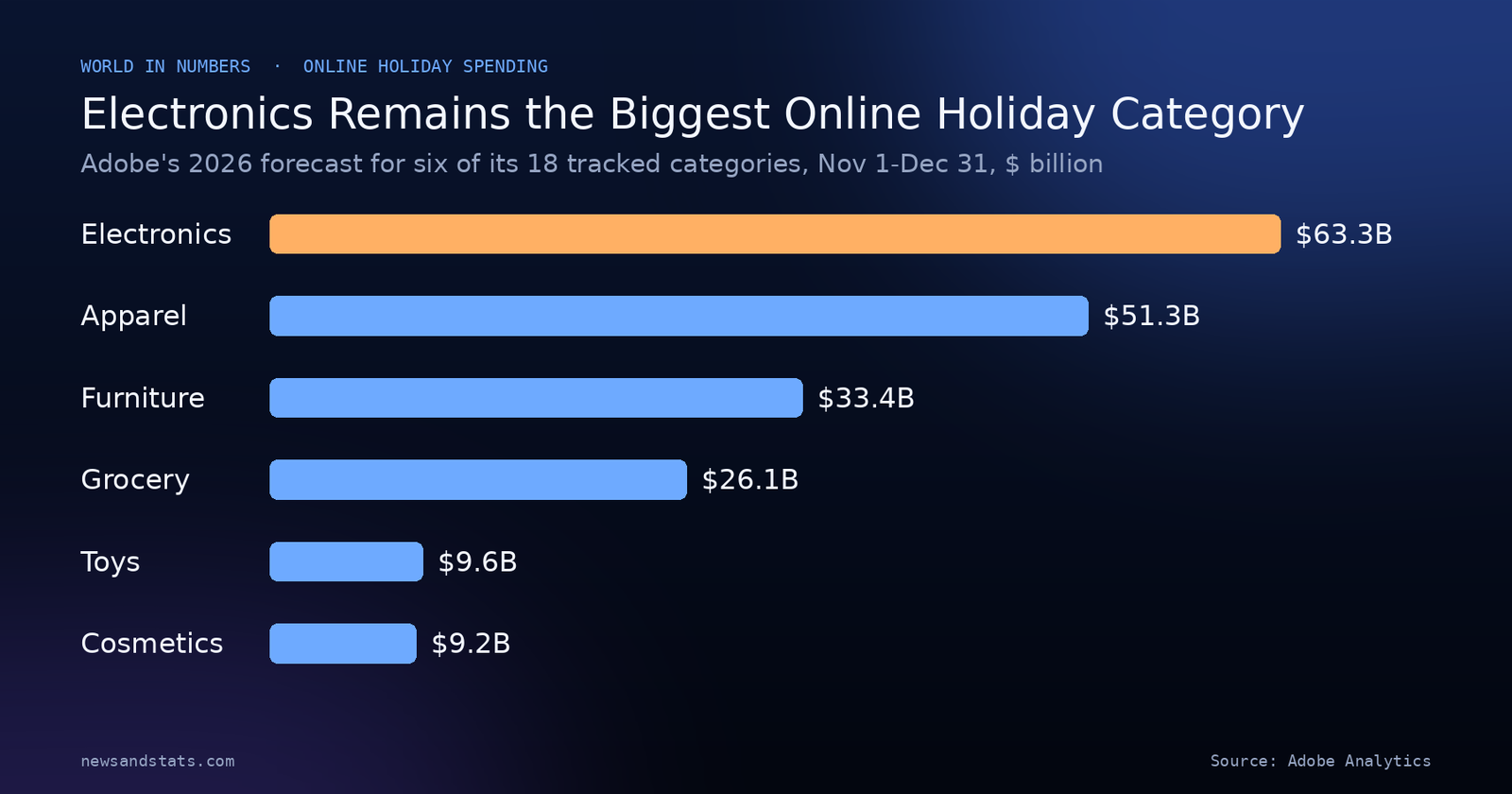
Of the 18 categories Adobe tracks, six published forecasts show electronics remaining the single biggest online category at $63.3 billion, up 5.9% year over year, followed by apparel at $51.3 billion (up 4.7%), furniture at $33.4 billion (up 7.3%), grocery at $26.1 billion (up 10.3%), toys at $9.6 billion (up 9.6%) and cosmetics at $9.2 billion (up 9.5%). Electronics and apparel together account for about 41.7% of the entire $275.1 billion online total (my calculation).
Grocery’s 10.3% growth rate is the fastest of the six, a sign that routine, repeat purchases are shifting online even during a season usually associated with gifts rather than groceries. Electronics, meanwhile, remains the single biggest category even against the backdrop of our own coverage of memory-chip shortages and falling smartphone shipments elsewhere in the same supply chain.
Source: Adobe Analytics, 2026 holiday shopping forecast, category-level projections.
5. Discounts Barely Move Even as Shoppers Expect Higher Prices
| Category | 2026 peak discount | 2025 peak discount |
|---|---|---|
| Electronics | 30% | 30.1% |
| Toys | 29% | 28% |
| TVs | 23% | 24.2% |
| Computers | 23% | 22.8% |
| Apparel | 23% | 23.2% |
| Sporting goods | 19% | 19.5% |
| Appliances | 18% | 19.2% |
| Furniture | 18% | 19% |
Source: Adobe Analytics, 2026 holiday shopping forecast, discount-depth projections.
Adobe’s forecast discounts for 2026 are, category by category, almost identical to 2025’s. Across Cyber Week, the season’s maximum discount is forecast at up to 30% off list price, with smaller windows of up to 14% in early November and up to 21% just ahead of Thanksgiving. That flatness matters next to a separate finding from Deloitte’s 41st annual holiday retail survey, fielded among 4,000 US consumers in late August and early September 2026: 79% of respondents expect prices to be higher than last year, up from 77% in 2025 and 69% in 2024. Retailers are not forecasting deeper discounts to offset that expectation — shoppers are simply being asked to spend more into prices they already believe are rising.
6. Phones, Not Desktops, Are the Default Checkout
Mobile devices are forecast to account for 57.4% of all online holiday spending this season, up from 56.4% in 2025, and the mobile share climbs even higher on Thanksgiving Day itself, to a record 63% (from 61.6% in 2025). Buy now, pay later financing is forecast to carry $21.3 billion of November-December spending, up 6.6% year over year — about 7.7% of the entire online total (my calculation) — and 82% of that buy-now-pay-later spending is expected to happen on mobile. On Cyber Monday alone, Adobe forecasts $1.09 billion in buy-now-pay-later spending; on Black Friday, $807 million.
7. AI Is Quietly Becoming Part of the Shopping Trip
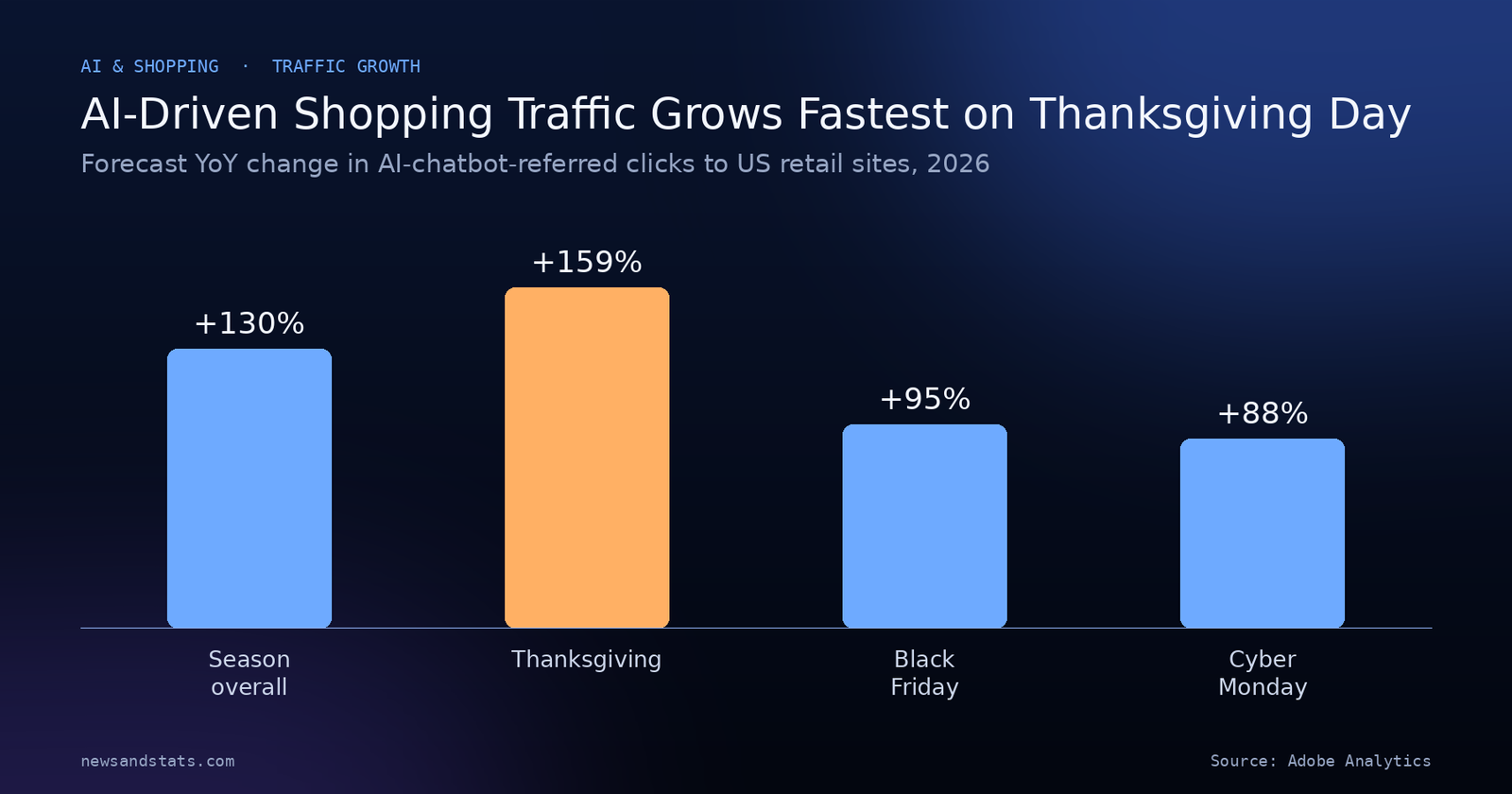
Adobe forecasts that clicks reaching US retail sites from AI chatbots and assistants will rise 130% year over year this season, with the growth even sharper on individual days: up 159% on Thanksgiving, 95% on Black Friday and 88% on Cyber Monday. In a separate Adobe survey of 5,000 consumers fielded in July 2026, 77% of people who use AI tools while shopping said the tools make them feel more confident in their purchases, and 69% said they are less likely to return what they buy as a result.
Deloitte’s survey finds a more cautious consumer underneath that traffic growth: generative AI is the primary tool for at least one holiday shopping task for 39% of respondents, but only 16% say they would let an AI tool complete a purchase on its own. That traffic growth is arriving alongside a broader AI investment wave and a fast-moving chip industry, each covered in more depth in our own reporting on the Stanford AI Index 2026 and global semiconductor sales. Retail is a small piece of that wider AI boom, but the traffic numbers suggest it is a real one, even if most shoppers still want a human-sized say in the final purchase.
Source: Adobe Analytics, 2026 holiday shopping forecast, AI traffic projections.
8. Who’s Actually Spending: Gen Z and Millennials Claim Half the Wallet
Deloitte’s survey puts average expected 2026 holiday spending per respondent at $1,654, up 4% from $1,595 in 2025 (2024: $1,778). That splits into $988 for retail goods — gifts, hosting, clothes, décor — up 10% year over year, and $666 for holiday activities such as travel, events and hosting at home, down 4% year over year. Spending power is sharply uneven: respondents with household income under $50,000 plan to spend $693 on average, while those with income of $200,000 or more plan to spend $3,607 — more than five times as much (my calculation).
The generational story is the headline, even without a full breakdown: for the first time in Deloitte’s survey history, Gen Z and millennial respondents together are expected to account for 50% of total 2026 holiday spending, with both groups planning double-digit percentage increases over last year. Other findings point to a season shaped as much by mood as by budget: 50% of respondents plan to give an experience as a gift, up from 47% in 2025 and 39% in 2024; 33% plan to give cash, up from 29%; and 33% plan to buy themselves something, spending an average of $299 on self-gifts, up 13% year over year.
9. Online Edges Out In-Store, and Retailers Hire Cautiously
Deloitte’s respondents plan to put 55% of their retail-goods budget online and 45% in-store, working out to an average $548 online and $440 in-store, both up from 2025’s $508 and $394. Price and value rank as the top reason shoppers choose a particular retailer, ahead of convenience and the product itself, and the average shopper still plans to visit four physical stores this season, unchanged from 2025.
Retailers are not betting as heavily on that momentum when it comes to staffing. NRF expects retailers to hire between 325,000 and 375,000 seasonal workers this year, against an estimated 356,000 last year — a range that, at its low end, would be one of the smaller seasonal hiring pushes in years. NRF attributes the caution to higher gas prices, persistent inflation, higher interest rates and elevated consumer debt, the same pressures that show up in Deloitte’s finding that 28% of shoppers expect to exhaust their holiday budget by the end of October, the highest share in six years (24% in 2025). Spending is still forecast to rise. The workforce built to handle it is not rising with it.
What to watch
- Whether NRF’s final tally, usually published in January, confirms the $1.013 trillion estimate or lands below the 4.2% growth rate as cautious consumers pull back.
- Whether Adobe’s live Cyber Week data confirms Cyber Monday’s forecast $15.1 billion as the season’s single biggest day, or whether Black Friday’s faster growth rate closes the gap.
- Whether seasonal hiring lands within NRF’s 325,000-to-375,000 range, or finishes nearer the bottom, an early signal of retailer caution.
- Whether the forecast 130% jump in AI-chatbot-referred shopping traffic holds up once Adobe reports final Cyber Week numbers in December.
- Whether grocery’s forecast 10.3% online growth, the fastest of the six categories cited here, continues into December as a sign that routine spending keeps moving online.
The bottom line
Three independent forecasters — NRF, Adobe and Deloitte — all expect 2026 to be the biggest US holiday shopping season on record, with total retail spending forecast to cross $1 trillion for the first time and online spending alone forecast at $275.1 billion. None of that growth comes from falling prices: discounts are barely moving, most shoppers expect prices to rise, and spending power is concentrated at the top of the income scale. The season’s one clearly new feature is artificial intelligence, which is forecast to drive far more traffic to retail sites even though most shoppers still will not let it finish the purchase.
Related reading
- Why memory chips got so expensive: the DRAM shortage in numbers: electronics are the single biggest online holiday category, even as this memory shortage pushes component costs higher.
- Global Smartphone Shipments Fall 22% in Record Q3 Decline: a supply-side squeeze on one of the same electronics categories driving holiday spending.
- Stanford AI Index 2026 in 8 Numbers: The $344.7 Billion Surge and the Shrinking US Lead: the broader AI investment wave behind this season’s AI-driven shopping traffic.
- Global Commodity Prices in 8 Numbers: The World Bank’s 23% Surge and Energy Shock Spillover: the inflation backdrop against which holiday shoppers are budgeting.