The world’s foundational industrial commodity is experiencing a stark geographical decoupling.
According to the official global steel demand forecast published by the World Steel Association (worldsteel) on 12 October 2026 in New Delhi, worldwide apparent steel use will remain essentially unchanged in 2026 at 1,722 million metric tonnes (Mt). This represents a zero-growth plateau (0.0%) compared to 2025, before demand is projected to rebound by 1.7% in 2027 to reach 1,752 Mt.
Yet this headline stagnation masks a historic divergence between the world’s two largest Asian economies. In China, which still consumes over half the world’s steel, demand is projected to contract by 2.0% in 2026, dragged down by an unyielding residential property crisis and local government infrastructure retrenchment. Conversely, outside China, global steel demand is expanding by 1.5% in 2026 and is forecast to accelerate to 4.0% in 2027.
Leading this charge is India, where steel consumption is expanding by 7.9% in 2026 to reach 172.4 Mt, followed by another 8.0% surge in 2027 to 186.2 Mt. Subtracting China’s 2.0% contraction from India’s 7.9% growth rate reveals a massive 9.9-percentage-point expansion spread between the two Asian giants (my calculation). The center of gravity in global metallurgy is undergoing its most significant structural realignment in a generation.
1. The 1,722 Mt plateau: why global steel stalled in 2026
The revision of global steel forecasts between April and October 2026 tells the story of an uneven industrial recovery.
In its April 2026 outlook, worldsteel anticipated modest global demand growth of 0.3% for 2026 and 2.2% for 2027. By October, the Economics Committee revised the 2026 outlook down to flatline at 1,722 Mt, while trimming 2027 growth to 1.7% (1,752 Mt).
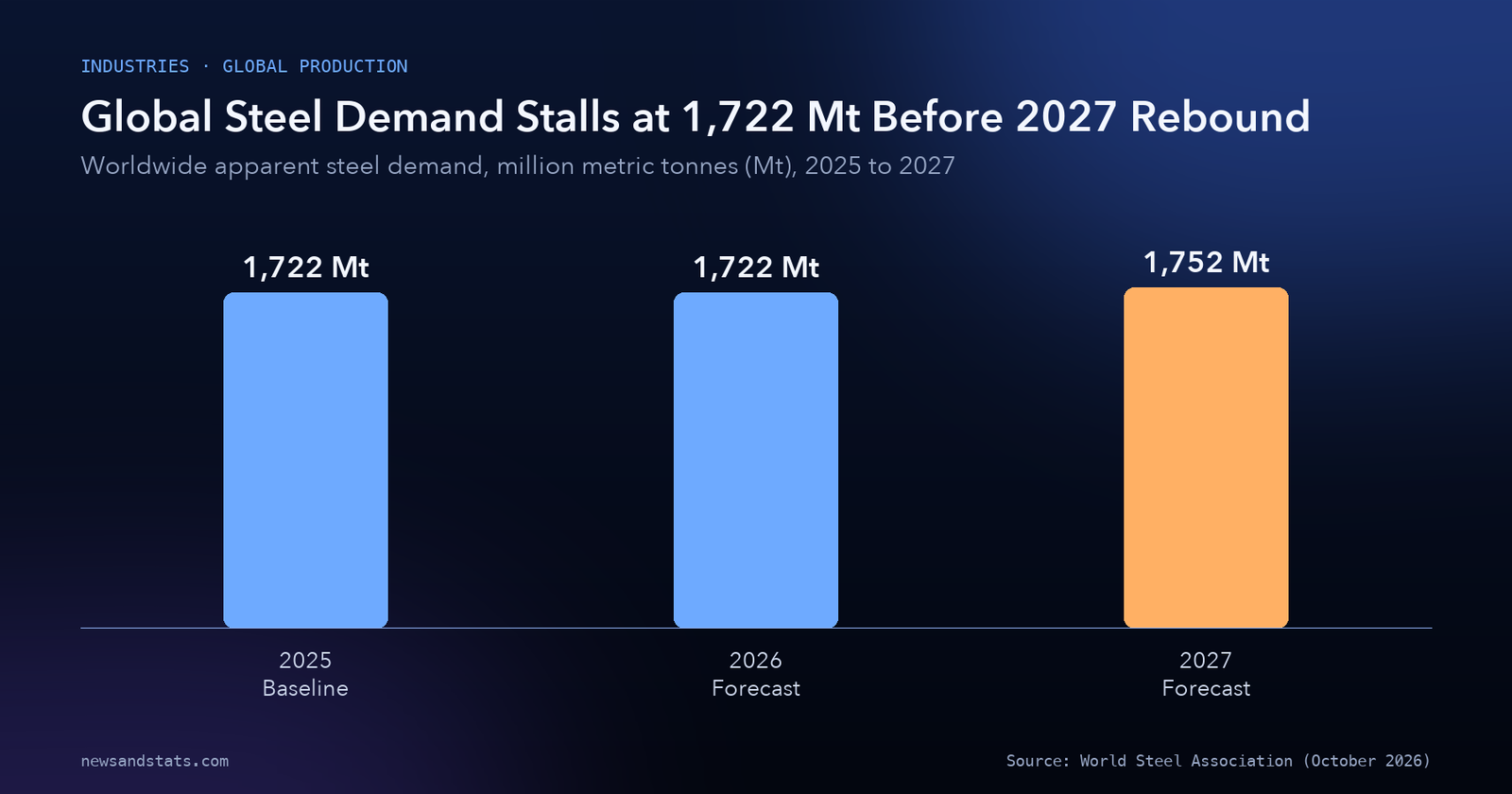
Source: World Steel Association, Short Range Outlook October 2026, Global demand forecast summary.
Alfonso Hidalgo de Calcerrada, Chair of the worldsteel Economics Committee, explained the forces behind this revision during the New Delhi presentation:
“The trajectory we set out in April holds, but the anticipated recovery is proving slower and more gradual than we had expected. Global steel demand is now forecast to be flat in 2026 rather than to grow modestly, and to grow by 1.7% in 2027 rather than 2.2%. Almost the whole of that revision is a China story. Outside China, demand grows by 1.5% this year and accelerates to 4.0% in 2027.”
Subtracting the 1,722 Mt baseline from the 1,752 Mt forecast for 2027 indicates that global industry will consume an additional 30.0 Mt of finished steel products next year (my calculation).
This plateau has significant repercussions for global bulk shipping networks. As analyzed in our investigation of global maritime trade chokepoints, seaborne iron ore and coking coal flows have faced elevated ton-mile costs due to maritime rerouting around African capes. When total steel output remains flat, steelmakers cannot pass elevated logistics surcharges onto finished product buyers, tightening operating margins across primary blast furnaces.
2. The China drag: real estate slump drives a 2.0% contraction
The principal drag on the global steel balance sheet originates in Beijing and China’s regional provinces.
Chinese steel demand is forecast to contract by 2.0% in 2026, marking another year of structural retreat:
- Persistent property recession: The downturn in residential real estate investment has failed to decelerate as economists had expected earlier in 2026. Floor space under construction, residential housing starts, and developer financing remain depressed.
- Negative infrastructure support: Municipal infrastructure investment, traditionally deployed by authorities as a counter-cyclical stimulus to lift steel use, remained in negative territory throughout 2026 due to provincial debt constraints.
- Manufacturing export resilience: Chinese manufacturing steel consumption continued to expand on the back of aggressive industrial exports, particularly electric vehicles, industrial machinery, and white goods. However, export growth was insufficient to offset the double-digit declines in building construction steel use.
For 2027, worldsteel projects that China’s steel demand contraction will narrow to 1.0%. The property downturn is expected to begin decelerating while remaining negative, while central authorities maintain a disciplined, cautious posture toward debt-financed civil infrastructure projects.
This prolonged Chinese property contraction has created a massive structural surplus. With domestic apparent steel use falling 2.0%, Chinese mills have channeled excess billet, wire rod, and hot-rolled coil into international export markets, prompting trade friction and anti-dumping investigations across Europe, Latin America, and Southeast Asia.
3. India’s infrastructure boom: surging 7.9% to record volumes
While China struggles to manage industrial overcapacity, India has emerged as the world’s most dynamic locomotive of steel consumption.
According to worldsteel, India will remain the fastest-growing major steel market on earth:
- 2026 demand reaches 172.4 Mt: Apparent steel use is forecast to expand by 7.9% year-on-year.
- 2027 demand reaches 186.2 Mt: Steel use is projected to grow by an additional 8.0% year-on-year.
- Net volume addition: Subtracting 172.4 Mt from 186.2 Mt reveals that Indian industry will absorb an additional 13.8 Mt of finished steel in 2027 alone (my calculation).
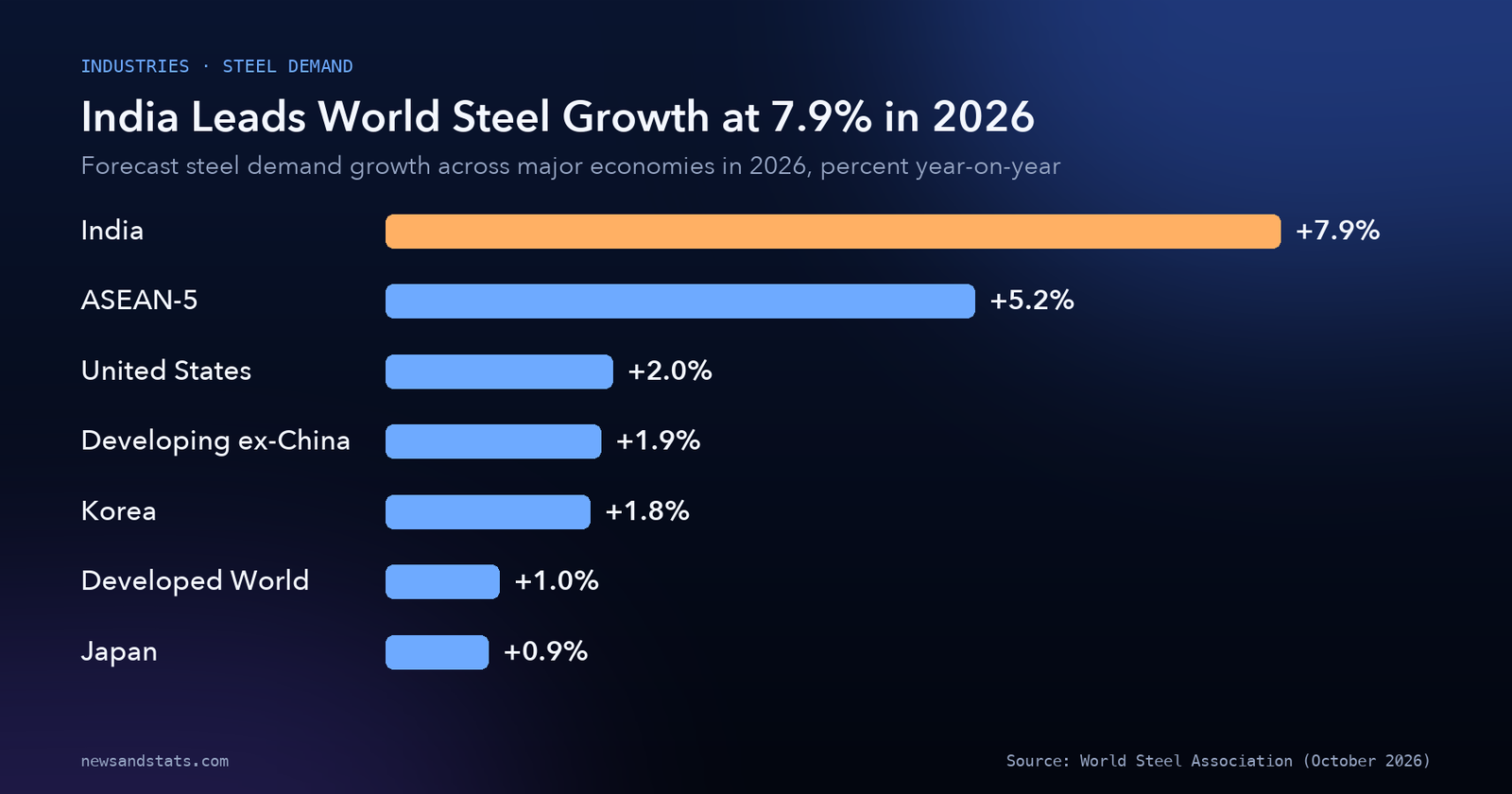
Source: World Steel Association, Short Range Outlook October 2026, Table 1: Regional steel demand.
India’s extraordinary steel growth is fueled by synchronized demand drivers across the economy:
- National infrastructure megaprojects: Dedicated freight rail corridors, high-speed rail lines, highway expansions, and port modernizations are consuming record volumes of heavy structural steel and rebar.
- Private real estate activity: Unlike China’s debt overhang, Indian private urban housing construction remains vigorous, underpinned by middle-class urbanization.
- Renewable energy buildout: India’s aggressive installation of utility-scale solar farms and wind corridors requires substantial volumes of galvanized electrical steel and mounting structures, reinforcing the trends documented in our look at clean energy innovation and battery patents.
- Automotive and machinery expansion: Automotive manufacturing is expanding rapidly, supported by robust domestic consumer purchases and rising vehicle exports.
This divergent trajectory reinforces the findings in our comparative study of the India vs China economic growth gap. While China’s heavy industry transition reflects a maturing, post-construction economy, India is in the steepest phase of its infrastructure development curve.
Southeast Asia is mirroring this regional dynamism: the ASEAN-5 economies are forecast to expand steel demand by 5.2% in 2026, before moderating to 3.2% in 2027. Vietnam represents the standout performer, where apparent steel use will reach approximately 30.0 Mt for the first time, propelled by commercial building and state-backed civil works.
4. The Gulf reversal: Middle East conflict defers 11% of demand
The sharpest geographical reversal in the entire October 2026 report occurred across the Arabian Peninsula.
In 2025, steel demand across the Gulf Cooperation Council (GCC) surged by an extraordinary 17.7%, propelled by giga-projects in Saudi Arabia, real estate expansions in the United Arab Emirates, and ambitious economic diversification plans.
However, regional military conflict and shipping vulnerabilities in the Persian Gulf abruptly halted this momentum:
- GCC steel demand is forecast to contract by approximately 11% in 2026.
- Project awards deferred: Commercial project awards, structural steel orders, and construction groundbreakings were postponed as regional security risks escalated.
- The deferral dynamic: Worldsteel stresses that this decline represents the temporary deferral of capital projects rather than permanent demand destruction.
- 11.3% rebound in 2027: Under the baseline assumption that Gulf shipping corridors and the Strait of Hormuz normalize, worldsteel projects GCC steel demand will rebound by 11.3% in 2027, returning regional consumption back to its 2025 peak level.
Adding the 11% decline in 2026 to the 11.3% projected rebound in 2027 illustrates a dramatic 22.3-percentage-point operational swing for Middle Eastern fabricators (my calculation).
This regional disruption directly mirrors the logistical and fiscal pressures analyzed in our report on who pays for the 2026 energy shock. When regional conflict raises maritime insurance premiums and threatens energy infrastructure, heavy industrial supply chains freeze new commitments until transit security is re-established.
5. Developed world stabilization: data centers and energy lift the US by 2.0%
Across advanced industrial economies, steel consumption is stabilizing after four consecutive years of contraction following the post-pandemic cycle.
In the developed world as a whole, steel demand is projected to grow by 1.0% in 2026 and 2.2% in 2027. However, worldsteel emphasizes that this recovery remains modest in historical terms: the 2025 developed-world steel market was roughly 60.0 Mt, or 15%, smaller than in 2017–2018. The combined growth forecast across 2026 and 2027 will recover only about 10.0 Mt of that 60.0 Mt deficit, leaving pre-crisis volumes a distant target.
The United States represents the strongest developed market:
- US steel demand is projected to grow by 2.0% in 2026, followed by approximately 1.5% in 2027.
- Non-residential construction drivers: Growth is concentrated heavily in mega-projects, specifically artificial intelligence data center construction, semiconductor fabrication facilities, and electrical power transmission infrastructure.
- Energy sector steel: Power generation, renewable energy grid interconnections, and oil and gas transport are absorbing heavy plate and tubular steel.
- Residential softness: Conversely, US residential construction remains subdued, constrained by elevated mortgage interest rates and high building material costs.
In Europe, the recovery is more hesitant:
- European Union apparent steel use is forecast to contract by 0.3% in 2026, representing a downward revision of 1.5 percentage points compared to April forecasts.
- Stock building ahead of CBAM: A significant portion of 2025’s apparent European consumption was artificial inventory building ahead of the Carbon Border Adjustment Mechanism (CBAM) implementation in 2026.
- 3.1% rebound in 2027: EU steel demand is projected to rebound by 3.1% in 2027, supported by public infrastructure, defense procurement under revised fiscal frameworks, and civil engineering investments in rail and clean energy.
In East Asia, Japan and South Korea are navigating shallow recoveries:
- Japanese steel demand is projected to grow 0.9% in 2026 and 1.7% in 2027, supported by machinery capex.
- South Korean steel demand is forecast to expand 1.8% in 2026 and 1.3% in 2027, aided by commercial shipbuilding backlogs and automotive manufacturing.
| Economic region / market group | 2026 demand growth (YoY %) | 2027 demand growth (YoY %) | Key demand driver | Primary operational risk |
|---|---|---|---|---|
| Total Global Market | 0.0% (1,722 Mt) | +1.7% (1,752 Mt) | Broad-based recovery outside China | Prolonged Chinese property slump |
| China | -2.0% | -1.0% | Manufacturing exports | Real estate downturn and provincial debt |
| World Outside China | +1.5% | +4.0% | Developing Asia and infrastructure | Spillover from regional conflicts |
| India | +7.9% (172.4 Mt) | +8.0% (186.2 Mt) | Public infrastructure & private housing | Domestic inflation & input costs |
| Developing Economies (ex-China) | +1.9% | +5.1% | Urbanization & industrial capex | Middle East transit disruption |
| ASEAN-5 | +5.2% | +3.2% | Vietnam building boom (~30 Mt) | Export market softening |
| Developed World | +1.0% | +2.2% | Data centers, energy & defense | 50 Mt unrecovered gap vs 2017–18 |
| United States | +2.0% | ~+1.5% | Data centers & energy infrastructure | High mortgage rates & housing drag |
| European Union | -0.3% | +3.1% | Defense spending & clean energy | Post-CBAM inventory destocking |
| Gulf Cooperation Council (GCC) | -11.0% | +11.3% | Deferred giga-project mobilization | Conflict & maritime chokepoints |
| Japan | +0.9% | +1.7% | Corporate machinery investment | Automotive supply headwinds |
| South Korea | +1.8% | +1.3% | Commercial shipbuilding backlogs | Sluggish domestic construction |
Source: World Steel Association, Short Range Outlook October 2026, Comprehensive regional data tables.
This industrial resilience aligns with the trade findings in our evaluation of the global trade outlook and merchandise resilience. High-tech capital investments—from power generation to advanced chip manufacturing—are insulating heavy manufacturing from broader consumer macroeconomic headwinds.
6. The 2027 inflection: outside-China demand accelerates to 4.0%
The most encouraging signal for global industrial suppliers is the synchronized growth acceleration projected for 2027.
While 2026 represents a year of consolidation, 2027 is positioned as an inflection point where developing and developed economies outside China expand simultaneously.
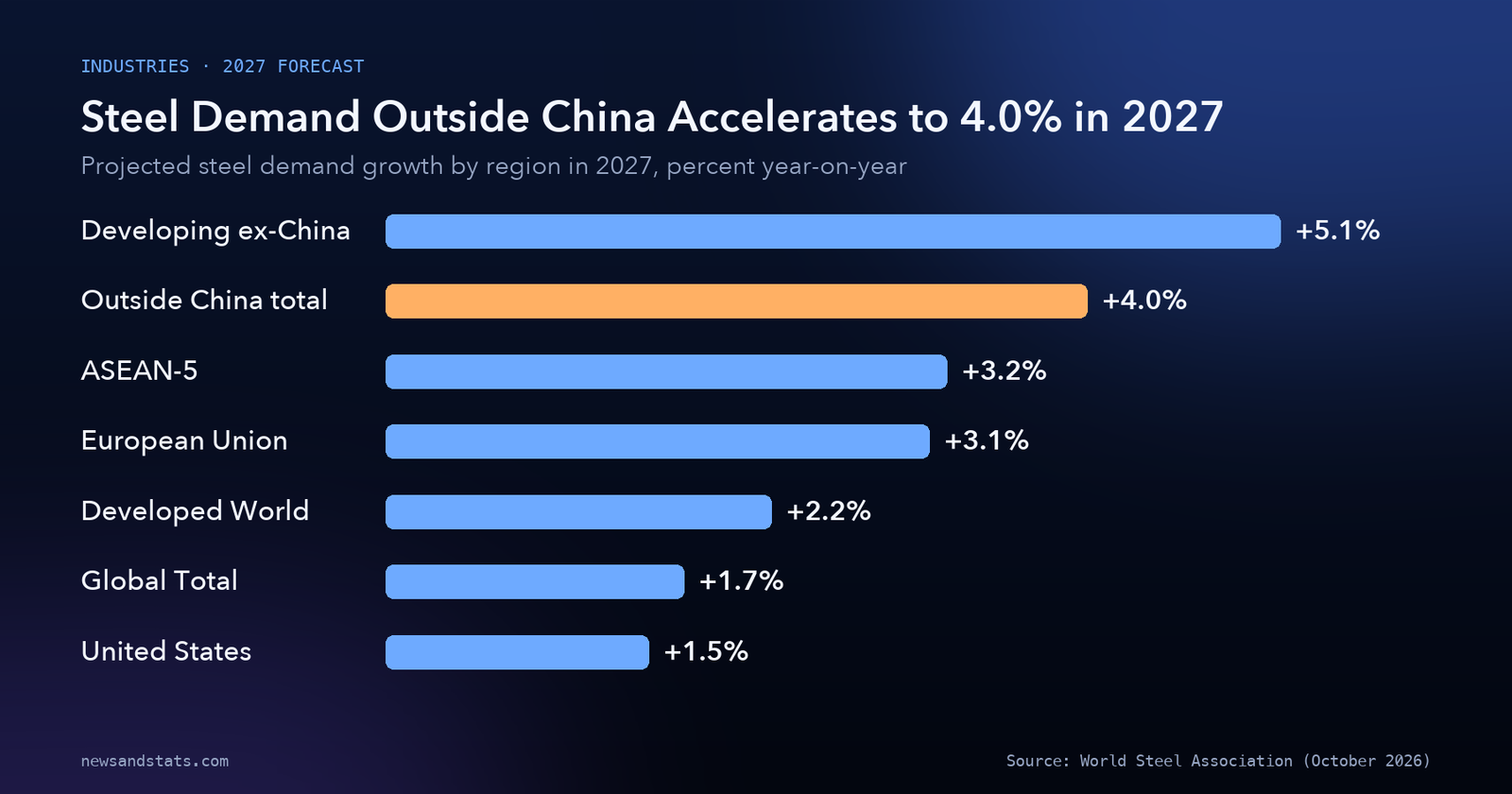
Source: World Steel Association, Short Range Outlook October 2026, Regional outlook for 2027.
Across markets outside China, steel demand will accelerate from 1.5% in 2026 to 4.0% in 2027:
- Developing world excluding China: Demand will surge by 5.1% in 2027, up from 1.9% in 2026, driven by Developing Asia and the normalization of Gulf construction awards.
- Developed world: Steel use will accelerate from 1.0% to 2.2% in 2027, underpinned by European fiscal stimulus and American clean energy manufacturing.
- The spread outside China: Subtracting the 1.5% growth rate in 2026 from 4.0% in 2027 demonstrates a 2.5-percentage-point acceleration across markets outside China (my calculation).
As Alfonso Hidalgo de Calcerrada observed, synchronized growth of 4.0% across the non-Chinese global market represents a scale and breadth of expansion rarely seen over the past decade. If geopolitical uncertainties in the Middle East subside and European civil engineering projects mobilize, the global steel industry will exit its 2026 standstill with substantial commercial momentum.
What to watch
- Chinese local government bond issuances: Track whether China’s Ministry of Finance introduces targeted debt swaps to revive municipal infrastructure spending, preventing a deeper contraction than the forecast 1.0% in 2027.
- CBAM full compliance and carbon border tariffs: Monitor the operational impact of Europe’s Carbon Border Adjustment Mechanism payments taking full effect in 2027, and whether import substitution accelerates domestic EU scrap-based electric arc furnace production.
- Indian domestic capacity commissioning: Follow whether major Indian steel producers (Tata Steel, JSW, SAIL) commission planned brownfield and greenfield blast furnaces fast enough to meet 8.0% demand growth without triggering surging finished steel imports.
- Strait of Hormuz commercial traffic normalization: Observe whether Gulf shipping corridors normalize in early 2027, allowing deferred GCC infrastructure contracts to remobilize toward the forecast 11.3% rebound.
- US electrical grid transformer backlogs: Watch whether utility equipment shortages delay data center and renewable energy construction starts, dampening US structural steel demand below the projected 1.5% pace in 2027.
The bottom line
The global steel industry is concluding 2026 at a neutral standstill of 1,722 million metric tonnes, but beneath this surface plateau lies a profound shift in global economic leadership. China’s domestic steel contraction of 2.0% has brought its multi-decade expansion to a decisive close, while India’s infrastructure boom (+7.9% in 2026 and +8.0% in 2027) establishes South Asia as the primary engine of global commodity growth. With steel demand outside China projected to accelerate to 4.0% in 2027, heavy industry is transitioning from a China-centric model to a diversified, multi-polar landscape anchored in emerging Asia, Western energy transition infrastructure, and high-tech manufacturing. For ongoing analysis of industrial materials, metallurgy, and heavy manufacturing supply chains, explore our Industries coverage.
Related reading
- Global Maritime Trade in 8 Numbers: How Chokepoint Rerouting Reshapes Shipping: container shipping rates, bulk shipping ton-miles, and Cape of Good Hope diversions.
- India vs China: the economic gap in 10 numbers: demographic divergence, GDP growth trajectories, and industrial competitiveness.
- Who pays for the 2026 energy shock? The numbers, country by country: energy market volatility, refining crack spreads, and industrial power costs.
- Global Trade Outlook 2026: AI Beats the War: WTO trade volumes, high-tech supply chains, and multilateral export resilience.
- Clean Energy Innovation in 8 Numbers: The Patent Race, Battery Dominance, and the $55 Billion Squeeze: clean energy R&D, industrial electrification, and clean technology patents.