Humanoid robots in factories make headlines every few weeks: a new contract, a new pilot, a new forecast. In 2025, manufacturers shipped roughly 13,000 humanoid robots worldwide, according to the research firm Omdia — a number that sounds large until you count how many are actually working a shift on a factory floor. Wall Street expects shipments to explode: Goldman Sachs now projects 6.5 million humanoid robots a year by 2035, more than four times its own estimate from earlier in 2026. But the named, operating-today deployments are still small. Toyota’s newest contract covers seven robots. BMW’s widely cited pilot ran for 11 months with a handful of machines, and the company has not disclosed how many Figure robots replaced it. The gap between shipment counts, Wall Street’s forecasts and what is actually bolted to a factory floor is this year’s real story about humanoid robots in factories, and it is told entirely in numbers.
1. 13,000 robots, three names, and one disputed count
Omdia’s “General-Purpose Embodied Intelligent Robot 2026” report put global humanoid robot shipments at approximately 13,000 units in 2025. Three Chinese companies accounted for most of that total. AgiBot ranked first, with more than 5,100 units shipped and roughly 39% of the global market, a figure the Shanghai-based company confirmed in its own release of Omdia’s findings. Independent coverage of the same Omdia report from TechNode gives a more precise AgiBot count of 5,168 units, and puts second-place Unitree Robotics at 4,200 units and third-place UBTech at 1,000 units. A second account of the same report from OODA Loop matches those three figures and adds that Unitree held about 32% of the market. Added together, AgiBot, Unitree and UBTech shipped about 10,368 of the estimated 13,000 total — roughly 80% of the world’s humanoid robots in 2025 came from three companies, all Chinese, a concentration that echoes the manufacturing strength that shows up across the India-China economic comparison we published this week.
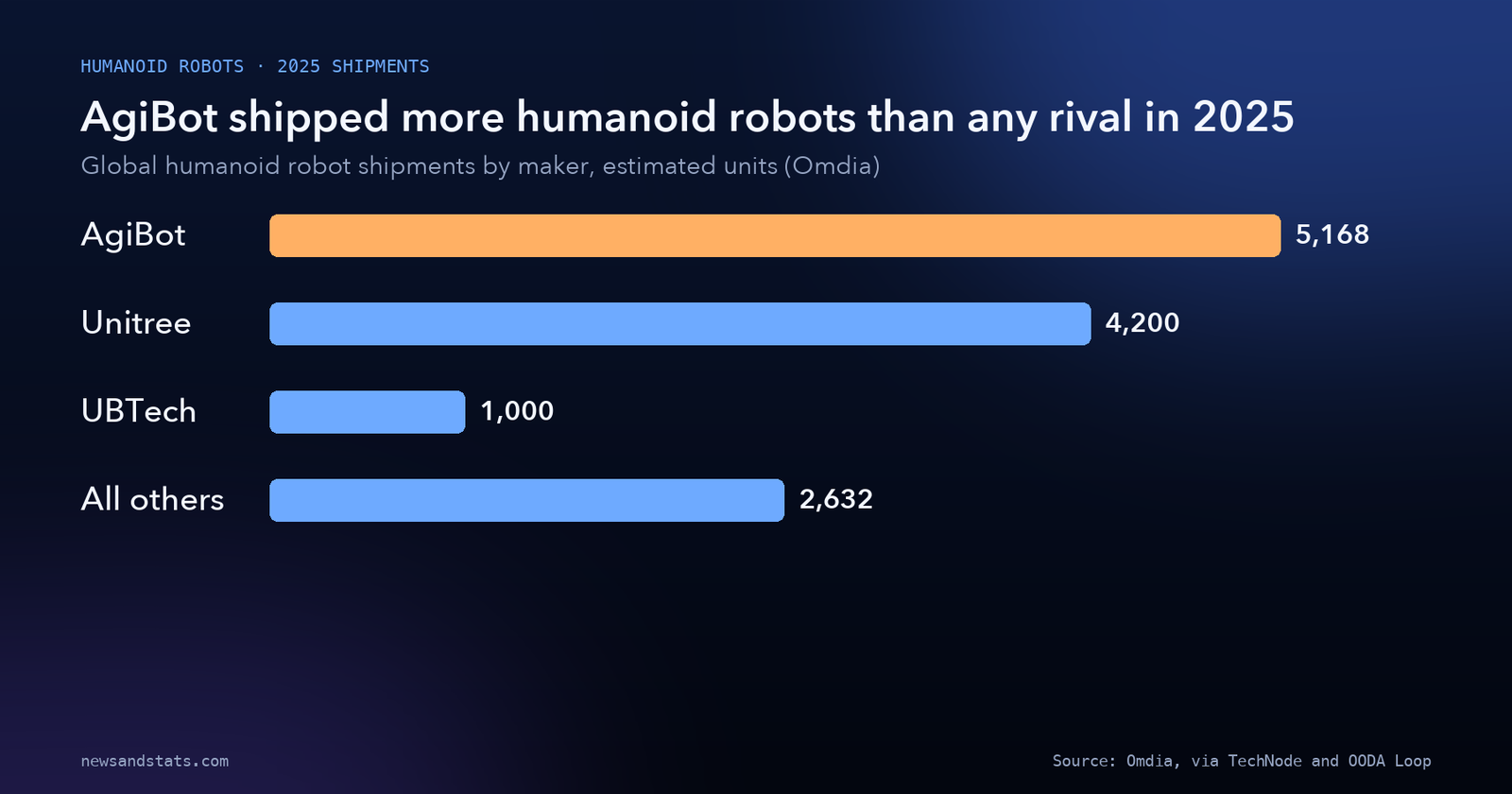
Source: Omdia, “General-Purpose Embodied Intelligent Robot 2026”, via TechNode and OODA Loop.
2. Why the counts disagree: shipped, produced, or just promised
Omdia’s 4,200-unit estimate for Unitree was not the company’s own number. On 22 January 2026, Unitree issued a statement — later distributed through PR Newswire and republished by outlets including Utusan Malaysia — putting its own 2025 shipments at more than 5,500 humanoid robots, with total production exceeding 6,500 units. Unitree’s statement is specific about what it counts: units “actually sold and delivered to end customers,” excluding unfulfilled orders and excluding its dual-arm wheeled robots, which are a different product line from its bipedal humanoids. That single methodology choice — shipped versus produced, and which robot platforms count as “humanoid” at all — is enough to move a company from second place to first place in different tallies of the same year. It is also a preview of a cost problem the whole industry shares with AI hardware generally: humanoid robots lean on the same category of compute and memory chips behind the memory-chip shortage already squeezing AI hardware budgets elsewhere, so even the companies building them disagree on basic unit economics. Omdia itself, in the same report that ranked AgiBot first, projected that global annual humanoid robot shipments would reach 2.6 million units by 2035 — a separate forecast from Goldman Sachs’ far larger 6.5 million figure for the same year, a reminder that “by 2035” forecasts from different firms are not directly comparable.
3. Wall Street’s number keeps climbing: Goldman’s 2026-2035 math
Goldman Sachs has forecast the humanoid robot market before, and each version has gone up. In a report published in late 2023 and updated in January 2024, Goldman Sachs Research estimated the global humanoid robot market could reach “at least US$6 billion” within 10 to 15 years, or up to US$154 billion by 2035 in a “blue-sky” scenario where every technical and cost hurdle is cleared. By September 2026, in an 80-page Physical AI report covered independently by 24/7 Wall St. and by Humanoid.guide, Goldman’s base case had moved well past its earlier blue-sky scenario: 75,000 humanoid robot shipments in 2026, 890,000 by 2030 (up from a prior estimate of 256,000) and 6.5 million by 2035 (up from a prior estimate of 1.4 million). The bank’s projected 2035 market value rose alongside the unit count, from about $38 billion to about $138 billion. A later article from Analytics Insight, published 19 October 2026, independently confirms the 6.5 million figure. Lay Goldman’s new 2026 forecast next to Omdia’s actual 2025 count and the jump is stark: 75,000 projected shipments is about six times Omdia’s roughly 13,000 for the year before (my calculation, dividing the two verified figures). That kind of upward revision has a familiar shape — it looks like the pattern behind how much hyperscalers are now committing to AI infrastructure, where announced spending totals have repeatedly outrun what forecasters expected twelve months earlier.
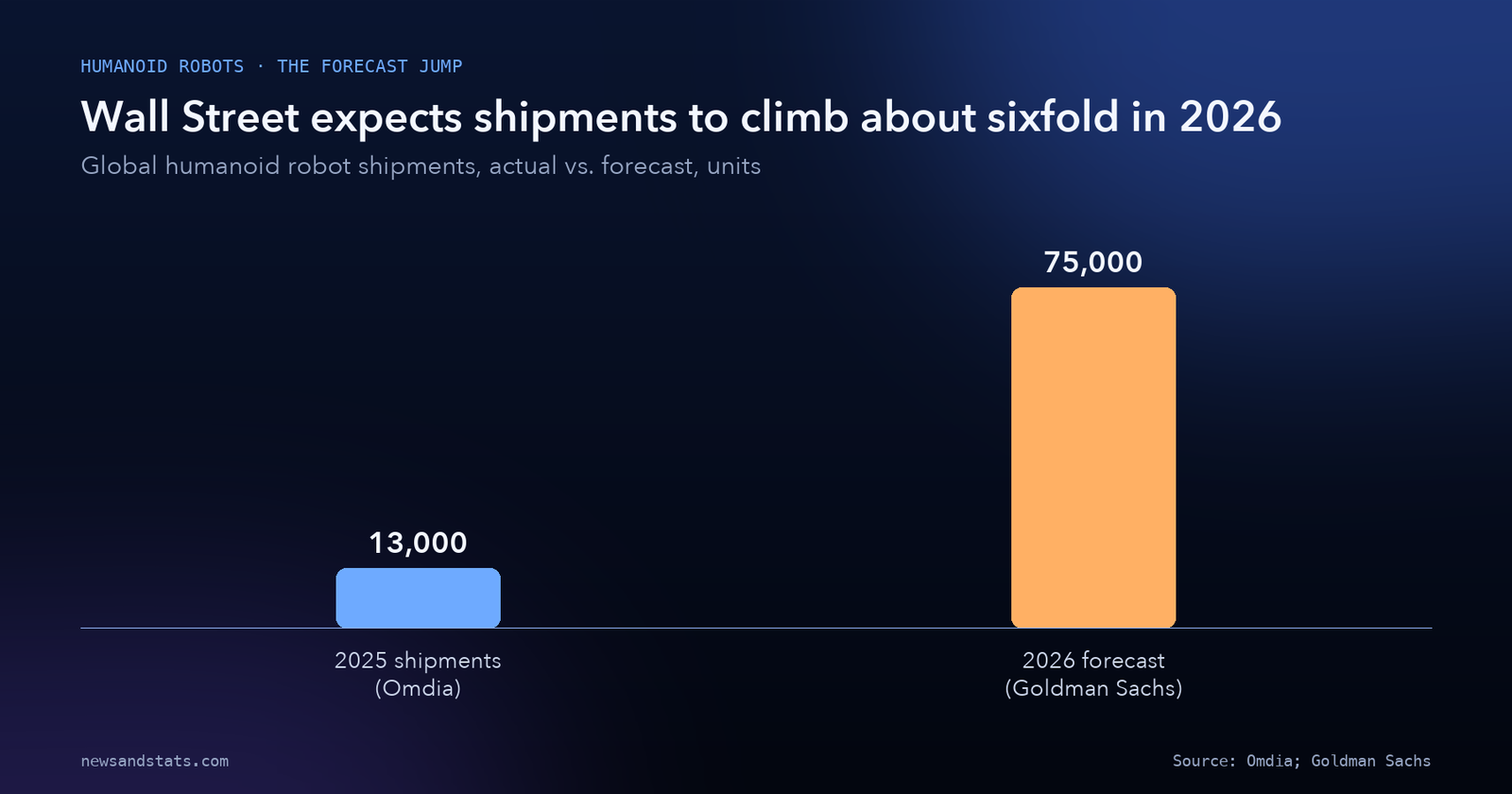
Source: Omdia; Goldman Sachs, via 24/7 Wall St..
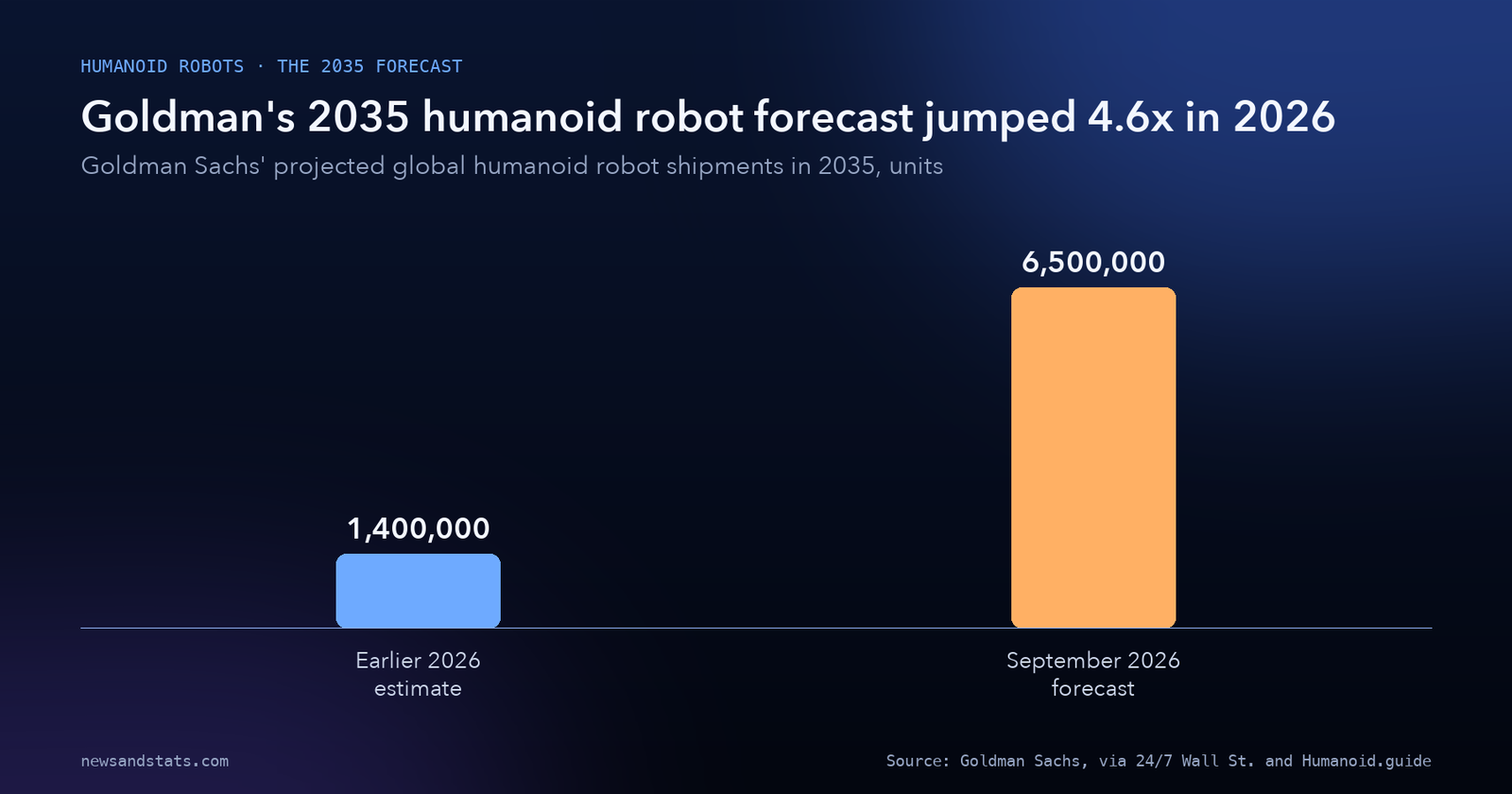
Source: Goldman Sachs, via 24/7 Wall St. and Humanoid.guide.
4. What seven robots actually looks like: Toyota’s new contract
Set against those projections, named factory deployments look almost tiny. On 19 February 2026, Agility Robotics announced that Toyota Motor Manufacturing Canada had signed a commercial, robots-as-a-service agreement covering seven Digit humanoid robots at its Woodstock, Ontario plant, which builds RAV4 SUVs. Coverage from both TechCrunch and Robotics 24/7 agree on the headline figure: the contract followed a year-long pilot that began with three test units, and the production robots’ job is to unload totes of auto parts from an automated warehouse tugger so human workers do not have to. Toyota’s president, Tim Hollander, said the company wanted to “improve the team member experience,” and Agility’s chief business officer described the task as suited to “highly repetitive, very physical tasks where there exist very large labour gaps.” Seven robots is a rounding error against Goldman’s 75,000-unit global forecast for 2026 — about 0.01% of it (my calculation) — and it is a modest footprint next to the electricity grid strain AI data centers are already causing elsewhere in the AI build-out, which is measured in gigawatts, not robot units. That is the scale mismatch at the center of this story: the forecasts describe an industry: the contracts describe single plants.
5. The slow-build model: Schaeffler’s “four-digit” robots by 2032
German industrial supplier Schaeffler took a different approach: committing to volume years in advance rather than piloting a handful of units first. On 13 May 2026, the London-based robotics company Humanoid announced, in its own press release, a binding, phased deployment and supply agreement with Schaeffler covering a “four-digit number” of Humanoid’s wheeled robots across Schaeffler’s global factories by 2032. The real work starts much smaller and later: the first deployment phase runs from December 2026 through June 2027, at just two German sites — Herzogenaurach, focused on box-handling in a live production environment, and Schweinfurt, which begins with a three-month capability demonstration before a further three months validating stable, continuous operation. Alongside the robot deployment, Schaeffler signed a separate five-year actuator-supply agreement running through 2031, under which it becomes Humanoid’s preferred supplier, covering more than half of Humanoid’s joint-actuator demand for its wheeled robot platforms. Reading the two agreements together shows the actual sequence behind a headline robot-count: years of component supply and small-site testing come first, and the thousands-of-units figure is the target at the far end, not a count of robots running today.
6. BMW and Figure: 30,000 cars, 11 months, and a new job for Figure 03
BMW’s humanoid robot program is the industry’s most closely tracked pilot-to-production case, and even here the robot count is not public. Figure AI’s Figure 02 robots worked in the body shop at BMW’s Plant Spartanburg, in South Carolina, inserting sheet-metal parts for the welding process. According to Automotive World and The Robot Report, both citing BMW Group’s own announcement, that 11-month deployment supported production of more than 30,000 BMW X3 vehicles. Neither source states how many Figure 02 units were on the floor to do it. Having completed that pilot, BMW announced around 25-29 June 2026 that it was moving to the newer Figure 03 model for a different task: picking unsorted parts from large containers and sorting them onto a sequencing trolley for delivery to assembly workers, a logistics role rather than a body-shop one. BMW’s vice president of production control and logistics, Ulrich Wieland, said the company was “looking forward to deploying Figure 03 for a sequencing use case in logistics” after the Figure 02 pilot’s success. Figure AI’s founder and chief executive, Brett Adcock, said the Figure 02 deployment “proved that humanoids are no longer lab experiments.” That is a different kind of labor substitution than the one worrying entry-level knowledge workers, where generative AI software, not a physical machine, substitutes for junior tasks — but both stories share the same reporting problem: a named deployment, a partial number, and a fleet size nobody involved will confirm.
7. The claims and the count, side by side
| What’s reported | Figure | Stage, as of late October 2026 |
|---|---|---|
| Global humanoid robot shipments, 2025 | ~13,000 (Omdia) | Already shipped |
| Goldman Sachs 2026 global forecast | 75,000 | Forecast, not yet observed |
| Goldman Sachs 2035 global forecast | 6.5 million | Forecast, revised up from 1.4 million |
| Toyota Motor Manufacturing Canada | 7 Digit robots | Signed; deploying through 2026 |
| Schaeffler, via Humanoid | “Four-digit” wheeled robots by 2032 | Phase 1 (two sites) starts December 2026 |
| BMW Plant Spartanburg | Figure 03, sequencing role; fleet size undisclosed | Active, following a completed Figure 02 pilot |
Figures and sourcing as detailed in the sections above: Omdia; Goldman Sachs; Agility Robotics; Humanoid; BMW Group and Figure AI.
Reading the table top to bottom is the article in miniature: the top rows are counted in the tens or hundreds of thousands, and the bottom rows — the ones anyone can point to and say “that robot is working right now” — are counted in single or low double digits, with “undisclosed” doing a lot of work.
What to watch
- Whether Toyota expands beyond its seven contracted Digit units at Woodstock once the robots are running through 2026.
- Whether Schaeffler’s Herzogenaurach line goes live on schedule in December 2026, the first real test of the Humanoid agreement’s Phase 1 date.
- Whether BMW or Figure AI discloses an actual fleet size for Figure 03 at Spartanburg, resolving the gap left by the undisclosed Figure 02 headcount.
- Whether Goldman Sachs revises its 75,000-unit 2026 base case again once full-year shipment data is available in early 2027.
- Whether Omdia’s and Unitree’s 2026 shipment counts for Unitree converge, or whether the same shipped-versus-produced dispute repeats.
- Whether Omdia’s 2.6 million-unit 2035 forecast and Goldman’s 6.5 million-unit forecast move closer together as more companies publish their own production figures.
The bottom line
Two things are true about humanoid robots in factories at the same time: shipments are growing fast off a small base, and named, confirmed, operating deployments remain few. Omdia counted about 13,000 humanoid robots shipped worldwide in 2025, concentrated in three Chinese makers; Goldman Sachs expects that figure to reach 75,000 in 2026 and 6.5 million by 2035. None of that forecast growth has happened yet, and the deals that have happened — Toyota’s seven robots, Schaeffler’s 2032 target, BMW’s undisclosed Figure 03 fleet — are each, by design, early and small. The industry’s shipment numbers and Wall Street’s forecast numbers describe two different things, and neither one tells you how many humanoid robots are actually clocking a shift today. For more on what AI is changing — and not yet changing — at work, see our AI & Work coverage.
Related reading
- Is AI hurting entry-level jobs? Two studies, two answers: a look at AI’s effect on a different kind of labor, generative software rather than physical robots.
- The $750 billion AI bet: who spends it, and who pays: the hyperscaler spending race that shows the same pattern of forecasts outrunning reality.
- Data Center Power Demand Is Set to Double by 2030: the physical-infrastructure side of the AI build-out, measured in gigawatts instead of robot units.